
Last updated: November 19, 2026
Quick answer: Thyroid antibody tests can give a clear autoimmune clue in 1 blood draw, but they do not by themselves tell you how underactive the thyroid is or whether treatment is needed. This article explains Why Thyroid Antibodies Matter: TPOAb and TgAb Explained in the context of Hashimoto’s thyroiditis and thyroid function testing. Thyroid antibody tests measure whether the immune system is making proteins that target the thyroid gland. The two main ones are TPOAb, which targets thyroid peroxidase, and TgAb, which targets thyroglobulin; when they are positive, they can point to autoimmune thyroid disease, especially Hashimoto’s thyroiditis.
Thyroid antibody tests: what they measure and why they matter
Thyroid antibody tests look for immune proteins in blood that react against thyroid tissue, and that makes them different from the usual thyroid panel. A TSH result tells you how the pituitary is responding; free T4 and free T3 tell you about circulating hormone levels; thyroid antibodies ask a different question: is the immune system attacking the thyroid gland?
That distinction matters because autoimmune disease can be present before thyroid hormone levels change. In other words, a person can have positive antibodies and still have a normal TSH for a while. In Hashimoto’s thyroiditis, that early phase can last for months or longer, so antibody testing can help earlier than hormone tests alone.
The most common antibodies on a thyroid antibody test are:
- TPOAb: antibodies to thyroid peroxidase, an enzyme the thyroid uses to make hormone.
- TgAb: antibodies to thyroglobulin, a protein stored in the thyroid and used in hormone production.
A positive result does not tell the whole story by itself. It supports an autoimmune explanation, but it does not automatically tell you how underactive the thyroid is today, how fast it will change, or whether treatment is needed right now. If the result is unclear, a clinician should interpret it alongside TSH and free hormone tests.
For a deeper framework on how these tests sit inside a larger panel, the thyroid lab interpretation hub is the right next stop.
What TPOAb means when it shows up on a lab report

TPOAb means the body has made antibodies against thyroid peroxidase, and that is the antibody most often associated with Hashimoto’s thyroiditis. Thyroid peroxidase is one of the enzymes involved in making thyroid hormone, so antibodies against it are a sign of thyroid-directed autoimmunity rather than a simple hormone shortage.
This test is the one clinicians most often use when they want evidence that hypothyroidism has an autoimmune cause. A positive TPOAb result can show up before overt hypothyroidism develops, during mild thyroid failure, or in a person whose thyroid function is still in range. A negative result does not completely rule out autoimmune thyroid disease, but it makes TPOAb-driven disease less likely.
The practical value of TPOAb is that it helps answer a cause-and-pattern question. If the thyroid is underactive and TPOAb is positive, the story fits Hashimoto’s much better than a temporary, non-autoimmune cause. If the thyroid hormones are normal and TPOAb is positive, the result still matters because it can signal higher risk of future thyroid dysfunction and justify periodic follow-up.
A common mistake is treating a positive TPOAb as a treatment target in itself. It is not. The number on the report does not work like blood pressure or glucose, where lower is automatically better. A person with a positive TPOAb result still needs context: symptoms, TSH, and free hormone levels. If the report is confusing, a clinician should explain what it means for that patient.
What TgAb means, and why doctors still care about it
TgAb means the immune system is making antibodies against thyroglobulin, and it also supports the diagnosis of autoimmune thyroid disease. Thyroglobulin is a large protein used by the thyroid to make and store thyroid hormone, so antibodies to it can appear in the same autoimmune process that produces TPOAb.
TgAb is less famous than TPOAb, but it still matters. It can be present in Hashimoto’s thyroiditis, sometimes alongside TPOAb and sometimes on its own. A positive TgAb result helps build the autoimmune picture, especially when symptoms or thyroid function tests are already pointing toward thyroid disease.
There is a second reason TgAb gets ordered: it can interfere with some thyroglobulin measurements used in thyroid cancer follow-up. That is a separate use case from routine thyroid antibody testing, but it explains why the test is not just a curiosity. Laboratories and clinicians care about it because it can change how another test is interpreted.
The catch is that TgAb is less specific than many people expect. A positive result does not tell you whether the thyroid is currently failing, and it does not tell you whether symptoms are due to thyroid disease or something else. It is evidence, not a standalone diagnosis.
A useful way to think about TgAb is this: TPOAb is usually the headline antibody in Hashimoto’s disease, while TgAb is often supporting evidence. If both are positive, the autoimmune case is stronger. If only TgAb is positive, the result still counts, but it usually needs more context before anyone draws a firm conclusion.
How thyroid antibody results fit into Hashimoto’s disease

Thyroid antibody results fit Hashimoto’s disease by showing that the thyroid problem is autoimmune, not just hormonal. Hashimoto’s thyroiditis is the most common autoimmune thyroid disease linked with thyroid antibody positivity, and TPOAb is the antibody most often associated with it.
The pattern often looks like this:
- A clinician orders thyroid antibody tests because symptoms, a goiter, family history, or an abnormal thyroid panel raises suspicion.
- The lab reports TPOAb, TgAb, or both as positive.
- The result supports autoimmune thyroid disease, especially Hashimoto’s.
- Thyroid function tests and symptoms decide what happens next.
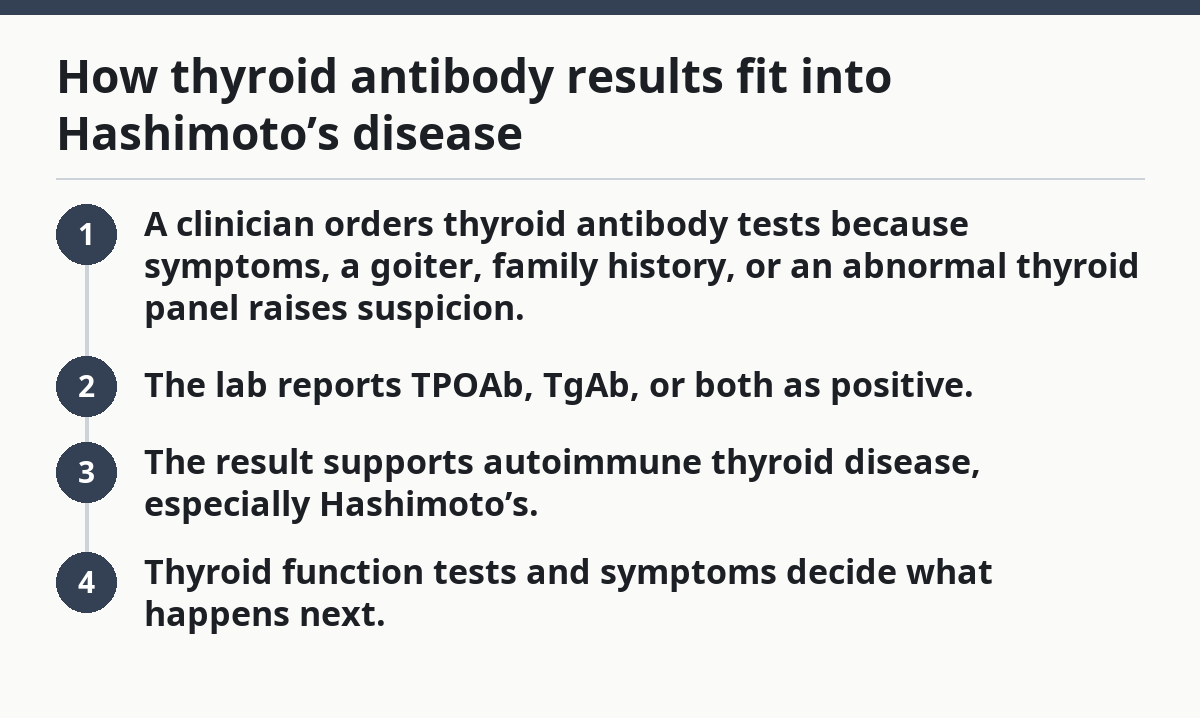
That sequence matters because antibodies explain the cause, but they do not define the current severity on their own. A person can have positive antibodies and normal thyroid function. Another person can have antibodies plus raised TSH and low thyroid hormone, which points to established hypothyroidism. The antibody result helps connect the dots, but it does not replace the rest of the map.
This is also where overreading causes trouble. Some people see a positive antibody report and assume they need urgent treatment. Others see a positive result with normal TSH and assume nothing is happening. Both reactions can miss the point. Positive antibodies mean the thyroid is in an autoimmune setting; they do not automatically mean immediate medication, and they do not mean “ignore it.”
Hashimoto’s is not the only autoimmune condition that can travel with thyroid antibodies, either. Autoimmune diseases cluster, so the presence of TPOAb or TgAb can fit into a broader immune pattern. That does not turn the test into a screening panel for everything autoimmune; it simply means the result may be one clue among several.
Why a positive thyroid antibody result does not equal a diagnosis by itself
A positive thyroid antibody result does not equal a diagnosis by itself because the lab tells you about immune activity, not the full clinical picture. Antibodies are one piece of evidence, and they are most useful when they line up with symptoms, thyroid function tests, and exam findings.
The article leaves out a common mistake: a positive TPOAb or TgAb can mean:
- Hashimoto’s thyroiditis is likely
- autoimmune thyroid disease is present but thyroid function is still preserved
- the result is incidental and not the main cause of the person’s symptoms
That range is exactly why clinicians do not stop at antibodies. They look at the setting. For example, if a patient has fatigue, constipation, cold intolerance, and a persistently high TSH, a positive TPOAb makes autoimmune hypothyroidism much more likely. If another patient has normal thyroid function, no goiter, and a low-level positive antibody result, the interpretation is more cautious.
The trade-off is simple: antibody testing adds specificity, but it also adds ambiguity for people trying to read the report alone. A positive result can be emotionally hard to see because it sounds definitive. It is not definitive in isolation. It is a marker of immune targeting, not a direct measure of thyroid output.
That is why antibody testing is useful when the question is “why is this happening?” and less useful when the only question is “what is my thyroid doing today?” For the second question, thyroid hormone tests do the heavy lifting. For the first, TPOAb and TgAb can be an important clue, but a clinician still has to interpret them.
What to do when the result is positive
A positive thyroid antibody result usually means the next step is to interpret it alongside thyroid function, symptoms, and history, not to chase the antibody number itself. The goal is to decide whether the result is a quiet marker of autoimmunity or part of an active thyroid disorder.
A practical sequence looks like this:
- Confirm which antibody is positive. TPOAb, TgAb, or both each carry slightly different weight, and the lab report should name the exact test.
- Check the thyroid context. TSH and, when ordered, free T4 or free T3 show whether the thyroid is still keeping up or beginning to fail.
- Match the result to symptoms and exam findings. Fatigue, cold intolerance, constipation, menstrual changes, goiter, or thyroid tenderness change how meaningful the antibody result is.
- Ask whether the result changes follow-up. In many cases, it means periodic monitoring rather than immediate treatment, especially if thyroid function is still normal.
The result also has limits. A positive antibody test does not tell you how quickly thyroid function will change, and it does not tell you whether symptoms are caused by the thyroid or something else. That is the trade-off: you gain evidence of autoimmunity, but not a complete diagnosis by lab alone.
This is also why antibody testing is not the place to look for general supplement fixes or broad “thyroid support” claims. The result is about immune targeting of the thyroid gland. It is not a nutritional shortcut, and it is not a substitute for medical follow-up when thyroid function is abnormal.
If the report is positive and the symptoms are significant, a clinician should be the one to connect the dots. That is especially true when the result comes with a clearly abnormal TSH or a visible thyroid enlargement.
What thyroid antibody tests are not for
Thyroid antibody tests are not for reading every thyroid problem, and they are not the test to use when the real question is simply whether thyroid hormone is low or high today. They are about autoimmune thyroid disease, not day-to-day hormone interpretation.
That limitation matters because antibody results can be misused. People sometimes order or focus on TPOAb and TgAb expecting them to explain weight change, fatigue, anxiety, or hair loss on their own. Those symptoms are nonspecific. Antibodies may be relevant, but they are not enough by themselves to sort out the cause.
They are also not a good way to monitor treatment response in the short term. Antibody levels can stay positive for a long time, and the clinical question usually shifts to thyroid function and symptoms rather than trying to “normalize” the antibody number. In routine care, that is usually a better use of time and money than repeating the same antibody test over and over.
I would call thyroid antibody testing useful but narrow. It is the right tool when the question is autoimmune thyroid disease, especially Hashimoto’s thyroiditis. It is the wrong tool when the question is “what does my TSH mean?” or “do I need a dose change?” Those are different problems and deserve different tests. For more on that distinction, see the thyroid function tests guide and the Hashimoto’s overview.
Key takeaways
- TPOAb and TgAb are blood markers that point to immune attack on the thyroid gland.
- TPOAb is the antibody most closely linked with Hashimoto’s thyroiditis.
- TgAb also supports autoimmune thyroid disease and can matter for other thyroid testing contexts.
- A positive result can appear before thyroid hormone levels change.
- Antibody tests help explain cause; they do not tell the full story on their own.
- The result is most useful when paired with symptoms and standard thyroid function tests.
Do positive thyroid antibodies always mean Hashimoto’s?
No. Positive thyroid antibodies strongly suggest autoimmune thyroid disease, but they do not always equal Hashimoto’s on their own. TPOAb is the stronger clue, and the diagnosis is firmer when the antibody result matches the thyroid function pattern, symptoms, and exam findings. A clinician usually needs the full picture before naming the disease.
Can thyroid antibodies be high with normal tsh?
Yes. Thyroid antibodies can be positive while TSH is still normal. That can happen early in autoimmune thyroid disease, before the thyroid starts failing enough to change hormone levels. In that situation, the result matters because it may justify follow-up, even if treatment is not needed right away.
Why would a doctor order antibody tests?
A doctor orders thyroid antibody tests to look for autoimmune thyroid disease, especially when symptoms, a goiter, family history, or an abnormal thyroid panel raise suspicion. The tests help answer why the thyroid may be underactive or at risk of becoming underactive, which is different from simply measuring current thyroid hormone levels.
Drafted with AI; not yet reviewed by a person.