Why Thyroid Lab Results Can Change Even When You Feel the Same

Last updated: November 19, 2026
Quick Answer: Thyroid lab results can change by a few points or more even when you feel the same, and the numbers are sensitive to timing, illness, and normal biologic swing. This page explains why thyroid lab variability happens and what to do with a result that moved from one test to the next.
Thyroid lab results can change even when you feel the same because thyroid lab variability is real, and the numbers are sensitive to timing, illness, and normal biologic swing. In this article, Why Thyroid Lab Results Can Change Even When You Feel the Same, a TSH that moved from one test to the next does not automatically mean your thyroid disease changed. For background on thyroid testing, see the American Thyroid Association’s patient information and the NHS guide to thyroid function tests. American Thyroid Association, NHS
Why thyroid lab variability is common even without new symptoms
Thyroid lab variability is common because TSH, free T4, and free T3 do not behave like a fixed home thermometer. They shift with the time of day, recent illness, sleep loss, stress, and the distance between tests. That means two results can look different while your day-to-day health feels unchanged.
The most useful way to think about thyroid labs is as a trend, not a single snapshot. A TSH of 3.8 and then 2.6 may reflect ordinary variation, especially if the blood draws were at different times, you had a cold, or the lab itself changed. A result only becomes more meaningful when it repeats in a pattern.
This is one reason a generic “your labs changed, so your thyroid is worse” message is often wrong. Symptoms matter, but they do not track perfectly with numbers. Fatigue, brain fog, constipation, and weight change can come from sleep, stress, anemia, medications, or infection, and those can be present while thyroid labs stay flat.
The range also matters. If your TSH is near the edge of the lab’s reference interval, a small shift can push it from “normal” to “abnormal” or back again. That border effect looks dramatic on paper and mild in real life.
The practical takeaway is simple: one change is data, not a verdict. Compare the result with the prior one, the timing of the draw, and whether anything in the last 1–3 weeks could have nudged it.
What a TSH trend is telling you
A TSH trend is telling you how hard your pituitary gland is pushing on the thyroid over time, not whether you had a “good” or “bad” day. TSH is usually the most responsive marker, so it often changes before symptoms do.
A useful trend needs at least 2 results drawn under similar conditions. If one TSH was taken at 8 a.m. and the next at 2 p.m., that alone can create a difference. The same is true if one test followed a mild viral illness and the next followed a quiet month at home. The trend becomes cleaner when the interval, lab, and conditions are closer together.
This is where people get tripped up: TSH can move more than free T4 when the body is adjusting. If you are on thyroid hormone replacement, a dose change may show up in TSH before you feel any different. If you are not on treatment, a mild rise or fall can still be a short-term wobble rather than a disease change; if you are unsure, consult a clinician before drawing conclusions. For general guidance on interpreting thyroid tests, the American Thyroid Association and Cleveland Clinic both note that context matters. American Thyroid Association, Cleveland Clinic
What helps is looking for direction over 2 or 3 tests, not reacting to a single point. A rising TSH across multiple draws, especially with a falling free T4, deserves more attention than a one-off bump. The reverse is also true: a one-time lower TSH does not automatically mean over-treatment or a new thyroid problem; consult a professional if the result is unexpected. For readers who want the broader testing context, the hub on thyroid testing, labs, and appointment prep is the right next stop after this page.
Why can free T4 fluctuate from one blood draw to the next?
Free T4 can fluctuate from one blood draw to the next because it sits closer to the bloodstream’s immediate chemistry than many people expect. Even small shifts in binding proteins, illness, or medication timing can move the number.
Free T4 is usually steadier than TSH in the short term, but it is not fixed. Blood draw timing matters, especially if you take levothyroxine in the morning. If the dose is taken before the lab, the level can look different than if the blood is drawn before the pill. The same test drawn 20 minutes apart from another day may not match exactly.
Illness can also distort free T4. A respiratory infection, stomach bug, or other acute stressor can temporarily alter thyroid hormone handling. The body often behaves differently during the 7 to 14 days around an illness than it does during a stable month.
The other trap is assuming every shift is clinically meaningful. A small movement inside the reference range may not explain symptoms at all. If free T4 is still within range and TSH is stable, the “change” may be noise, not a new diagnosis.
This is why a doctor may repeat thyroid labs instead of changing treatment immediately; if the result is borderline or the context was unusual, repeating under similar conditions can be safer. Repeating the test under similar conditions often separates a real trend from a single erratic draw. That is more honest than chasing every minor wobble.
What illness, sleep, and stress can do to thyroid labs
Illness, sleep, and stress can change thyroid labs without changing your thyroid gland itself. That is the key reason people can feel the same while the numbers move.
A short illness can shift TSH and free T4 temporarily. The body changes metabolism during infection or recovery, and the lab can reflect that adjustment. If the draw happened during or soon after a fever, flu-like symptoms, or even a significant stomach illness, the result may not represent your usual baseline.
Sleep matters because thyroid regulation is tied to circadian rhythm. A few nights of short sleep, night shifts, or an irregular schedule can affect hormone signaling. A blood draw after 4 hours of sleep is not the same as one after a normal night, even if you feel “fine” enough to function.
Stress can also play a part, especially when it is sustained. It may not create a dramatic thyroid disorder out of nowhere, but it can nudge the system enough to blur the picture. People often expect stress to show up as a huge lab swing; in practice, it more often creates a modest shift that confuses interpretation.
The mistake is to ask one lab to explain a whole month of life. If you had illness, poor sleep, or a major stressor in the 1–3 weeks before testing, the result may need a repeat before anyone concludes that thyroid treatment has changed; if the timing was messy, consult a clinician before acting on the result.
A cautious read is better than an anxious one: compare the result with your recent health, not just the lab printout.
How timing of blood draw can change the number
Timing of blood draw can change the number because thyroid markers vary across the day and around medication dosing. The exact clock time is not a footnote; it is part of the test.
A blood draw at 7 a.m. and one at 4 p.m. are not perfectly interchangeable. TSH has a daily rhythm, and the level can differ depending on when the sample was collected. If you are trying to compare two results, a 9 a.m. draw and a 3 p.m. draw may tell different stories.
Medication timing matters just as much. If you take thyroid medicine before one draw and after another, the free T4 can shift in a way that looks like a biologic change. That is not the same as your thyroid suddenly improving or worsening. It is a snapshot affected by the last dose.
Here is a practical way to make comparisons cleaner:
- Use the same lab when possible. The result is easier to compare when the assay method stays consistent.
- Keep the draw time similar, such as both at 8 a.m. or both in the early morning. The trend is easier to trust.
- Record whether thyroid medicine was taken before the blood draw. That helps explain a free T4 bump that might otherwise look mysterious.
- Repeat the test after a stable stretch, often 6 to 8 weeks after a dose change or after recovery from an illness. The result is more useful than a rushed recheck.
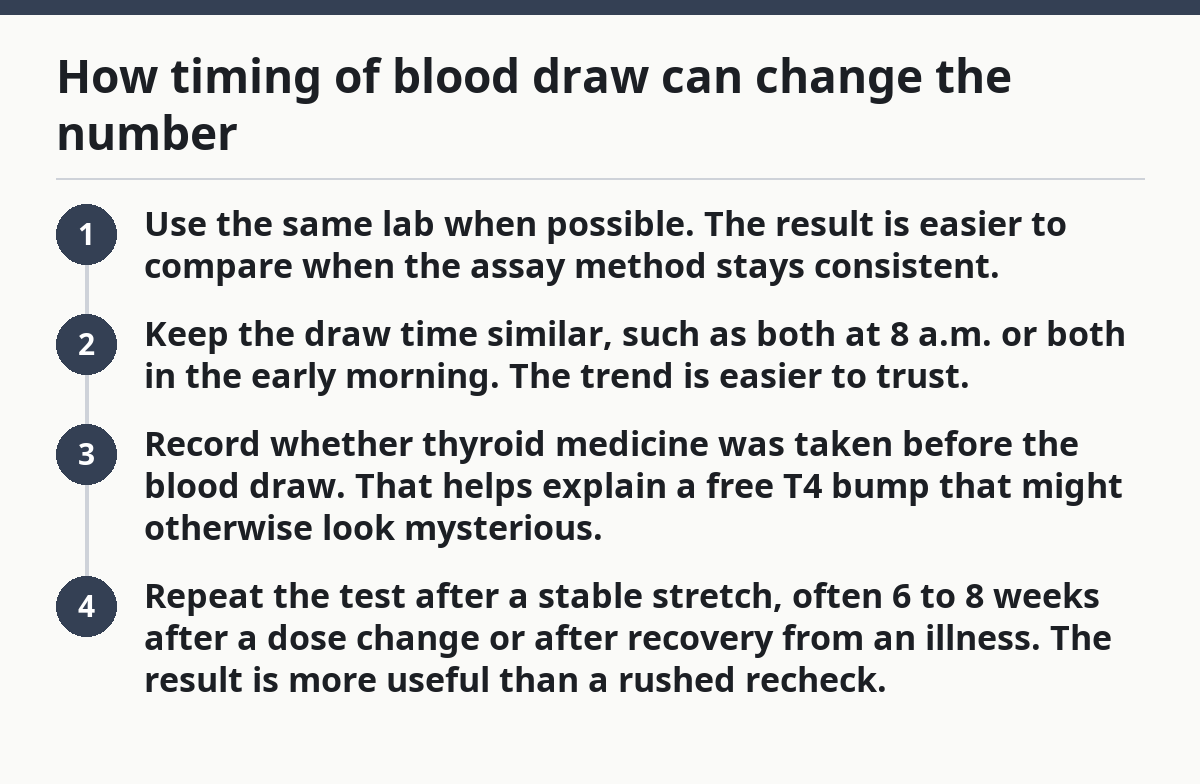
The point is not perfection. The point is reducing avoidable noise so the result says something real.
Common mistakes that make thyroid lab changes look bigger than they are
Common mistakes make thyroid lab changes look bigger than they are because they turn ordinary variation into a false alarm. The biggest mistake is treating one result as a verdict on the whole thyroid system; if the number seems out of line, consult a clinician before changing anything.
The first error is over-reading a small shift inside the reference range. A TSH moving from 2.1 to 3.0 may feel alarming on paper, but it may not mean anything important if symptoms are unchanged and free T4 is steady. The cost of that mistake is unnecessary worry and sometimes unnecessary dose changes.
The second error is comparing tests that were not collected under similar conditions. Different labs, different times of day, recent illness, and changing medication timing all add noise. The fix is not more panic; it is better comparison.
The third error is ignoring the rest of the picture. A thyroid result does not live alone. If sleep, stress, infection, or a medication change occurred in the same window, that matters. A person can feel the same and still have a lab move because the body is responding to something temporary.
The fourth error is assuming symptoms must match the lab exactly. They often do not. That mismatch is frustrating, but it is common. A symptom flare can come from a non-thyroid cause, and a lab shift can show up before any symptom does.
The practical response is restraint: look for a repeat pattern, not a single surprise. If the result changed once but the clinical picture did not, repeating the panel under steadier conditions is often the smarter move; when in doubt, recheck with a clinician rather than acting on one value.
When a repeat test is the right next step
A repeat test is the right next step when the change is small, the context was messy, or the result does not fit how you feel. Rechecking under cleaner conditions often answers the question better than changing treatment immediately.
A repeat is especially useful after recent illness, poor sleep, a new medication, or a blood draw taken at a different time of day. It is also useful when TSH moved but free T4 did not, or when free T4 shifted slightly while symptoms stayed stable. In those cases, the first test may be a temporary wobble.
A typical follow-up interval after a treatment change is often 6 to 8 weeks, because thyroid markers need time to settle. If the question is a transient factor rather than a dose change, the timing may be shorter or longer depending on the clinician’s judgment. The main idea is to give the body enough time to stop reacting to the short-term trigger.
This is also the point where a professional review matters. If results are swinging widely, if TSH and free T4 are moving in opposite directions, or if symptoms are significant, the interpretation gets more complicated. A clinician can decide whether the issue is assay noise, recovery from illness, medication timing, or a real change in thyroid status.
The honest limitation is that no lab strategy removes uncertainty completely. But a second test, drawn under steadier conditions, is often the fastest way to separate a real trend from everyday thyroid lab variability. For more on timing and follow-up, see the MedlinePlus thyroid test overview and the NHS guidance. MedlinePlus, NHS
Key Takeaways
- A changed thyroid number does not always mean your thyroid function changed.
- TSH usually shifts more than free T4, so it can look dramatic before symptoms do.
- Illness, sleep loss, stress, and blood draw timing can all move results.
- Comparing tests is most useful when the lab, clock time, and medication timing are similar.
- A repeat test is often the safest way to sort real change from temporary noise.
Why did my thyroid labs change so much?
A large change can happen when more than one factor stacks together. Illness, different blood draw times, recent medication timing, and normal biologic variation can all push TSH or free T4 in the same direction. If the new result does not match how you feel, a repeat test often clarifies whether the shift was temporary.
Can stress affect thyroid test results?
Yes, stress can affect thyroid test results, though usually in a modest and indirect way. Short-term stress may not produce a dramatic thyroid disorder, but sustained stress can alter the body’s hormone signals and make a lab look different from baseline. A clinician should interpret the number alongside sleep, illness, and recent life changes.
How often should thyroid labs be repeated?
Thyroid labs are often repeated about 6 to 8 weeks after a dose change, because that gives TSH time to settle. If the first result was drawn during illness or at an unusual time, the repeat may be scheduled sooner or later based on the clinical picture. A professional should guide the interval when symptoms are changing.
Drafted with AI; not yet reviewed by a person.