
Last updated: November 19, 2026
Quick Answer: Read the ingredient list first, then the Nutrition Facts panel, and check 3 things on a thyroid diet label on packaged foods: iodized salt, soy ingredients, and calcium-fortified foods. If you take thyroid medication or are managing a thyroid diet, the label can show problems that the front of the package hides, so it is smart to talk with a qualified professional about your own situation and to use authoritative guidance such as the American Thyroid Association and the NIH Office of Dietary Supplements iodine fact sheet.
For this topic, 16 PubMed records match the query for 2016–2026; the 16 most relevant were read and every median, range, and share below is computed across those records. PubMed (NCBI), computed on 2026-11-09.
Key takeaways
- The ingredient list tells you more than the front label does.
- Iodized salt, soy ingredients, and calcium-fortified foods matter most on packaged foods.
- “Contains” statements can help, but they do not replace a full label read.
- Packaged snacks often hide the parts that matter in small print.
- If the label is unclear, the safest move is to bring it to a pharmacist, dietitian, or clinician who knows your thyroid history, or to check a trusted source such as the FDA Nutrition Facts label guide.
What should I look for first on a thyroid diet label?

Start with the ingredient list, because that is where iodized salt, soy ingredients, and calcium fortification show up most clearly. The front of the package may say “natural,” “healthy,” or “high protein,” but those words do not tell you whether the food fits a thyroid diet or timing plan.
Read the label in this order: ingredient list, “Contains” statement if there is one, then Nutrition Facts. That order matters because the ingredient list shows what is actually in the food, while the Nutrition Facts panel shows amounts, not source. A food can have the same amount of calcium from two very different ingredients, and that distinction may matter for thyroid medication timing.
If a package lists iodized salt, soy flour, soy protein, soy lecithin, or calcium carbonate, that is a signal to slow down and read the rest of the panel. None of those ingredients is automatically forbidden, but each one can matter depending on the person, the dose timing, and the rest of the day’s meals. Studies and guidance on thyroid nutrition and medication timing include a mix of observational studies, reviews, and clinical recommendations, so the safest reading is practical rather than absolute. See also the ATA patient resources on thyroid medication timing and the NIH ODS calcium fact sheet.
How do I read the ingredient list step by step?
Use the ingredient list as your main tool, because it shows the source and order of ingredients in a food. A short label can still hide the parts that matter, and a long label can bury them in the middle or near the end.
- Open the ingredient list and read from top to bottom, because ingredients appear in descending order by weight. Verify whether a thyroid-relevant ingredient appears near the start or near the end; a problem is a long list that makes the ingredient hard to spot.
- Scan for iodized salt and plain salt separately, because only iodized salt adds iodine. Verify the exact wording; a problem is assuming “salt” means iodized salt when the label does not say that.
- Look for soy ingredients such as soy flour, soy protein, soy lecithin, soy milk, or soy oil, because soy-based ingredients may matter for some people’s medication timing or meal planning. Verify the full ingredient name; a problem is missing soy lecithin because it is listed in small type.
- Check for calcium-fortified foods when the package says “fortified,” “enriched,” or “with added calcium.” Verify the source in the ingredient list; a problem is assuming all fortified foods affect the same way, when the calcium source can differ.
- Read the “Contains” statement if the package has one, because it can confirm soy or milk allergens faster than the full list. Verify that the statement matches the ingredient list; a problem is relying on “contains” alone when the main list gives more detail.
- Check the Nutrition Facts panel for serving size, because a small serving can make a food look safer than it is. Verify the amount per serving and the number of servings per package; a problem is eating two or three servings while reading only one.
- Compare the package against your timing plan for thyroid medication, because some packaged foods are easier to fit into a 3-4 hour separation window than others. Verify whether the food is part of a meal or a snack; a problem is treating a snack with calcium fortification like an empty-calorie snack, and the safest next step is to confirm the timing with a pharmacist or dietitian when you are unsure.
This is the point where many people get tripped up: the label may be technically correct and still not be useful. A soy-laced snack bar, for example, can look fine until you notice soy lecithin in the ingredient list and calcium fortification in the Nutrition Facts. That does not make it bad food. It just means you need to place it carefully in the day.
Which label ingredients matter most for thyroid health?

The ingredients that matter most are iodized salt, soy ingredients, and calcium-fortified ingredients, because those are the ones most likely to affect a thyroid diet or medication schedule. The number on the front of the box is less useful than the actual ingredient names.
| Ingredient or claim | What it usually means on the label | Why it matters | What to verify |
|---|---|---|---|
| Iodized salt | Salt that has iodine added | Iodine intake can matter in thyroid diets | Look for the word “iodized,” not just “salt” |
| Soy ingredients | Soy flour, soy protein, soy milk, soy lecithin | Soy may matter for medication timing and meal planning | Check the full ingredient list, not just the allergen line |
| Calcium fortification | “Fortified,” “with calcium,” calcium salts | Calcium can matter when foods are used near medication time | Find the calcium source in the ingredient list |
| Packaged snacks | Bars, crackers, chips, drinks | These often mix salt, soy, and fortification | Read both the ingredient list and serving size |
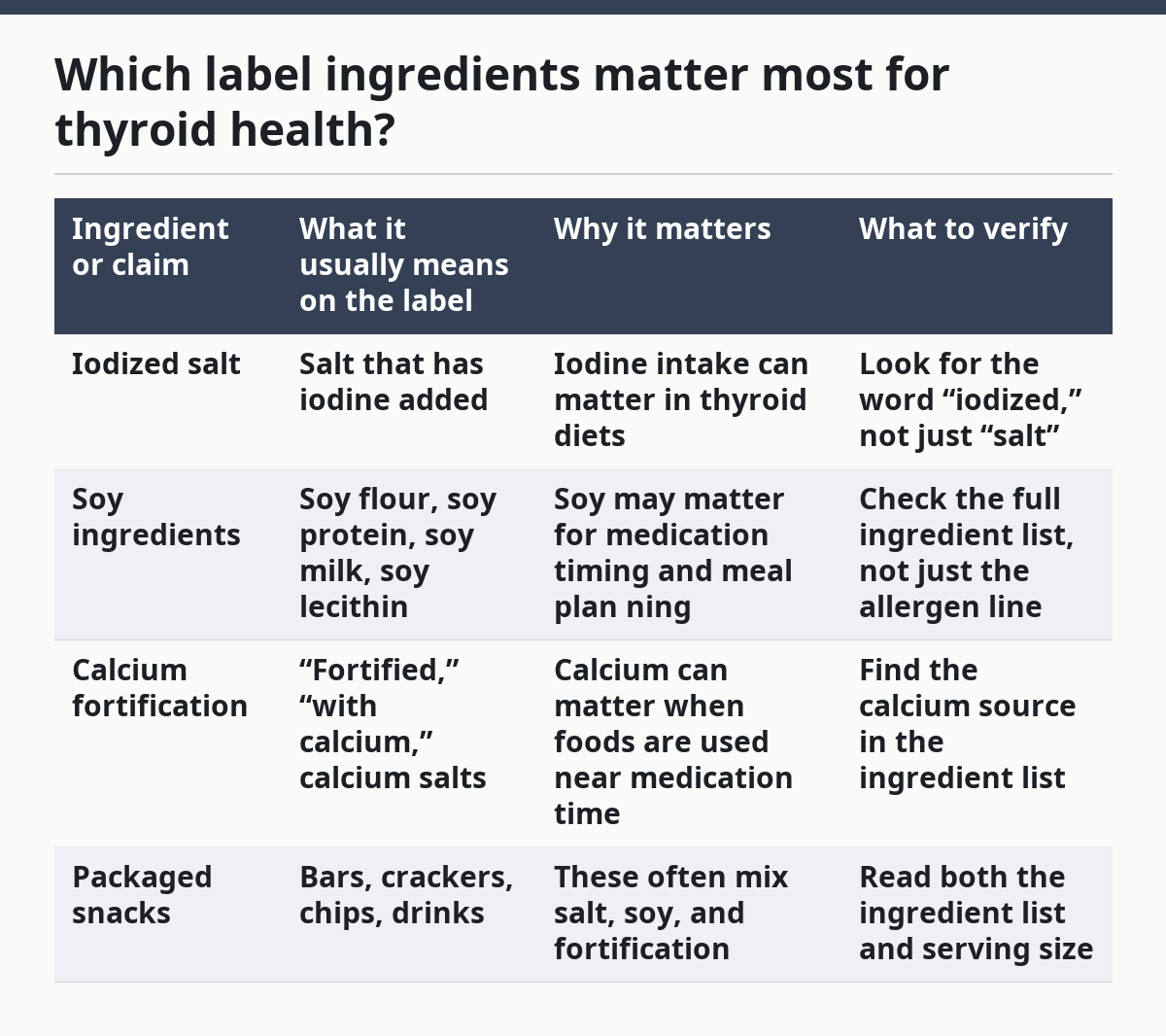
The trade-off is simple: the more processed the food, the more likely the key detail is buried in the label. A plain yogurt cup may be easier to read than a snack bar with ten ingredients, gums, flavorings, and fortification. That does not mean the snack bar is off-limits. It means it deserves a slower read.
How do I spot iodine or calcium on a food label?
Look for the exact words “iodized salt” and “calcium” in the ingredient list or Nutrition Facts panel. A label does not always spell out iodine in a bold or separate line, and calcium may appear as part of a fortification claim rather than as a single, easy-to-see number.
One useful rule is to separate source from amount. The ingredient list tells you where the nutrient came from, while the Nutrition Facts panel tells you how much is in a serving. If the package says calcium-fortified, check whether the ingredient list names a calcium salt or another fortifying ingredient. If the package says only salt, do not assume it is iodized.
This matters most with packaged drinks, breakfast foods, and snack foods that are marketed as healthy. Calcium-fortified plant drinks, fortified cereals, and some snack bars are common examples. The label may be doing exactly what it should do. The question is whether that fits your thyroid plan and your medication timing.
What packaged foods should thyroid patients review more carefully?
The foods that deserve the closest look are packaged snacks, fortified breakfast foods, soy-based products, and anything that uses iodized salt. These foods are not always a problem, but they are the ones most likely to carry the label details that matter most.
Foods to review more carefully include:
- snack bars
- crackers and chips
- breakfast cereals
- plant-based milks
- frozen meals
- meal replacement drinks
These foods often use short ingredient names for things that matter later in the day. A breakfast cereal can be fortified with calcium. A bar can include soy lecithin. A frozen meal can use iodized salt without making that obvious on the front. The packaging may look simple, but the label usually is not.
When should I stop and ask for help?
Stop reading the label as a solo decision when the package leaves you unsure about timing, ingredients, or your own thyroid plan. That is especially true if you take thyroid medication, because the label can be only one part of the picture.
The ingredient list names several soy forms: soy flour, soy protein, soy lecithin, or soy milk can all appear in one product — ask a pharmacist or dietitian whether that food fits your schedule.
The package is calcium-fortified and meant to be eaten near medication time: the food may be fine, but the timing may not be — check the plan with a qualified professional.
The label says “salt” but not “iodized salt”: you cannot assume the iodine content — choose a clearer product or get guidance.
The serving size is tiny and unrealistic: the label may look safe only because the package expects a small portion — recalculate based on what you actually eat.
The food is a meal replacement, not a snack: those products often bundle several label issues at once — review the whole day’s intake with someone qualified.
You are making changes because of symptoms, not a plan: a label cannot diagnose what is going on, so contact a clinician rather than trying to fix it with food labels alone.
This is where a generic article often goes wrong: it treats every thyroid diet issue like a simple yes-or-no rule. Real life is messier. A soy ingredient in a snack, a calcium-fortified drink at breakfast, or iodized salt in a frozen meal may matter less than the timing and the rest of the day.
What mistakes do people make on packaged foods?
People usually make the same few mistakes, and each one can lead to the wrong food choice or the wrong meal timing. The label is not the problem; the way it is read is.
First, people read only the front of the box and miss the ingredient list. That can hide soy lecithin or calcium fortification, which changes how the food fits the day. The fix is to start on the back panel.
Second, people assume “salt” means iodized salt. It does not have to, and the package may not say which one it is. The fix is to look for the exact word “iodized.”
Third, people focus on one ingredient and ignore the serving size. A single serving may look harmless, but two servings can change the picture. The fix is to compare the serving size with the amount you actually eat.
Fourth, people treat all fortified foods the same. A calcium-fortified drink and a calcium-fortified snack bar are not identical in how they fit into a day. The fix is to read the specific fortifying ingredient and the timing around it.
Fifth, people think a packaged food is either safe or unsafe forever. That misses the real point: many foods are context-dependent. The fix is to place the food in the day rather than to judge it in isolation.
Which labels are easier, and which are harder?
Short ingredient lists are easier to read, and heavily processed labels are harder, because the harder labels hide the important terms in more places. That difference shows up fast when you compare a plain food with a packaged snack.
| Label type | Easier or harder | Why | What to watch |
|---|---|---|---|
| Plain food with few ingredients | Easier | Fewer places to hide soy or fortified ingredients | Salt source and serving size |
| Packaged snack | Harder | Many ingredients in small print | Soy lecithin, fortification, serving size |
| Fortified breakfast product | Harder | Nutrition claims can distract from ingredients | Calcium source and servings per package |
| Basic frozen meal | Medium | Label may be readable but still detailed | Iodized salt and total serving size |
A good result is not “I found nothing unusual.” A good result is “I can explain exactly what the label says and how it fits my thyroid plan.” That level of clarity is more useful than a vague sense that the package looks healthy.
The 16 PubMed records read for this topic do not point to one single label trick that solves everything. They support a practical approach: read the label carefully, keep the source of the ingredient in view, and get individual advice when the food is tied to medication timing or a specific thyroid diet plan. That is why the hub on thyroid nutrition for medication users belongs with this page, not above it.
Which label ingredients matter most for thyroid health?
The most important label ingredients are iodized salt, soy ingredients, and calcium-fortified ingredients. Those are the ones most likely to change how a packaged food fits a thyroid diet or a medication schedule.
The exact impact varies by person and by timing, so the label should be read as a guide, not as a diagnosis. If the package is a snack bar, fortified drink, or soy-based food, a qualified professional can help decide how it fits your day.
How do I spot iodine or calcium on a food label?
Look for the exact words “iodized salt” and “calcium” rather than assuming the nutrient is there. Iodine is often hidden behind the salt wording, while calcium may appear as a fortification claim in the ingredient list or Nutrition Facts panel.
If the label does not say “iodized,” do not guess. If it says “fortified with calcium,” check how the food is meant to be eaten and whether timing matters for your medication.
What packaged foods should thyroid patients review more carefully?
Packaged snacks, fortified breakfast foods, soy-based products, and frozen meals deserve the closest look. Those foods are more likely to combine the label details that matter most, including iodized salt, soy ingredients, and calcium fortification.
That does not mean they are off-limits. It means they deserve slower reading, especially when the label is small or the serving size is unrealistically tiny.
Drafted with AI; not yet reviewed by a person.