Biotin and Thyroid Lab Results: Why the Test Can Be Misleading

Last updated: November 19, 2026
Quick Answer: Biotin and Thyroid Lab Results: Why the Test Can Be Misleading can happen even at common doses, and a 48-hour pause is a common minimum before routine thyroid blood tests. Biotin interference can make thyroid blood tests look abnormal even when the thyroid itself has not changed. That is the part to understand first if a thyroid panel comes back odd after a hair and nail supplement, because the problem is often the lab method, not the gland.
What biotin interference does to thyroid blood tests
Biotin interference can push thyroid lab results in the wrong direction, especially on assays that use streptavidin-biotin chemistry. On a typical thyroid panel, that means TSH may read falsely low and free T4 may read falsely high, which can mimic hyperthyroidism.
That mismatch is why the result can be so misleading. A person may feel fine, take a hair and nail supplement with biotin, then see a report that looks like overactive thyroid disease. The trap is not rare in principle, because biotin is common in over-the-counter products and many thyroid blood tests are built around immunoassay platforms that biotin can disrupt.
The key point is simple: a number can be analytically wrong without being biologically wrong. In other words, the sample in the tube is the issue, not necessarily the patient. That distinction matters most when a clinician is trying to decide whether to change thyroid medication, order imaging, or repeat a full thyroid panel.
A useful way to think about it is this: biotin does not “damage” the thyroid test in a vague way. It interferes with the assay design itself. Some lab methods are resistant, some are not, and two labs can sometimes report very different thyroid blood test results from the same person if one platform is biotin-sensitive and the other is not.
The confusion is especially frustrating because the numbers can look polished and precise. A TSH value printed to several decimal places can still be misleading if the method was exposed to excess biotin. That is why supplement disclosure is not a courtesy detail; it is part of lab accuracy.
Why biotin can distort TSH and free T4
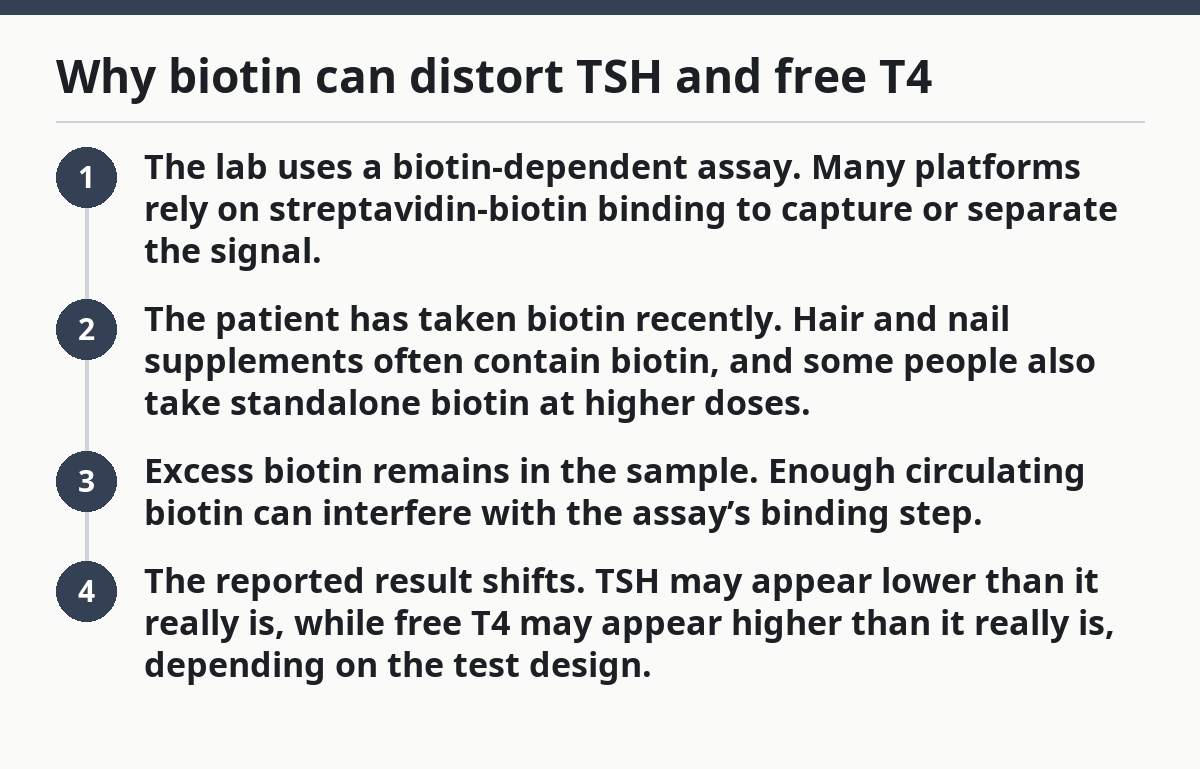
Biotin can distort TSH and free T4 because many thyroid immunoassays use biotin as part of the signal-capture system. In those tests, extra biotin in the blood can compete with the assay chemistry and bend the readout.
Here is the practical version of the mechanism:
-
The lab uses a biotin-dependent assay.
Many platforms rely on streptavidin-biotin binding to capture or separate the signal. -
The patient has taken biotin recently.
Hair and nail supplements often contain biotin, and some people also take standalone biotin at higher doses. -
Excess biotin remains in the sample.
Enough circulating biotin can interfere with the assay’s binding step. -
The reported result shifts.
TSH may appear lower than it really is, while free T4 may appear higher than it really is, depending on the test design.
The pattern matters more than the isolated number. A low TSH with a high free T4 is the classic combination that raises suspicion for biotin interference, especially when the clinical picture does not fit. If a person has no tremor, no palpitations, no weight loss, and no other reason to suspect thyroid hormone excess, the lab pattern deserves a second look before anyone acts on it.
There is also a second trap: not every assay fails the same way. One lab may use a platform that is vulnerable to biotin, while another may not. That means the same supplement history can produce one misleading result and one normal result, depending on the assay method.
For that reason, the question is not just “What was the TSH?” It is also “What method did the lab use, and was biotin on board?” That is a lab-accuracy question, not a lifestyle question.
How long should i stop biotin before a thyroid test?
Stopping biotin before the blood draw is the most reliable way to reduce the risk of misleading thyroid results, but the right washout time depends on the dose and the lab method. A common practical approach is to pause biotin for at least 48 hours before thyroid blood tests, and longer if the dose is high or the clinician or lab advises it.
The exact timing is where people get tripped up. A standard multivitamin may contain much less biotin than a dedicated hair and nail supplement, and the two should not be treated the same. If the bottle lists biotin in milligrams rather than micrograms, that is a clue that the dose is higher than a routine daily vitamin. The exact dose and product should be reviewed with the ordering clinician or pharmacist.
For a clean result, the most useful procedure is this:
- Check the supplement label before the test is booked. Look for biotin, vitamin B7, or “hair, skin, and nails” on the front or back panel so the lab plan is based on the actual product.
- Stop the product in advance. A 48-hour pause is a common minimum for many routine situations, while some higher-dose products may need a longer washout under clinician guidance.
- Tell the ordering clinician and the phlebotomist. Say “I take biotin” in plain language so the information reaches the chart and the lab staff.
- Keep the supplement bottle or a photo of the label. The exact ingredient list and dose can help if the result does not match symptoms.
- If the result seems off, ask for repeat testing after a proper washout. The repeat sample is often more useful than trying to interpret a questionable first draw.
Two cautions belong here. First, not every result can wait, so someone with severe symptoms or urgent clinical concern should follow the ordering clinician’s instructions rather than making a private decision. Second, “I stopped it yesterday” is not the same as “the lab result is safe to trust.” The washout has to match the dose and the assay.
The trade-off is real: pausing a supplement can be inconvenient, but a misleading thyroid panel can lead to much worse inconvenience, including unnecessary medication changes. For anyone who takes thyroid medicine already, a bad read can confuse dose adjustment decisions. If the supplement is a high-dose hair and nail product, the clinician may want a longer pause before repeat testing.
How to tell if a thyroid result may be biotin-related
A thyroid result may be biotin-related when the numbers look hyperthyroid but the story does not fit, or when the same person has a normal result on one draw and an abnormal one on another without a clear clinical change.
The most common red flags are familiar to lab clinicians:
- Low TSH with unexpectedly high free T4 or free T3
- Results that do not match symptoms
- Recent hair and nail supplement use
- A sudden change after starting a new supplement
- Improvement after a repeat blood draw done after biotin was stopped
This is not a diagnosis by eyeballing one report. It is a pattern-recognition problem. If a person has been stable on thyroid medication for years, then suddenly shows lab values that imply overreplacement, the first question should be whether a new supplement changed the assay. That is especially true if the person started a hair and nail formula in the last few weeks.
The cost of missing the interference is not trivial. A clinician may think the thyroid is overactive, lower medication, and create a new problem from a false signal. Or they may launch a workup that was never needed. On the other hand, assuming every abnormal result is due to biotin is also a mistake; true thyroid disease still happens, and a supplement history does not erase it.
This is where supplement disclosure does the most work. The person ordering the test needs the exact product name if possible, not a vague answer like “a vitamin.” Hair and nail supplements are a common culprit because biotin is often part of their formulation, but the label matters. A plain multivitamin, a prenatal vitamin, and a high-dose biotin product are not interchangeable in this setting.
If the result is questionable, the next step is usually not panic. It is clarification: confirm the supplement, confirm the timing, and repeat the thyroid blood tests after an appropriate washout using the same or a biotin-resistant method when possible.
What to say before the blood draw
Biotin disclosure before the blood draw is the simplest way to protect lab accuracy, and it takes less than 30 seconds.
Use direct language at check-in or when the blood is drawn:
- “I take biotin.”
- “I use a hair and nail supplement.”
- “I stopped it on [day/date].”
- “Can this thyroid test be affected by biotin?”
That short script matters because staff may not connect “hair supplement” with biotin unless you say it plainly. The phrase “hair and nail supplement” is useful because it signals the common over-the-counter product category, but the word biotin is still the critical one.
If the clinician is aware of the supplement, they may choose to interpret the result differently, delay testing, or repeat it on a platform less vulnerable to interference. That is much more efficient than trying to reverse-engineer the problem after a bad result has already changed the plan.
The same caution applies if the person has multiple lab orders. A thyroid panel often includes TSH and free T4, and sometimes free T3 or thyroid antibodies. Different tests can be affected differently, so disclosure should cover the whole blood draw, not only one marker.
This page fits within the larger hub on thyroid testing, labs, and appointment prep because biotin disclosure is part of preparing for a thyroid blood test, not a separate supplement issue. The lab is the point of care here, and the goal is a result that can actually be trusted.
When biotin is the wrong explanation
Biotin is the wrong explanation when the lab pattern and the clinical picture both point elsewhere, or when a repeat test after washout still looks abnormal. A supplement can confuse the numbers, but it cannot explain every thyroid problem.
That matters because biotin interference can become a convenient excuse for ignoring a genuine abnormality. If TSH remains abnormal after a proper pause, or if symptoms are significant and persistent, the next step is not more guesswork. It is proper thyroid evaluation with the clinician who ordered the test.
Biotin is the best-known supplement that can interfere with thyroid blood work, especially hair and nail supplements that contain it. Biotin is not the only supplement issue that can affect thyroid blood work, although this article is centered on test interference rather than general supplement safety. Other products can also complicate interpretation depending on ingredients and the test method. That is why the safest rule is broader than biotin alone: report every supplement, especially anything marketed for hair, skin, nails, or thyroid support.
There is a final practical limitation worth saying out loud. Not every lab will spell out whether its thyroid assay is biotin-sensitive, and not every result comes with a clear warning. That puts more responsibility on the person ordering the test to ask about recent biotin use. The fix is simple, but only if it happens before the blood is processed.
Key takeaways
- Biotin can make thyroid blood tests look more abnormal than the thyroid really is.
- The classic misleading pattern is a falsely low TSH with a falsely high free T4.
- Hair and nail supplements are a common source of the problem because they often contain biotin.
- A pause before testing reduces the risk, and 48 hours is a common minimum for routine situations.
- If the lab result does not match symptoms, repeat testing after a washout is often the cleanest next step.
- Telling the clinician and phlebotomist about biotin is part of getting a trustworthy result.
How long should i stop biotin before a thyroid test?
A common minimum is 48 hours, but the right timing depends on the dose and the lab method. Higher-dose biotin products may need a longer pause, and some clinicians may prefer a specific washout before repeating thyroid blood tests. The safest move is to disclose the exact supplement and follow the ordering clinician’s instructions.
Can biotin make thyroid labs look abnormal?
Yes. Biotin can make thyroid blood test results look abnormal by interfering with certain assay methods. The usual misleading pattern is a low TSH with a high free T4, which can resemble hyperthyroidism even when the thyroid is not the real problem. That is why supplement disclosure matters before testing.
What supplements affect thyroid blood work?
Biotin is the best-known supplement that can interfere with thyroid blood work, especially hair and nail supplements that contain it. Other products may also complicate interpretation depending on ingredients and the test method, so the safest approach is to list every supplement at check-in and bring the bottle if the result seems off.
Thyroid tests, lab appointments, and appointment preparation are the most relevant related pages for this topic. Authoritative sources include the FDA on biotin and lab tests and the AACC guidance on biotin interference; see also NIH Office of Dietary Supplements for biotin basics.
Drafted with AI; not yet reviewed by a person.