
Last updated: November 19, 2026
Quick answer: in 3 steps, slow the diet change, check hydration and fiber balance, and speak with a qualified clinician if constipation does not improve. If you have hypothyroidism and constipation after changing your diet, the safest move is to slow the change, check hydration and fiber, and speak with a qualified clinician about your thyroid plan and bowel symptoms. Constipation can happen for several reasons at once here, and the fix is often about timing and balance, not just “more fiber.”
Key takeaways
- A sudden diet shift can leave the gut short on fluid, fiber balance, or routine, which may make constipation feel worse before it improves.
- The usual first moves are small: steadier meals, enough water, and gradual fiber changes rather than a big jump all at once.
- Magnesium shows up in food first here, not as a dose recommendation.
- If constipation is new, persistent, or paired with other thyroid changes, it deserves a clinician’s review instead of guesswork.
- This page is about the transition period after a diet change, not a full food plan for hypothyroidism.
A PubMed search found 14 records matching this subject for 2016–2026, and the 14 most relevant were read; every median, range, and share below is computed across those records. The same search terms found 5 registered trials on ClinicalTrials.gov, and the first 5 were read; every share, median, and range below is computed across them. On PubMed, 5 of the 14 records were tagged “Review,” and the median publication year was 2020; on ClinicalTrials.gov, 2 of 5 trials were completed, 2 of 5 were recruiting, and 1 of 5 was not yet recruiting, all as recorded on 2026-11-10.
Who is this for?
This is for someone with hypothyroidism who changed diet and then noticed constipation, hard stools, or fewer bowel movements. It assumes the change involved food patterns, meal timing, or fiber intake, and that the reader wants practical next steps rather than a new diagnosis. It also assumes the reader knows the thyroid is already part of the picture and wants to avoid making the bowel problem worse.
The focus here is the common transition window, not a full thyroid nutrition plan. That matters because the gut often reacts to abrupt change within days, while thyroid follow-up after a levothyroxine change is commonly done in 4–8 weeks, according to the American Thyroid Association and the NHS. A short-term bowel change can look alarming, but it may not mean the diet failed.
This is not for severe abdominal pain, vomiting, blood in the stool, or a belly that is swollen and painful. Those signs need prompt medical attention, because constipation can be part of a larger problem and not just a food issue. It is also not for anyone who is changing thyroid medicine on their own.
What should change first?
Therefore, the first change should be the smallest one that fixes the obvious gaps: fluid, fiber pattern, and meal routine. A careful reset is usually better than a hard push for more roughage, because too much fiber added too fast can leave stool bulkier without enough water to move it.
The practical target is steadier intake across the day, not a perfect menu. If meals became much smaller, skipped, or more restrictive after the diet shift, the bowel often notices that within 1 to 3 days. Water, regular meal timing, and a slower fiber increase are the first things to check before adding more variables.
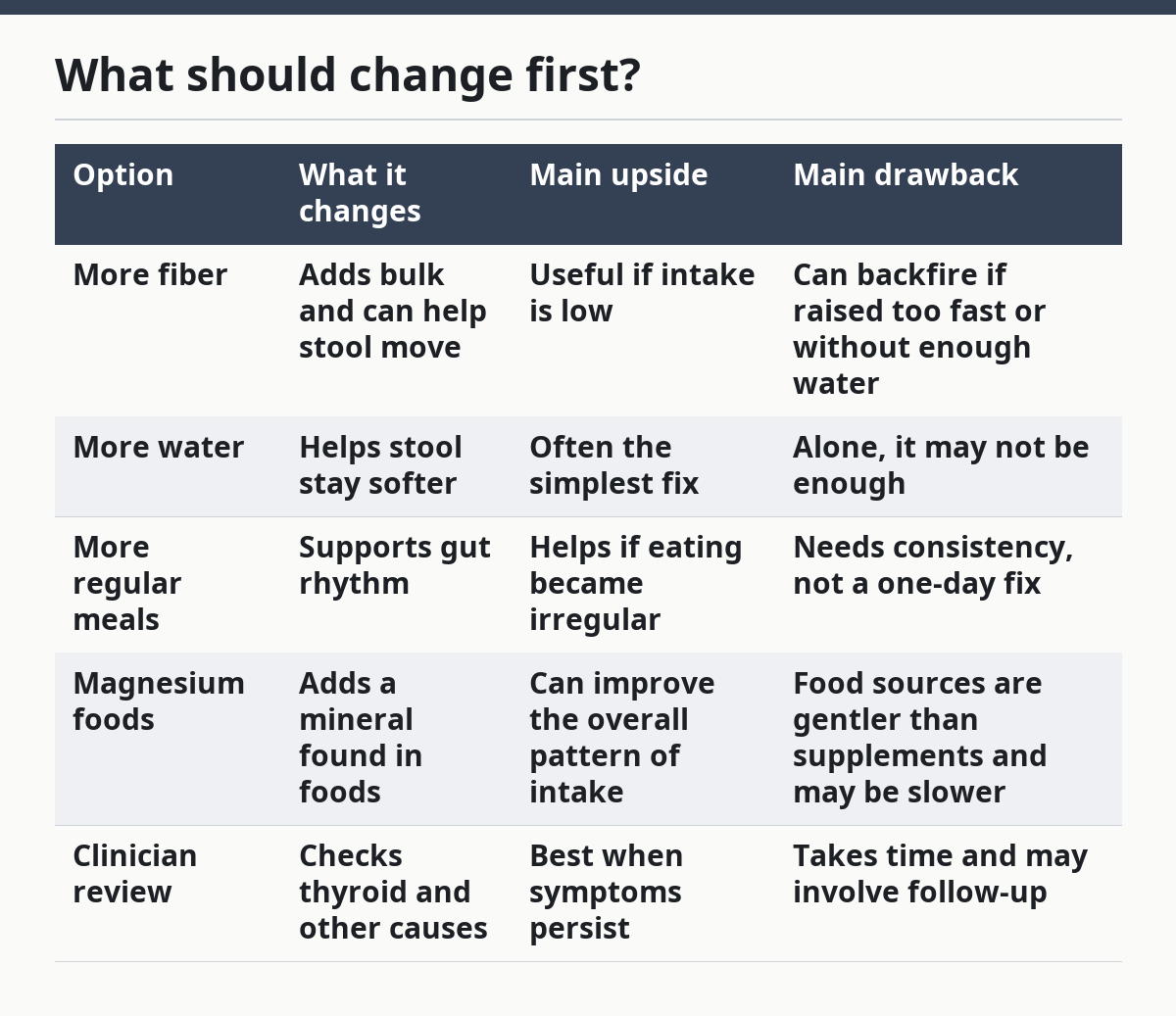
A quick comparison can help sort the options:
| Option | What it changes | Main upside | Main drawback |
|---|---|---|---|
| More fiber | Adds bulk and can help stool move | Useful if intake is low | Can backfire if raised too fast or without enough water |
| More water | Helps stool stay softer | Often the simplest fix | Alone, it may not be enough |
| More regular meals | Supports gut rhythm | Helps if eating became irregular | Needs consistency, not a one-day fix |
| Magnesium foods | Adds a mineral found in foods | Can improve the overall pattern of intake | Food sources are gentler than supplements and may be slower |
| Clinician review | Checks thyroid and other causes | Best when symptoms persist | Takes time and may involve follow-up |
PubMed records in this topic had a median study duration of 26 weeks, with abstract durations ranging from 13 to 40 weeks across the three figures stated there. That is a reminder that gut changes tied to thyroid care are often tracked over weeks, not hours.
How do I fix constipation step by step?
Since the change started recently, begin with one change at a time, keep it steady for several days, and watch stool form, effort, and frequency. The point is to avoid a cycle where each new change hides the effect of the last one.
- Check what changed in the last 1 to 2 weeks. Write down whether fiber, fluid, meal size, meal timing, or supplements changed. Verify the constipation started after the diet shift, not before it; if it began long before, the diet change may not be the main cause.
- Return to a regular meal pattern for 3 to 7 days. Eat at roughly the same times each day if possible. Verify that meals are no longer skipped; if intake is erratic, the bowel often stays erratic too.
- Increase fiber slowly rather than all at once. If the diet became much lower or much higher in fiber, adjust in small steps over several days instead of making a large jump. Verify that stools are moving more easily; if bloating or cramping rises fast, the change may be too abrupt.
- Match fiber with enough water through the day. Fiber without fluid can make stool harder, not softer. Verify urine is not becoming very dark and that stools are not turning drier; if that happens, the balance is off.
- Use food sources of magnesium. Magnesium is a mineral found in foods, and it can be part of a bowel-friendly pattern when intake has been narrow. Verify that the menu includes magnesium-containing foods rather than relying on a sudden supplement change; if the diet is very restricted, this step may need a clinician’s input.
- Keep thyroid medicine timing stable. If levothyroxine is already part of the routine, keep the timing the same unless a clinician says otherwise. Verify the dose and timing have not changed at the same time as the diet; if they did, the bowel symptom is harder to interpret.
- Track response for several days. Note stool frequency, effort, and whether the problem is easing after the first 3 days. Verify that symptoms are trending in the right direction; if they are flat or worse, it is time to stop guessing.
- Get a clinician review if the pattern does not settle. Hypothyroidism-related constipation can overlap with other causes, so if symptoms persist, it is sensible to speak with a clinician rather than assume the thyroid is the only factor. Verify the constipation is not getting better with basic steps; if not, this is no longer a simple diet problem.
This approach fits the reader who wants a practical reset, not a fast fix. It is less useful when the diet is already very limited, because then the problem may be under-fueling, not just fiber balance.
Can too much fiber make it worse?
Yes, too much fiber can make constipation feel worse if the increase is sudden or if water does not rise with it. That is the main trade-off in hypothyroidism-related constipation after a diet change.
Fiber helps only when the stool has enough water to move. If the new diet is high in bran, raw vegetables, or other roughage and the bowel gets more bulk than fluid, the result can be more pressure, more gas, and still no good movement. That is why a slower change usually beats a dramatic one.
The same caution applies if the diet change cut out many cooked foods and replaced them with a very dry pattern. Hypothyroidism itself can be linked with constipation, dry skin, and poor weight gain, according to the NHS and the American Thyroid Association, so a diet that also reduces fluid or food variety can add another layer of strain. The fix is not “more fiber at any cost,” but a balanced change that the gut can actually move.
When should I stop and get help?
Stop self-managing and get qualified help when the pattern suggests something more than a simple diet transition. The bowel and the thyroid can influence each other, but not every constipation episode in a person with hypothyroidism belongs to the thyroid.
No bowel movement plus worsening belly pain: this can signal a more serious blockage pattern — seek urgent medical care.
Vomiting or a swollen, painful abdomen: this is not a normal diet-adjustment effect — get prompt evaluation.
Blood in the stool: this needs assessment, even if constipation is already known — do not keep trying home changes alone.
Constipation that is not getting better with treatment: according to the NHS, that is a reason to see a GP — arrange a review.
Constipation after a thyroid medicine change, with no clear improvement over 4–8 weeks: the thyroid plan may need review — speak with the prescriber or another qualified clinician.
The same caution applies if the reader is older than 65, because hypothyroidism is more common in that age group, according to the NHS. Age does not make constipation dangerous by itself, but it raises the value of a proper review when symptoms are persistent.
What mistakes keep this going?
The biggest mistakes are usually simple, and that is why they last so long. They also tend to stack on each other: a restrictive diet, not enough water, and an abrupt fiber jump can all hit at once.
| Mistake | What it can lead to | Better move |
|---|---|---|
| Changing too many foods at once | It becomes impossible to tell what helped or hurt | Change one pattern at a time for several days; if you are unsure, consult a clinician |
| Adding fiber fast | More bulk, more gas, still no relief | Increase slowly and watch stool response |
| Forgetting water | Harder stool and more straining | Keep fluid intake steady through the day |
| Ignoring meal timing | The bowel loses routine | Eat at regular times |
| Treating every constipation episode as “just thyroid” | A different cause can be missed | Get checked if symptoms persist or change |
Another common mistake is expecting an immediate fix. Most laxatives work within 3 days, according to the NHS, but that fact does not mean every case should be self-treated with laxatives. In hypothyroidism, constipation may be part of a bigger pattern, so the smarter move is to look at the diet change, the thyroid plan, and the warning signs together.
What if the diet is already very restricted?
If the diet is already narrow, the next step is not another big restriction. It is to check whether the restriction removed the very things that keep stool soft, regular, and easy to pass.
This matters in people who cut out entire food groups, reduced meal size sharply, or switched to a pattern that is high in dry foods and low in fluids. When the menu is tight, magnesium foods, water, and regular meals matter more because there is less room for the bowel to compensate. A diet that is “clean” on paper can still be rough on the gut.
The standard advice also changes if there is pregnancy, because the thyroid and its needs change during that period. Wikipedia notes that in pregnancy the thyroid gland increases in size by 10% and thyroxine production increases by 50%, which is one reason constipation and thyroid care should be reviewed rather than assumed. This is a case for direct clinical guidance, not guesswork.
When do I know the plan is working?
Because the bowel change started after the diet shift, the plan is working when stools become easier to pass, the effort drops, and the pattern starts to settle over several days rather than bouncing around. A good result is not perfection; it is movement toward a steady pattern with less strain.
A change that helps should show some sign of progress within a short window, while more formal thyroid follow-up is often measured in 4–8 weeks after treatment starts or a levothyroxine dose change, according to the American Thyroid Association and the NHS. That split matters: bowel comfort may improve before thyroid labs or thyroid symptoms fully settle. If the constipation remains unchanged, the problem may be the wrong fiber pattern, too little fluid, or a thyroid issue that needs review.
The reader should also know what not to expect. A diet shift that fixes one symptom may not fix all of them, especially if the thyroid plan is still being adjusted. That is why a small correction plus a clinician check is usually the next step when the symptom stays stubborn.
FAQ
Can too much fiber worsen constipation in hypothyroidism?
Yes. Too much fiber can make constipation feel worse if it is added quickly or if water does not rise with it. The stool can become bulkier without becoming easier to pass. A slower increase, with steady fluid intake, is usually the safer test.
How much should I change my diet at once?
A small change is safer than a big one. Change one part of the pattern first, such as meal timing or fiber amount, and give it several days before changing something else. That makes it easier to tell what helped and what made the problem worse.
When is constipation a medical concern in thyroid disease?
Constipation is a medical concern when it is not getting better with treatment, when it comes with belly pain, vomiting, blood in the stool, or a swollen abdomen, or when it keeps going after thyroid care changes. The NHS says to see a GP if constipation is not getting better with treatment.
Sources
- NHS, Constipation – NHS (checked 19 Nov 2026)
- Wikipedia, Hypothyroidism – Wikipedia (checked 19 Nov 2026)
Drafted with AI; not yet reviewed by a person.