Last updated: November 19, 2026
Quick Answer: If you miss a dose of levothyroxine, the safest next step is usually to verify the prescription label, check how long ago it was due, and ask a pharmacist or clinician if you are unsure. The missed dose question is not always simple, because the right answer can depend on timing, other medicines, and how your thyroid treatment is scheduled. For general medication guidance, see the NHS and MedlinePlus.
Key Takeaways
- For a same-day missed dose, check the label, check the clock, and ask a pharmacist if the timing is unclear.
- A second tablet is not the default answer after one missed dose, and a double dose can be the wrong move for some people and schedules.
- Standard missed-dose advice does not fit every situation, so stop guessing when the routine is unusual.
- The most common errors are predictable, and each has a better alternative.
Who this applies to, and what it assumes

This guide is for a person who takes levothyroxine on a regular dose schedule and has realized a dose was missed, delayed, or accidentally skipped. It assumes you have the medicine in hand, can read the prescription label, and know whether your tablet is a once-daily medicine or part of a more unusual regimen set by a clinician. It also assumes you are not trying to manage a severe reaction or a separate medical emergency.
Do not use a generic internet answer if any of these apply: pregnancy, a recent thyroid surgery, a history of heart rhythm problems, or a complicated medication list with iron, calcium, bile acid binders, or seizure medicines. Those situations can change the margin for error. A pharmacist can often help quickly, and the prescriber should be involved when the regimen is unusual or the label instructions are unclear. For thyroid-treatment background, see the American Thyroid Association and MedlinePlus.
Levothyroxine is a narrow-therapeutic-index medicine, which means small changes in how it is taken can matter more than they would with many other tablets. That is why people are told to stick to the same dose schedule each day. The practical question is not “How can I make up for a bad morning?” It is a general question of how to get back on schedule without creating a second mistake.
Studies matching this topic on PubMed are limited but relevant. The search results used for this article were reviewed on 2026-10-20, and the set included review-type articles as well as other study designs. The point is not the exact count; it is that the public record on missed levothyroxine doses is not built around one universal rule.
What to do the same day
For a same-day missed dose, the first move is to verify the label, check the clock, and ask a pharmacist if the timing is unclear. The goal is to avoid an accidental double dose while still returning to the normal routine as safely as possible.
- Confirm exactly what was missed. Check the tablet count, the day of the week, and the prescription label. Verify the strength on the bottle and whether the dose was scheduled once daily. A problem is not just a late tablet; it is also a second tablet taken from memory after the first one was already swallowed.
- Check how long ago the scheduled time passed. Note the approximate time, not just “this morning.” A delay of 1 hour, 6 hours, or 18 hours can affect the choice people usually ask about. If you cannot tell when it was due, consult a pharmacist rather than improvising.
- Look for any special instructions on the prescription label. Some labels include language about missed doses, food timing, or “take as directed.” Verify whether the pharmacist wrote any note that modifies the standard routine. A problem is a label that differs from what you remember; the label wins until a clinician says otherwise.
- Do not stack doses without guidance. If you are considering taking two tablets, stop and check with a pharmacist or prescriber first. The specific risk is a double dose from assumption, not from the missed tablet itself. If you already took an extra tablet, that is a different problem and should be reported promptly.
- Keep the next scheduled dose in view. Check whether the next dose is due in roughly 12 to 24 hours, depending on your routine. The issue is not just whether one tablet can be made up; it is whether making it up would push the schedule off course. If the next dose is close, that is exactly when advice matters most.
- Check for medicines that can confuse the plan. Iron, calcium, multivitamins, bile acid binders, and some antacids can complicate thyroid pill timing. Verify whether you took them near the levothyroxine dose. If you cannot separate the timing clearly, consult a pharmacist rather than estimate.
- Use a pill tracker before you take anything else. Mark the missed dose in a phone note, pill app, or paper calendar before deciding. A simple tracker prevents the common “Did I already take it?” loop. If you cannot prove the dose was missed, do not take a second tablet on memory alone.
- Reset the routine for the next day. Return to the regular dose schedule unless a clinician tells you to do something different. Verify the next morning’s plan on the label. A problem is trying to “fix” the missed dose by changing the schedule for several days, which can create a new pattern of errors.
A practical rule of thumb is that the missed-dose question should be answered before the next bottle is opened, not after the uncertainty has spread through the day. If the label is confusing, call the pharmacy that filled it. The pharmacist can usually translate the directions fast and can also tell you whether the formulation or strength on hand changes the advice.
For broader timing issues, the hub on thyroid medication timing and daily routines is the better place to start; this page is only for the missed-dose problem itself.
Should you take two levothyroxine pills after missing one?

Not automatically. A second tablet is not a default answer just because one dose was missed, and a double dose can be the wrong move for some people and some schedules.
The reason is simple: levothyroxine is usually taken on a stable schedule, and the “make up” decision depends on when the omission happened, how close the next dose is, and whether a clinician has already given a personal rule for missed tablets. If a prescriber has given you an explicit written plan, follow that plan. If not, the safer move is to ask a pharmacist before taking extra tablets.
A common mistake is treating levothyroxine like an ordinary pain reliever, where doubling up feels harmless. It is not in that category. The medication has a long biologic effect, but that does not make every extra dose harmless or every late dose meaningless. People with heart disease, older adults, and anyone with a sensitive thyroid balance have less room for error. The FDA medication guide and MedlinePlus both emphasize careful use and consistent dosing.
If the only thing you know is “I forgot once,” that is not enough to justify taking two pills. If you know you missed it and want a real answer, the most useful next step is to read the label, check the timing, and speak with the pharmacist who filled the prescription or the clinician who manages the thyroid condition. That is the right standard of caution, not overreaction.
When the standard advice does not apply
Standard missed-dose advice does not apply cleanly in several situations, and those are the times to stop guessing. Pregnancy: thyroid dosing can matter more, and a missed-dose question should go to the clinician managing the pregnancy — do not self-correct with an extra tablet without guidance. Recent thyroid surgery or radioactive iodine treatment: the regimen may be intentional and time-sensitive — call the treating team. Known heart rhythm problems or chest symptoms: an extra dose can be more concerning — get qualified advice before changing anything. Multiple missed doses in a row: the problem is no longer a single slip — contact the prescriber or pharmacist for a plan. Unclear bottle instructions or a tablet-strength change: the risk is taking the wrong amount — verify the label before taking the next tablet. New medication that can interfere with thyroid dosing: the issue may be timing, not only the missed dose — ask a pharmacist to review the full list.
This is also where people with cognitive load, shift work, or a chaotic morning routine should slow down. The question is not whether a person is “bad at taking medicine.” The question is whether the usual advice still fits the current situation. If it does not, the right answer is outside the general internet rule.
The mistakes people make with a missed levothyroxine dose
The most common errors are predictable, and each one has a better alternative.
-
Taking two tablets from memory: this can turn uncertainty into a double dose — verify the bottle, the label, and the clock first, then ask a pharmacist if the answer is not obvious.
-
Skipping the next dose to “balance it out”: this can create a second missed-dose cycle — return to the regular schedule unless a clinician gives a different instruction.
-
Using a text thread or old note instead of the prescription label: old instructions can be wrong after a refill or dose change — read the current label on the current bottle.
-
Guessing after a medication mix-up: pills can look alike, especially after a refill at a different pharmacy — confirm the imprint, strength, and pharmacy label before swallowing anything.
-
Forgetting to tell the pharmacist about other medicines: timing with calcium, iron, antacids, or multivitamins can change the advice — list everything taken in the same morning or evening window.
-
Waiting until the next refill to ask about the missed dose: that leaves the error unresolved for days — call the pharmacy the same day if the plan is unclear.
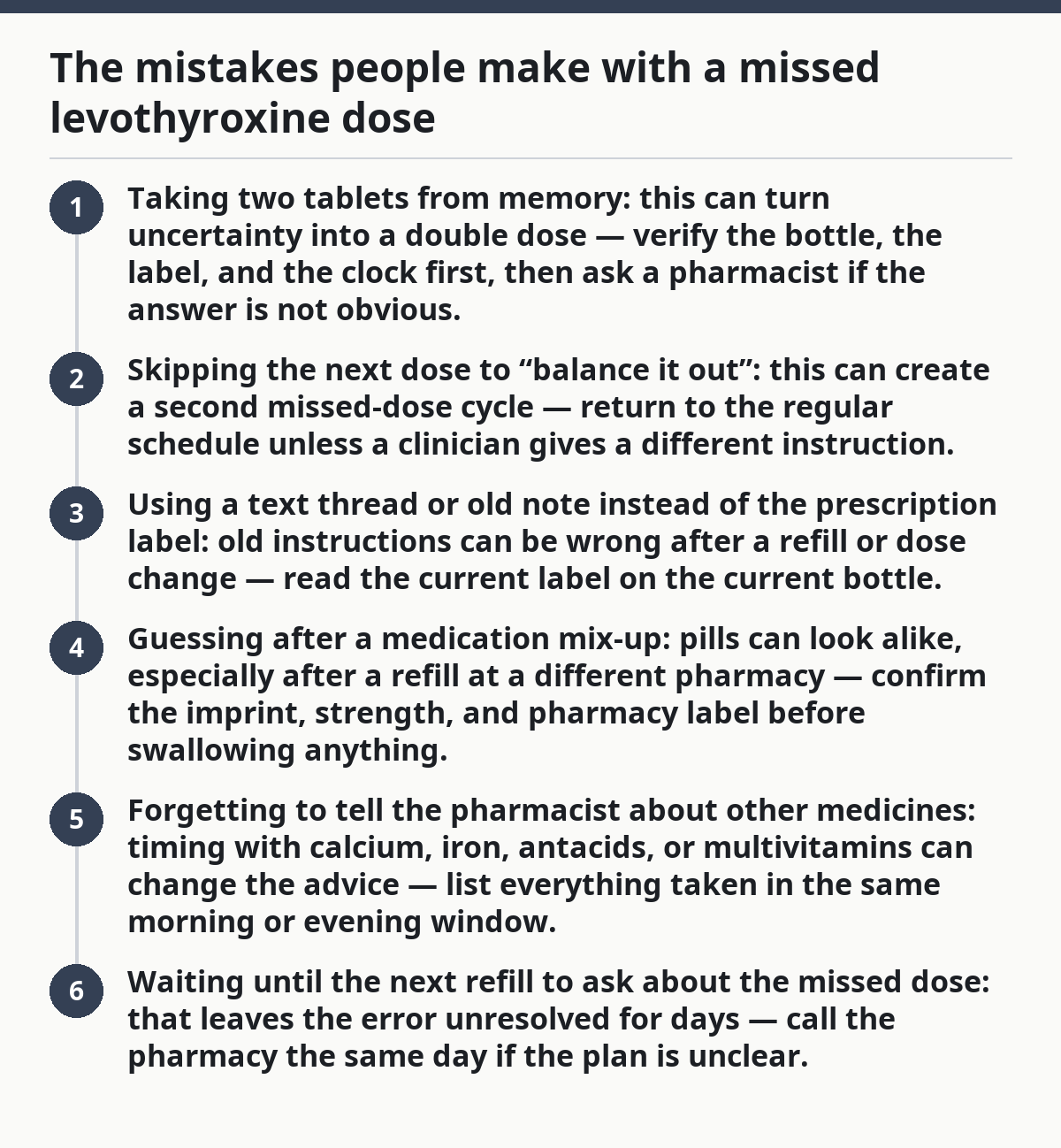
The cost of these mistakes is usually not dramatic after a single slip, but the pattern matters. Repeated errors can lead to weeks of inconsistent dosing, and then the real issue is no longer the one missed tablet. It is the unstable routine around it. That is why pill tracking matters more than willpower.
How to keep from missing the next dose
A missed dose is often a system problem, not a memory problem. The fix should be simple enough to survive a rushed morning and specific enough to be checked at a glance.
Use one pill tracker, not three. A paper calendar on the fridge, a phone reminder, or a pill organizer can each work, but mixing all three often creates confusion. If you use a weekly organizer, refill it on the same day each week and compare the compartment against the prescription label before the first dose of the day. If you use a phone reminder, set it for the same time every day and name it clearly, such as “Levothyroxine,” not “meds.”
The main figure that matters here is not a percentage; it is a routine interval. The fewer decision points between waking up and swallowing the tablet, the fewer chances there are to miss it. A 5-minute habit is easier to keep than a 30-minute ritual. Keep the bottle in one consistent place that matches the schedule you actually follow, and check off the dose immediately after taking it.
A good result is not perfection. A good result is knowing by noon whether the dose was taken, being able to prove it with a tracker, and not having to wonder again at night. If the routine still fails twice in 7 days, that is a sign the system needs revision with the pharmacist or clinician, not more guesswork.
What the evidence actually covers
The published literature around thyroid medication timing is not the same thing as a universal missed-dose rule. In the PubMed sample used for this article, review and systematic-review records were part of the mix, which means a lot of the accessible material is synthesis or discussion rather than direct, one-size-fits-all instruction.
That matters because people often want a single hard rule for a missed tablet. The evidence base is broader than that question. It includes timing, adherence, and regimen consistency, but the missed-dose decision still depends on the individual prescription, other medicines, and the reason levothyroxine was prescribed in the first place. A generic answer can be too blunt for someone with a narrow therapeutic margin.
The honest trade-off is this: the safer advice is less satisfying than a confident rule. It tells you to check the label, talk to a pharmacist, and consider your own regimen instead of just “taking two and moving on.” That is not indecision. It is the right kind of caution for a thyroid medicine. For authoritative patient guidance, see the NHS, MedlinePlus, and the American Thyroid Association.
When should I call my doctor after missing a dose?
Call your doctor when the missed dose is not a one-off or when your situation makes the usual advice less reliable. A single forgotten tablet is often handled with pharmacy guidance, but repeated misses, an unclear label, pregnancy, heart symptoms, recent thyroid treatment changes, or several missed doses in a row justify direct medical advice.
A same-day call is also sensible if you are unsure whether you already took the tablet, if a pharmacist cannot reconcile the instructions, or if your prescription recently changed strength. The goal is to avoid making a timing mistake into a dosing mistake.
Should I take two levothyroxine pills after missing a dose?
Not unless a qualified clinician or pharmacist has told you that this is the right plan for your prescription. A double dose may be inappropriate for some people, especially when the next dose is close or the treatment plan is unusual.
The safer first step is to check the label, confirm the timing, and ask for advice if the answer is not clear. If you already took two tablets by mistake, contact a clinician or pharmacist for guidance.
What happens if I forget my thyroid medicine?
A single missed dose usually does not turn into an emergency by itself, but it can disrupt your usual medication pattern.
Drafted with AI; not yet reviewed by a person.