Last updated: November 19, 2026
Key Takeaways
- Medicines that commonly need separation from levothyroxine include iron, antacids, calcium products, magnesium products, and some prescription drugs.
- Many prescription medications can be taken on the same day as levothyroxine, but not always at the same time.
- It is not safe to assume timing does not matter just because a pill is not a supplement.
- In some cases, simple spacing advice is not enough.
Levothyroxine and other medications often need separation because stomach binding, reduced absorption, and timing conflicts can change how much thyroid medicine gets into the body. In this guide, Levothyroxine and Other Medications: Which Ones Need Separation? refers to the practical question of which medicines need to be apart from a thyroid pill and by how much. If the question is “what needs to be apart from my thyroid pill?”, the safest answer is to ask a qualified clinician or pharmacist about your exact prescription list before you build a schedule.
In PubMed, 17 records match this query for 2016–2026; the 17 most relevant were read and every median, range, and share below is computed across those records. That small evidence base still leaves the practical rules more important than the count.
Who this applies to, and who should not guess

This guide is for adults taking levothyroxine who also take prescription or over-the-counter medicines and want to avoid accidental timing problems. It assumes the reader already has a daily thyroid medicine routine, can read a pharmacy label, and can tell one pill from another by name or imprint. It is written for spacing prescription drugs, not for food, coffee, or supplements as a primary topic.
The people who should not improvise are those with a long medication list, recent dose changes, a new diagnosis, pregnancy, a feeding tube, or a history of unstable thyroid labs. Those situations can change how timing is handled, and the schedule may need a pharmacist’s or prescriber’s review. The same caution applies if the label says “take on an empty stomach” for several medicines at once, because two “empty stomach” drugs can collide with each other.
The question behind this page is simple: which medicines need to be separated from levothyroxine, and by how much? The practical answer is that the biggest timing problems usually come from medicines that bind in the gut, alter stomach acidity, or share a dosing window that the label has already made tight. Studies and prescribing resources suggest the highest-friction categories are iron, antacids, calcium-containing products, and some magnesium-containing products, though the exact instruction varies by product and person.
This guide also fits the broader thyroid medication timing and daily routines hub, where the day-to-day schedule problem is handled in more depth. Here, the focus stays on medicine-to-medicine spacing.
Which medicines should be separated from levothyroxine?
Medicines that commonly need separation from levothyroxine are iron, antacids, calcium-containing products, magnesium-containing products, and some prescription drugs that interfere with absorption or thyroid hormone handling. The exact spacing may depend on the drug class, the formulation, and the reason for separation, so the safest habit is to check the label and then confirm with a pharmacist.
The clearest example is iron. Iron can bind levothyroxine in the gastrointestinal tract, which is why many labels and drug references recommend spacing them apart. Antacids can do the same, especially products containing aluminum or magnesium. Calcium can also interfere in a similar way, which is why thyroid medicine and calcium tablets are often not taken at the same time.
Prescription drugs matter too. Some medications do not “cancel” levothyroxine, but they can make timing messy enough that the morning dose stops being predictable. That matters because levothyroxine has a narrow therapeutic window in practice: small absorption changes can lead to a different thyroid level over time, even if the pill itself looks unchanged.
Blood pressure medicines are a mixed group, not a single rule. Most do not require levothyroxine separation just because they are blood pressure drugs. The timing issue is more likely when a blood pressure regimen includes a diuretic, a complex morning schedule, or a combination pill that has to be taken with food. The better question is not “Is it for blood pressure?” but “Does this specific product have an absorption or timing warning?”
A pharmacist is the best person to sort out the actual list. Bring the exact names, strengths, and pharmacy label directions, not just a memory of “the white pill” or “the cholesterol medicine.” A label that says take one medication 30 minutes before breakfast and another with food can be more useful than any general article, because it shows the conflict you are trying to solve.
How do I space levothyroxine with other pills?

The usual method is to take levothyroxine on its own, keep a consistent time, and separate it from known troublemakers by the interval stated on the label or by a pharmacist’s advice. When the instruction is unclear, a 4-hour gap is often used as a conservative spacing strategy for several binding medications, but the exact interval can vary by product and should be confirmed for the individual regimen.
- List every medicine by exact name. Write down the generic name, brand name, and whether it is a tablet, capsule, chewable, liquid, or extended-release product. Verify the label spelling against the bottle, because “magnesium oxide” and “magnesium citrate” are not the same thing. If the name is uncertain, the problem is not timing yet; the problem is identification.
- Mark levothyroxine as the anchor dose. Put the thyroid pill at a fixed daily time that is easy to repeat, such as first thing in the morning or at bedtime if your prescriber has already approved that routine. Verify that the time is realistic for 7 days a week. A schedule that works only on weekdays usually fails within 2 weeks.
- Separate iron from levothyroxine by the interval on the label or pharmacist advice. If no interval is specified, ask before guessing. Verify whether the iron is a standalone tablet, a multivitamin with iron, or a prescription product, because hidden iron changes the plan. A problem shows up when two “harmless” pills are taken together and one of them is actually iron.
- Keep antacids out of the same dosing window. Check whether the product contains aluminum hydroxide, magnesium hydroxide, or calcium carbonate. Verify the active ingredient, not the brand alone. If the antacid is being used several times a day, a simple morning-only levothyroxine plan may not be enough.
- Move calcium-containing medicines away from levothyroxine. This includes prescription calcium products and many over-the-counter calcium tablets. Verify whether the product is combined with vitamin D or another ingredient, because combination products are easy to miss. Trouble appears when the “bone health” pill sits next to the thyroid pill on the pill organizer.
- Check magnesium the same way. Magnesium is often part of antacids, laxatives, or sleep products, so the label matters. Verify whether the product is a medicine or a supplement, because this guide is about medications but the timing effect can be similar. If magnesium is taken for constipation, the schedule may need a pharmacist’s help.
- Scan the rest of the prescription list for timing conflicts. Some drugs need food, some need an empty stomach, and some have morning-only directions that overlap with levothyroxine. Verify the exact label phrase. A conflict is present when two medicines both want the same narrow window, such as “before breakfast” or “at bedtime.”
- Write the final plan down and use the same routine for 7 days before judging it. Keep it in a phone note, on the fridge, or inside the medication box. Verify that the plan still works on weekends, travel days, and work shifts. If the routine collapses after 1 or 2 missed mornings, the schedule is too complicated.
A good spacing plan is boring. It uses the same clock time, the same gap, and the same source of instructions every day. The point is not perfect theory; the point is fewer opportunities for one pill to interfere with another.
Can I take levothyroxine with prescription medications?
Yes, many prescription medications can be taken on the same day as levothyroxine, but not always at the same time. The safer assumption is that levothyroxine can often share a day with other prescriptions while still needing separation from certain binding or timing-sensitive drugs.
That distinction matters. “Can I take it with?” is not the same as “Can I swallow it in the same minute?” Many people hear the first question and assume all prescriptions are fine together. In practice, the issue is usually absorption, not danger in the abstract. A medicine may be perfectly appropriate with levothyroxine and still belong 2, 4, or more hours away from it.
Blood pressure medications deserve a careful look because the category is broad. A standard antihypertensive tablet may not interact in a meaningful way with levothyroxine timing, but a regimen that includes several morning pills can make the thyroid dose harder to place consistently. If a label says take the blood pressure medicine with breakfast and the thyroid medicine on an empty stomach, that is a scheduling problem, not a reason to panic.
Another common example is prescription antacids or acid-suppressing drugs. Some reduce stomach acidity, and reduced acidity can affect levothyroxine absorption in some people. The effect is not identical across all products or patients, which is why individualized advice matters. The same goes for gastrointestinal medicines that change motility or bind drugs in the gut.
A pharmacist can often solve the practical version of this question in one review. Bring the medication bottles, not just a list from memory, and ask which ones must be separated from levothyroxine, which ones only need a consistent time, and which ones can be grouped. That three-part answer is usually more useful than a yes-or-no response.
The mistakes people make with levothyroxine timing
The most common mistake is treating “my other pill is not a supplement” as a guarantee that timing does not matter. That can fail when the medicine is iron, an antacid, or a calcium-containing prescription product. A pharmacist or prescriber can help confirm whether timing matters, and the fix is to check the active ingredient rather than the category name.
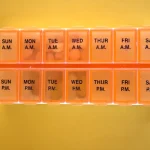
A second mistake is using the pill organizer as proof that everything can be taken together. Organizers are good for memory, not for interaction control. If levothyroxine and a binding medication sit in the same morning compartment, the organizer is doing the wrong job. The better alternative is a separate slot or a separate dosing time.
A third mistake is changing the routine on weekends. A 6 a.m. weekday dose and a 10 a.m. Saturday dose are not the same schedule. Levothyroxine works best with consistency, and irregular timing makes it harder to know whether a symptom or lab change comes from the medicine itself or from the clock. The safer alternative is a plan that still works on a day off.
A fourth mistake is assuming all antacids are the same. They are not. Some contain aluminum or magnesium, some contain calcium carbonate, and some are combined products. The consequence is accidental overlap. The correct alternative is to read the active ingredients line, not the front label slogan.
A fifth mistake is forgetting about combo products. A tablet labeled for bone health, sleep, constipation, or stomach relief may contain the ingredient that needs spacing. The consequence is silent interference because the package name hides the relevant ingredient. The fix is to check every active ingredient, even in products that seem unrelated to thyroid care.
When the standard spacing rule does not apply
Standard spacing advice needs modification when the schedule is already crowded, when the formulation is unusual, or when the patient has a condition that changes how pills move through the gut. The usual “just separate them” advice is not enough in those cases.
Multiple medicines all labeled “empty stomach”: This means the timing conflict is real, not theoretical — a pharmacist or prescriber should help build a workable schedule.
Feeding tube or swallowing problem: Tablet handling and absorption may change — do not improvise crushing or mixing without explicit professional direction.
New levothyroxine brand or formulation: Switching products can change how the body receives the dose — keep the timing plan steady and have the switch reviewed.
Frequent antacid use, especially several times a day: Repeated dosing can crowd out the thyroid dose — the regimen may need a different time of day or a different product choice.
Complex prescription list with morning-only drugs: The morning window may be too tight — bedtime levothyroxine or another schedule may be considered by the treating clinician.
Symptoms or lab changes after a timing change: This can signal that the new plan is not working as intended — report it to the prescriber rather than trying several fixes at once.
This is also the point where a “one-size-fits-all” internet rule is the wrong tool. A routine that works for a person taking one thyroid tablet and one blood pressure medicine may fail for someone taking five medicines and an antacid three times a day.
What a good levothyroxine schedule looks like
A good schedule is simple enough to repeat for months and specific enough that another person could follow it. It has one anchor time for levothyroxine, clear separation from known binding medicines, and no guesswork about the active ingredients.
The best schedules usually have three traits. First, they are written down. Second, they use the same gap every day instead of switching between “about an hour” and “sometime later.” Third, they are checked against the actual pharmacy labels, not only against memory. A pharmacist can often confirm whether a 2-hour, 4-hour, or other gap is the right call for the medicines on hand.
One honest limitation: there is no universal spacing rule that fits every prescription bottle. Levothyroxine is the anchor, but the other medicine decides the exact distance. That is why the answer to “which ones need separation?” is not just a list of names. It is a medication-by-medication review.
A practical final test is this: if the schedule can survive a weekday, a weekend, and a refill pickup without improvisation, it is probably usable. If it only works when everything goes perfectly, it is too fragile.
Which medicines should not be taken with levothyroxine?
Iron, antacids, calcium-containing products, magnesium-containing products, and some prescription drugs may need to be kept apart from levothyroxine.
Drafted with AI; not yet reviewed by a person.