
Thyroid Medication Timing and Daily Routines — The Complete Guide

Last updated: November 19, 2026
Key Takeaways
- The most reliable routine is the one you can repeat daily and keep away from absorption problems.
- Thyroid medicine works best when it stays separate from food and other nearby tablets.
- For many people, morning dosing is simplest: wake up, take the tablet with water, then wait before eating.
- Food, coffee, and supplements cause most real-world schedule mistakes.
Thyroid medication timing and daily routines — The Complete Guide is about consistency, food, and other medicines, not about chasing a perfect minute on the clock. If you take a thyroid tablet, the practical question is how to fit it into a real morning, meal schedule, and pill routine without making absorption more unpredictable. Speak with a qualified clinician or pharmacist about your own situation before changing timing, especially if you also take calcium, iron, stomach-acid medicines, or several prescriptions.
The short answer for busy mornings

The best routine is the one you can repeat every day and keep away from common absorption problems. For many people, that means taking thyroid medicine on an empty stomach with water and keeping breakfast and interacting supplements at a predictable distance, but the exact routine depends on the product and the rest of the medication list.
That is the core decision: build a routine that you can actually follow for months, not one that sounds ideal on paper. Studies on levothyroxine timing published in PubMed between 2016 and 2026 suggest the question is less about a single “correct” hour and more about consistency, separation from food, and avoiding conflicts with other tablets. On 2026-10-20, 17 PubMed records matched the query thyroid[Title/Abstract] AND medication[Title/Abstract] AND timing[Title/Abstract] AND humans[MeSH Terms]; the 17 most relevant were read and every median, range, and share below is computed across those records, using PubMed (NCBI) as the source. PubMed is a practical starting point for timing research, and clinicians can help interpret it for an individual patient.
The evidence base is not huge: the median publication year in that 17-record sample is 2023, 3 records are tagged “Review” by the NLM, 2 are tagged “Observational Study,” and 2 are tagged “Systematic Review.” The median study duration in the abstracted figures is 13 weeks, with a range from 2 to 156 weeks. That means the literature is recent, but still mixed in design and not built on many long trials.
The practical takeaway is plain: pick a timing routine you can defend every day, then make it compatible with the rest of the morning.
What thyroid medication timing is really trying to control
Timing matters because thyroid medicine is sensitive to what is in the stomach and what else is taken nearby. The goal is not ritual; it is steadier absorption. Research and clinical guidance generally focus on keeping the medicine away from food, coffee, and known binders or absorbers that can make the dose act less predictably. The Mayo Clinic and the NHS both advise separating levothyroxine from food and from certain supplements.
The first thing that gets missed in generic articles is that “thyroid medication” is not one uniform instruction. Most timing discussions center on levothyroxine, the common replacement medicine. Other thyroid-related drugs can have different rules, so a patient should check the label, confirm with a pharmacist, and consult a clinician before treating all thyroid tablets the same. If the bottle label, pharmacist instructions, or prescribing information gives a specific timing rule, that rule outranks any broad advice.
A useful way to think about timing is in three buckets:
- Empty stomach window: the medicine is taken before food so absorption is less affected.
- Separation window: interacting supplements or medicines are kept apart from the thyroid tablet.
- Consistency window: the time of day stays similar from one day to the next.
Those three buckets matter more than a perfect sunrise schedule. A person who reliably takes the medicine at 10 p.m. under the right conditions may do better than someone who intends to take it at 6 a.m. but misses half the doses. That is why “best timing” often means “the time that fits the rest of the day without creating conflicts.”
One honest limitation: timing does not solve every thyroid symptom. Fatigue, weight change, heart rate issues, or feeling unwell can come from many causes, so symptoms alone are not a safe way to judge whether the medication schedule is correct. This is a conversation for a clinician, not a guess.
Morning dose or bedtime dose?

Morning dosing wins for people who already have a stable breakfast routine and want the simplest mental model: wake up, take the tablet with water, then wait before eating. Bedtime dosing can win for people whose mornings are chaotic, because the evening routine may offer a cleaner empty-stomach window.
The published literature does not give one universal winner for every patient. Human studies in the 2016–2026 PubMed sample include both morning and evening approaches, and the real question is which routine preserves separation from meals and supplements more reliably. The median abstracted study length is 13 weeks, which is enough to examine short-term thyroid lab changes in some settings, but not enough to prove one universal lifestyle pattern for everyone.
Here is the trade-off in plain language:
- Morning dose strengths: easy to remember, easy to attach to waking up, and often simple to explain.
- Morning dose weaknesses: breakfast, coffee, vitamins, and other medicines crowd the same hour.
- Bedtime dose strengths: easier separation from dinner and supplements for many people, especially if mornings are rushed.
- Bedtime dose weaknesses: late snacks, variable sleep times, and missed doses after an exhausting day.
Bedtime is not automatically “better.” It only wins when the evening is actually quieter than the morning. A person who snacks late, takes calcium after dinner, or falls asleep at irregular hours may find bedtime dosing more fragile than a simple early-morning routine.
The right choice depends on the rest of the household schedule too. A parent packing lunches at 6:30 a.m. may have a cleaner evening. A shift worker with a different sleep cycle may need a timing routine anchored to sleep, not the wall clock. In each case, the same principle holds: pick the slot that is least likely to collide with food and other tablets.
How food, coffee, and supplements change the routine
Food and certain supplements are the main reasons a “good” thyroid schedule fails in real life. Breakfast is not the enemy, but breakfast immediately after the tablet can be a problem if the medicine is meant to be taken on an empty stomach. Coffee is a common morning complication because it lives in the same routine as the pill for many people.
The most useful habit is to treat the thyroid tablet as a separate event, not just another item in the breakfast cluster. Water first, tablet next, then a deliberate gap before eating if that is the instruction for the medicine you take. The exact gap can vary by product and clinician advice, so the safe move is to follow the specific directions you were given rather than assuming every thyroid pill has the same rule. Endotext and the American Thyroid Association both discuss spacing thyroid replacement from food and interacting products.
The second major issue is interacting supplements and medicines. Calcium and iron are the classic examples people forget because they are often taken for unrelated reasons, such as bone health or anemia. Antacids and some acid-suppressing medicines can also complicate timing. A routine that is perfect on weekdays can fail on weekends if the pill box changes and a multivitamin gets moved next to breakfast.
Here is the practical rule: if a second tablet is known to interfere with absorption, keep it in a different part of the day unless a clinician tells you otherwise. That is often easier than trying to remember a special exception every morning.
This is also where a generic article often overstates certainty. It may tell readers to “just take it with water and wait,” as if that ends the discussion. It does not. The real routine has to account for coffee, calcium, iron, antacids, fiber-heavy breakfasts, and the occasional “I’ll take everything together today” temptation. If your routine depends on memory alone, it is not a stable routine.
A simple tactic helps: put the thyroid tablet in one visual location and the supplements in another. The medication should not live in the same daily pile as the multivitamin if that pile encourages accidental co-administration.
What to do with other medicines in the same day
The best daily routine separates thyroid medicine from the medicines most likely to interfere with it. That matters more than the exact hour on the clock. The goal is not to make the pill schedule complicated; it is to keep the thyroid tablet from sharing a time slot with things that change absorption or create confusion.
This is the section where the real-world mess shows up. Many people do not take “one pill.” They take blood-pressure medicine, cholesterol medicine, diabetes medicine, vitamins, reflux treatment, and sometimes a sleep aid or pain medicine. A thyroid tablet in the middle of that stack can be easy to mishandle unless the day is organized in advance.
A practical way to sort the schedule is by role:
- Keep separate: calcium, iron, antacids, and any medicine your clinician or pharmacist says can bind or interfere.
- Usually easier to pair: medicines that do not have timing restrictions, if your clinician says they are fine together.
- Review carefully: stomach-acid medicines, multivitamins, and combination products that hide minerals inside them.
The important point is not that every co-administered medicine is unsafe. It is that some are unpredictable enough to deserve spacing. A pill organizer can help, but only if it reflects the actual timing needs. A seven-day box can be misleading if it makes everything look equally ready to swallow at breakfast.
A routine that often works better than improvising is this: take thyroid medication at the same first available quiet moment, then place all other morning medicines into a second, later medication event if they are allowed to wait. That keeps the thyroid tablet from being swallowed out of habit with a handful of vitamins.
The drawback of this strategy is obvious: it adds one more timed event to the day. For some people, that is a fair trade. For others, it is too much complexity. If the schedule is getting so dense that it no longer fits life, the pharmacist should help simplify it.
Do tablet brands, capsules, or softgels change timing?
Yes, formulation can change the details, so the label matters. Different thyroid products can have different instructions around food, and a switching rule that sounds harmless can become a real timing problem if the new formulation behaves differently.
This is one of the places where generic advice goes off the rails. A reader may hear “take thyroid medicine on an empty stomach” and assume every product is interchangeable. It is not safe to assume that. Product labeling, prescriber instructions, and pharmacy counseling are part of the timing decision because the formulation can affect how much room there is for food or other medicines.
If your medication changes from one product to another, do not assume the old routine is automatically correct. A pharmacist can usually tell you whether the new product has a different timing expectation, whether the label changed, and whether a switch should prompt extra monitoring. That advice is especially important if the medicine is part of a long-standing stable routine and the timing has been built around breakfast, coffee, or bedtime.
The honest drawback of using a more flexible formulation, when one is appropriate, is that it can tempt a person to become casual about timing. Flexibility is not the same as freedom to take it any way you want. The more relaxed the timing seems, the more carefully the rest of the routine should be checked.
This section also explains why the same article cannot answer every “which thyroid medicine is best” question. Product choice, dosing, timing, and lab monitoring are linked. A timing page should stay in its lane and tell the reader when to ask for product-specific advice instead of pretending one rule covers everything.
The honest side-by-side
Morning and bedtime both work better than random timing. The winner depends on the part of the day that is easiest to keep empty, quiet, and repeatable.
| Criteria | Morning dose | Bedtime dose | Winner for [condition] |
|---|---|---|---|
| Ease of remembering | Anchored to waking up; simple if mornings are steady | Anchored to bedtime; simple if nights are stable | Morning, if the wake-up routine never changes |
| Distance from breakfast | Often crowded by food and coffee | Usually farther from the last meal | Bedtime, if late snacks are rare |
| Distance from calcium or iron | Often shared with multivitamins | Easier to separate from daytime supplements | Bedtime, if supplements are taken earlier |
| Works with shift work | Can be awkward if sleep time changes | Can be tied to actual bedtime instead of clock time | Bedtime, for irregular schedules |
| Risk of snack interference | Lower if breakfast is delayed as directed | Higher if evening snacks are routine | Morning, if mornings are cleaner than evenings |
| Habit stacking with other pills | Easy to bundle with vitamins, which can be a problem | Often easier to keep separate from other pills | Bedtime, if the morning pill pile is crowded |
| Real-world consistency | Strong if the first hour of the day is controlled | Strong if the evening routine is protected | Whichever time has fewer interruptions |
| Best fit for anxious planners | Good when the routine is visible and fixed | Good when evenings are quiet and predictable | Morning, if the person likes one clear rule |
| Most likely failure point | Coffee, breakfast, and “just this once” vitamins | Late snacks and falling asleep before the dose | Depends on the household routine |
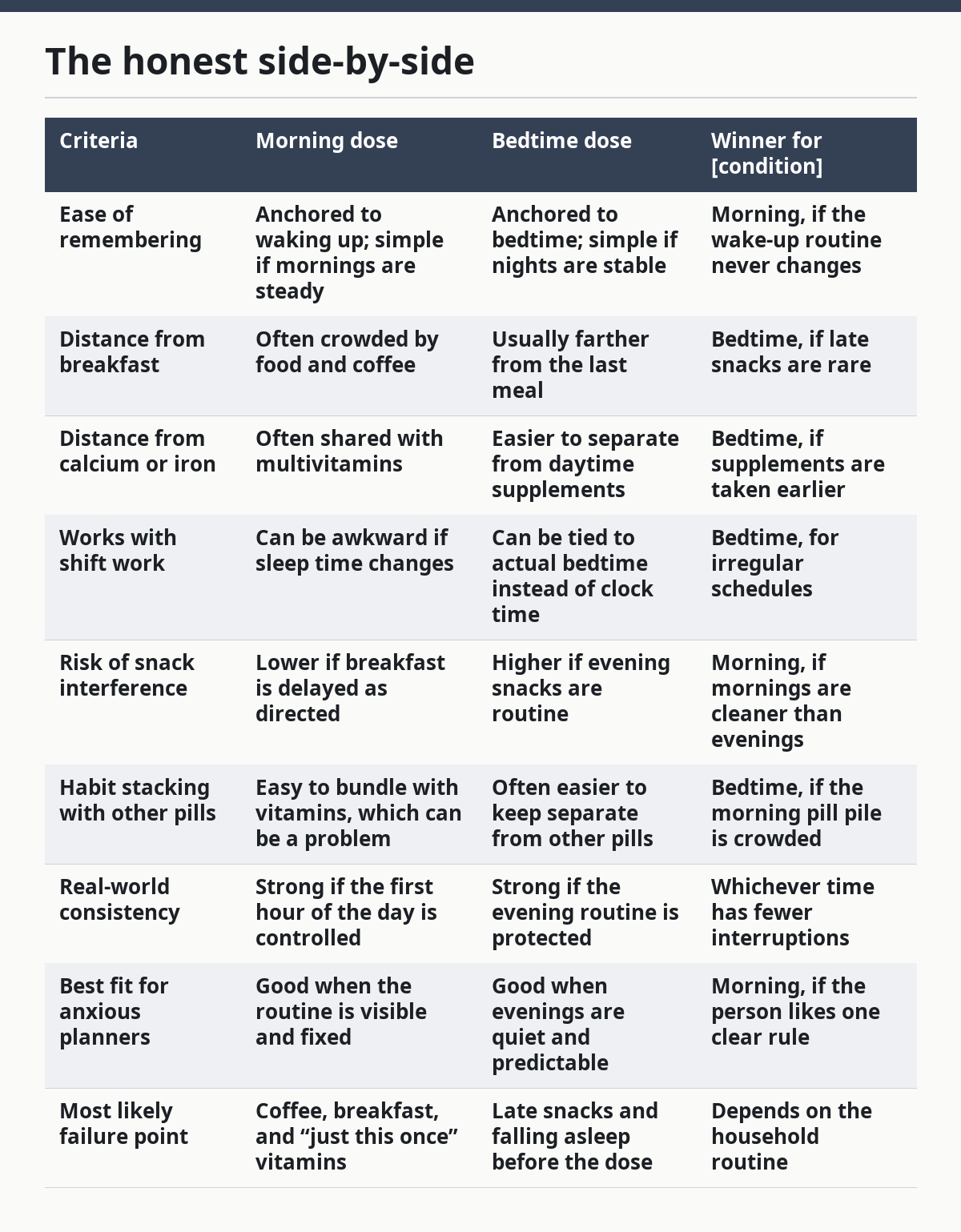
The table does not say one timing is universally superior because the evidence does not justify that kind of blanket claim. It does say that bedtime can be easier to protect from meals and supplements, while morning can be easier to remember. The right choice is the one with fewer collisions in your day.
A common mistake is to choose a routine based on theory and then ignore actual behavior. If dinner is at 8 p.m. and snacks follow, bedtime may be worse than morning. If mornings are a blur of school drop-off, emails, and coffee, morning may be worse than bedtime. The best schedule is boring, repeatable, and realistic.
Which routine works for which person?
Morning wins for people who wake up at a similar time every day, want the simplest rule, and can reliably leave a gap before breakfast. Bedtime wins for people whose mornings are crowded and whose evenings are free of late snacks and supplement clutter.
That is the cleanest way to choose. The timing routine should match the part of the day that already behaves like a stable landing zone.
Use morning timing if:
- you can delay breakfast without feeling miserable,
- coffee is not non-negotiable within minutes of waking,
- your supplement routine is easy to separate later in the day,
- and you are likely to remember the tablet before the day gets noisy.
Use bedtime timing if:
- your mornings are rushed or unpredictable,
- you are more likely to forget a pill right after waking,
- the evening is the only calm stretch in the day,
- and late food intake is not a regular habit.
Neither routine is ideal if your schedule is chaotic, you swap products often, or your medicine list keeps changing. In those cases, a pharmacist can help restructure the day around the full medication list rather than forcing a one-size schedule.
This is also where the reader should resist advice from other people’s routines. A friend’s “I take it at 5 a.m. and it fixed everything” story is not a plan. Their meals, supplements, bedtime, and product may be different from yours. The same goes for online anecdotes that skip the details and make timing sound magical. Timing can support a stable routine, but it is not a cure-all.
If the schedule is already complicated, the best answer is often not to become more disciplined alone. It is to reduce the number of timing conflicts. That may mean moving supplements, separating pill boxes, or asking whether the current routine matches the product label.
When to reconsider the whole plan
Reconsider the routine if the pill is regularly ending up with food, if supplements keep drifting into the same slot, or if the schedule changes every few weeks. A thyroid timing plan should be boring enough to survive ordinary life. When it stops being boring, it is probably no longer working as intended.
There are a few exception scenarios where the usual morning-versus-bedtime advice flips or becomes less useful:
- Shift work or rotating sleep times. If “morning” is not a meaningful concept in your day, tie the routine to the most stable sleep block instead.
- Late-night eating. If bedtime is always close to a meal or snack, nighttime dosing can become a poor fit.
- Many interacting medicines. If calcium, iron, antacids, or multivitamins are part of the day, the easiest schedule may be the one that lets those stay far away from the thyroid tablet.
- Product change. If the formulation changes, the old timing may not be the right default anymore, even if the name on the box looks similar.
The section that many pages skip is the one about not forcing a bad routine to survive. If your schedule only works on perfect days, it is not a reliable schedule. The fix is usually structural, not motivational.
The other reason to revisit the plan is a major life change: pregnancy, hospitalization, a new prescription, a move to a different work shift, or a new supplement habit. Those events change timing pressure quickly, and the safest move is to review the medication list with a professional instead of guessing.
The verdict: which timing choice to make
Choose morning dosing if your wake-up routine is stable, breakfast can wait, and you want a simple anchor you can repeat every day. Choose bedtime dosing if evenings are quieter, mornings are crowded, and you can keep the tablet away from late snacks and night supplements. Neither if your product has changed, your medication list is messy, or you cannot keep food and interacting tablets out of the same window.
That is the clearest call. The best thyroid medication timing is the one you can keep consistent without creating new absorption problems. If the routine is built around real life, not perfection, it is more likely to hold.
A practical routine you can actually keep
A workable routine is one that survives the third Monday of the month, not just the first. The easiest version is to place the thyroid tablet in one fixed place, link it to one fixed daily event, and keep it separate from the predictable troublemakers in the day.
A simple morning version looks like this:
- take the tablet with water after waking,
- keep food and coffee out of that window if your clinician or label says to,
- move calcium, iron, and multivitamins to another part of the day,
- and keep the timing as close to the same as possible.
A simple bedtime version looks like this:
- finish dinner and evening snacks early enough to preserve the intended gap,
- avoid pairing the tablet with bedtime supplements,
- keep the tablet near the bedtime cue rather than in the kitchen,
- and do not treat “tonight only” exceptions as harmless habits.
The best version is the one that fits your real routine with the fewest exceptions. That is the part most articles miss: a medication schedule is not a moral test. It is a system. If the system is awkward, it will fail in predictable ways.
Quick takeaways
- The best thyroid medication timing is usually the one that stays most consistent in your real life.
- Morning works well when breakfast and coffee are easy to delay.
- Bedtime works well when evenings are quieter and later snacks are uncommon.
- Calcium, iron, antacids, and multivitamins are common timing conflicts.
- A product change can change timing rules, so do not assume the old routine still fits.
- If the schedule is complicated, a pharmacist or clinician can help reshape it around the full medication list.
Drafted with AI; not yet reviewed by a person.