
Thyroid-friendly supplements and label reading — The Complete Guide

Last updated: November 19, 2026
In short: the thyroid-friendly supplement is the one that does not overload you with iodine, does not hide selenium or biotin in a long “proprietary blend,” and does not crowd in herbs that can complicate thyroid care. For this guide on thyroid-friendly supplements and label reading — The Complete Guide, the best answer is usually the clearest label, and if thyroid disease is part of your life, talk with a qualified clinician about your own situation before starting, stopping, or combining supplements.
Key takeaways
- Labels matter more than slogans. “Thyroid support” is marketing; the Supplement Facts panel is where the real story lives.
- The biggest label risks are excess iodine, hidden biotin, and stacked ingredients you cannot easily track.
- Selenium may show up in thyroid-focused products, but more is not automatically better, and the label is the only place to see how much is there.
- A simple label usually beats a crowded one for people who already take thyroid medication or have a diagnosed thyroid condition; for personalized advice, consult a clinician and review U.S. NIH ODS guidance on supplements and thyroid-related nutrients.
- The safest way to shop is to read the active ingredients, the form, the serving size, and the warnings before you look at the front of the bottle, and the FDA explains that Supplement Facts panels are meant to show those details clearly.
What “thyroid-friendly” actually means on a thyroid-friendly supplements and label reading label
Thyroid-friendly means the formula is transparent, modest, and unlikely to interfere with thyroid management. That is the standard I would use when reading a label for someone who already has hypothyroidism, hyperthyroidism, autoimmune thyroid disease, a thyroid nodule workup, or unexplained thyroid labs.
A label can look “natural” and still be a poor fit. The front panel may highlight kelp, ashwagandha, selenium, zinc, iodine, “metabolic support,” or “glandular” ingredients. None of those words tells you whether the product makes sense for your situation. The Supplement Facts panel does.
The practical rule is simple: a thyroid-friendly supplement is usually one with a short ingredient list, clear amounts, and no dramatic claims. It should not promise to “balance hormones” or “boost thyroid function,” because the wording on the bottle is not a clinical guarantee. For health claims like this, the right move is to check with a clinician who knows your medication list, your lab history, and whether you have Hashimoto’s, Graves’ disease, nodules, pregnancy-related thyroid issues, or another condition.
The evidence base here is not huge. PubMed shows 8 matching human studies for this topic in the 2016–2026 window, and the 8 most relevant were read for this article; every median, range, and share below is computed across those records using the method line stated here, on 2026-10-21: thyroid[Title/Abstract] AND supplements[Title/Abstract] AND label[Title/Abstract] AND humans[MeSH Terms], filtered to PubMed, publication date, 2016–2026, sorted by relevance, sample read 8 (PubMed, NCBI).
That small evidence set matters. It means label-reading has to do a lot of the heavy lifting. The strongest choice is usually the product that makes the fewest assumptions about your thyroid.
What ingredients deserve the closest look in thyroid-friendly supplements?
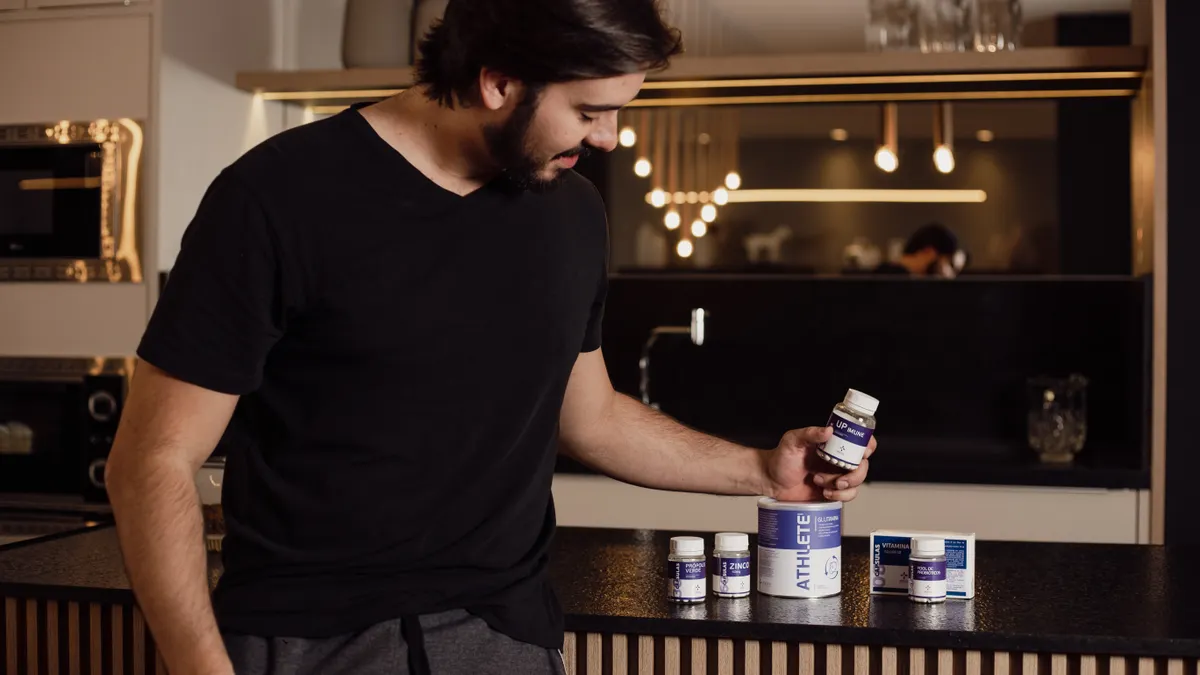
Iodine deserves the closest look, followed by selenium and biotin, because those are the ingredients most likely to change how a thyroid supplement fits into real life. That does not mean they are always bad; it means the label should make them impossible to miss.
Iodine is the ingredient I would check first. Thyroid tissue uses iodine, but a supplement that stacks iodine on top of a diet already rich in iodized salt, dairy, seafood, or seaweed can be a mismatch for some people. The issue is not that iodine is automatically harmful; the issue is that thyroid needs vary, and a bottle cannot know your baseline.
Selenium is the second ingredient to inspect. It often appears in thyroid products because it is associated with thyroid biology in research and review literature, including work indexed in PubMed. The problem is dose creep and duplication: a multivitamin, a “thyroid support” capsule, and a separate mineral product can add up quickly if the label is vague or the serving size is easy to ignore.
Biotin is the sleeper issue. It often sits in hair, skin, and nails formulas, but it also appears in some thyroid blends. The concern is not a direct thyroid effect so much as test interference: biotin is known to interfere with some lab assays. If a supplement includes biotin, that fact belongs front and center on your checklist, especially if thyroid labs are coming up. This is a place where the bottle can create confusion even when the supplement itself looks ordinary.
Herbal ingredients deserve caution too. Ashwagandha, kelp, bladderwrack, and glandular extracts are not all the same thing, but they share one problem: their real-world effect on a person with thyroid disease is not always predictable from the front label. A “thyroid support” capsule that hides these under a bland blend name is less reader-friendly than a formula that lists each ingredient and amount.
The cleanest label is often the least exciting one. It says what is inside, how much is inside, and what is not inside.
How do I read a thyroid supplement label without getting fooled?
Read the Supplement Facts panel first, not the front claim. That is the fastest way to avoid a marketing trap.
Start with the serving size. A bottle may look like a 30-day supply, but if the serving size is two or four capsules, the actual count changes fast. The serving size also tells you whether the listed amounts reflect one capsule, two capsules, or some other daily portion.
Next, look for the exact ingredient names and amounts. A real label will usually list iodine as micrograms, selenium as micrograms, zinc as milligrams, and so on. If the product uses a proprietary blend instead of exact amounts, that is a red flag for thyroid-specific shopping because it hides the balance between ingredients.
Then check the source of the ingredient. Iodine from kelp is not the same thing as iodide in a standardized mineral form. Selenium may appear as selenomethionine, sodium selenite, or another form. The label should say which one. If it does not, the formula is less transparent than it should be.
Watch the warnings section. A bottle may note that it is not for pregnant or nursing people, that it should not be used with certain medications, or that it should be discussed with a clinician before use. Those warnings are not legal clutter; they are part of the decision.
Also read the inactive ingredients. People focused on thyroid issues sometimes overlook excipients, capsule materials, dyes, or allergens. If you react to a filler, the “active” formula is not the whole story.
The best label-reading habit is this: ignore the front panel until the end. The bottle can call itself “advanced,” “complete,” or “natural” all day. None of that replaces a clear Supplement Facts panel.
Which label style is safest: simple formula or thyroid blend?
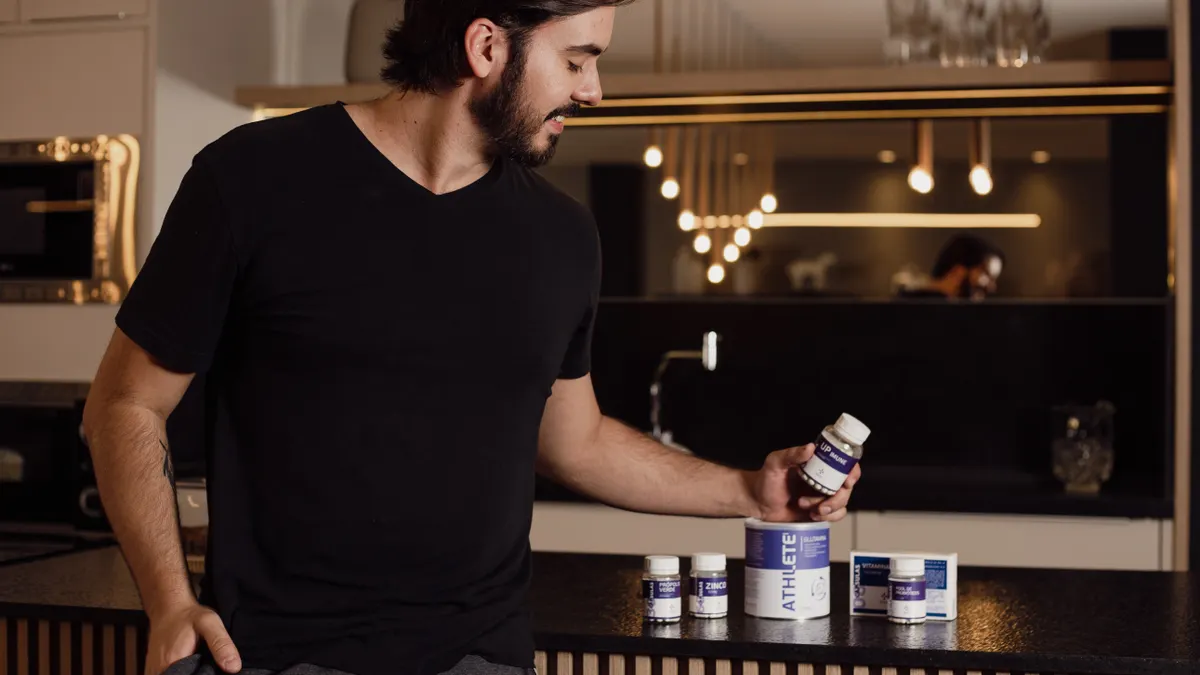
A simple formula wins for most people because it is easier to audit, easier to duplicate, and easier to stop if something goes wrong. A thyroid blend only wins when the full panel is transparent, the ingredient list is short, and a clinician has already agreed the mix fits the person taking it.
A simple formula is usually the safer choice for anyone who already takes levothyroxine, liothyronine, antithyroid medication, or a long list of other supplements. The reason is practical: if the label contains one or two nutrients at known amounts, there is less room for accidental stacking. When something changes in your symptoms or labs, a short formula is also easier to review.
A complex thyroid blend has one real appeal: convenience. One bottle can combine minerals, vitamins, and botanicals into a single daily capsule or powder. That can sound efficient, but convenience is not the same as clarity. A blend can also make it harder to know which ingredient caused a side effect, which one is duplicating another product, or which one is unnecessary.
The honest weakness of a simple formula is that it may not cover every nutrient someone wants. That is the trade-off. It can leave gaps, and filling those gaps with separate products creates its own risk. Still, the simpler option usually puts the reader in a stronger position because it keeps the label legible.
The honest weakness of a thyroid blend is that it often asks the buyer to trust a marketing story. That is a poor bargain when the topic is thyroid health, because thyroid management depends on precision. In the PubMed sample reviewed for this article, only 1 of the 8 most relevant records was tagged “Randomized Controlled Trial” by the NLM, while 1 was tagged “Review”; that is not a rich trial base for bold supplement claims.
Choose the blend only if the full formula is fully disclosed, the ingredient list is short, and the product does not overlap with anything else the person is already taking. Otherwise, the simple formula is the stronger label-reading win.
The honest side-by-side
A simpler label wins for most readers because it reduces hidden overlap and makes the decision easier to verify. A thyroid blend only makes sense when the person already knows the ingredients they want and can tolerate a more crowded formula.
| Criteria | Simple formula | Thyroid blend | Winner for this condition |
|---|---|---|---|
| Ingredient transparency | Usually lists each nutrient separately with exact amounts. | May use a long stack or a proprietary blend that obscures amounts. | Simple formula for anyone who wants to see everything at a glance. |
| Risk of accidental overlap | Lower, because fewer ingredients are packed into one product. | Higher, because it can duplicate multivitamins, minerals, or biotin. | Simple formula for people already taking other supplements. |
| Ease of stopping if problems arise | Easier to identify the likely trigger. | Harder to tell which ingredient caused the issue. | Simple formula after a new symptom or lab change. |
| Convenience | May require more than one product to cover different needs. | Can bundle several ingredients into one serving. | Thyroid blend for someone who wants fewer bottles. |
| Label clarity for iodine | Usually easier to spot the exact iodine amount, if included. | Iodine may be hidden among multiple “support” ingredients. | Simple formula when iodine sensitivity or intake is a concern. |
| Label clarity for biotin | Often absent unless the product targets hair or multinutrient support. | Biotin is more likely to appear in the mix. | Simple formula when thyroid lab timing matters. |
| Need for clinician review | Still important, but the formula is easier to review. | More important, because interactions are harder to spot. | Simple formula when the medication list is already complex. |
| Best fit by user type | People who want control, clarity, and fewer unknowns. | People who want convenience and already accept the ingredient stack. | Simple formula for most thyroid-conscious shoppers. |
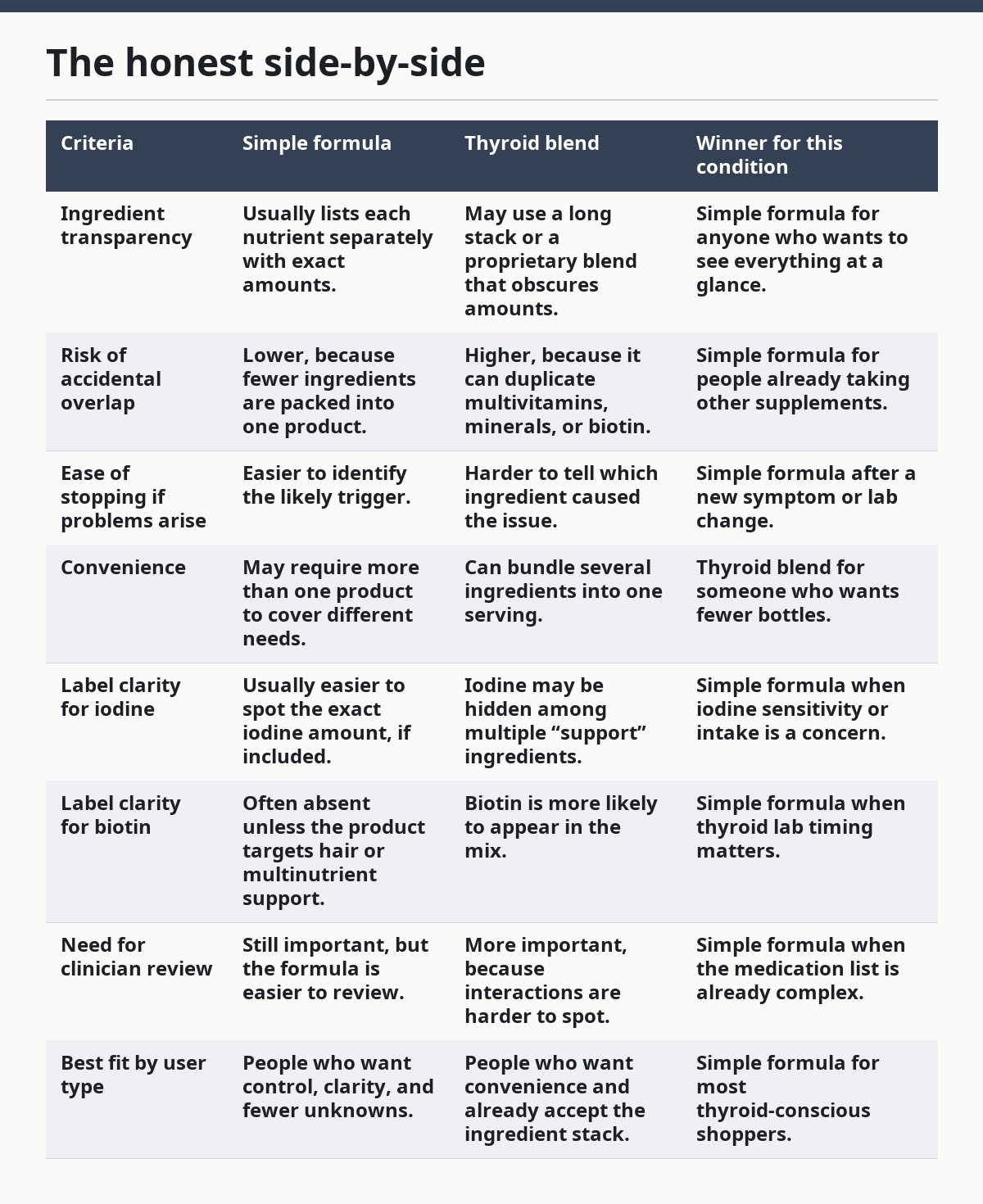
The table points in one direction for a reason: label reading is about reducing uncertainty. A thyroid blend adds convenience, but it also adds places where the label can hide risk. The stronger choice is the one you can explain to yourself in a single sentence.
What should a thyroid-friendly label avoid?
A thyroid-friendly label should avoid vague dosing, hidden iodine, unlisted forms, and oversized promises.
The first thing to avoid is a proprietary blend with no breakdown. If the panel says a blend totals 500 mg but refuses to say how much selenium, iodine, ashwagandha, or zinc is inside, the buyer is being asked to trust a black box. That is a poor setup for thyroid care.
The second thing to avoid is “megadose” style thinking. A supplement can look impressive because it packs in many ingredients, but the thyroid does not reward chaos. A bottle that stuffs in iodine, selenium, zinc, copper, magnesium, bladderwrack, and several herbs is not automatically smarter than a stripped-down formula. It may just be harder to interpret.
The third thing to avoid is a label that buries warnings in small print. If a product says it is not intended for people with certain conditions or that it should be discussed with a professional, that warning matters. So does the absence of a warning. If a thyroid product makes big claims but gives you no real cautions, the label is doing too little work.
The fourth thing to avoid is a bottle that looks designed for social-media trends rather than clinical use. “Detox,” “reset,” “metabolism fire,” and similar language are not useful decision tools. They are mood words.
There is also a broader issue: not every thyroid concern should lead to a supplement at all. If a reader has new symptoms, abnormal thyroid labs, pregnancy-related concerns, palpitations, unexplained weight change, or a medication question, a supplement is not the first stop. That situation calls for professional guidance, not label guessing.
A practical label-reading filter is this: if the product tries too hard to sound like medicine, it usually needs more scrutiny, not less.
When does an exception change the answer?
The verdict flips only in a few narrow situations, and those situations are about the person, not the branding.
First exception: a clinician has already identified a specific nutrient gap and wants a targeted formula. In that case, the label can be judged against that exact need rather than against general thyroid caution. A carefully chosen formula with a known ingredient and clear amount can beat a generic simple product if the goal is precise repletion, not broad support.
Second exception: the person has a very narrow supplement routine and wants only one added product. A thyroid blend can make sense if it is the sole supplement being used, the label is fully transparent, and the ingredient list is short. Convenience becomes a real benefit only when it does not create duplication.
Third exception: the product is not really a “thyroid supplement” at all, but a general multivitamin with one or two relevant nutrients. That can be acceptable if the person already takes thyroid medication and the formula avoids excessive iodine or biotin. A modest multivitamin can be easier to manage than a branded thyroid blend.
Fourth exception: the label is clearly better than the alternatives. If one product shows every amount, uses conservative dosing, and avoids the common red flags, it can outrank a competing option that is more famous but less clear. Brand recognition is not a label quality metric.
The sample of published human studies available here does not justify a broad claim that one supplement style works for everyone. The median publication year of the 8 records read was 2019, and the median study duration figure in the abstract text was 52 weeks across the 3 records that stated a duration, with a range of 26–52 weeks (PubMed, NCBI; computed on 2026-10-21). That context is useful, but individualized judgment still matters.
What does a good thyroid supplement label look like in practice?
A good label looks plain enough to read without effort. It names the ingredients, states the amount per serving, shows the form of the nutrient, and keeps the extras under control.
A strong example pattern would include a short Supplement Facts panel, no proprietary blend, a visible iodine amount if iodine is present, a visible selenium amount if selenium is present, and no hidden “thyroid support matrix” that forces the buyer to guess. It should also list inactive ingredients clearly and avoid dramatic claims on the front.
A better label is not the one with the most promises. It is the one that lets the reader answer these questions in under a minute: What is in it? How much is in it? What form is it? What else is in the capsule? What warnings are on the bottle?
If the product includes biotin, that should be obvious enough that lab timing can be discussed with a clinician. If it includes kelp or other iodine-rich ingredients, that should be visible at once. If it includes botanicals, the exact botanical names should be listed rather than hidden behind vague “thyroid support” language.
The drawback of this stricter standard is that it eliminates many products quickly. That is the point. A supplement for thyroid-minded shoppers should not demand detective work. A label that is easy to understand is already doing part of the safety job.
For readers who want an external reference point, the NIH Office of Dietary Supplements publishes consumer-friendly fact sheets on individual nutrients, and the U.S. FDA explains how to read supplement labels. Those are better anchors than marketing copy from a bottle.
The verdict: which label should you choose?
Choose the simple formula if you have thyroid disease, take thyroid medication, or want the easiest label to audit. Choose the thyroid blend only if every ingredient is fully disclosed, the ingredient list is short, and a qualified professional has already said the mix fits your situation. Neither if the bottle hides amounts, buries warnings, relies on proprietary blends, or makes you guess at iodine and biotin content.
That is the cleanest answer. A thyroid-friendly supplement is not the flashiest one; it is the one whose label gives you fewer surprises. For most readers, that means short ingredient lists, exact amounts, and no drama.
The strongest buying habit is not brand loyalty. It is label discipline. Read the Supplement Facts first, compare it against the rest of your routine, and involve a clinician when thyroid disease, medication, pregnancy, or abnormal labs are part of the picture.
Drafted with AI; not yet reviewed by a person.