
Last updated: November 19, 2026
Quick answer: if thyroid symptoms cluster for more than 2 weeks, especially with palpitations, weight change, heat or cold intolerance, bowel changes, hair loss, or menstrual shifts, the pattern is worth clinical review. Thyroid Symptoms, Patterns, and When to Seek Help — The Complete Guide explains how to spot those patterns, when to get help, and why one symptom alone rarely settles the question. If this sounds like your situation, speak to a qualified clinician about your own case, because thyroid problems can overlap with anemia, depression, menopause, medication effects, and sleep disorders. For background on thyroid disorders, see the NIDDK overview and the NHS guidance on underactive and overactive thyroid conditions. For treatment and testing context, the American Thyroid Association and NICE also provide patient-facing guidance.
Key takeaways
- A single symptom rarely tells the whole story; the pattern over time is what raises or lowers concern.
- Thyroid issues can push the body in different directions: overactive thyroid often looks “sped up,” while underactive thyroid often looks “slowed down.”
- A normal thyroid panel does not always explain every symptom, and not every symptom points to the thyroid.
- Red-flag symptoms like chest pain, severe shortness of breath, confusion, fainting, or a very rapid heart rate need urgent medical attention.
- The useful question is not “Do I have thyroid disease?” but “Which pattern fits, and how fast do I need help?”
The question most people are really asking is: Do my symptoms fit a thyroid problem, and what should I do next? The short answer is that the pattern, the speed of change, and the presence of red flags decide the next step. Public PubMed records show 76 records match the query for 2016–2026; the 76 most relevant were read and every median, range, and share below is computed across those records, using the PubMed search logic thyroid[Title/Abstract] AND symptoms[Title/Abstract] AND patterns[Title/Abstract] AND humans[MeSH Terms] with PubMed database, publication date window 2016–2026, sorted by relevance, sample read 76, computed on 2026-10-24. In that set, 17 (22%) were tagged “Review” by NLM, 2 (2%) were “Observational Study,” 2 (2%) were “Systematic Review,” 1 (1%) was a “Clinical Trial,” and 1 (1%) was a “Randomized Controlled Trial” (PubMed/NCBI). The abstracted study-duration figure had a median of 27 weeks across 24 stated figures; these are research details, not treatment advice, and a clinician should interpret them in context. A clinician should also judge whether any lab result, symptom cluster, or medication history truly fits thyroid disease.
What Actually Determines the Right Answer Here
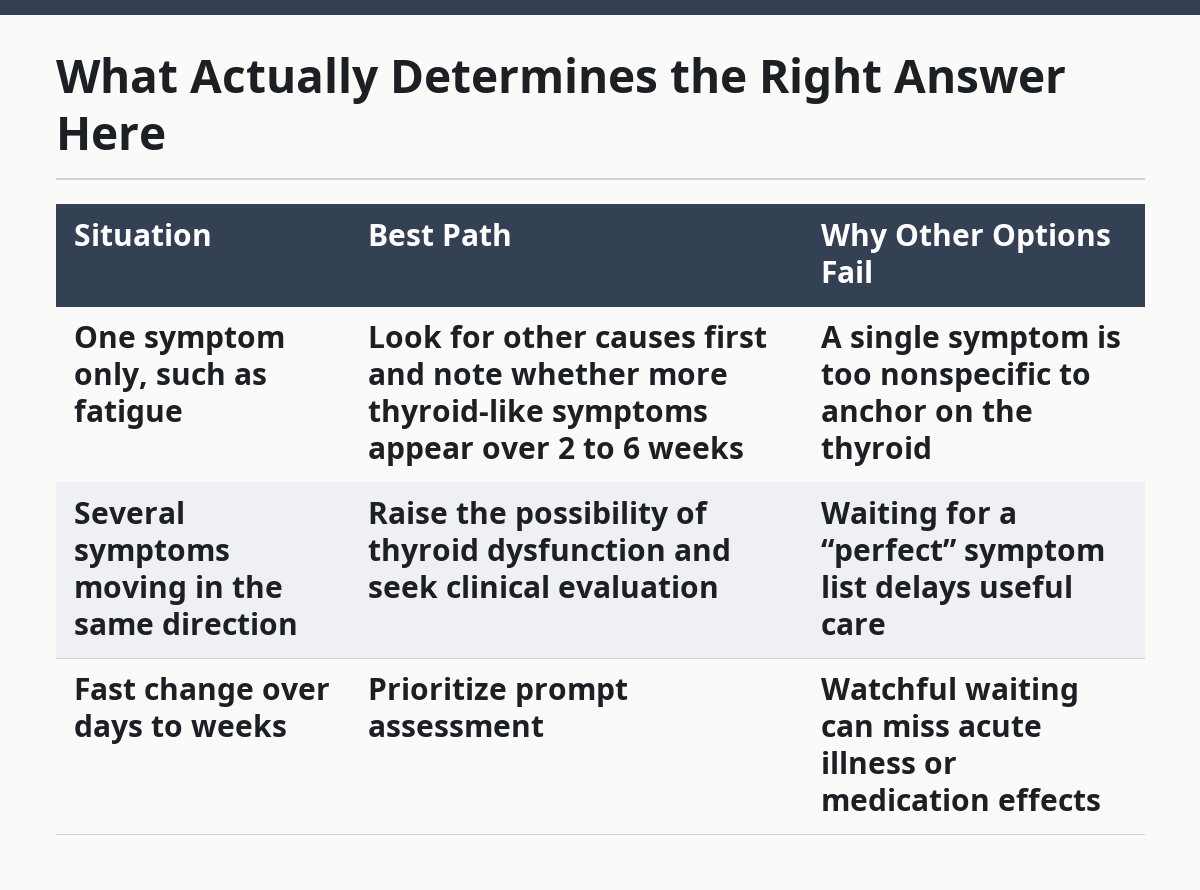
The right answer depends on whether the symptoms look more like thyroid overactivity, thyroid underactivity, or something else entirely. If you have one symptom in isolation, the signal is weak. If you have a pattern—for example, palpitations plus tremor plus heat intolerance over several weeks, or fatigue plus constipation plus cold intolerance plus dry skin—the signal gets stronger.
That is why a generic “thyroid symptoms” list misleads people. A racing heart can come from hyperthyroidism, but it can also come from panic, dehydration, caffeine, anemia, infection, or stimulant medicines. Fatigue can come from hypothyroidism, but also from depression, poor sleep, pregnancy, diabetes, iron deficiency, chronic pain, or inflammatory illness.
The speed of change matters too. A symptom that builds over months often points somewhere different from a symptom that appeared over days or 2 to 3 weeks. Rapid change raises concern for a medication effect, thyroiditis, infection, or another acute problem. A slower change may suggest a more chronic process, but that is not guaranteed.
The pattern also changes by age and life stage. In a person in their 20s with new palpitations and weight loss, thyroid overactivity may sit high on the list. In a person over 50 with new constipation, dry skin, and feeling cold, underactivity rises. In pregnancy, symptoms can be easy to misread because nausea, fatigue, and heat intolerance can overlap with normal changes. Menstrual changes also complicate the picture, because perimenopause can imitate thyroid symptoms almost symptom for symptom.
Here is the practical rule: if symptoms cluster, persist, and change your daily function, the threshold to seek assessment gets lower. If they are brief, mild, and clearly tied to stress, caffeine, a new medicine, or a viral illness, the thyroid is only one possibility.
| Situation | Best Path | Why Other Options Fail |
|---|---|---|
| One symptom only, such as fatigue | Look for other causes first and note whether more thyroid-like symptoms appear over 2 to 6 weeks | A single symptom is too nonspecific to anchor on the thyroid |
| Several symptoms moving in the same direction | Raise the possibility of thyroid dysfunction and seek clinical evaluation | Waiting for a “perfect” symptom list delays useful care |
| Fast change over days to weeks | Prioritize prompt assessment | Watchful waiting can miss acute illness or medication effects |
- Write down the exact symptoms, not just “feeling off.” Include sleep, bowel habits, heart rate sensations, weight change, temperature sensitivity, and menstrual changes.
- Mark when each symptom started. A timeline of **1 week**, **1 month**, or **6 months** is far more useful than memory alone.
- List new medicines, supplements, and dose changes. Biotin, amiodarone, lithium, and thyroid hormone are classic examples that can confuse the picture or affect thyroid tests.
- Note whether symptoms are getting better, worse, or coming in waves.
- Decide whether red flags are present: chest pain, severe breathlessness, fainting, confusion, or a very fast or irregular pulse.
- If red flags are absent but the pattern is persistent, arrange a clinical review rather than waiting for the symptoms to “declare themselves.”
Quick check: if you have only one vague symptom, the thyroid is possible but not the front-runner; if you have a cluster that has lasted weeks, the thyroid moves up the list.
If You’re Dealing With Fatigue, Weight Change, or Brain Fog, What Does It Mean?

It often means you should not assume the thyroid is the only explanation. Fatigue, weight gain, and “brain fog” are common in underactive thyroid, but they are also common in sleep debt, depression, iron deficiency, medication side effects, alcohol use, chronic pain, and poorly controlled blood sugar. If those symptoms arrive together and persist for more than a few weeks, the pattern deserves assessment, but it is still not a diagnosis. Consult a qualified clinician, because these symptoms are nonspecific and can overlap with many other conditions; the NHS and NIDDK both note that underactive thyroid symptoms can be broad and easily confused with other causes.
The detail that matters is whether the symptoms line up with a slower body state. Underactive thyroid often shows a “slowed down” pattern: less energy, constipation, dry skin, coarse hair, feeling cold, puffy face, heavier or more irregular periods, and slowed thinking. The signs can be subtle. A person may not notice weight gain at all, especially if appetite has also changed or activity has dropped.
If weight change is the main concern, context matters. An increase of a few pounds after a holiday, a move, or a job change is not the same as steady gain over 3 to 6 months with colder-than-usual tolerance and constipation. The same goes for fatigue. Being tired after a week of poor sleep is not the same as persistent exhaustion that makes stairs, concentration, and routine chores harder.
A common mistake is to overfocus on the scale. Thyroid-related symptoms can show up with no major weight change. Another mistake is to treat “normal TSH once” as a complete answer when symptoms continue; a clinician may need to look at the whole picture, including timing, medications, and whether another condition better explains the pattern. The American Thyroid Association advises matching symptoms with test results rather than relying on one number alone.
If the symptoms fit a slow pattern but are mild, the situation is usually not an emergency. If they are worsening, affecting work or driving, or accompanied by swelling, shortness of breath, or marked mental slowing, the need for review goes up.
- Track the symptom cluster for **2 weeks**: energy, bowel movements, sleep quality, temperature sensitivity, skin changes, and concentration.
- Check whether the pattern is broad or narrow. Broad means several body systems are involved; narrow means just one symptom dominates.
- Review medicines that can mimic fatigue or weight change, including sedating antihistamines, some antidepressants, steroids, and beta-blockers.
- Look for clues that point away from thyroid disease: loud snoring, recent stress, low mood, heavy alcohol use, or iron loss from heavy periods.
- Seek medical assessment if the symptoms are persistent, progressive, or paired with cold intolerance, constipation, dry skin, or menstrual change.
- If you also have chest pain, fainting, severe breathlessness, or confusion, move to urgent care rather than routine follow-up.
Quick check: if fatigue comes with cold intolerance, constipation, dry skin, or slower thinking over weeks to months, the thyroid deserves consideration; if it comes alone, look wider first.
Could This Be an Overactive Thyroid?
Yes, if the pattern looks “sped up”: palpitations, shakiness, heat intolerance, sweating, anxiety-like feelings, frequent bowel movements, unexplained weight loss, and sleep trouble are classic clues. But a fast body state is not automatically thyroid disease. Caffeine, panic, infection, stimulant medicines, menopause, and some heart rhythm problems can look similar.
What makes overactive thyroid more likely is the combination, not the single symptom. For example, palpitations plus weight loss plus heat intolerance over several weeks is a different pattern from one episode of palpitations after espresso. Eye symptoms can matter too: bulging eyes, eye irritation, or double vision raise concern for Graves-related eye disease, though not everyone with hyperthyroidism has eye involvement.
If the pulse feels unusually fast at rest, or if there is a noticeably irregular heartbeat, that deserves more urgency than vague jitteriness. A symptom pattern that includes tremor, frequent stools, anxiety, and heat intolerance should not be dismissed as “just stress” without considering the thyroid. But it is equally wrong to assume every anxious or sweaty spell is thyroid-related.
A useful benchmark is function. If you are waking repeatedly from sleep, needing to change clothing because of sweating, losing weight without trying, or feeling your heart race at rest, the impact has crossed from nuisance into something that deserves evaluation. If there is chest pain, fainting, severe shortness of breath, or a very rapid or irregular pulse, urgent care is the safer path.
The drawback of waiting for the “classic” picture is that the classic picture is often incomplete. Some people present with subtle symptoms, especially early on. The drawback of overcalling thyroid disease is that it can distract from heart, anxiety, or medication causes that need different treatment entirely.
- Note whether the symptoms are symmetrical and persistent rather than one-off.
- Check for triggers such as caffeine, decongestants, nicotine, stimulant medications, or recent illness.
- Watch for weight loss, heat intolerance, tremor, loose stools, and sleep disruption appearing together.
- Document your resting pulse if you can do so safely; a persistently fast or irregular heartbeat is more concerning than occasional awareness of heartbeats.
- Arrange clinical assessment soon if the pattern persists for **days to weeks**, especially if it is worsening.
- Move to urgent care if chest pain, fainting, severe breathlessness, confusion, or a very fast/irregular pulse is present.
Quick check: if you feel “sped up” in multiple ways at once, overactive thyroid becomes more plausible; if the symptom is isolated and tied to a trigger, the thyroid is less likely.
How Do Thyroid Symptoms Show Up in Different Patterns?

They show up as clusters, and the cluster tells you more than the label does. The most useful pattern is not “I have one thyroid symptom,” but “my body is acting slowed down” or “my body is acting sped up.” That distinction helps you decide what belongs on the short list and what does not.
Here are the common patterns in plain language:
- Slowed-down pattern: fatigue, constipation, cold intolerance, dry skin, hair thinning, heavier periods, puffy face, slow thinking.
- Sped-up pattern: palpitations, heat intolerance, sweating, tremor, anxiety-like feelings, frequent stools, weight loss, poor sleep.
- Mixed or unclear pattern: fatigue plus palpitations, weight change plus anxiety, or brain fog with menstrual change. Mixed patterns are common and are where people get stuck.
The mixed pattern is where a generic article does the most damage. A person can have fatigue from poor sleep and palpitations from anxiety, or fatigue from thyroid underactivity and palpitations from anemia. One pattern can even obscure another. That is why symptom timing matters. If the fatigue came first and the palpitations came after a new medicine, that is a different story from the reverse.
The table below is a practical way to sort what you are noticing.
| Situation | Best Path | Why Other Options Fail |
|---|---|---|
| Slowed-down cluster over months | Think thyroid underactivity as one possibility and seek assessment | Treating the symptoms separately can miss the pattern |
| Sped-up cluster over days to weeks | Think thyroid overactivity or another acute cause and seek prompt review | Waiting for more symptoms can be risky if the heart is involved |
| Mixed cluster with no clear direction | Compare timelines, medicines, and life-stage causes before assuming the thyroid | A mixed picture is easy to mislabel |
The right next step depends on the pattern’s severity and duration. Mild symptoms that are stable are different from worsening symptoms that affect work, sleep, or driving. The body does not give a neat one-symptom answer, and thyroid disease rarely obliges a neat one either.
- Sort symptoms into “slowed down,” “sped up,” or “mixed.”
- Write the first symptom and the most recent symptom on a timeline.
- Note whether the pattern changed after pregnancy, menopause transition, surgery, infection, or a medicine change.
- Identify whether the heart, bowels, skin, sleep, or menstrual cycle are involved.
- Use that pattern to decide urgency: same-week review for persistent mixed or sped-up symptoms; routine review for stable, mild slowed-down symptoms.
- Escalate immediately if red flags appear.
Quick check: if multiple body systems are changing in the same direction, the pattern matters more than any single complaint.
What Tests Usually Help, and What Can Mislead?
Thyroid blood tests help when they are matched to the right symptom pattern, but they can mislead when used as a stand-alone answer. The usual starting point in many settings is TSH, sometimes paired with free T4 and, when needed, free T3 or thyroid antibodies. That is a general framework, not a prescription, and a qualified clinician decides what is appropriate in your case.
The problem with testing too early or too casually is that normal or borderline results may not explain the whole picture. The problem with skipping testing when symptoms are persistent is that an important thyroid disorder can be missed. Timing matters because illness, pregnancy, recent thyroid medicine changes, and some supplements can distort results. Biotin is a common troublemaker because it can interfere with certain assays; people often do not think to mention it.
Symptoms and labs should fit together. For example, a person with a classic slowed-down pattern and a clearly abnormal TSH has a more coherent picture than a person with a vague symptom and a borderline lab value. Likewise, a person with strong sped-up symptoms and a normal single test may still need a clinician to look for other explanations, repeat testing later, or consider a different target.
A common mistake is expecting one number to settle everything. Thyroid disease can be about the trend, the context, and the match between symptoms and lab pattern. Another mistake is chasing thyroid testing for every fatigue complaint. That adds noise and can distract from iron deficiency, sleep apnea, depression, or medication effects. The useful approach is selective, not reflexive.
If you already have thyroid disease and your symptoms changed after a dose change or a new medicine, the question is different. That is not “Do I have thyroid disease?” It is “Is the current situation stable, or does the pattern suggest reassessment?”
- Bring a symptom timeline and a full medicine/supplement list to the appointment.
- Mention biotin explicitly if you take it, because it can affect some lab methods.
- Ask which tests are being ordered and what clinical question they are meant to answer.
- Do not overread one borderline result; ask how it fits with symptoms and prior values.
- If symptoms and labs do not match, ask what else is being considered instead of assuming the thyroid is ruled in or out.
- Follow up if the pattern changes, especially over **2 to 8 weeks**.
Quick check: if your symptoms are persistent but your test picture seems thin or confusing, the issue may be test timing, medication interference, or a non-thyroid cause.
When Should I Seek Help for Thyroid Symptoms?
You should seek help sooner when symptoms are persistent, worsening, or paired with red flags; you should seek urgent help when breathing, chest symptoms, heart rhythm, or mental status change is involved. That is the safest answer.
A practical way to think about it is by urgency:
- Urgent today: chest pain, fainting, severe shortness of breath, confusion, severe agitation, or a very fast or irregular heartbeat.
- Prompt medical review: a cluster of thyroid-like symptoms that has lasted weeks, is getting worse, or is affecting daily life.
- Routine review: mild, stable symptoms that fit a possible thyroid pattern but do not involve red flags.
The timing matters because thyroid problems can sit quietly for a while, but they can also become clinically important in ways a person feels immediately. A rapid pulse, confusion, or marked breathlessness changes the calculation. So does pregnancy, because the threshold for assessment is lower when both parent and fetus may be affected.
If you are unsure where you fall, use function as the tie-breaker. Can you work, sleep, drive, climb stairs, and think normally? Or is there a clear drop from your usual baseline? A visible change in baseline is a better reason to seek help than a symptom that has stayed unchanged for months.
Do not wait for a “perfect” set of symptoms before asking for care. That delay is one of the most common errors. At the same time, do not panic over one symptom without context. The better move is to match urgency to the pattern, the speed, and the presence of warning signs.
- Check for urgent red flags first: chest pain, fainting, severe breathlessness, confusion, or a very fast/irregular pulse.
- If any red flag is present, seek urgent care rather than waiting for a routine appointment.
- If no red flags are present, decide whether the symptoms are persistent for **more than 2 weeks** or progressively worsening.
- Prepare a list of symptoms, timings, medicines, supplements, and recent life events such as pregnancy, infection, or medication changes.
- Book a clinician visit if the pattern is persistent, mixed, or affecting daily function.
- Seek follow-up if the picture changes after the visit, because thyroid-related symptoms can evolve over time.
Quick check: if symptoms are mild and stable, routine review may be enough; if they are worsening or red-flagged, the answer shifts to urgent care.
When the Standard Advice Is Wrong
The standard advice is wrong when it tells you to “watch and wait” despite a clear symptom cluster, or when it tells you thyroid symptoms are the answer for every tired, anxious, or weight-changing person. Both errors are common.
Here are the edge cases where the normal script breaks down:
-
Pregnancy or postpartum
- What changes: normal pregnancy symptoms overlap with thyroid symptoms, and postpartum changes can confuse the picture.
- What to do instead: lower the threshold for clinical review, especially if palpitations, marked fatigue, heat intolerance, or mood changes are strong or persistent.
-
Medication effects
- What changes: medicines such as amiodarone, lithium, glucocorticoids, and some supplements can alter thyroid function or mimic thyroid symptoms.
- What to do instead: review the medication list line by line and do not assume the thyroid is the first cause.
-
Biotin use
- What changes: biotin can interfere with some thyroid lab assays.
- What to do instead: mention every supplement, including hair and nail products, because the lab result may not match the true physiology.
-
Heart symptoms dominate
- What changes: palpitations, chest discomfort, or irregular pulse can point to a cardiac issue even when thyroid disease is in the background.
- What to do instead: treat the heart symptom as the priority, especially if it comes with fainting, shortness of breath, or chest pain.
-
Older adults
- What changes: thyroid symptoms can be subtler, and underactive thyroid may present as slowing, constipation, or cognitive change rather than a textbook cluster.
- What to do instead: do not dismiss “just aging” if the change is new over weeks to months.
-
Normal tests, persistent symptoms
- What changes: a single normal test does not always explain symptoms, especially if the timing was off or the symptom pattern changed.
- What to do instead: ask what else was considered, whether repeat testing is warranted, and whether another condition better matches the story.
The wrong move in these edge cases is to force the story into a simple yes/no thyroid box. The better move is to ask what changed the baseline and what else could explain the same pattern.
- List the special circumstance first: pregnancy, postpartum period, biotin, new medicine, or heart symptoms.
- State exactly which symptoms are new and when they started.
- Do not rely on a single lab or a single symptom to decide the next step.
- If heart symptoms, confusion, fainting, or breathing problems are present, escalate urgency immediately.
- If the case is complicated, bring a full medication and supplement list to the clinician.
- Reassess if the pattern changes over the next **1 to 4 weeks**.
Quick check: if your situation includes pregnancy, postpartum changes, biotin, heart symptoms, or a new medicine, the usual “thyroid symptoms” advice is too simple.
What a Reader Should Do Next, Step by Step
The safest next step is to sort the symptoms, check for red flags, and get the right level of help without overreacting or underreacting. That is the whole game.
Start with the symptom pattern. Then ask: is this a slowed-down cluster, a sped-up cluster, or a mixed one? Then ask: is it stable, worsening, or abrupt? Then ask: are there red flags? That sequence gives you a more reliable answer than searching symptom lists for the fifth time.
A practical path looks like this:
- Write down the main symptom cluster and when it began.
- Separate one-off events from persistent changes.
- Review medicines and supplements, including biotin.
- Check for red flags that require urgent care.
- Arrange medical review if the pattern is persistent or progressive.
- Bring your timeline to the visit so the clinician can compare symptoms with the likely thyroid pattern and other causes.
Because symptom checkers only match words, it helps to resist the internet trap. A symptom checker cannot judge the pattern in your body, the pace of change, or the medical context that matters. A real clinician can put those pieces together, and that is exactly why the advice here points toward professional review rather than self-diagnosis.
The best outcome is not “I guessed the thyroid problem correctly.” The best outcome is “I recognized that the pattern needed attention and got the right help at the right time.”
Quick check: if you can describe the timeline, the cluster, and the red flags in one minute, you are ready for a useful clinical conversation.
Drafted with AI; not yet reviewed by a person.