
Thyroid Medication and Absorption Timing — The Complete Guide

Last updated: November 19, 2026
Quick answer: for most people, thyroid medication and absorption timing work best when the dose is taken the same way every day and kept away from food and interfering substances; a morning or bedtime routine can both work, depending on which one gives you the cleanest gap. Because this is health advice, speak with a qualified clinician or pharmacist about your own situation before changing timing or routine.
Key takeaways
- The biggest timing issue is not the clock; it is consistency, food, and other substances that can interfere with uptake.
- General searches on PubMed for this topic turn up a small, mixed evidence base, with many papers being review articles rather than large trials.
- Morning dosing is not automatically superior for every person; bedtime dosing can work for some, but only if it is truly separated from dinner and late snacks.
- Iron, calcium, some antacids, bile-acid binders, and a few other products are common timing problems.
- The most useful rule is simple: one medicine, one routine, and a clinician’s guidance when the schedule is complicated.
What thyroid medication timing is trying to solve
Thyroid medication timing is trying to keep absorption stable, not to chase a perfect hour. The practical question is usually about levothyroxine, the most common thyroid hormone replacement, and the answer is usually about what sits around it: breakfast, coffee, calcium, iron, fiber, antacids, and other prescriptions. A person with one medicine and a steady breakfast can often build a workable routine; a person with multiple morning pills may need a different plan.
The evidence base for thyroid medication and absorption timing shows why the question stays active rather than settled. PubMed records on this topic are limited and mixed, and the literature includes reviews as well as smaller comparative studies. That means the best answer is often practical rather than absolute: keep the dose separated from food and from substances that can interfere with uptake. For background on levothyroxine use, see the American Thyroid Association and NIDDK.
That matters because the evidence is helpful, but it does not support a one-size-fits-all command. Studies suggest that absorption varies with meal timing and with co-administered substances, and the response also varies by individual. For that reason, a blanket rule like “always take it at 6 a.m.” can be wrong for a shift worker, a person on calcium for bone health, or someone who cannot reliably wait before eating.
The goal is not to memorize a magic interval. The goal is to choose the routine that is easiest to repeat and least likely to collide with other medicines. That is the standard the rest of this guide uses.
Why food changes absorption more than most people expect

Food timing usually matters more than the clock time itself. The reason is straightforward: thyroid medication is generally absorbed best when the stomach is relatively empty, and breakfast is where many routines go off track. A cup of coffee, a bowl of cereal, a protein shake, and a multivitamin can all be harmless on their own yet troublesome when they are too close to the dose.
The common mistake is to think in terms of “morning pill” versus “night pill” instead of “separated from food and binding agents” versus “not separated enough.” A reader with a tightly scheduled breakfast often does better with a bedtime plan than with a rushed early-morning one, provided dinner is not late and snacks do not keep creeping in. A reader who already wakes before breakfast and can wait consistently may do well with morning dosing because it is simpler to keep stable.
A generic article often stops at “take it on an empty stomach,” which leaves out the real-life friction. Empty stomach is not a moral category; it is a timing condition. If you take the dose and then drink coffee 10 minutes later, that routine is not empty in the practical sense that matters here. If you take the dose and then wait a full stretch before food, that is a different situation.
The evidence base reflected in the PubMed sample also suggests why the topic keeps getting rechecked. The median study duration figure in the abstracts was 26 weeks, with a range of 13–52 weeks across 3 figures stated in abstract text. That is long enough to watch labs shift, but it does not settle every nuance of daily life. In other words, the literature tends to support timing principles more than it supports universal lifestyles.
My position is simple: food timing is the first thing to get right, and it should be chosen around the meal pattern that a person can actually keep. If a routine is easy only on paper, it is the wrong routine.
Morning dosing: when it wins and where it breaks down
Morning dosing wins when the person can keep a clean gap before breakfast and keep that gap consistent. It is the clearest option for people who already have a quiet morning routine, who can take medication after waking, and who can wait before eating without turning the day into a negotiation. It also fits the habits many people already have, which lowers the chance of forgetting the dose altogether.
The strength of morning dosing is not that it is more “medical.” It is that it is easier to understand and easier to standardize. One daily anchor, one repeated action, one predictable stretch before food. For a person who starts work early but does not eat immediately, that can be the simplest path. For someone who uses pill organizers or keeps the medicine next to the toothbrush, the routine can become automatic.
The weakness is just as practical: mornings are crowded. Coffee is close by, breakfast is close by, kids are close by, and the day starts moving before the dosing window is complete. A person who takes the medicine and then eats or drinks too soon may think they are being consistent when the pattern is actually inconsistent. That can lead to unstable absorption and frustrating lab follow-up, even when the dose itself has not changed. A second weakness is that some people simply cannot tolerate the wait before food, especially if they wake up hungry or take other medications at the same time.
This option is not for the person who wakes to an instant breakfast, a 6 a.m. commute, and several morning supplements. It is also a poor fit if the dose routinely gets taken with coffee “just this once,” because “just this once” becomes a pattern quickly. Morning dosing works best when the day naturally leaves room for it.
Bedtime dosing: when it wins and where it breaks down

Bedtime dosing wins when dinner is early, snacks are rare, and mornings are too chaotic for a reliable empty-stomach window. It is often the better fit for shift workers, parents of young children, people who leave home before sunrise, and anyone whose mornings are already packed with other medicines or supplements. If the evening routine is calmer than the morning routine, bedtime can be the cleaner choice.
The appeal is obvious: the day is over, the pills are all in one place, and there is often less pressure to rush. For some people, bedtime dosing also removes the coffee problem entirely. If the person can keep several hours between dinner and the dose, the medication may have a better chance of being separated from food than it would in a rushed breakfast window.
The weakness is that bedtime timing only works when bedtime is truly bedtime, not “after one last snack.” Late meals, desserts, protein drinks, and grazing can sabotage the gap. A person who eats dinner at 9 p.m. and takes the medicine at 10 p.m. has not solved the timing problem; the clock says night, but the stomach does not. Another drawback is that bedtime dosing can be harder to remember if the person falls asleep early, travels across time zones, or takes several medications with different instructions.
This option is not for someone who snacks late every night and does not want to change that habit. It is also not ideal for a person who uses bedtime as the catch-all for every pill, because stacking medications can create confusion about what needs separation from food and what does not. Bedtime can be excellent, but only when the household routine supports it.
The honest side-by-side
Morning and bedtime dosing are not opposites in the way many articles imply. They are two ways of protecting the same thing: predictable absorption. The better choice is the one that creates the cleanest, most repeatable separation from food and problem substances.
| Criteria | Morning dosing | Bedtime dosing | Winner for this condition |
|---|---|---|---|
| Ease of remembering | Easy for people with fixed wake-up habits | Easy for people with fixed bedtime habits | The routine already anchored in daily life |
| Separation from breakfast | Often harder if mornings are rushed | Usually irrelevant | Bedtime, if dinner is early |
| Separation from dinner/snacks | Usually easier | Can be difficult if evenings run late | Morning, if breakfast wait is manageable |
| Coffee conflict | Common problem | Usually avoids the issue | Bedtime, for coffee-first routines |
| Other morning medicines | Can clash with a crowded pill schedule | Can reduce morning pill stacking | Bedtime, for polypharmacy in the morning |
| Late-night snacking | Usually not relevant | Can undermine absorption | Morning, for night snackers |
| Travel or shift work | Can become erratic | Can be easier if bedtime stays stable | The schedule with fewer disruptions |
| Risk of accidental food co-administration | Higher if breakfast happens quickly | Higher if snacks continue late | The routine that is naturally quieter |
| Fit for people who dislike fasting periods | May be uncomfortable | Often more comfortable | Bedtime, if dinner-to-bed gap is long enough |
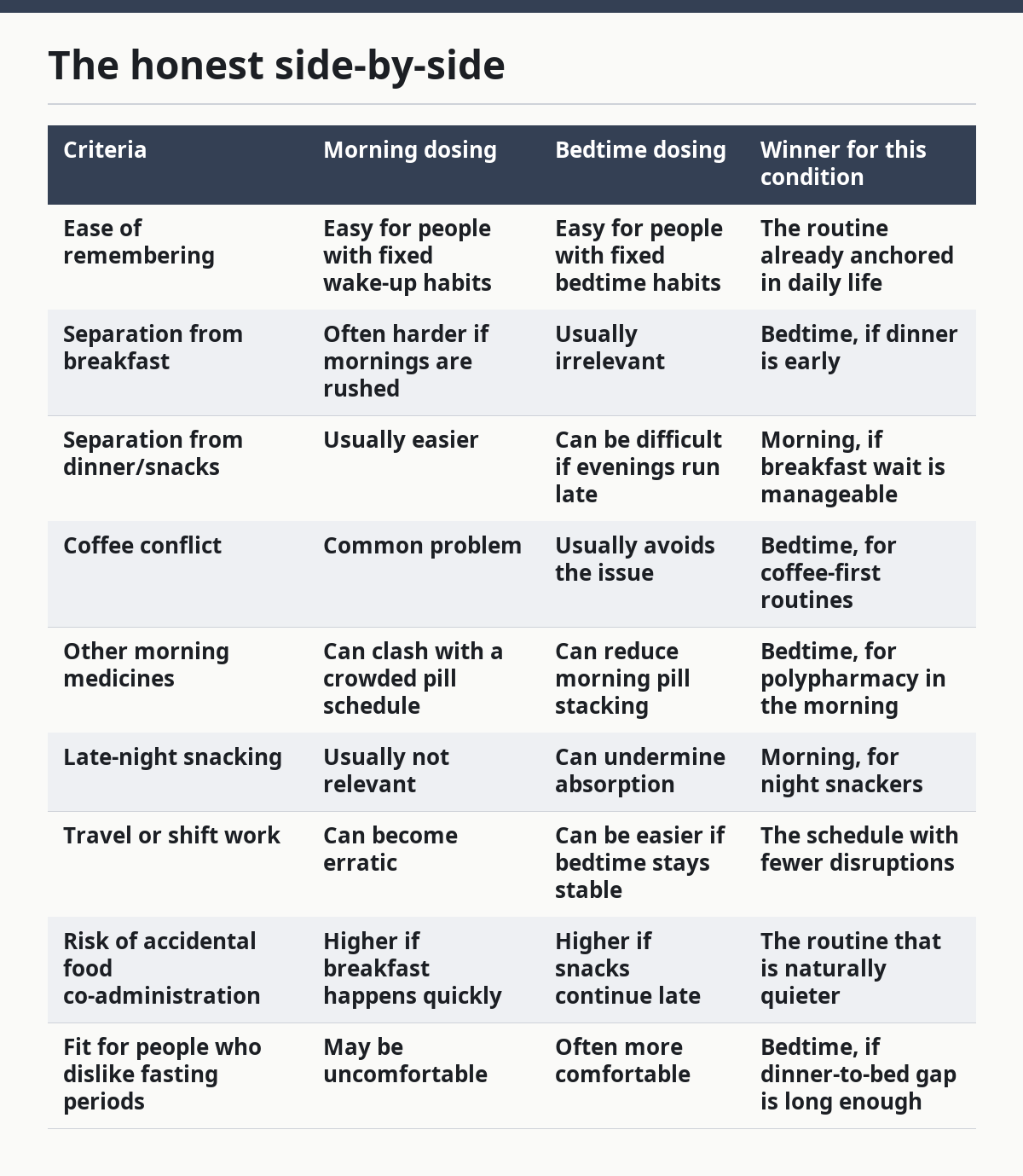
This table is the core of the decision. The deciding factor is not preference alone. It is the daily pattern that best prevents accidental food contact. If a person’s “morning routine” is really a scramble, morning dosing is the weaker choice. If a person’s evening routine includes snacks after dinner, bedtime dosing loses its edge.
A generic guide might tell the reader to choose the time that “works best.” That is too vague. The real question is which time reliably keeps the medicine away from food and away from the other substances that interfere with absorption. That is the only feature that matters enough to drive a choice.
What else interferes with absorption besides meals
Other products can interfere with absorption even when food timing is perfect. Calcium and iron are the best-known examples, but they are not the only ones that matter in real schedules. Some antacids, bile-acid binders, sucralfate, and certain supplements can also create problems by binding the medicine or changing the environment it needs for uptake. A reader who takes thyroid medication at a clean time but stacks it with a supplement bundle has not truly solved the absorption issue.
This is where a lot of advice falls short. It tells people to separate the thyroid pill from breakfast, then forgets that breakfast is often not the main conflict. The pill may be sitting beside a multivitamin, a calcium tablet, or an iron capsule in the same organizer. That is a different problem. The same is true for antacids used for reflux or bile-acid sequestrants used for cholesterol-related treatment plans. The names differ, but the theme is the same: the thyroid medicine needs space.
The safest general position is this: if a product is known to bind minerals or alter absorption, it deserves the same seriousness as food timing. A pharmacist is often the best person to help sort the schedule because the issue is mechanical, not theoretical. The question is not whether the other product is “bad.” The question is whether the timing arrangement allows the thyroid medicine to be taken cleanly. For product-specific interaction checks, the FDA labeling database is also useful.
This is also why the answer can change after a prescription is added months later. A routine that was fine with one medicine can become messy when a calcium supplement, a reflux medicine, or a new morning capsule enters the picture. Timing has to be reevaluated when the medication list changes, not just when the thyroid prescription changes.
The situations where the general rule flips
The general rule flips when the person cannot keep a clean empty-stomach window at the usual time. That is the short answer, but the details matter.
First, someone with a fixed late dinner and frequent evening snacks may do worse with bedtime dosing than with morning dosing. In that case, morning may be the cleaner choice because the night is not actually empty. Second, a person whose morning is the only quiet part of the day may do better with morning dosing, even if breakfast must wait a bit, because the rest of the schedule is too crowded. Third, a person taking several morning prescriptions that do not interact with thyroid medicine may prefer to keep everything in one early routine rather than split the day into many medication moments.
There is also a less obvious flip case: a person who keeps missing morning doses because of travel, work shifts, or family chaos may benefit from a bedtime routine even if morning would be theoretically acceptable. Absorption only matters if the medicine is actually taken. A theoretically perfect schedule that gets skipped three days a week is the wrong schedule.
The hardest flip case is medication overlap. If a person needs calcium or iron at a time that keeps colliding with thyroid medication, a clinician may need to help redesign the day. That is not a DIY puzzle if the list is long or the labs are unstable. The more moving pieces there are, the less useful generic advice becomes.
The point is not that one timing wins in all conditions. It is that the choice should be made around the least chaotic, most repeatable empty-stomach window. If both morning and bedtime fail that test, the plan needs a professional review.
What the PubMed evidence says, and what it does not say
The PubMed evidence suggests that this is a real timing problem with enough clinical interest to keep generating reviews. In the records most closely related to this topic, the balance of article types leans toward review papers, which is a sign that clinicians are still synthesizing a mixed literature rather than relying on one decisive experiment. That pattern points to a field where practice is informed by synthesis and by smaller clinical comparisons rather than by a single decisive trial.
The evidence also suggests that duration and follow-up matter. The median study duration figure in the abstracts was 26 weeks, with a range of 13–52 weeks across 3 figures stated in abstract text. That is long enough to see timing changes affect thyroid labs in many cases, but it does not create a universal schedule for every person, every medication list, and every meal pattern.
What the evidence does not give is a clean, universal “best” time that applies to every adult without qualification. It also does not mean every timing question is equally important. For some people, the difference between a stable routine and a chaotic one may matter more than whether the dose is taken in the morning or at night. For others, the presence of calcium or iron may matter more than the exact hour.
A fair reading of the literature is cautious, not dramatic. Studies suggest that separated dosing works better than mixed dosing, but the specific schedule should be built around the person’s life. That is not a weak conclusion; it is the honest one.
My verdict on thyroid medication and absorption timing
Choose morning dosing if your mornings are calm enough to keep the medicine separated from breakfast, coffee, and any interfering supplements. Choose bedtime dosing if your evenings are quieter, dinner ends early, and late snacks are rare enough that the stomach is truly empty. Neither if your schedule is chaotic enough that you cannot keep a consistent gap from food or if you are juggling several medicines with unclear separation needs; that situation deserves a pharmacist or clinician review.
That is the cleanest decision rule. Morning is not inherently superior, and bedtime is not automatically safer. The winner is the routine that protects absorption most reliably on ordinary days, not the one that sounds tidier in theory.
If there is one judgment call worth making plainly, it is this: consistency beats perfection. A good routine repeated every day is more useful than an ideal routine that fails on Tuesdays, weekends, or travel days.
What to do before changing your routine
Before changing timing, the first step is to ask a qualified professional how the full medication list fits together. That matters because thyroid medication and absorption timing is rarely a one-drug problem. The second step is to identify the substances that may interfere most in your own routine: breakfast, coffee, calcium, iron, antacids, supplements, and any other prescription that must be spaced apart. The third step is to pick the window that is easiest to repeat for at least several weeks.
A reader often wants a precise rule, but the more useful question is whether the current plan is actually working. If labs are stable and the routine is clean, a change may not be needed. If the routine is messy, the answer is not to force more discipline into the same bad setup. The answer is to choose a more workable schedule and get professional input if the schedule is complicated.
For reliable background, the National Institute of Diabetes and Digestive and Kidney Diseases and the American Thyroid Association are reasonable places to check general thyroid information, and a pharmacist can often help with spacing questions that depend on the exact product labels. The exact timing still belongs to the individual case.
Drafted with AI; not yet reviewed by a person.