Last updated: November 19, 2026
Quick Answer: A high TSH result usually means the thyroid is underactive or levothyroxine is not meeting the body’s needs, but the right next step is to review the full picture with a clinician, not to assume one cause. This article explains What High TSH Means: Underactive Thyroid, Missed Doses, or Dose Too Low?
A high TSH result usually means the thyroid is underactive, or that levothyroxine treatment is not meeting the body’s needs. It can also mean missed doses, too low a dose, or a temporary shift that needs follow-up testing rather than an immediate change. For context on thyroid testing, see the National Institute of Diabetes and Digestive and Kidney Diseases and the American Thyroid Association: https://www.niddk.nih.gov/health-information/endocrine-diseases/hypothyroidism and https://www.thyroid.org/hypothyroidism/.
What a high TSH result is telling you
A high TSH result means the pituitary gland is asking the thyroid gland to work harder. TSH, or thyroid-stimulating hormone, rises when the body senses that thyroid hormone activity is too low at the tissue level.
That is why a high TSH often points toward hypothyroidism. In plain language, the thyroid is not keeping up, so the pituitary sends a louder signal. In a person not taking thyroid medicine, that may mean the thyroid gland itself is underactive. In a person already taking levothyroxine, it often means the current dose is not enough for the body’s needs, or that the medication has not been taken consistently long enough to show the full effect.
A high TSH does not tell the whole story by itself. A lab report with TSH alone is a clue, not a full diagnosis. Free T4 matters because it helps show whether the thyroid hormone level is actually low, or whether the body is only beginning to drift out of range. That is why thyroid lab interpretation often looks at TSH with free T4, not as a standalone number.
There is no single “high” TSH threshold that means the same thing for everyone. Labs use their own reference ranges, and the meaning changes depending on whether the person has known hypothyroidism, has had thyroid surgery, takes levothyroxine, or is pregnant. The same number can carry a different weight in those settings.
The key point is simple: a high TSH usually means the body is not getting enough thyroid hormone effect, but the reason can differ. The next sections sort out the common causes and the practical next step.
Is a high TSH always hypothyroidism?

A high TSH often means hypothyroidism or undertreated hypothyroidism, but it is not the only explanation. In someone with no thyroid treatment, the common reading is that the thyroid gland is underactive, though a clinician should interpret the result in context. In someone already on levothyroxine, the more useful question is whether the dose is too low, the doses were missed, or the medication was not absorbed well enough.
There are two broad patterns people run into, and a clinician can help distinguish them:
-
Untreated or newly diagnosed hypothyroidism.
The thyroid gland itself is not making enough hormone. TSH rises because the pituitary keeps pushing for more output. -
Treated hypothyroidism with a high TSH.
The person is taking levothyroxine, but the thyroid signal is still high. That can happen when the dose is too low, when doses are missed, or when the body has not had enough time to settle after a change.
A result can also sit in the middle: a high TSH with a normal free T4. That pattern is often called subclinical hypothyroidism. It does not mean “nothing is wrong.” It means the pituitary is already working harder even though free T4 is still within range. Some people feel fine with that pattern; others do not. What happens next depends on the degree of elevation, symptoms, pregnancy status, and whether thyroid antibodies or repeat labs suggest a stable trend.
A generic answer goes wrong here. A high TSH is not automatically a dose problem. It can be a true hypothyroid state, but it can also reflect a treatment gap that is fixable without assuming the thyroid has suddenly worsened.
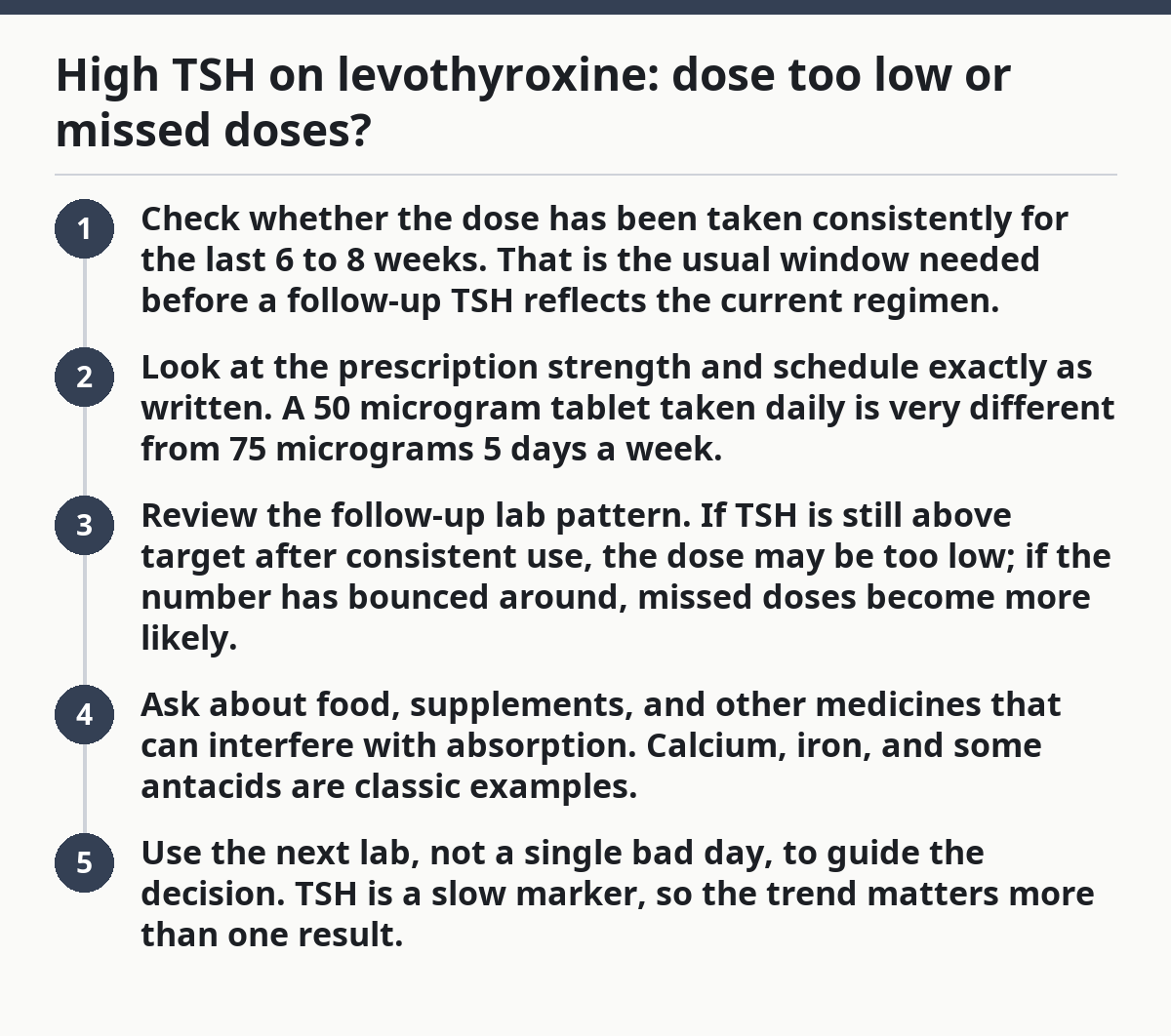
High TSH on levothyroxine: dose too low or missed doses?
A high TSH on levothyroxine usually comes down to one of three things: the dose is too low, doses are being missed, or the medicine is not being taken in a way that lets it work predictably.
Missed doses are common because levothyroxine is taken daily and the effect is gradual. One skipped tablet does not always move the lab much, but repeated misses can. The pituitary responds over days to weeks, not minutes, so a person may feel “mostly fine” while TSH quietly drifts upward.
Dose too low is the other common explanation. The tablet amount may no longer match the body’s needs after weight change, aging, pregnancy, starting or stopping interacting medicines, or a change in thyroid function. A TSH that stays raised after several weeks of consistent use often makes dose adjustment more likely than simple observation.
Here is the practical way to think through it:
- Check whether the dose has been taken consistently for the last 6 to 8 weeks. That is the usual window needed before a follow-up TSH reflects the current regimen.
- Look at the prescription strength and schedule exactly as written. A 50 microgram tablet taken daily is very different from 75 micrograms 5 days a week.
- Review the follow-up lab pattern. If TSH is still above target after consistent use, the dose may be too low; if the number has bounced around, missed doses become more likely.
- Ask about food, supplements, and other medicines that can interfere with absorption. Calcium, iron, and some antacids are classic examples.
- Use the next lab, not a single bad day, to guide the decision. TSH is a slow marker, so the trend matters more than one result.
A high TSH can tempt people to overcorrect. They assume the dose must be increased right away. That is sometimes right, but not always. If the last month included several missed tablets, the better fix may be consistency first, then a repeat TSH and free T4 after the usual interval. If the dose truly is too low, waiting too long leaves symptoms on the table.
The honest trade-off is this: treating a high TSH with a bigger dose can help, but increasing too quickly when missed doses are the real issue can overshoot once adherence improves.
What happens when TSH is high but free T4 is normal?
A high TSH with normal free T4 often means early or mild hypothyroidism, often called subclinical hypothyroidism. The thyroid hormone level is still in range, but the pituitary is already signaling that the system is strained.
This pattern shows up in a few common settings. It can appear before overt hypothyroidism becomes obvious. It can also show up in someone on levothyroxine whose dose is slightly low but not dramatically off. In either case, the body is telling the same story: thyroid support is not quite enough, even if free T4 has not dropped below range.
This is one of the places where the wording matters. “Subclinical” does not mean unimportant. It means the abnormality is seen in labs before it is obvious in a more advanced hormone deficit. Some people with this pattern have symptoms like fatigue, constipation, or feeling cold; others do not. Symptoms alone do not tell the whole story because they overlap with sleep loss, anemia, depression, and many other conditions.
A high TSH with normal free T4 is also where follow-up labs matter most. A repeat test in about 6 to 8 weeks can show whether the TSH normalizes, stays high, or moves into a clearer hypothyroid pattern. That trend helps separate a temporary blip from a stable problem.
A common mistake is to dismiss the result because free T4 is still normal. That can delay care when the pattern is persistent. Another mistake is to treat every mild elevation as an emergency. It is usually not. The more useful move is to match the result with symptoms, history, and repeat testing.
If the person is pregnant, trying to conceive, has known thyroid disease, or has had thyroid surgery, the threshold for action is often lower. That is a situation for direct medical review rather than self-adjusting levothyroxine.
What to do next after a high TSH
A high TSH should lead to a structured follow-up, not a guess. The point is to confirm whether the result reflects untreated hypothyroidism, an undertreated dose, or a missed-dose pattern that can be corrected before changing treatment.
Start with the actual lab report, the current levothyroxine dose, and the date of the last dose change. Those three details tell most of the story. Then decide what to repeat and when.
The most practical next steps are:
-
Confirm the current regimen.
Write down the exact levothyroxine strength, how many tablets are taken, and how often. A schedule like 88 micrograms daily is very different from alternating 75 and 88 micrograms. -
Check timing and consistency.
If doses have been missed in the last 2 weeks, the TSH may not reflect the intended dose yet. Consistent daily use matters more than a few good days. -
Repeat thyroid labs at the right interval.
Many clinicians use a 6- to 8-week window after a dose change or after fixing a dosing problem because TSH changes slowly. A repeat TSH, often with free T4, is the usual way to see the effect. -
Review possible absorption issues.
Calcium, iron, some antacids, and taking levothyroxine too close to food can blunt absorption. The result can look like undertreatment even when the prescription strength seems reasonable. -
Ask whether the result fits the clinical picture.
Someone with long-standing hypothyroidism and a mildly high TSH may need a small dose adjustment. Someone with one missed week in the middle of the last month may need adherence fixed before any change.
This approach avoids the two classic errors: changing the dose too fast, or ignoring a result that clearly suggests the current plan is not working. It also keeps the focus where it belongs — on the thyroid gland, levothyroxine use, free T4, and the repeat lab trend.
For a broader framework on labs and context, the hub on thyroid lab interpretation is the better next stop. See also the thyroid nodules guide and the hypothyroidism treatment page for related context.
When a high TSH should not be brushed off
A high TSH should not be brushed off when the person has known hypothyroidism, symptoms are worsening, or the result has stayed high on repeat testing. It also deserves quicker attention if the person is pregnant, has had thyroid surgery, or has a history of thyroid cancer care that requires tighter control.
A mildly raised TSH can be watched in one setting and acted on in another. The difference is the clinical context, not just the number. A person on levothyroxine with persistent fatigue and constipation may need a dose review. A person who missed several doses may need a clean, consistent 6-week stretch before the next lab. A person with no prior thyroid history and a high TSH may need evaluation for hypothyroidism rather than a prescription adjustment alone.
The honest limitation is that TSH is a delayed marker. It is excellent for tracking the pituitary’s response, but it is not an instant readout of today’s hormone effect. That means the result can lag behind real life by several weeks. It also means a high number may reflect what happened 1 to 2 months ago more than what happened yesterday.
That lag is why self-adjusting levothyroxine is a bad idea. A quick bump in dose can overshoot once adherence improves, and an unnecessary drop can leave true hypothyroidism untreated. The safer move is to use the TSH result as a signal to review the full picture with a clinician, especially when free T4 is abnormal, symptoms are strong, or there is any special situation such as pregnancy.
Key Takeaways
- A high TSH usually means the body is not getting enough thyroid hormone effect.
- In untreated people, it often points to hypothyroidism from an underactive thyroid gland.
- In people taking levothyroxine, the usual suspects are a dose that is too low, missed tablets, or poor absorption.
- High TSH with normal free T4 can fit subclinical hypothyroidism and often needs repeat testing rather than a rushed decision.
- The most useful next step is usually a careful review of dose, timing, and follow-up labs after about 6 to 8 weeks.
Can high TSH happen even if free T4 is normal?
Yes. A high TSH with normal free T4 is a real pattern and is often called subclinical hypothyroidism. It can also happen in someone taking levothyroxine when the dose is a little low or doses have been inconsistent. The result is usually interpreted in context, not as a stand-alone emergency.
Does high TSH mean I need more levothyroxine?
Not always. A higher dose is one common answer, but missed doses, timing problems, and absorption issues can raise TSH too. The usual next step is to review the current dose, confirm consistent use, and repeat TSH and free T4 after the appropriate interval before changing treatment.
How long does it take TSH to respond to a dose change?
TSH usually takes about 6 to 8 weeks to reflect a levothyroxine dose change. That delay is why follow-up labs are not done the next day or next week. The result needs time to settle so the new number reflects the current dose rather than the old one.
Drafted with AI; not yet reviewed by a person.