Last updated: November 19, 2026
A thyroid blood test panel makes sense only when TSH, free T4, and free T3 are read as one pattern, not three separate numbers. If you are trying to figure out whether the result points toward hypothyroidism, hyperthyroidism, or something in between, start with TSH, then check whether free T4 and free T3 support it or push against it. This practical interpretation guide helps you read TSH, free T4, and free T3 together.
Key takeaways
- TSH is the pituitary gland’s signal to the thyroid; free T4 and free T3 show how much hormone is circulating in usable form.
- A high TSH with low free T4 usually points to primary hypothyroidism.
- A low TSH with high free T4 and/or free T3 usually points to hyperthyroidism.
- A normal TSH may not fully settle the question when free T4 or free T3 is low or high.
- The pattern matters more than one isolated result, especially when one marker is only slightly outside the reference range.
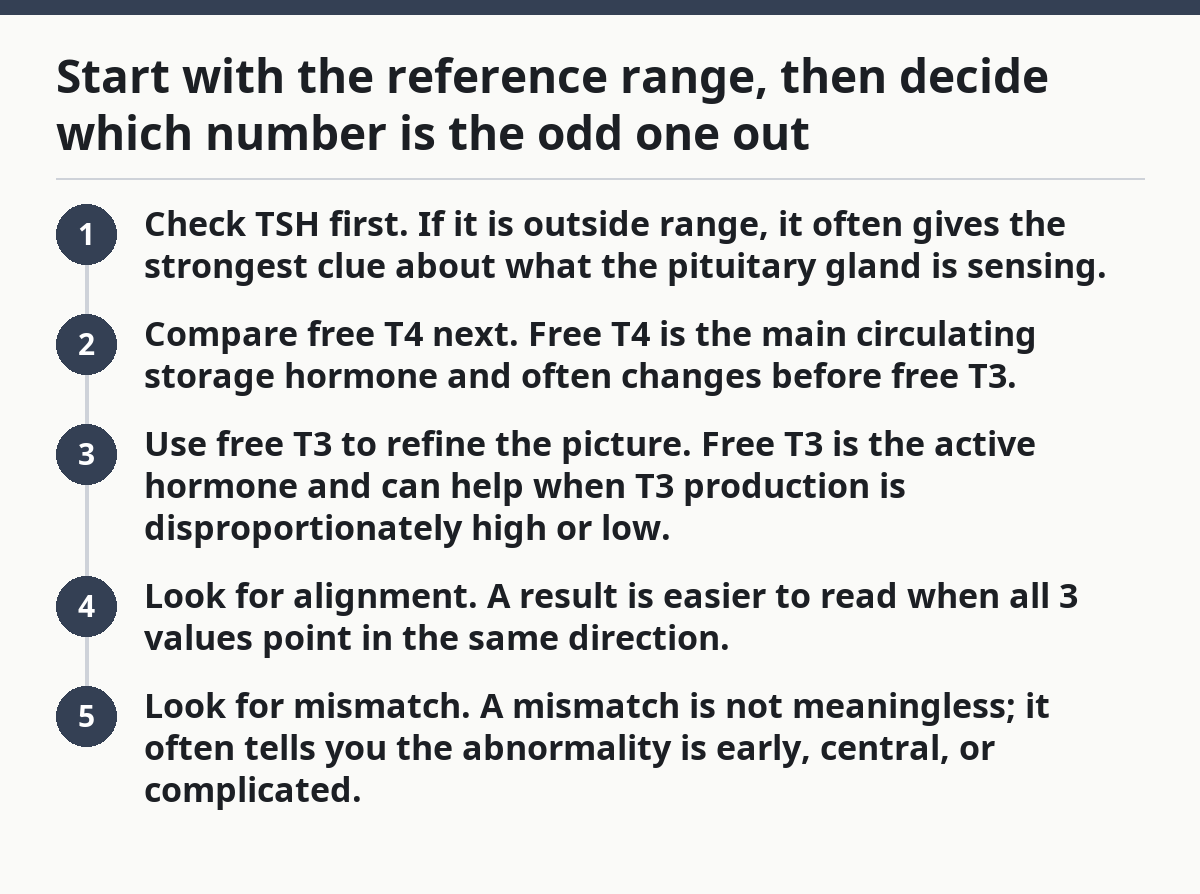
Start with the reference range, then decide which number is the odd one out
The right first step is to compare each result with the laboratory’s reference range, because “normal” depends on the range printed on that report. A TSH of 4.5 may be flagged high in one lab and still sit inside another lab’s upper limit; the same is true for free T4 and free T3. The reference range is not decoration. It is the yardstick.
Begin by marking each value as low, within range, or high. Then ask one practical question: which result does not fit the others? In a typical thyroid blood test panel, TSH is the control signal, while free T4 and free T3 are the output. If TSH is abnormal and the free hormones agree with it, the pattern is usually straightforward. If they disagree, the panel needs more interpretation.
A simple way to think about it:
- Check TSH first. If it is outside range, it often gives the strongest clue about what the pituitary gland is sensing.
- Compare free T4 next. Free T4 is the main circulating storage hormone and often changes before free T3.
- Use free T3 to refine the picture. Free T3 is the active hormone and can help when T3 production is disproportionately high or low.
- Look for alignment. A result is easier to read when all 3 values point in the same direction.
- Look for mismatch. A mismatch is not meaningless; it often tells you the abnormality is early, central, or complicated.
A common mistake is to treat one out-of-range number as the whole story. In a 2024 thyroid blood test panel, that can cost you the real pattern, so consult a clinician if the report is unclear. A mildly low free T3 with a clearly normal TSH is not the same thing as a high free T3 with a suppressed TSH, even though both involve free T3. The first may be a nonspecific pattern; the second is much more suggestive of excess thyroid hormone effect. If you only remember one rule, make it this: compare the numbers against each other before you compare them against a label.
How do I read TSH, free T4, and free T3 together?
You read them by asking what the pituitary gland is trying to do, then checking whether the thyroid hormone levels match that signal. TSH is the command; free T4 and free T3 are the response.
The most useful method is to work through the panel in order.
-
Note whether TSH is high, low, or normal.
A high TSH usually means the pituitary is asking for more thyroid hormone. A low TSH usually means it is backing off because there is enough hormone effect. If TSH sits in range, the axis may be balanced or may be partially masked. -
See whether free T4 agrees with TSH.
High TSH plus low free T4 usually means the thyroid is underperforming. Low TSH plus high free T4 usually means the thyroid is overproducing or there is too much thyroid hormone effect. When TSH and free T4 point in opposite directions, the result deserves a closer look. -
Use free T3 as the tie-breaker, not the lead actor.
Free T3 can be high while free T4 is still normal, especially in early or T3-predominant hyperthyroid patterns. It can also be low when the body is under stress or converting less T4 to T3. A single free T3 value rarely stands alone. -
Sort the panel into one of the common patterns.
That is how the result becomes clinically useful instead of just numerically busy.
A practical example: if TSH is 8.0 and free T4 is low, the pattern is not subtle; the pituitary is signaling too hard because circulating hormone is not enough. If TSH is 0.02 and free T4 is high, the axis is suppressed because the body is seeing too much hormone effect. If TSH is normal and free T4 is normal but free T3 is low, the panel does not automatically prove thyroid disease. That combination may need context from symptoms and the rest of the report.
This approach is not for people trying to self-diagnose from a single printout with no context; if the result is unclear, consult a clinician. It is for anyone who wants to understand why the same TSH number can mean something different depending on free T4 and free T3.
What the common result combinations usually mean
The same 3 tests tend to fall into a handful of recognizable patterns, and each one points in a different direction. The point is not to memorize every rare exception; the point is to recognize the 4 or 5 combinations that show up most often in routine thyroid blood test panels.
-
High TSH, low free T4, often low or low-normal free T3
This is the classic pattern for primary hypothyroidism. The pituitary gland is pushing hard because the thyroid is not supplying enough hormone. The lower free T3 may follow because there is less T4 available to convert. -
Low TSH, high free T4, often high free T3
This pattern usually fits hyperthyroidism or thyroid hormone excess. The pituitary has turned down TSH because the body is already seeing too much hormone effect. -
Low TSH, normal free T4, high free T3
This can happen when T3 rises before T4 does. It is one reason free T3 matters. A panel that looks nearly normal if you stop at TSH and free T4 may still show a thyroid hormone excess pattern when free T3 is included. -
Normal TSH, low free T4, low or normal free T3
This is a mismatch pattern. It is not the classic hypothyroid picture, because TSH is not responding the way you would expect. That makes the result harder to read and means the thyroid axis may not be the whole story. -
Normal TSH, high free T4, normal free T3
This is another mismatch. It can reflect timing, assay issues, or a less straightforward endocrine pattern. It should not be waved away, but it should not be overcalled from a single number either. -
High TSH, normal free T4, normal free T3
This often suggests early or subclinical hypothyroidism. The pituitary is sensing a problem before the free hormone levels clearly fall. The panel is not “normal” just because free T4 and free T3 are still inside range.
The trade-off here is simple: the more normal-looking numbers you have, the less certain the interpretation becomes. That is not a flaw in the test. It is the limit of using blood work to describe a hormone axis that changes over time. A result can be meaningful without being definitive.
A generic article often gets this wrong by making every outlier sound dramatic. It is not dramatic if one marker is barely outside range and the others are solidly normal. It becomes more meaningful when the pattern is repeated across 2 or 3 markers, or when the numbers fit a classic direction such as high TSH with low free T4.
What does it mean if TSH is normal but free T4 is low?
A normal TSH with low free T4 is a mismatch that should not be read as a routine normal thyroid result. The pituitary is not responding as you would expect if the thyroid hormone level is truly low.
That pattern raises the question of whether the problem is in the pituitary gland or somewhere higher in the control system rather than in the thyroid alone. In a straightforward primary thyroid problem, TSH usually rises when free T4 falls. When that does not happen, the pattern needs context and often more evaluation.
This is one place where free T3 can help, but it does not solve the whole question by itself. If free T3 is also low, the picture looks more concerning for a real hormone shortage that is not being signaled normally. If free T3 is normal, the result still needs careful reading, because the normal TSH does not fully match the low free T4.
The practical mistake is to stop at the word “normal.” A normal TSH does not always settle the question when free T4 is low. That mistake can cost time, especially when the lab pattern is early, central, or otherwise atypical. The better move is to treat the result as a pattern problem, not a single-test problem.
Why are TSH and free T4 both abnormal?
TSH and free T4 are both abnormal because the feedback loop is actively reacting, and the direction of the reaction tells you which way the thyroid axis is moving. When TSH and free T4 both move in the same expected direction, the pattern is easier to read; when they move in opposite directions, the pattern is more complicated.
If TSH is high and free T4 is low, the pituitary is trying to drive the thyroid harder but the thyroid is not keeping up. If TSH is low and free T4 is high, the pituitary is suppressing its signal because there is already too much circulating hormone effect. Those are the two cleanest patterns.
When both are abnormal but do not match in the usual way, the result may reflect a central problem, medication effect, recovery phase, or another nonstandard pattern. Free T3 then becomes a useful third data point, but not a final answer. It can show whether the active hormone is also shifted, especially when free T4 and TSH do not give a simple story.
The common error is to assume any abnormal pair means the same disease. It does not. A high TSH with low free T4 has a different meaning than a low TSH with low free T4, even though both have “abnormal” in them. The numbers are telling different stories.
When should free T3 change how you read the panel?
Free T3 should change your reading when TSH and free T4 do not fully explain the pattern, or when the result suggests more active hormone effect than free T4 alone shows. It is especially useful when free T3 is high while free T4 is still normal, or when free T3 is unexpectedly low despite a less striking TSH change.
Think of free T3 as the most behaviorally relevant of the 3 numbers, but not the first one to trust in isolation. The body acts on T3, yet the lab panel still depends on TSH and free T4 to show the control loop. That is why a free T3 result can sharpen the picture without replacing the other two tests.
A few practical rules help:
- If TSH is suppressed and free T3 is high, the panel fits excess thyroid hormone effect even if free T4 is not very high.
- If TSH is high and free T3 is low, that supports reduced thyroid hormone availability, especially when free T4 is also low.
- If free T3 is the only abnormal test, do not force a diagnosis from it alone. The pattern may be real, but it is less complete than a matched TSH and free T4 change.
This is also where overreading becomes easy. A single borderline-low free T3 does not automatically mean thyroid disease. It may reflect a broader physiologic shift. The better question is whether TSH and free T4 move with it, and whether the whole panel points in one direction. That is the practical difference between reading a thyroid blood test panel and staring at three unrelated lab lines.
What is the safest way to use this guide?
A safer way to use this guide is to use it to understand the pattern, then bring the full report to a clinician if the numbers are outside range or do not line up cleanly. Thyroid labs are not read on a 1:1 basis with symptoms, and they are not diagnosed by one value alone.
If you are trying to make sense of the panel yourself, keep 3 limits in mind. First, reference ranges vary by laboratory, so the same number can land differently on different reports. Second, TSH, free T4, and free T3 can disagree, and disagreement is itself a clue. Third, this guide is about pattern interpretation, not treatment decisions.
This is not the page for pre-test preparation, and it is not the page for explaining why values can shift even when you feel unchanged. It is also not the page for medication timing or biotin questions. Those are separate issues because they change the test, not the pattern.
The best use of this guide is simple: compare the numbers, label the pattern, and then ask whether the result looks like classic hypothyroidism, classic hyperthyroidism, a subclinical pattern, or a mismatch that needs a more careful read. That is the difference between a useful thyroid blood test panel and a confusing one. For more background, see the American Thyroid Association’s patient information on thyroid function tests and the NHS guidance on thyroid blood tests.
What does it mean if tsh is normal but free t4 is low?
A normal TSH with a low free T4 is not a routine normal result. It is a mismatch that can point to a problem outside the usual thyroid-only pattern, including possible pituitary involvement or another atypical situation. The key point is that the normal TSH does not fully cancel the low free T4.
Drafted with AI; not yet reviewed by a person.