Supplements, ingredients, and thyroid label safety

Last updated: November 19, 2026
The quick answer is this: thyroid label safety is best judged by two things — the active ingredients in the formula and whether the label is clear enough to avoid accidental overlap with thyroid medication, iodine, stimulants, or hidden glandulars. In this guide to Supplements, ingredients, and thyroid label safety — The Complete Guide, the practical question is whether a label is easy to verify, not whether it sounds impressive. If someone has thyroid disease, is pregnant, or takes levothyroxine or similar medicine, this is a situation to review with a qualified clinician before starting anything new.
Key Takeaways
- A simple, transparent label can be easier to review and may fit a person’s thyroid plan.
- A label becomes risky when it is vague, overloaded, or designed to sound medical without showing exactly what is inside.
- The ingredients that deserve the most caution are iodine, kelp, glandular thyroid extracts, stimulants, and certain botanicals commonly marketed for thyroid support.
- A practical reading order is identity, ingredient list, amounts, warnings, and timing conflicts.
The one question that matters most: is this label safe for thyroid use?
The safest answer is only if the label is simple, transparent, and compatible with the person’s thyroid plan. A thyroid-friendly supplement label is one that clearly lists every ingredient, does not hide proprietary blends, and does not stack iodine, kelp, glandular extracts, caffeine, or “thyroid support” herbs without a clear reason. That matters because thyroid-related supplements sit in a narrow zone where the label can look harmless while the ingredient list creates real risk.
The best way to read these products is to separate label safety from ingredient safety. A clean label can still contain a poor choice for someone with Hashimoto’s, Graves’ disease, thyroid nodules, or a medication schedule that is easy to disrupt. A messy label is worse: it makes it hard to know what is actually in the capsule, what interacts with medicine, and what might be misleading advertising.
PubMed reflects how active this area is: 621 PubMed records match this subject for 2016–2026; the 100 most relevant were read and every median, range and share below is computed across those records — note: the search was widened because the full subject had too little published on it, so these figures describe the wider subject rather than this exact question, with the selection rule supplements[Title/Abstract] AND ingredients[Title/Abstract] AND humans[MeSH Terms] filtered to PubMed, publication date, 2016–2026, sorted by relevance, sample read 100, computed on 2026-10-27. Of those 100 most relevant, 62 (62%) were tagged Review, 8 (8%) Systematic Review, 2 (2%) Meta-Analysis, and 2 (2%) Randomized Controlled Trial, all from PubMed (NCBI).
The practical lesson is plain: label safety is not about chasing the “best thyroid supplement.” It is about avoiding the wrong ingredient, the wrong combination, or the wrong timing. For an individual case, a pharmacist, endocrinologist, or other qualified professional should review the full label, the medication list, and any thyroid diagnosis before use.
What makes a thyroid supplement label risky even before you read the ingredients?
A label becomes risky when it is vague, overloaded, or designed to sound medical without showing exactly what is inside. The biggest red flags are proprietary blends, “thyroid support” claims with no ingredient amounts, and ingredient panels that hide iodine sources under botanical names like kelp or bladderwrack. Those are not just marketing problems; they make it harder to tell whether the product fits a person’s thyroid status at all.
One problem is stacking. A label may combine iodine, selenium, zinc, ashwagandha, tyrosine, guggul, and caffeine in one formula. Each ingredient may have a different role, but together they can create a product that is hard to interpret, especially for someone already taking thyroid medication. Another problem is overpromising. A product that says “supports thyroid function” can still be unsuitable if it includes a stimulant blend, a glandular extract, or a dose pattern that conflicts with a prescription schedule.
A safer label usually has:
- a complete Supplement Facts panel
- listed amounts for each ingredient
- no hidden blend totals
- no vague “proprietary thyroid matrix”
- a clear allergen statement
- a short ingredient list that can be checked against the person’s medication plan
The weakness of a “clean” label is that it can still be incomplete in ways readers miss. For example, it may list iodine but not the source form, or it may list magnesium without noting the compound. Those details matter because they affect how the product is interpreted and whether it looks like a thyroid-support formula or a general multivitamin with a thyroid marketing angle.
Which ingredients deserve the most caution?
The ingredients that deserve the most caution are iodine, kelp, glandular thyroid extracts, stimulants, and certain botanicals commonly marketed for thyroid support. They are not automatically unsafe in every context, but they are the ingredients most likely to create label problems or clinical confusion.
Iodine is the clearest example. It is essential in thyroid hormone production, but more is not better, and people with thyroid disease do not all respond the same way. A label that adds iodine “for thyroid health” without explaining the amount or source deserves scrutiny, especially if it also includes kelp. Kelp can vary naturally in iodine content, which makes the actual intake less predictable than a label may imply.
Glandular or desiccated thyroid-related extracts are a separate concern. If a supplement hints at thyroid tissue, organ support, or glandular ingredients, that is not a casual wellness add-on. Those products can blur the line between supplement and medicine, which is exactly why a qualified professional should review them carefully.
Stimulants matter because symptoms can be misleading. Caffeine, synephrine-like ingredients, and aggressive energy blends may make a person feel “more thyroid active” without addressing any thyroid issue at all. That can confuse the picture if someone is trying to track fatigue, palpitations, or heat intolerance.
Ashwagandha, tyrosine, guggul, and similar botanicals appear often in thyroid formulas, but the research is mixed and context-dependent. Studies suggest these ingredients may affect thyroid-related markers in some settings, but that does not make them broadly appropriate for anyone with thyroid disease. A label that treats them as universally beneficial should be read cautiously, and a clinician should be consulted when thyroid disease or medication use is part of the picture.
The honest downside of this caution is that it makes shopping slower. A person cannot just scan for “thyroid support” and trust the rest. The label has to be read ingredient by ingredient, and if that process raises uncertainty, the product is not a good candidate for self-selection.
How do I read a thyroid supplement label without missing the danger signs?
The safest way to read a thyroid supplement label is to check it in the same order every time: identity, ingredient list, amounts, warnings, and timing conflicts. That sounds basic, but most mistakes happen because the reader skips one of those steps and trusts the front label instead of the fine print.
Start with the product identity. If it is called a “thyroid support,” “metabolism support,” or “adrenal-thyroid” formula, assume the front panel is marketing, not safety. Turn to the Supplement Facts panel and the full ingredient list. Look for every source of iodine, every botanical, every stimulant, and every glandular ingredient. If the product uses a proprietary blend, the label is already less useful because it hides the relative amounts.
Then read the warnings. A serious label should flag pregnancy, breastfeeding, medication use, thyroid disease, and allergy concerns where relevant. A label that has none of those warnings is not automatically safe; it may simply be incomplete.
Next, check for timing conflicts. This matters especially for people taking levothyroxine or other thyroid medication. Even when an ingredient is not inherently dangerous, minerals and fibers in supplements can interfere with absorption if taken too close to medication. The label may not spell that out clearly, so the absence of guidance is itself a problem.
The most overlooked clue is what the label does not say. If it does not identify the iodine source, does not list exact amounts, or does not explain why a botanical is there, that silence should count against it. A careful label answers questions before the customer has to hunt for them.
For a general-reference source on medication safety and ingredient review, the U.S. National Institutes of Health’s MedlinePlus and the NIH Office of Dietary Supplements are useful starting points. The NIH Office of Dietary Supplements has fact sheets on iodine and selenium, and MedlinePlus can help users check supplement and drug information, though neither replaces individual medical advice. A pharmacist or endocrinologist remains the right person to interpret a specific bottle in the context of a specific diagnosis.
What should be on a safer thyroid-friendly label?
A safer thyroid-friendly label is one that is boring in the best way: it says exactly what is in the bottle and nothing more dramatic than necessary. The best labels for this use case usually have a short ingredient list, modest formulation claims, and no mystery ingredients that try to “do everything.”
Here is the practical profile of a safer label:
- every ingredient is named clearly
- the source of iodine, if present, is explicit
- mineral forms are listed, not just umbrella names
- the panel avoids glandular or organ-based ingredients unless a clinician has reviewed them
- there is no proprietary blend hiding the dose structure
- warnings are visible and specific
- the product does not read like a stimulant formula in a thyroid costume
This kind of label is strongest for someone who wants a basic nutritional supplement and is trying to avoid accidental thyroid overlap. It is not a substitute for medical treatment, and it is not automatically the right choice for everyone with thyroid disease. But it is easier to evaluate, easier to compare, and less likely to create surprises.
The weakness is that safer labels can look less exciting. They may seem too simple compared with “advanced thyroid complex” products that promise energy, weight, mood, and metabolism support in one capsule. That simplicity is the point. In thyroid-sensitive situations, fewer ingredients usually means fewer unknowns.
A label becomes less safe when it tries to solve too many problems at once. If a product claims to support thyroid function, adrenal function, metabolism, and mood all in one line, the burden of proof rises. A reader should not have to decode a whole wellness pitch to learn whether iodine or a stimulant is in the bottle.
The honest side-by-side: broad thyroid-support formulas vs. minimal ingredient formulas
Broad thyroid-support formulas win when the goal is a marketed “all-in-one” product and the user understands the trade-offs. Minimal ingredient formulas win when the goal is label clarity, lower interaction risk, and easier review by a clinician or pharmacist.
| Criteria | Broad thyroid-support formula | Minimal ingredient formula | Winner for this condition |
|---|---|---|---|
| Ingredient transparency | Often lower if proprietary blends are used | Usually higher because each ingredient is listed plainly | Minimal ingredient formula for label review |
| Chance of hidden overlap with thyroid care | Higher, especially with iodine, botanicals, and stimulants together | Lower when the panel is short and explicit | Minimal ingredient formula for medication users |
| Need for professional review | Higher because interpretation is harder | Still wise, but easier to assess | Minimal ingredient formula for quick screening |
| Marketing clarity | Usually stronger | Usually weaker | Broad formula for shoppers who want “all-in-one” messaging |
| Risk of stimulant confusion | Higher if energy ingredients are included | Lower if the formula is simple | Minimal ingredient formula for people tracking symptoms |
| Ease of comparing labels | Harder because formulas differ widely | Easier because the same few ingredients stand out | Minimal ingredient formula for comparison shopping |
| Potential to overpromise | Higher | Lower | Minimal ingredient formula for skeptical readers |
| Best fit with thyroid medication | Less predictable without clinical review | More manageable, though timing still matters | Minimal ingredient formula for people on levothyroxine |
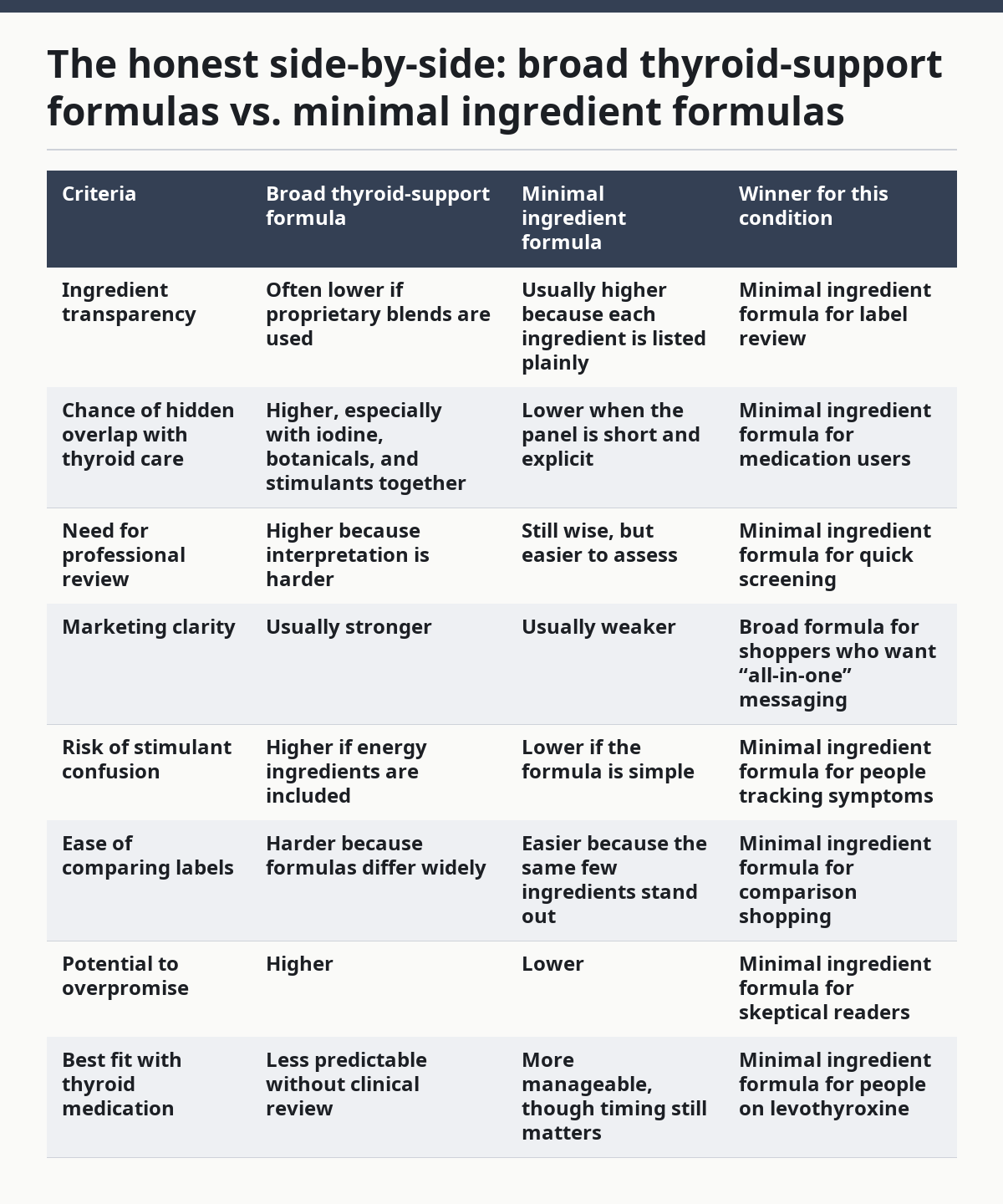
The broad formula wins only when a person is already comfortable reading labels, has no relevant medication conflicts, and has gotten a professional okay for the full ingredient set. Even then, the drawback is real: more ingredients mean more opportunities for overlap, side effects, and confusion about what caused what.
The minimal formula is not “better” in every abstract sense. It is better for the reader who wants a product that is easier to evaluate, easier to pause if needed, and less likely to contain a hidden thyroid-related landmine. That is why it wins most label-safety decisions.
When does the recommendation flip?
The recommendation flips when the product is not being used as a casual supplement but as part of a medically managed plan. In those situations, a broader formula can sometimes be the better choice — but only after review.
One flip case is documented deficiency correction. If a qualified professional has identified a specific nutrient gap, a targeted formula with one or two ingredients may be more appropriate than a minimalist label that looks tidy but misses the actual need. The label still has to be clear, but the goal changes from “lowest risk” to “correct the specific issue.”
Another flip case is a medication-free person with a very simple formula. If a product contains a small number of well-identified nutrients, no stimulant blend, no glandulars, and no ambiguous thyroid claims, the label may be acceptable even if it sounds more specialized than minimal. The key is not the marketing style; it is the actual panel.
A third flip case is when a clinician specifically recommends monitoring the exact ingredient set. In that setting, a more complex label may be acceptable because the complexity is intentional and supervised. The reader should still avoid self-selecting a formula just because it sounds thyroid-focused.
A fourth flip case is any product that contains iodine plus another active thyroid-oriented ingredient. That combination deserves extra caution. The more the label tries to act on thyroid function directly, the less appropriate it is for unsupervised use.
The honest rule is this: the verdict flips only when the supplement has a clear medical reason for being more complex, and that complexity is being watched by a qualified professional. Without that oversight, simpler is safer.
The verdict: which kind of thyroid label is safer?
Choose the minimal ingredient formula if the goal is to reduce thyroid-related label risk, make ingredient review easier, or avoid accidental overlap with medication. Choose the broad thyroid-support formula only if a qualified professional has reviewed the full label and the product has a clear reason to be more complex. Neither is a good choice if the label hides amounts, uses a proprietary blend, includes glandular ingredients without a clear medical rationale, or is being considered as a substitute for thyroid care.
That is the cleanest call because it matches the real-world decision. A person with thyroid disease does not need more hype; they need fewer unknowns. In this category, the best label is usually the one that gives the reader the most information and the fewest surprises.
What should make me put the bottle back on the shelf?
The bottle should go back on the shelf if the label is vague, packed with overlapping active ingredients, or built around a thyroid claim that sounds stronger than the evidence behind it. A few signs are especially hard to ignore: no exact amounts, a proprietary blend, hidden iodine sources, glandular extracts, or a stimulant-heavy formula disguised as wellness support.
One practical rule helps here: if the reader cannot explain every major ingredient in one sentence, the label is probably too complicated for self-selection. That is especially true for products aimed at thyroid support, where the same capsule may affect symptoms, lab interpretation, medication timing, and anxiety about the condition itself.
The strongest case for skipping a product is simple uncertainty. A supplement does not need to be dangerous to be a bad choice. If the label is too dense, too commercial, or too hard to match to the person’s diagnosis and medication schedule, the right answer is not to “see what happens.” The right answer is to stop and ask a pharmacist, endocrinologist, or other qualified professional to review it.
That is not overcaution. It is the correct response to a category where ingredients can matter more than branding.
FAQ
How do I know if a thyroid supplement is label-safe?
A thyroid supplement is label-safe when every ingredient is named, every amount is visible, and nothing hidden changes the risk profile. If the label uses a proprietary blend, buries iodine sources, or mixes stimulants with thyroid-oriented botanicals, it deserves extra scrutiny before anyone with thyroid disease uses it.
Are iodine and kelp the same thing on a label?
No, they are not the same thing, and that difference matters. Iodine is the nutrient; kelp is a source that can vary in iodine content, which makes the label harder to interpret. A product that names kelp should be read more carefully than one that lists a clear iodine form and amount.
Can a “natural” thyroid supplement still be risky?
Yes. “Natural” does not mean thyroid-safe, and it does not mean interaction-free. Botanicals, glandular extracts, iodine sources, and stimulant blends can all create problems depending on the person, the diagnosis, and the medication list.
Should someone on levothyroxine treat every supplement as a problem?
No, but the label should be reviewed before anything new is added. Some supplements may be compatible, while others can interfere with absorption or muddy symptom tracking. A pharmacist or endocrinologist is the right person to sort out timing and ingredient overlap.
Is a shorter ingredient list always better?
Usually, yes, for thyroid label safety. A shorter list is easier to verify and less likely to hide an interaction, but the ingredient quality still matters. A short label with iodine, stimulants, or glandulars can still be the wrong choice for a given person.
Drafted with AI; not yet reviewed by a person.