Last updated: November 19, 2026
Quick Answer: Thyroid-specific eating patterns work best for most people when they focus on 3 things: medication timing, enough protein and fiber, and avoiding excess iodine. Thyroid-specific eating patterns are meal plans built around one goal: support thyroid function while protecting medication absorption and steadying symptoms such as fatigue, constipation, and weight swings. The right pattern depends on the thyroid problem itself, the medicines being used, and whether the person needs iodine correction, gluten removal, or just better timing and consistency.
Key takeaways
- The first fix is usually not a special diet; it is taking thyroid medicine the right way and leaving enough time around calcium, iron, and coffee. The American Thyroid Association advises consistent levothyroxine timing and spacing from interfering supplements.
- People with Hashimoto’s often ask about gluten, but the strongest reason to avoid it is confirmed celiac disease or a clear medical reason, not thyroid disease alone. The National Institute of Diabetes and Digestive and Kidney Diseases recommends testing before gluten removal when celiac disease is suspected.
- Too much iodine can worsen thyroid disease, especially autoimmune thyroiditis, so “more seaweed” is not a safe default. The American Thyroid Association warns against excess iodine from supplements and seaweed.
- Protein, fiber, and regular meals help many people with hypothyroidism feel less wiped out and less constipated, but they do not replace treatment; for thyroid-specific eating patterns, ask a clinician if symptoms persist.
- A thyroid-specific pattern can help, but it is wrong for anyone trying to use food as a substitute for levothyroxine, liothyronine, methimazole, or surgery when those are needed. MedlinePlus and the NIDDK both describe medication as core treatment.
What a thyroid-specific eating pattern is actually trying to do
A thyroid-specific eating pattern is not one diet; it is a set of food rules matched to a thyroid diagnosis. For hypothyroidism, the usual aim is to avoid blocking medication, prevent nutrient gaps, and reduce symptoms that make life miserable, such as sluggish bowels and energy dips. For hyperthyroidism, the aim changes: the person may need enough calories, enough protein, and sometimes more attention to bone health because the body is running hot and burning through reserves.
The biggest mistake is treating “thyroid diet” as a cure. Food can help correct specific problems, but it cannot restart a failing thyroid gland or calm Graves’ disease by itself. The American Thyroid Association and the National Institute of Diabetes and Digestive and Kidney Diseases both emphasize medical treatment as the core of care; diet sits beside that, not above it. If a page on thyroid eating ignores medication and diagnosis, it is selling a fantasy, so consult a clinician before making major changes.
A useful thyroid pattern usually has four parts:
- Medication timing — levothyroxine is commonly taken on an empty stomach, separated from calcium and iron.
- Mineral balance — enough iodine, selenium, iron, and zinc, but not megadoses.
- Meal structure — enough protein and fiber to support satiety, bowel regularity, and muscle mass.
- Trigger control — for some people, this means a gluten-free plan, a low-iodine plan, or a short-term calorie-dense pattern.
The right pattern is diagnosis-specific. Someone with Hashimoto’s and normal labs does not need the same food rules as someone with active Graves’ disease, and someone on methimazole does not need the same diet as someone recovering from thyroidectomy.
Do thyroid diets really work?
They work best when they solve a real problem instead of promising a miracle. A thyroid-specific pattern can improve symptoms indirectly by making medication work as intended, reducing constipation, filling nutrient gaps, and avoiding excess iodine or other diet traps. What it cannot do is reliably “fix” autoimmune thyroid disease on its own, so ask a professional before expecting food to do the job of medicine.
For hypothyroidism, the most practical benefit often comes from consistency. Levothyroxine is sensitive to food timing, coffee, calcium, iron, and some supplements. If the drug is taken at different times each day, or if breakfast changes from light to heavy to high-fiber, lab numbers can swing around. That alone can create the feeling that the thyroid is “unstable” when the real issue is absorption.
For Hashimoto’s, some people report less bloating or joint discomfort on a gluten-free diet, but that does not mean gluten is the main problem for everyone. The clearest medical reason to remove gluten is celiac disease, which is more common in people with autoimmune thyroid disease than in the general population. A clinician may reasonably screen for it if symptoms point that way. Without celiac disease, a gluten-free diet is a judgment call, not a universal rule.
For hyperthyroidism, eating enough matters more than people expect. Appetite can rise, but body weight can still fall because the metabolic rate is raised. That is where a thyroid-specific pattern helps: frequent meals, higher energy density, and enough protein to limit muscle loss. It is support, not a cure, so consult a clinician if weight loss is rapid.
The wrong expectation is this: “If I eat clean enough, I won’t need treatment.” That belief delays care and can make symptoms worse for months. A thyroid-specific eating pattern earns its keep when it makes standard treatment work better, not when it replaces it.
The most important food rules for hypothyroidism
Hypothyroidism usually does best with a pattern that is boring, repeatable, and medication-friendly. The winning move is not a special cleanse or a 12-step restriction list; it is protecting levothyroxine absorption and making sure the day’s food actually helps energy and bowel function.
The first rule is spacing. Calcium supplements, iron supplements, antacids, and some multivitamins can interfere with levothyroxine. Coffee can also interfere if taken too close to the dose. The safest pattern is to take the medicine the same way every day, then keep breakfast, supplements, and coffee at a consistent interval. The exact interval should follow the prescribing clinician’s instructions, because formulations and individual responses vary.
The second rule is to eat enough protein. Eggs, Greek yogurt, poultry, tofu, fish, legumes, and lean meat help preserve lean mass and can reduce the feeling of being “dragging all day.” They also make breakfast less likely to spike hunger an hour later. A breakfast of toast alone is usually a poor fit for someone fighting hypothyroid fatigue.
The third rule is to keep fiber high enough to help constipation, but not so aggressively high that it becomes another absorption problem. Beans, oats, berries, vegetables, chia, and flax are all useful, yet suddenly jumping to a very high-fiber pattern can change how medication behaves. A slower increase is smarter than a dramatic overhaul.
The fourth rule is to avoid iodine excess. Seaweed snacks, kelp supplements, and “thyroid support” blends can contain very large iodine amounts, and that can backfire in autoimmune thyroid disease. The safe instinct is not “more is better”; it is “stay near normal food patterns unless a clinician says otherwise.”
This pattern is wrong for someone who wants instant weight loss through fasting or extreme restriction. It is also wrong for someone who ignores the medicine schedule and then blames food alone when labs drift. The real benefit comes from ordinary food used consistently, not heroic dietary discipline.
Hashimoto’s: when gluten-free helps and when it doesn’t
A gluten-free pattern is the most debated thyroid diet, and it is only clearly justified in a few situations. It is the right call if the person has celiac disease, wheat allergy, or a clinician-directed trial for persistent symptoms with a strong autoimmune picture. It is not automatically required just because Hashimoto’s exists.
The reason gluten comes up so often is that celiac disease and autoimmune thyroid disease can travel together. If a person with Hashimoto’s has chronic diarrhea, iron deficiency, bloating, unexplained weight loss, mouth ulcers, or a family history of celiac disease, screening is worth discussing with a clinician before making major food changes. Removing gluten before testing can complicate diagnosis.
If celiac disease is not present, gluten-free eating may still help some people feel less bloated or more in control of eating patterns. That can be real without being universal. The problem is cost: gluten-free products are often more expensive, less convenient, and lower in fiber unless the person learns how to build meals from naturally gluten-free foods like potatoes, rice, beans, fruit, eggs, dairy, meat, fish, tofu, and vegetables.
A gluten-free thyroid pattern wins for the person who has:
- confirmed celiac disease,
- a clear gluten-related diagnosis,
- or a supervised elimination trial with a defined reintroduction plan.
It loses for the person who has:
- no celiac disease,
- no clear symptom relationship,
- and a tendency to turn every meal into a label-reading exercise.
The trade-off is simple: a gluten-free pattern can make life cleaner for the right patient, but it is not a thyroid treatment. If the food rules become more complicated than the disease they are meant to help, the pattern has failed.
For a trustworthy medical overview, the Celiac Disease Foundation and the National Institute of Diabetes and Digestive and Kidney Diseases both publish patient-facing material on celiac disease and testing. The American Thyroid Association also has patient education on autoimmune thyroid disease and related diet questions.
Graves’ disease and hyperthyroidism: what to eat when your body is running fast
A hyperthyroid eating pattern should usually be calorie-dense, protein-forward, and easy to tolerate. The problem in Graves’ disease or other forms of hyperthyroidism is not lack of willpower; it is that the body is burning fuel too quickly. Food needs to replace that fuel before muscle and bone take the hit.
This is the opposite of a weight-loss plan. Skipping meals is a bad fit because it can worsen weakness, tremor, and irritability. A better structure is three meals plus snacks, with each meal containing protein, carbohydrate, and fat. Smoothies, nut butters, yogurt, avocado, eggs, rice bowls, soups with beans or meat, and fortified milk or soy milk can be useful because they are easier to get down when appetite is unreliable. For many people, 3 meals and 2 snacks is a practical target.
Calcium and vitamin D matter because untreated hyperthyroidism can affect bone turnover. That does not mean megadoses are needed; it means the pattern should include regular calcium-rich foods unless there is a medical reason not to. In some cases, a clinician will also want a bone health assessment, especially if the hyperthyroidism has been prolonged.
Iodine is the big warning sign here. Some people assume that iodine is always helpful for the thyroid, but in Graves’ disease and certain nodular thyroid problems, excess iodine can worsen things. Seaweed, kelp capsules, and iodine-heavy supplements are poor choices unless a clinician has given a specific reason to use them.
This pattern is wrong for someone who is trying to “detox” Graves’ disease with fasting, cabbage juice, or a supplement stack. It is also wrong for anyone whose symptoms are severe enough that eating is barely happening; that needs medical attention, not just menu planning.
The honest strength of this pattern is practical: it helps preserve body mass while standard treatment takes effect. The weakness is that it can feel emotionally upside-down to eat more when weight is already dropping. That is exactly why it is useful. Hyperthyroidism often makes hunger and weight signs misleading.
The honest side-by-side
A thyroid-specific eating pattern is not one choice; it is a decision between a broad, symptom-supportive pattern and a more restrictive diagnosis-driven pattern. The broad pattern works for most people with treated thyroid disease. The restrictive pattern wins only when there is a specific medical reason, such as celiac disease, iodine sensitivity, or a clinician-directed short-term plan.
| Criteria | Broad thyroid-supportive pattern | Restrictive thyroid-specific pattern | Winner for this condition |
|---|---|---|---|
| Medication compatibility | Easier to keep consistent with daily levothyroxine timing | Harder if it adds many supplement rules or meal timing changes | Broad pattern when the goal is steady absorption |
| Nutrient adequacy | Easier to cover protein, fiber, and calories | Can be excellent, but only if carefully planned | Broad pattern for most everyday patients |
| Hashimoto’s symptom trials | May not remove a food trigger if one exists | Can help if gluten or another food is truly a trigger | Restrictive pattern when celiac disease or a supervised trial is in play |
| Hyperthyroidism support | Good for regular meals and weight maintenance | Can be useful if calories are very hard to keep up | Restrictive pattern only if needed for a documented reason |
| Risk of overrestriction | Low | Higher, especially with multiple exclusions | Broad pattern for people prone to food anxiety |
| Ease of long-term adherence | Higher | Lower unless the diagnosis strongly justifies it | Broad pattern for chronic management |
| Cost and practicality | Usually simpler and cheaper | Often more expensive and label-heavy | Broad pattern for families and busy schedules |
| Iodine control | Moderate, with ordinary food choices | Can be necessary in special cases | Restrictive pattern when excess iodine is part of the problem |
| Best fit for treatment stage | Stable disease or routine management | Active symptoms, celiac disease, or clinician-guided intervention | Depends on the diagnosis and current labs |
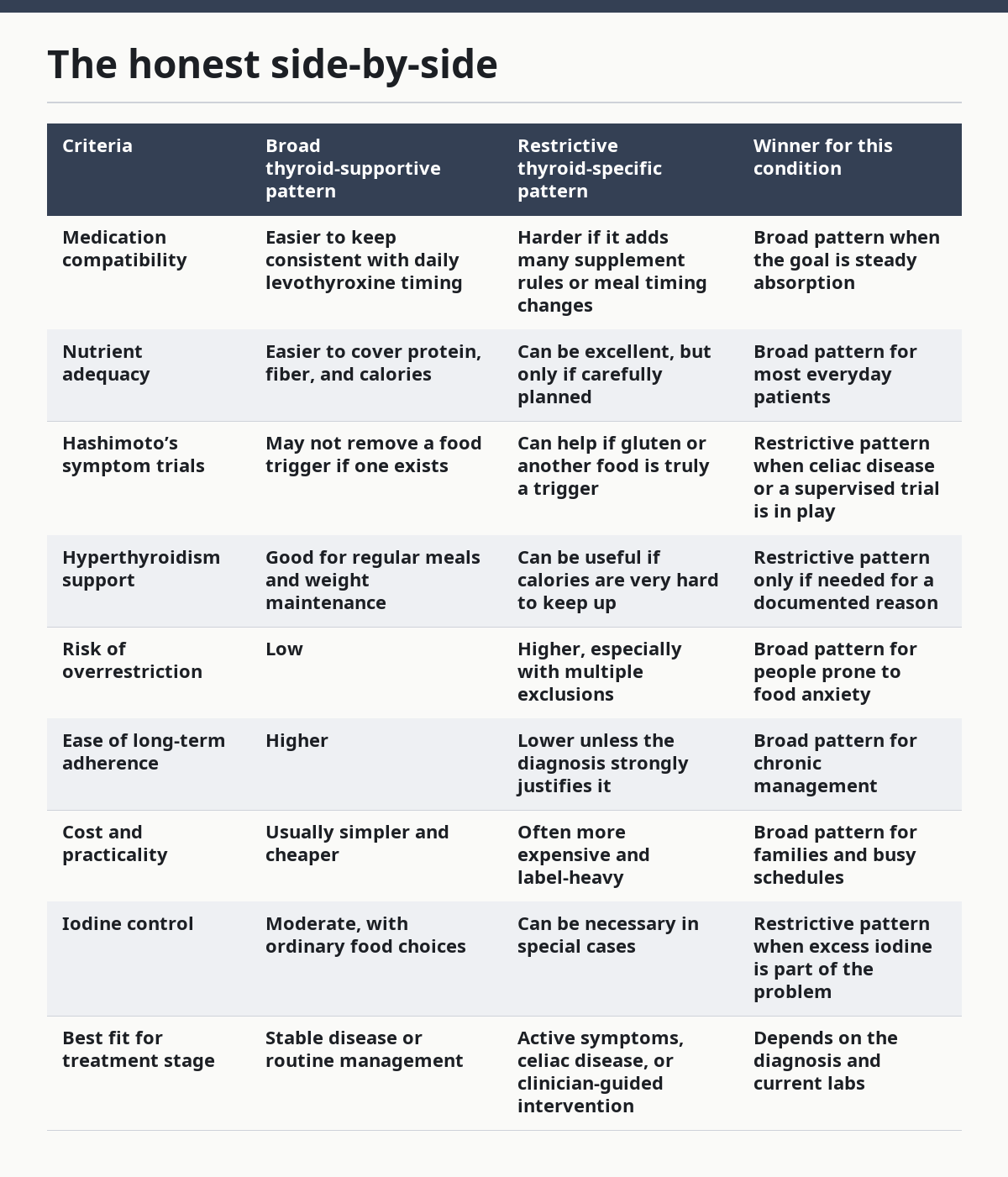
The table points to one clear conclusion: the broad pattern wins for most people because it is easier to follow, less expensive, and less likely to create new problems. The restrictive pattern wins only when there is a concrete reason that outweighs those costs.
When a thyroid diet should be tighter — and when it should be looser
A tighter pattern is justified when there is a defined diagnosis, not just a vague feeling that “something is off.” Celiac disease is the clearest example. If gluten damage is confirmed, avoiding gluten is not optional management; it is treatment. Another reason is excess iodine exposure from supplements or unusual food habits. In that case, tightening the pattern around iodine makes sense because the exposure itself is part of the problem.
A looser pattern is better when thyroid disease is treated and stable, when labs are moving in the right direction, and when the main challenge is day-to-day consistency. That usually means a regular eating schedule, sensible portions, and a small number of rules that can actually be followed on a workday. It also means leaving room for normal social eating instead of turning every restaurant meal into a medical event.
There are three common mistake states:
- The “everything is forbidden” state — the person cuts gluten, dairy, soy, sugar, seed oils, nightshades, and caffeine at once. That usually produces burnout.
- The “food will fix this” state — the person stops treatment and chases supplements. That delays care.
- The “nothing matters” state — the person takes medication randomly and eats in a way that makes absorption unpredictable. That undermines treatment.
A tighter thyroid-specific pattern is right when there is a clear target. A looser one is right when the thyroid condition is already being treated and the job is to support, not micromanage, the body.
For readers who want a professional standard on iodine and thyroid disease, the American Thyroid Association’s patient resources are a useful starting point. The National Institute of Diabetes and Digestive and Kidney Diseases also has patient guidance on thyroid disease and related nutrition issues.
Which thyroid-specific eating pattern should you choose?
Choose the broad thyroid-supportive pattern if your thyroid disease is treated, your labs are monitored, and your main goal is steady medication absorption plus better day-to-day energy. Choose the restrictive pattern if you have confirmed celiac disease, a clinician-directed elimination trial, or a clear iodine-related reason to tighten food choices. Neither if you are trying to use diet alone to replace thyroid medication or to treat severe symptoms without medical care.
That is the cleanest answer because it matches the real decision. Most people do not need a dramatic thyroid diet. They need a disciplined, ordinary eating pattern that respects medication timing, avoids excess iodine, and gives the body enough protein, fiber, and calories to function.
The cost of choosing the wrong pattern is not theoretical. Overrestriction can make eating miserable and nutritionally thin. Underrestriction can keep symptoms muddy and labs unstable. The best choice is the one that addresses the actual diagnosis, not the one that sounds most extreme.
Frequently asked questions
Should I stop eating gluten if I have Hashimoto’s?
Not automatically. Gluten-free eating is most clearly recommended when celiac disease, wheat allergy, or another specific reason is present. If there are digestive symptoms, iron deficiency, or a family history of celiac disease, testing should come before cutting gluten so the diagnosis is not obscured.
Can food lower my thyroid antibodies?
Food may help symptoms and may reduce inflammation in some people, but it does not reliably normalize thyroid antibodies on its own. Antibody levels are only one piece of the picture, and treatment decisions usually depend more on thyroid function, symptoms, and the clinician’s assessment than on a single lab value.
Is iodine good or bad for thyroid disease?
It depends on the condition and the dose. Normal dietary iodine is necessary, but excess iodine from seaweed, kelp supplements, or high-dose products can worsen some thyroid problems, especially autoimmune disease and hyperthyroidism. A clinician should guide iodine changes when thyroid disease is already diagnosed.
What should I eat on levothyroxine?
Take levothyroxine exactly as prescribed, then keep timing around breakfast, coffee, calcium, and iron consistent. The food itself matters less than the timing discipline. A steady routine helps keep absorption more predictable than a constantly changing breakfast pattern.
Is there one best diet for thyroid disease?
No. The best pattern depends on whether the problem is hypothyroidism, Hashimoto’s, Graves’ disease, or something else, and on whether the person also has celiac disease or nutrient deficiencies. For many people, a simple, consistent, protein-containing pattern is more useful than a highly restrictive plan.
Drafted with AI; not yet reviewed by a person.