How to Read Reverse T3: What It Measures and When It Is Ordered

Last updated: November 20, 2026
Key Takeaways
- Reverse T3 shows one thyroid hormone pathway, not your full thyroid status.
- Clinicians usually order reverse T3 for complex thyroid cases, especially when illness, fasting, or stress may affect conversion.
- Reverse T3 reflects how the body handles T4 conversion, not a simple yes-or-no thyroid function result.
- Reverse T3 can rise when the body slows thyroid hormone activation during illness, starvation, or major stress.
Reverse T3 is a thyroid-related blood marker that reflects how much T4 is being diverted into an inactive form, and it’s usually ordered only in special cases, not as a routine thyroid test. This guide on How to Read Reverse T3: What It Measures and When It Is Ordered explains what reverse T3 measures, when clinicians ask for it, and why the result has real limits.
What reverse T3 actually measures
Reverse T3 measures one route of thyroid hormone metabolism, not your whole thyroid status. It is made from T4, the main hormone released by the thyroid, when the body changes it into a form that does not act like T3.
Picture this: you’ve got a thyroid panel in front of you and one result says reverse T3. You want to know if it means overactive thyroid, underactive thyroid, or something else entirely. The answer is it does not tell the full story.
Reverse T3 is part of the body’s hormone traffic pattern. T4 can follow different paths, and reverse T3 is one of the dead-end routes. That matters because a higher reverse T3 can show that the body is shifting hormone away from active T3 production, but it does not by itself diagnose a thyroid disease; a clinician should interpret it in context, often alongside free T4 and free T3, and may also consider guidance from the American Thyroid Association.
- T4 is the starting material.
- T3 is the active hormone.
- Reverse T3 is the inactive product of a different conversion path.
The test is usually discussed alongside free T4 and free T3, because those are the values that help show what the thyroid is doing at the hormone level. Reverse T3 is more of a metabolism clue than a stand-alone answer. For a broader lab framework, the hub on thyroid lab testing and interpretation is the better next stop for the overall picture.
When do clinicians order reverse T3?
Clinicians usually order reverse T3 when they are trying to sort out a complicated thyroid picture, especially if illness, fasting, or stress may be changing hormone conversion. They do not order it as a first-line test for every thyroid complaint.
Picture this: you have fatigue, brain fog, or cold intolerance, but the usual thyroid labs do not explain the whole picture. A clinician may look at reverse T3 when they suspect non-thyroidal illness or another situation that can change how the body handles T4.
Here’s the catch: reverse T3 tends to be used in narrow settings, not in routine screening. Common situations that may be associated with a higher reverse T3 pattern include:
- A hospitalized patient with significant illness
- A person with major calorie restriction or recent fasting
- A thyroid case where the usual pattern does not fit the symptoms
- A situation where the clinician is thinking about thyroid hormone metabolism, not just thyroid gland output
A practical way to think about it is this: reverse T3 may help explain why T4 is not turning into as much active T3 as expected. It does not replace the usual thyroid tests, and it does not stand alone as proof of a thyroid problem. For more context on standard thyroid evaluation, see TSH testing and free T4.
The test is far less useful if you are trying to answer a simple question like “Do I have hypothyroidism?” That question usually starts with other labs and the clinical picture, not reverse T3. If symptoms are the concern, hypothyroidism symptoms can help frame the discussion.
How reverse T3 is usually used
- Start with the reason for testing. The setting is usually a complex illness, fasting, or a confusing thyroid workup, not routine screening.
- Check the other thyroid markers first. Free T4 and free T3 help show whether the hormone pattern matches the symptoms.
- Look for a conversion shift. A higher reverse T3 can suggest the body is favoring an inactive path from T4.
- Interpret it with the illness context. A hospitalized patient with inflammation or poor intake can show a different pattern than an outpatient with stable health.
- Use it as a clue, not a verdict. The result adds context, but it does not diagnose on its own; a clinician should interpret it with the rest of the thyroid workup, and the Mayo Clinic notes that thyroid testing should be read in context.
What does reverse T3 tell you?
Reverse T3 tells you how the body is handling T4 conversion, not whether the thyroid gland is “working” in a simple yes-or-no way. A high result can point toward a slowdown in active hormone production, often in the setting of illness or stress.
Picture this: you’re staring at a lab report and wondering why a number can be high while the thyroid isn’t necessarily the main problem. Reverse T3 often rises when the body is under strain, and that can happen during non-thyroidal illness.
That is why clinicians treat it as a context marker; if the result is confusing, they may ask you to review it with a professional who can interpret the broader clinical picture and related labs, rather than using the number alone. It can suggest:
- More T4 is being shunted into reverse T3
- Less T4 may be available for conversion into T3
- The body may be responding to illness, calorie shortage, or physiologic stress
What it does not tell you is equally important. It does not show the full thyroid response, and it does not prove that symptoms are caused by thyroid disease. A person can have thyroid-like symptoms from many causes, and reverse T3 cannot separate all of them. For additional background, the Cleveland Clinic and MedlinePlus both emphasize that lab interpretation depends on the clinical setting.
The number also has a practical limit: a single reverse T3 result can be hard to act on without the rest of the labs and the clinical setting. That’s why it is not usually the first test ordered, and it is rarely the only one that matters.
Why reverse T3 can rise with illness
Reverse T3 can rise when the body slows down thyroid hormone activation during illness, starvation, or major stress. That pattern is one reason the test comes up in inpatient care and in other higher-stress settings.
Picture this: you are dealing with an infection, surgery recovery, or a long stretch of poor intake. The body may shift hormone use to conserve energy, and that can change the balance between free T4, free T3, and reverse T3.
This is where the term non-thyroidal illness matters. The thyroid gland may not be the core problem at all. Instead, the body changes hormone conversion because it is under strain. The Merck Manual describes this pattern as part of the illness response.
Common situations tied to a higher reverse T3 pattern include:
- Acute illness
- Hospitalization
- Starvation or major calorie restriction
- Severe stress on the body
This helps explain why a thyroid panel can look “off” even when the thyroid gland itself is not the main issue. The hard part is that the lab pattern can look unsettling if you don’t know the context.
A high reverse T3 in illness is usually a clue to the body’s response, not a target for casual treatment. If you are considering treatment changes, consult a clinician before acting on the result, because the right response depends on the full thyroid panel and the person’s condition.
What are the limits of reverse T3 testing?
Reverse T3 testing has limited day-to-day value because the result can be hard to use on its own and does not settle the question of thyroid disease. It is a support test, not a first answer.
Picture this: you want a clean yes-or-no result, but reverse T3 gives you a slice of the metabolism story instead. That mismatch is the main reason the test frustrates people who expect it to behave like a direct thyroid gauge.
The main limits are straightforward:
- It does not diagnose hypothyroidism or hyperthyroidism by itself.
- It does not replace free T4 or free T3.
- It can shift with illness, diet, and stress.
- It may reflect a temporary state rather than a chronic thyroid problem.
That means a high result can be real and still not point to a thyroid treatment decision. It can simply mean the body is changing hormone conversion for reasons that have nothing to do with the thyroid gland itself.
Another issue is overreading the test. A single reverse T3 number can tempt people to treat the lab instead of the patient. That is a bad trade. The number is a clue, not a final interpretation.
Common mistakes people make with reverse T3
- Treating it as a screening test. That can cost time and miss the real cause.
- Reading it without the illness context. That can lead to the wrong conclusion.
- Using it instead of standard thyroid tests. That leaves out the basics.
- Assuming symptoms prove a reverse T3 problem. Symptoms overlap with many conditions.
How should a reverse T3 result be read in practice?
A reverse T3 result should be read as one piece of a thyroid metabolism picture, not as a stand-alone diagnosis. The useful question is whether the result fits the clinical setting and the other thyroid labs.
Picture this: you are looking at a report that includes reverse T3, free T4, and free T3, and you want to know what matters first. Start with the reason the test was ordered, because the setting changes the meaning.
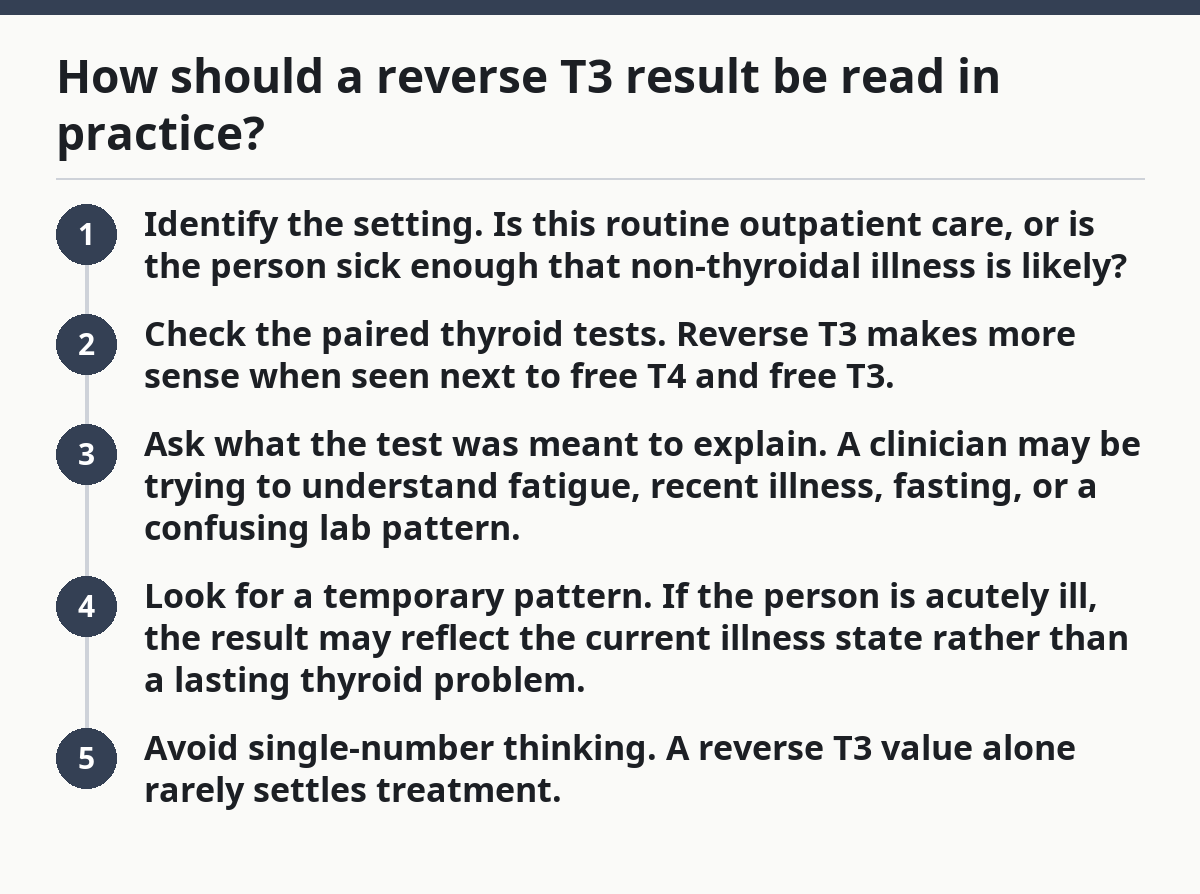
A practical reading approach looks like this:
- Identify the setting. Is this routine outpatient care, or is the person sick enough that non-thyroidal illness is likely?
- Check the paired thyroid tests. Reverse T3 makes more sense when seen next to free T4 and free T3.
- Ask what the test was meant to explain. A clinician may be trying to understand fatigue, recent illness, fasting, or a confusing lab pattern.
- Look for a temporary pattern. If the person is acutely ill, the result may reflect the current illness state rather than a lasting thyroid problem.
- Avoid single-number thinking. A reverse T3 value alone rarely settles treatment.
The truth is, this test is most useful when it helps explain why thyroid hormone handling looks different from what you expected. It is least useful when it is treated like a shortcut around the rest of the workup.
If you want the full read, reverse T3 belongs inside a larger thyroid lab interpretation process, not outside it. For related context, see T3 test and thyroid antibody tests.
What should you ask if reverse T3 is on your lab order?
You should ask why the test was ordered and what question it is supposed to answer. That is the simplest way to judge whether reverse T3 is useful in your case.
Picture this: you see reverse T3 listed on an order set and you are not sure if it adds anything. The right question is not “Is this number good or bad?” It is “What problem is this meant to clarify?”
The American Thyroid Association and other clinical sources emphasize using thyroid testing in context, so questions should stay practical:
- Is the concern non-thyroidal illness?
- Is the clinician looking at thyroid hormone metabolism rather than thyroid gland function?
- Are free T4 and free T3 being used alongside it?
- Is this result expected to change because of illness, fasting, or recovery?
This test is often ordered because the case is complex, not because the answer is obvious. That can be frustrating, but it is also the point. Reverse T3 is a clue for difficult settings, especially when standard thyroid results do not tell the whole story.
If you are looking for a simple routine thyroid answer, this is usually the wrong test to focus on. If you are trying to understand an unusual illness-related pattern, it may be part of the picture.
What does reverse T3 tell you?
Reverse T3 tells you how the body is diverting T4 into an inactive form. It can suggest altered thyroid hormone metabolism, especially during illness or stress, but it does not diagnose a thyroid disorder by itself. The result has to be read with free T4, free T3, and the clinical context.
Is reverse T3 useful for routine thyroid care?
Reverse T3 is usually not useful for routine thyroid care. It is mainly a niche test for specific situations, such as illness-related changes in hormone handling or a confusing thyroid picture. For everyday thyroid evaluation, other labs usually carry more weight.
Why would a doctor order reverse T3?
A doctor may order reverse T3 to help explain a thyroid-like lab pattern during illness, fasting, or recovery. The test can show whether the body is shifting T4 away from active T3 production. It is ordered to add context, not to replace standard thyroid tests.
Drafted with AI; not yet reviewed by a person.