Can You Take Ashwagandha with Hashimoto’s or Hypothyroidism?

Last updated: November 20, 2026
Quick Answer: If you have Hashimoto’s or hypothyroidism, ashwagandha may raise thyroid hormone activity, so it is not a casual add-on. Speak with a qualified clinician about your own meds, labs, and symptoms before you take it. The question, “Can You Take Ashwagandha with Hashimoto’s or Hypothyroidism?”, is best answered with your diagnosis, your medicines, and your most recent thyroid labs in mind.
Key Takeaways
- Ashwagandha is not a simple yes-or-no supplement for thyroid disease; evidence is limited and it may affect thyroid hormones.
- It may raise thyroid activity in some people, so it deserves caution with thyroid conditions.
- Before using it, review your diagnosis, medicines, and latest thyroid labs with a clinician.
- In several thyroid situations, ashwagandha should be paused or avoided because the risk is real.
Can you take ashwagandha with Hashimoto’s or hypothyroidism?
Ashwagandha is not a simple yes-or-no supplement for thyroid disease, because research suggests it can affect thyroid hormone levels and the evidence is still limited. In PubMed, the topic has 258 human records for 2016–2026 on this wider thyroid-and-supplements question; the 100 most relevant records were read, and every median, range, and share below comes from those records — this search was widened because the full subject had too little published on it, so these figures describe the wider subject rather than this exact question; sources: PubMed (NCBI), computed on 2026-10-31.
That matters most if you have Hashimoto’s, because that condition is autoimmune thyroid disease, not just low thyroid output. The immune system is already part of the picture, so a supplement that appears to stimulate thyroid function can be a mismatch for some people. Studies suggest the effect is variable, not predictable.
The evidence base is also thin in the way that makes decisions hard. Of the 100 most relevant PubMed records, 33 (33%) were tagged Review, 5 (5%) Systematic Review, 4 (4%) Observational Study, 2 (2%) Randomized Controlled Trial, and 1 (1%) Clinical Trial; the median publication year was 2021. That mix suggests the literature is still developing, not settled.
Therefore, treat ashwagandha like a thyroid-active herb, not a casual relaxation aid.
- Hashimoto’s: higher caution, because autoimmune thyroid disease can swing in both directions.
- Hypothyroidism: caution if you already take thyroid hormone or have unstable labs.
- New supplement user: don’t start it without checking for interactions and a plan to monitor labs.
- Pregnant or breastfeeding: skip the self-experiment and ask a clinician first.
What ashwagandha may do to thyroid hormones
Ashwagandha may increase thyroid activity in some people, which is why it comes up in thyroid discussions at all. That does not mean it “fixes” hypothyroidism, and it does not mean every person will react the same way. It means the herb can matter even when the label looks harmless. Sources such as MedlinePlus and the National Center for Complementary and Integrative Health (NCCIH) note that herb–medicine interactions and thyroid effects deserve caution.
Here’s the catch: thyroid labs can move before you feel much. A small shift in TSH (thyroid-stimulating hormone) or thyroid hormone levels may show up on bloodwork before symptoms are obvious. That can create a false sense of safety if you judge the supplement only by how you feel in the first 1–4 weeks.
The abstracts in the PubMed sample also show how uneven the dosing language is. The median dose figure appearing in those abstracts was 10 mg across 20 stated figures, and the median study duration figure was 26 weeks across 38 stated figures; those are not recommended doses or timelines, just what appeared in the abstract text. That spread is a warning sign, and you should consult a professional because the literature is too mixed to treat ashwagandha like a standardized thyroid tool.
A practical way to think about it:
- If your thyroid is already underactive, a stimulating effect could push labs or symptoms in the wrong direction.
- If you have Hashimoto’s, changing thyroid activity can muddy the picture of what’s happening in the autoimmune process.
- If you are on thyroid hormone, the herb may make it harder to tell whether your dose is still right.
Because of that, a clinician who follows thyroid disease is the right person to review the full picture.
What should you check before you try it?
You should check your diagnosis, your current medicines, and your most recent thyroid labs before you take ashwagandha. A loose plan is not enough here, because the herb sits right in the same lane as thyroid hormone management and can blur the picture. If you are unsure whether the question, “Can You Take Ashwagandha with Hashimoto’s or Hypothyroidism?”, applies to your case, ask a clinician before starting.
Picture this: you’re holding a bottle of herbal supplements and a lab slip from the last year. The label says “stress support,” but your chart says Hashimoto’s, hypothyroidism, or both. That is the moment to slow down and compare the herb against the thyroid facts, not the marketing copy.
Start with these checks:
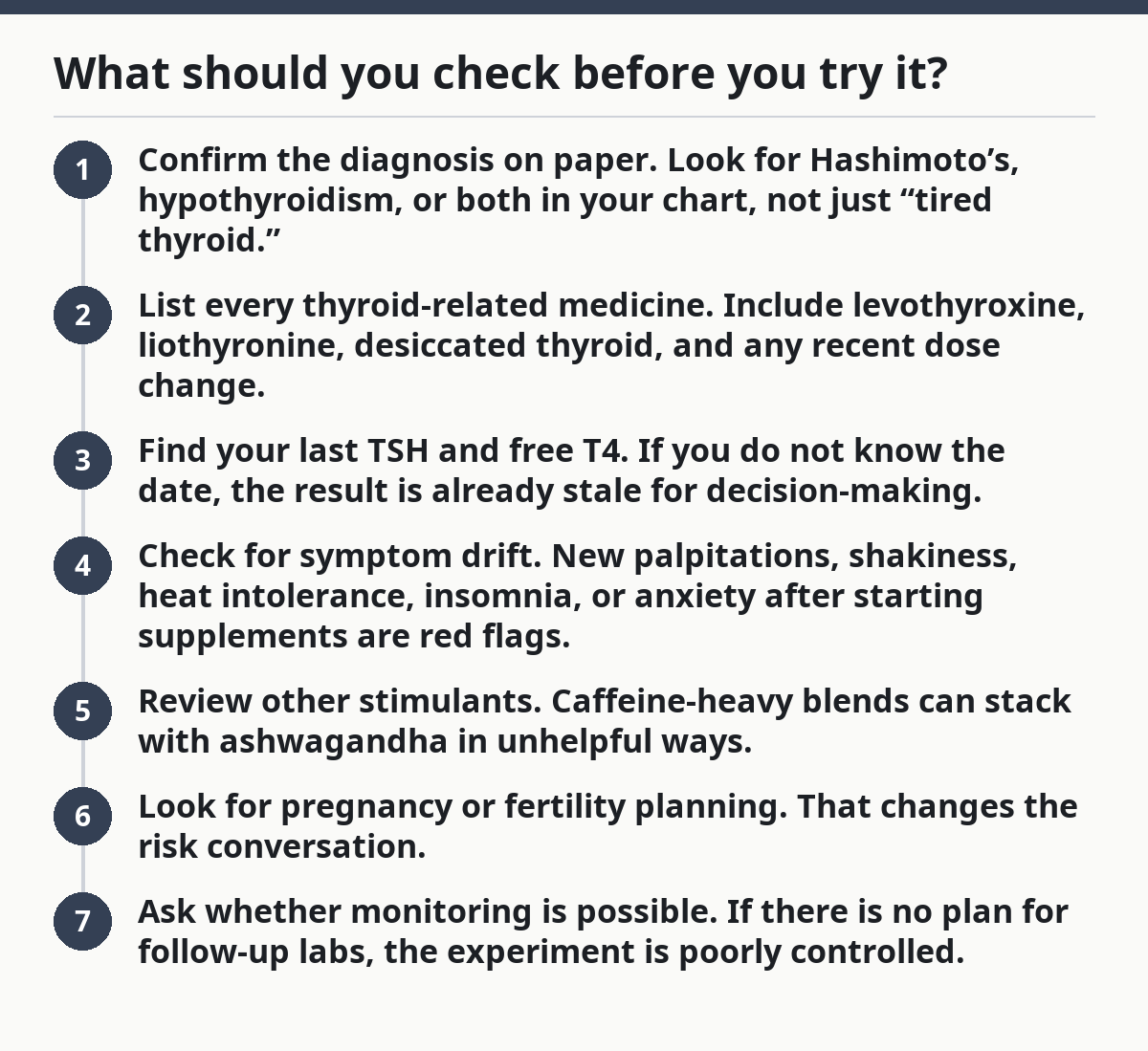
- Confirm the diagnosis on paper. Look for Hashimoto’s, hypothyroidism, or both in your chart, not just “tired thyroid.”
- List every thyroid-related medicine. Include levothyroxine, liothyronine, desiccated thyroid, and any recent dose change.
- Find your last TSH and free T4. If you do not know the date, the result is already stale for decision-making.
- Check for symptom drift. New palpitations, shakiness, heat intolerance, insomnia, or anxiety after starting supplements are red flags.
- Review other stimulants. Caffeine-heavy blends can stack with ashwagandha in unhelpful ways.
- Look for pregnancy or fertility planning. That changes the risk conversation.
- Ask whether monitoring is possible. If there is no plan for follow-up labs, the experiment is poorly controlled.
The goal is to stop the common mistake of treating thyroid disease like a generic “low energy” problem; a clinician can help you sort that out safely.
Who should avoid ashwagandha for now?
Ashwagandha should be avoided, or at least put on hold, in several common thyroid situations because the downside is not theoretical. The main problem is not that every person reacts badly; it’s that the people most likely to be harmed are the ones trying to fine-tune a fragile thyroid setup.
Unstable thyroid labs: this means your TSH or free T4 has been bouncing around — adding a thyroid-active herb can make the pattern harder to read, so wait and review the whole plan with a clinician.
Recent dose changes in thyroid hormone: this means your medication has changed in the last few weeks — if you add ashwagandha now, you won’t know what caused the next lab shift.
Symptoms of too much thyroid activity: palpitations, tremor, sweating, or insomnia can get worse — stop the supplement and seek medical advice rather than “pushing through.” A professional can help decide whether the symptoms are from the herb, the dose, or something else.
Pregnancy or breastfeeding: safety data are limited — skip self-treatment and ask a qualified professional before using any herbal supplements.
Known thyroid eye disease or other autoimmune flare patterns: the stakes are higher — avoid casual trials and get a clinician who knows autoimmune thyroid disease involved.
There’s also a simple rule for people with hypothyroidism who feel “off” on treatment: if the problem is already medication matching, a second thyroid-active product usually adds noise, not clarity. The better move is a proper medication review, not a new bottle, and a clinician can help with that.
Common mistakes that make this a bad idea
Ashwagandha goes wrong most often because people treat it like a calm-sleep herb instead of a hormone-relevant supplement. That mistake can distort thyroid labs, hide a medication issue, or make symptoms harder to interpret over the next 4–8 weeks.
Picture this: you start the herb for stress, then your heart races, sleep gets worse, or your labs change at the next check. The supplement now sits between you and a clean answer. That’s the cost of a casual trial in thyroid disease.
The most common errors are:
- Starting it during a medication change. Consequence: you won’t know whether the herb or the thyroid dose caused the change. Better alternative: wait until the thyroid plan is stable.
- Using it to “support” a low lab result. Consequence: it can distract from proper thyroid treatment. Better alternative: review the lab with a clinician.
- Ignoring new palpitations or anxiety. Consequence: you may miss a sign that your thyroid activity is too high for you. Better alternative: stop the herb and report the symptom.
- Taking a blended “stress formula.” Consequence: you may be reacting to more than ashwagandha. Better alternative: use a single-ingredient approach only if a clinician agrees it makes sense.
- Checking labs too soon, or not at all. Consequence: you lose the chance to see whether the herb changed TSH or thyroid hormone. Better alternative: plan follow-up testing with a professional.
- Assuming “natural” means thyroid-safe. Consequence: you can end up treating a hormone-active product like tea. Better alternative: treat it like a biologically active supplement.
The cleanest rule is simple: if your thyroid is already hard to manage, don’t add a moving part without a reason.
When does the standard advice not apply?
The standard advice changes when your thyroid history is complicated, your meds are still being adjusted, or your symptoms do not match your latest labs. In those cases, a blanket “yes” or “no” is too crude.
Picture this: you have Hashimoto’s, but your symptoms are mixed — fatigue, anxiety, and poor sleep all at once. Or you have hypothyroidism, but your numbers have changed since your last refill. That’s not a normal supplement decision. That’s a medication-and-disease review.
Use extra caution if any of these apply:
- You are on more than one thyroid medicine. Combination therapy can make small shifts matter more.
- You recently changed brands or formulations. Even without changing the dose, the body may respond differently.
- You have other autoimmune disease. The thyroid is not the only immune target, so symptom noise is common.
- You use stimulant herbs or high-caffeine products. The combined effect can look like overactive thyroid.
- You are trying to explain fatigue alone. Fatigue is nonspecific; ashwagandha is not a substitute for checking iron, sleep, mood, or medication timing.
If you want a broader look at ingredient safety around thyroid supplements, the hub on thyroid supplements and ingredient safety is the right place to start. This page stays focused on ashwagandha and the thyroid-specific questions around it. Different page, different job. For general interaction checking, see MedlinePlus, and for complementary-medicine safety, see NCCIH.
The practical bottom line on ashwagandha and thyroid disease
Ashwagandha is a gray-zone supplement for Hashimoto’s and hypothyroidism, not a routine yes. The concern is thyroid stimulation, lab confusion, and the way it can complicate a plan that already depends on careful hormone balance.
If your thyroid disease is stable, your medicines are unchanged, and your clinician knows you are interested in herbal supplements, this is a conversation worth having. If your labs are unstable, you have new symptoms, or you are adjusting thyroid hormone, this is the wrong time to experiment.
The best outcome is not “take it” or “never take it.” It’s a decision that fits your diagnosis, your medicines, and your follow-up plan.
Is ashwagandha safe for Hashimoto’s?
Ashwagandha is not clearly safe for Hashimoto’s in the way a neutral supplement would be. Hashimoto’s is autoimmune thyroid disease, and research suggests ashwagandha may affect thyroid activity in some people, which can muddy symptoms and labs. Because the evidence is limited, a clinician should review your specific case before you use it.
Can ashwagandha change thyroid lab results?
Ashwagandha can change thyroid lab results in some people, based on studies that suggest it may influence thyroid hormone activity. That means TSH and other thyroid markers may move even if you started it for stress. If you use it, lab monitoring matters, especially when thyroid hormone medicine is already part of the picture.
Should people with hypothyroidism avoid ashwagandha?
People with hypothyroidism often should avoid casual use of ashwagandha, especially if their medication or labs are not stable. The herb may push thyroid activity in a way that makes treatment harder to read. A qualified clinician can tell you whether your situation is one of the uncommon cases where closer supervision makes sense.
Drafted with AI; not yet reviewed by a person.