Last updated: November 19, 2026
Quick answer: If you vomit after taking levothyroxine, the next step depends on how soon it happened and whether the tablet may still be in your stomach; if you are unsure, call a pharmacist or prescriber. If the vomiting is ongoing or you have trouble keeping fluids down, seek medical advice. If you are looking for specific guidance on What to Do If You Vomit After Taking Levothyroxine, use the timing below.
If you vomit after taking levothyroxine, the next step depends on how soon it happened and how much of the tablet may still be in your stomach. Do not make a second move until you know the timing; then call a pharmacist or prescriber if you’re unsure. The steps below sort out what usually matters and what needs a clinician.
Key takeaways
- Vomiting right after a levothyroxine dose can leave you with little or no absorbed medicine.
- Timing matters more than the fact of vomiting alone.
- Don’t guess blindly about another tablet if you’re not sure how much time passed.
- Nausea, stomach illness, and repeat vomiting make the usual routine less reliable.
- A pharmacist can help with the practical next step when the situation is unclear.
What this problem usually means
If you vomit after taking levothyroxine, the pill may not have stayed in your stomach long enough to dissolve and move on to where it can be absorbed. That is the whole issue.
Levothyroxine is a thyroid hormone medicine, and its absorption can be affected by stomach contents, illness, and vomiting. The usual advice is based on drug labels and thyroid guidance from authoritative sources such as the NHS and the American Thyroid Association.
That does not mean every vomit episode is the same. A single episode after a stomach bug is different from vomiting that keeps happening every few hours.
The timing is the key.
Commonly reported absorption concerns with levothyroxine also show up in review papers, not just original studies. In that PubMed sample, 7 of 13 were tagged Review and 1 of 13 was tagged Systematic Review by the NLM.
Should I retake levothyroxine after vomiting?
Sometimes, but not by guesswork. A reasonable approach is to use the timing of the vomit, the condition of the tablet, and advice from a pharmacist or prescriber when the timing is unclear.
Picture this: you take your tablet with water, wait a bit, and then vomit into the sink. You’re tired, your stomach hurts, and you just want a clean answer. Here’s the catch: the right move depends on whether the medicine likely had time to pass out of your stomach.
A practical way to think about it is this:
- Very soon after swallowing: the dose may not have been absorbed well.
- Later on: more of the medicine may already have moved on.
- Repeated vomiting: the usual morning routine may not be dependable at all.
For a question like this, a pharmacist is often the quickest person to ask because the issue is timing, formulation, and whether another dose is reasonable in your situation. That is especially true if you take other thyroid medicine, have a sensitive stomach, or have vomiting from an illness that’s still active.
One hard rule belongs here: don’t invent a correction plan from memory. Levothyroxine has a long half-life, but that does not make every vomit episode a free pass. The details still matter.
How to think through the next 10 minutes
You can sort the situation in a few deliberate steps, starting with the clock.
Picture this: you’re standing at the sink with the pill bottle on the counter, trying to remember whether it was 5 minutes ago or 45. Slow down. Write down the time, the vomit time, and whether the tablet came back up whole or partly dissolved.
- Note the exact time you swallowed levothyroxine. Write it down in minutes, not “a little while ago.” Verify whether you can name the time within about 5 minutes. If you can’t, that is a sign to ask a pharmacist rather than guessing.
- Check whether vomiting was single or repeated. One episode is different from ongoing nausea or repeated emesis. Verify whether you have kept down water for at least 30–60 minutes. If not, the stomach is still unstable.
- Look for the tablet or capsule in the vomit if you can do so safely. A visible, intact tablet suggests little time for absorption. Verify whether the medicine looks whole, partly broken, or absent. If you’re too nauseated to check, don’t force it.
- Review the setting. Was this a stomach bug, migraine, motion sickness, or medication-related nausea? Verify whether there is an illness driving the vomiting. If fever, diarrhea, or dehydration is present, the situation is less predictable.
- Use one source of advice. Call your pharmacist, clinic, or prescribing office if the timing is unclear. Verify they know you take levothyroxine and that vomiting happened after the dose. If no one can be reached and the vomiting is ongoing, the problem is no longer a simple dosing question.
- Do not stack another dose just because you feel worried. Verify whether a second dose has already been taken or considered. If yes, that needs professional guidance, not improvisation.
- Return to the usual routine only when your stomach settles. Verify you can keep down fluids and are not vomiting again. If you cannot keep water down for several hours, the issue has moved beyond a pill-timing question.
A good result looks boring: one episode, a clear time, no repeat vomiting, and a professional answer if anything is fuzzy. A bad result is the opposite—uncertain timing, more vomiting, and no one checking the next step.
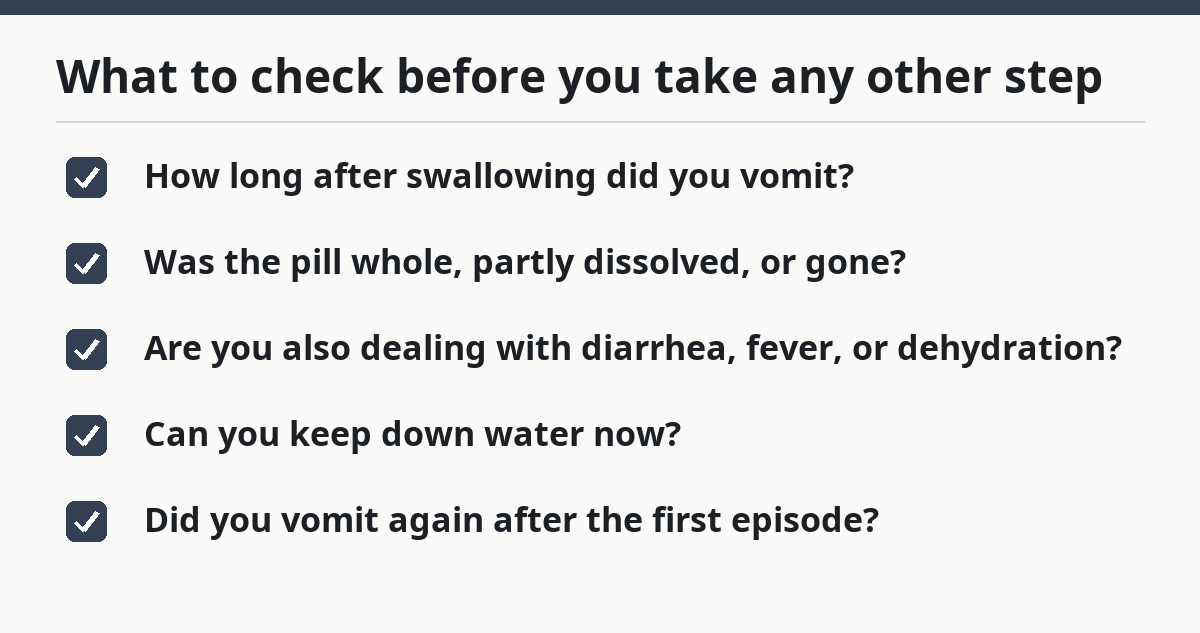
What to check before you take any other step
You need three facts before you act: timing, symptoms, and whether this looks like a short stomach illness.
Picture this: you feel slightly better, but the nausea is still there and you’re tempted to go by instinct. Don’t. Levothyroxine is a daily medicine, and repeat vomiting can turn one missed absorption window into a chain of confusion.
Check these points first:
- How long after swallowing did you vomit?
- Was the pill whole, partly dissolved, or gone?
- Are you also dealing with diarrhea, fever, or dehydration?
- Can you keep down water now?
- Did you vomit again after the first episode?
On the flip side, the absence of vomiting later in the day does not prove the morning dose was absorbed. That’s why “I feel fine now” is not the same as “the dose definitely stayed in.”
If you need more background on why timing and stomach conditions matter, the hub on thyroid medication timing and absorption covers the broader pattern. This page stays on the next-step decision after vomiting.
When the standard advice does not fit
The usual “wait and see” approach is the wrong tool in several situations.
Picture this: you’re not dealing with one brief episode. You’re dealing with a stomach virus, a migraine that keeps coming back, or nausea that started before the dose and won’t quit. That changes the problem from a single tablet question to an illness question.
Vomiting keeps happening: the stomach is too unsettled for the usual routine — contact a clinician or pharmacist, because repeat vomiting can make any timing guess unreliable.
You cannot keep fluids down: dehydration risk is rising — seek urgent medical advice, since the issue is no longer just the levothyroxine dose.
There is blood, severe pain, or chest symptoms: this is not a pill-timing issue — get urgent care.
You took the medicine with a major illness flare: absorption may be less predictable — ask a pharmacist how to handle the day’s dose.
You already took another tablet by mistake: the question is no longer whether to replace the dose — call for advice right away and explain exactly what happened.
People often want a one-line rule here. There isn’t one that fits every case. Nausea from illness, a tablet that came back up whole, and vomiting that starts hours later are not the same event.
Common mistakes that make this harder
Most mistakes come from trying to solve a timing problem with a memory problem.
Picture this: you’re tired, your throat burns, and you just want closure. That’s when people reach for guesswork. Here are the errors that cause the most confusion.
- Guessing the timing by feeling alone. The consequence is a bad decision about whether the dose may still have been absorbed. The better move is to check the clock and write the time down.
- Taking a second tablet on impulse. The consequence can be unnecessary extra medicine if enough had already been absorbed. The better move is to ask a pharmacist when timing is unclear.
- Ignoring repeat vomiting. The consequence is that a short illness becomes a day of uncertain dosing. The better move is to treat ongoing vomiting as a separate problem and consult a professional if it continues.
- Assuming a dry heave counts the same as full vomiting. The consequence is overreacting or underreacting. The better move is to describe exactly what happened when you ask for advice.
- Forgetting that illness changes absorption. The consequence is that the usual morning pattern may not work that day. The better move is to note fever, diarrhea, and dehydration.
- Trying to solve it by moving the next dose around on your own. The consequence is more confusion, not less. The better move is to keep the schedule steady unless a clinician says otherwise.
When should I call my doctor after vomiting my thyroid pill?
Call your doctor or pharmacist when the timing is unclear, vomiting happens more than once, or you’re ill enough that your normal schedule is breaking down.
Picture this: you’re still nauseated an hour later, and now you’re wondering whether to call or wait until tomorrow. The answer is to call sooner if you cannot sort out the details yourself. Levothyroxine is a medicine where small timing differences can matter, and a pharmacist can often give the quickest practical answer.
Call for advice if:
- the vomit came up soon after swallowing and you’re not sure what that means
- you keep vomiting for more than a short spell
- you have fever, diarrhea, or signs of dehydration
- you suspect you threw up the tablet itself
- you accidentally took another dose
- you’re unsure what to do because of another medicine, an illness, or a very sensitive stomach
The best part? You do not need to wait until the problem becomes severe to ask. A brief call can prevent a bad guess.
Should I retake levothyroxine after vomiting?
Maybe, but not automatically. The decision depends on how soon vomiting happened after the dose and whether the tablet likely stayed in your stomach long enough to be absorbed. If you’re unsure, a pharmacist or prescriber should guide the next step rather than you guessing.
How long after a dose does vomiting still count as absorption?
There is no single cutoff that fits everyone. Absorption depends on timing, whether the tablet was seen in the vomit, and whether you were sick with something like a stomach bug. If the timing is close or unclear, ask a pharmacist and consult a professional instead of treating the situation as if the dose definitely counted.
When should I call my doctor after vomiting my thyroid pill?
Call if vomiting repeats, you can’t keep fluids down, or you don’t know whether the dose was absorbed. Call sooner if there’s fever, diarrhea, blood, chest pain, or severe abdominal pain. If the episode is brief and you recover quickly, a pharmacist may be the fastest first call.
Drafted with AI; not yet reviewed by a person.