
When to Retest Vitamin B12 After Starting Treatment

Last updated: November 19, 2026
Quick Answer: for many people, the first vitamin B12 retest comes after a few weeks to a few months. The exact timing depends on the original result, the treatment route, and symptoms, so a clinician should set the schedule. This article on When to Retest Vitamin B12 After Starting Treatment uses that same rule throughout.
Key Takeaways
- Most follow-up retesting happens after a few weeks to a few months, not right away.
- Serum B12 is not always enough; MMA, homocysteine, and sometimes a CBC can show response better.
- Follow-up should match the original abnormality and the reason treatment started.
- If symptoms do not improve, the timing may be too early, the cause may be broader, or more review may be needed.
If you started treatment for vitamin B12 deficiency, the usual question is not “Do I need another test?” but “When should that test happen?” The short answer is that follow-up timing depends on why you were treated, whether you had symptoms such as neuropathy, and which lab was abnormal first, so a qualified clinician should guide your own schedule. For many cases, the first recheck is measured in weeks, not days. The NIH Office of Dietary Supplements notes that B12 status is assessed with serum B12 and related markers, including MMA and homocysteine. NIH ODS
Who this applies to — and who needs closer follow-up
This applies to people who have already started treatment for low vitamin B12 and want to know when follow-up labs make sense. It assumes the first test was low or borderline, treatment has already begun, and the next question is about monitoring rather than diagnosing the original problem. A clinician should help set the timing, because the right interval is not the same for every case.
The usual follow-up conversation is different for someone taking oral B12 for a mild, diet-related shortfall than for someone with pernicious anemia, gastric surgery, bowel disease, or neurologic symptoms. Pernicious anemia, for example, is an absorption problem rather than a simple intake problem, so the long-term plan often looks different from a one-time correction. Neuropathy — nerve damage that can cause numbness, tingling, burning, or balance trouble — also changes the urgency, because symptom tracking matters as much as the lab value. In practice, that can mean closer follow-up for people with nerve symptoms.
A generic “check it later” answer misses the point. Vitamin B12 follow-up testing is meant to answer a narrower question: did the treatment raise the marker you were watching, and did the body respond the way it should? In many clinics, that means a repeat blood test after enough time has passed for the result to move, not the next day or the next week. The British Society for Haematology has also emphasized that diagnosis and monitoring depend on the clinical context, not one number alone. (Source: BSH)
This page does not tell you whether you need B12, which supplement to buy, or how to treat a deficiency. It is only about retesting after treatment has started. If you are still sorting out broader nutrient testing decisions, the hub on thyroid nutrient testing and deficiency decisions covers the bigger picture.
If your symptoms are severe, rapidly worsening, or include gait changes, weakness, or memory trouble, this is not a do-it-yourself situation. The timing of repeat labs should be set with a clinician who can interpret vitamin B12 alongside the rest of the picture. If you also need a basic overview of test interpretation, see how blood tests are read.
When should vitamin B12 be retested after treatment starts?
The most common answer is after a few weeks to a few months, not immediately. Exact timing varies by the original lab abnormality, the route of treatment, and whether symptoms need closer watching. For many people, the first check is not on day 1, and it is not always the same week.
A repeat serum vitamin B12 test often makes sense only after treatment has had time to change the blood level. In practice, that usually means waiting long enough to see a real shift rather than a same-day fluctuation. If methylmalonic acid (MMA) or homocysteine was raised, those may be used as follow-up markers too, because they can reflect functional B12 deficiency more directly than serum B12 alone. The CDC’s laboratory guidance also notes that no single marker tells the whole story. CDC
The reason timing matters is simple: a lab that is drawn too early can look unchanged, even when the treatment is working. A lab drawn much later can tell you whether the level stayed up, which matters more in people with absorption problems such as pernicious anemia. The right interval also depends on whether the treatment was an injection series or oral therapy, because blood levels may rise on different schedules. In one recent randomized trial, 1000 µg oral B12 was compared with intramuscular treatment over 8 weeks, showing that timing and route both matter. BMJ Open
A practical retesting plan usually answers three questions at once:
- Did the marker improve?
- Did symptoms start to improve?
- Does the result fit the cause of deficiency?
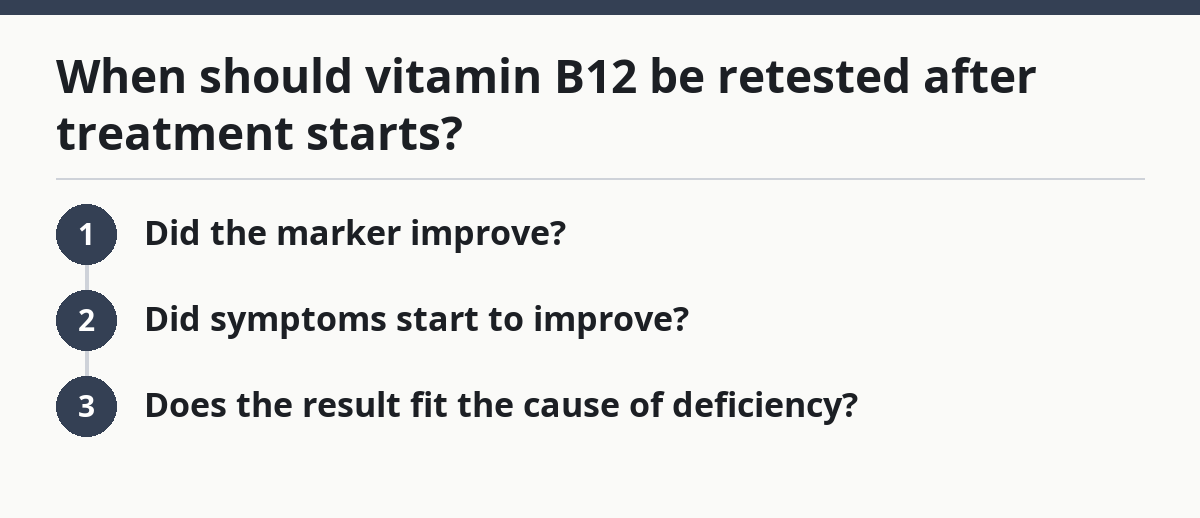
That last point is easy to miss. Someone with low intake may normalize differently from someone whose body cannot absorb B12 well. That is one reason generic timing advice can be misleading. It is also why a plan should be tailored to the original diagnosis, not copied from another patient.
Authoritative sources that clinicians commonly rely on for this kind of follow-up include the NIH Office of Dietary Supplements and professional guidance from hematology or primary-care organizations. Those sources support the general principle that lab follow-up should be individualized rather than automatic on a fixed calendar. See also the NICE evidence review for related monitoring principles.
Which labs matter on follow-up?
The most useful follow-up test is not always serum B12 alone; MMA, homocysteine, and sometimes a complete blood count can give a better read on response. Which one matters most depends on what was abnormal at the start. A repeat test should match the original problem when possible.
Serum vitamin B12 is the most familiar test, but it has limits. It can rise after treatment even when tissue-level recovery is still in progress, and it can be less informative when the first result was borderline rather than frankly low. That is why methylmalonic acid, a compound that rises when B12-dependent metabolism is impaired, is often discussed as a follow-up marker. Homocysteine is another blood marker that can increase in B12 deficiency, though it is less specific because folate and other factors can affect it too.
A complete blood count, or CBC, is also part of the follow-up picture when anemia was present. The CBC looks at red blood cell indices such as mean corpuscular volume, which can shift as the marrow responds. If the starting problem was anemia, improvement on the CBC can be as meaningful as the B12 number itself. For general lab reference ranges, the Merck Manual gives a useful overview of macrocytic patterns. (Source: Merck Manual)
For neurologic complaints, blood tests matter but they do not replace symptom tracking. Someone can have a better lab result before numbness or balance symptoms fully settle. That is why clinicians often care about both the number and the clinical course.
There is also a trade-off here: more testing is not always better. A long panel can create confusion if the markers move at different speeds. Serum B12 may improve first, while MMA or symptoms lag behind. That mismatch does not automatically mean the treatment failed; it may mean the follow-up window was too short or the original problem was more complex.
For most readers, the useful question is not “Which lab is perfect?” but “Which lab was abnormal in my case, and which one will show response most clearly?” That decision belongs with the person who ordered the test in the first place. If you are comparing options, see B12 blood test basics and MMA testing.
How follow-up usually works, step by step
The usual follow-up starts with the original result and ends with a repeat test that matches the reason for treatment. A common approach is below, but the exact schedule still belongs in a clinician’s plan. In many cases, the plan is written in weeks or months, not days.
- Confirm the original abnormality. Review whether the baseline issue was low serum B12, raised MMA, raised homocysteine, macrocytic anemia, or a mix of findings. Verify the exact pre-treatment value and the reference range. A problem appears when the starting test was borderline and no confirmatory marker was checked, because follow-up may be harder to interpret.
- Identify the cause of deficiency. Determine whether the likely cause was low intake, medication effect, malabsorption, pernicious anemia, or another condition. Verify whether absorption is likely intact. A problem appears when the cause is unclear, because oral treatment and injection follow-up can be interpreted differently.
- Note the treatment route. Record whether treatment is oral, sublingual, or injectable. Verify the exact form used and how often it is being taken or given. A problem appears when the route changes but the follow-up plan does not, because blood levels may shift on a different timeline.
- Set the first recheck window. Ask for the intended retest interval before the next lab is ordered. Verify whether the plan is measured in weeks or months, not days. A problem appears when testing is done too soon and the result looks unchanged despite treatment.
- Choose the follow-up marker. Decide whether the repeat test will be serum B12, MMA, homocysteine, a CBC, or a combination. Verify that the same lab method or at least the same type of test will be used if comparison matters. A problem appears when a different marker is substituted without explanation, because the numbers may not be directly comparable.
- Track symptoms in plain language. Write down numbness, tingling, fatigue, balance issues, tongue soreness, and memory complaints before the retest. Verify whether symptoms are stable, improving, or worsening. A problem appears when the number improves but neurologic symptoms do not, because that may need closer review.
- Repeat the blood work at the planned interval. Go for the repeat draw at the agreed time point, not earlier unless told to do so. Verify the result against the baseline and the relevant reference range. A problem appears when the follow-up value is still abnormal or only barely improved, especially if treatment has been consistent.
- Interpret the result in context. Review the lab change alongside the cause of deficiency, the treatment route, and the symptoms. Verify whether the result matches the expected direction of change. A problem appears when the lab looks better but the clinical picture does not, because the treatment plan may need a different explanation or a different workup.
One practical example: if someone started oral treatment for a borderline low B12 result and has no neurologic symptoms, the first repeat may be scheduled later than in someone with neuropathy or pernicious anemia. That difference is not a contradiction; it is standard clinical tailoring. In many practices, the repeat is still measured in weeks to months.
What if symptoms do not improve after treatment?
Because treatment matters, symptom response matters too, and it may not follow the lab on the same schedule. Lack of symptom improvement after treatment can mean the B12 problem was not the only issue, the follow-up was too early, or the body is not responding as expected. That is when the lab result and the person’s symptoms need to be reviewed together.
Neurologic symptoms are the biggest reason not to rely on a single blood number. Tingling, numbness, unsteadiness, and cognitive complaints can lag behind lab correction, and sometimes they point to another diagnosis entirely. If the level rises but neuropathy stays the same, that does not prove the treatment failed, but it does mean the story is incomplete.
Symptoms also improve at different speeds. Blood markers such as serum B12 can change sooner than neurologic function. A CBC can recover on one timeline, while nerve symptoms recover on another. That gap is one reason patients are often told to report symptom changes rather than waiting passively for the next lab. In other words, a better number at 2 weeks does not guarantee symptom relief at 2 weeks.
A useful rule of thumb is that worsening symptoms deserve more attention than stable symptoms. If numbness spreads, gait gets worse, weakness appears, or confusion develops, the follow-up plan should not wait for a routine retest. That is especially true when pernicious anemia or another malabsorption issue is involved, because the condition can require ongoing monitoring rather than one-time correction.
This is also where the limits of lab-only thinking show up. A “normal” B12 result after treatment does not automatically settle the question if symptoms are ongoing. The converse is also true: a modestly abnormal follow-up test does not always explain every symptom a person feels. The broader clinical picture still matters.
When the standard retest plan does not fit
The standard retest plan needs modification when absorption is impaired, neurologic symptoms are present, or the treatment route changes. In those cases, the follow-up timeline and the choice of lab can change by weeks or months. The point is not to force every case into the same schedule.
Pernicious anemia: This is an absorption problem, not a simple intake issue — follow-up is often longer term, and repeat testing may matter even after the first correction. The consequence of ignoring this is that a one-time “fixed” result can hide a continuing need for monitoring.
Neuropathy or other neurologic symptoms: Nerve symptoms may improve slowly and may need closer follow-up than a routine asymptomatic case — report changes promptly and do not wait only for a planned lab date. The consequence of delay is missing ongoing nerve injury or another cause of the symptoms.
Recent change from injections to oral treatment: The route has changed, so the blood level may behave differently — the first follow-up after the switch should be interpreted with that change in mind. The consequence of overlooking it is misreading a stable or falling level as failure when the schedule itself changed.
Borderline baseline results: A marginally low B12 often needs a more careful marker than serum B12 alone — MMA or homocysteine may be more informative. The consequence of skipping that nuance is overcalling or undercalling the problem.
Mixed nutrient issues: If folate deficiency, iron deficiency, or another anemia pattern is present, the CBC and symptoms may not track neatly with B12 alone. The consequence is a partial answer that misses the broader hematologic picture.
Common mistakes people make with B12 follow-up
The most common mistakes are testing too early, watching the wrong marker, and treating the lab like it is the whole story. Each one can distort the follow-up plan.
-
Rechecking after only a few days. The result may not have had time to change. The correct alternative is to use the interval your clinician set, often measured in weeks or months.
-
Using serum B12 as the only marker in a borderline case. A serum level can look reassuring without fully answering whether the deficiency was functionally corrected. The better alternative is to ask whether MMA or homocysteine should be part of the follow-up.
-
Ignoring symptoms because the number improved. A better lab does not automatically mean the neurologic picture has resolved. The correct alternative is to track symptom change alongside the result.
-
Assuming oral and injectable treatment should be judged on the same timetable. They do not always behave the same way in follow-up. The alternative is to keep the route of treatment in view when interpreting the lab.
-
Stopping monitoring after one “normal” result in absorption disorders. A person with pernicious anemia may need ongoing observation. The better approach is to treat the first normal value as a checkpoint, not a finish line.
When to get qualified help
A standard retest plan is not enough if the cause is unclear, symptoms are worsening, or the result does not match the clinical picture. In those cases, the next step is a clinician who can interpret B12 alongside the CBC, MMA, homocysteine, and the reason treatment started. For ongoing monitoring, you may also want the related page on anemia workup.
These situations need closer review:
Neurologic symptoms are new or worsening: This can mean the problem is more urgent than a routine follow-up suggests — contact a qualified professional promptly.
The follow-up test stays low despite treatment: This can point to absorption trouble, adherence issues, or a different diagnosis — the plan needs reassessment rather than repetition.
The baseline cause was pernicious anemia or another malabsorption condition: This often means the issue is chronic rather than one-off — long-term follow-up is usually needed.
If you want the next step to be clear, ask which marker will be repeated, when it will be drawn, and what result would count as an adequate response. That is the most practical way to keep When to Retest Vitamin B12 After Starting Treatment aligned with the reason treatment began.
Drafted with AI; not yet reviewed by a person.