
How Often Should Thyroid Labs Be Rechecked After a Dose Change?

Last updated: November 19, 2026
Key Takeaways
- Usual recheck timing is 6 to 8 weeks after a dose change, with TSH as the main test and free T4 often added.
- The follow-up plan begins when the prescription changes and ends with a repeat blood test to see whether another adjustment is needed.
- Six to 8 weeks is standard because TSH does not settle right away after a levothyroxine change.
- Thyroid labs are checked sooner or later than usual only when the clinical situation changes.
Thyroid labs are usually rechecked about 6 to 8 weeks after a levothyroxine dose change, because that is long enough for TSH to settle into a new steady state. If the change is bigger, symptoms are strong, or the thyroid doctor is adjusting treatment in an unusual situation, the timing may shift, but 6 to 8 weeks is the standard follow-up schedule most people hear. Clinicians should individualize the plan when needed, and authoritative guidance supports waiting long enough for a meaningful result. NICE and the American Thyroid Association both describe follow-up based on the biology of thyroid replacement.
The usual timing after a thyroid dose change
The usual timing is 6 to 8 weeks after the dose change, with TSH as the main blood test and free T4 often checked too. That interval is not arbitrary. Thyroid hormone changes slowly, and the lab values need time to reflect the new dose rather than the old one. If a blood test is done at 1 or 2 weeks, it can look promising or alarming for the wrong reason.
This timing applies most clearly to levothyroxine dose adjustments for hypothyroidism. A doctor may use the same window after a small increase or a small decrease, because the goal is the same: see the effect of the new daily dose once the body has had time to adapt.
A shorter interval can waste the appointment. A longer interval can leave a person on the wrong dose for too long. That is the trade-off. The 6- to 8-week window gives enough signal without turning the blood test into guesswork.
One useful way to think about it is this: the dose change is the first step, and the lab recheck is the confirmation step. If the clinician changes the prescription today, the next blood test is usually planned before the body has had time to fully respond. That is why thyroid lab follow-up is not immediate.
For a broader read on what the numbers mean once they come back, the hub on thyroid lab interpretation is the right companion page.
How the thyroid lab follow-up schedule works in practice
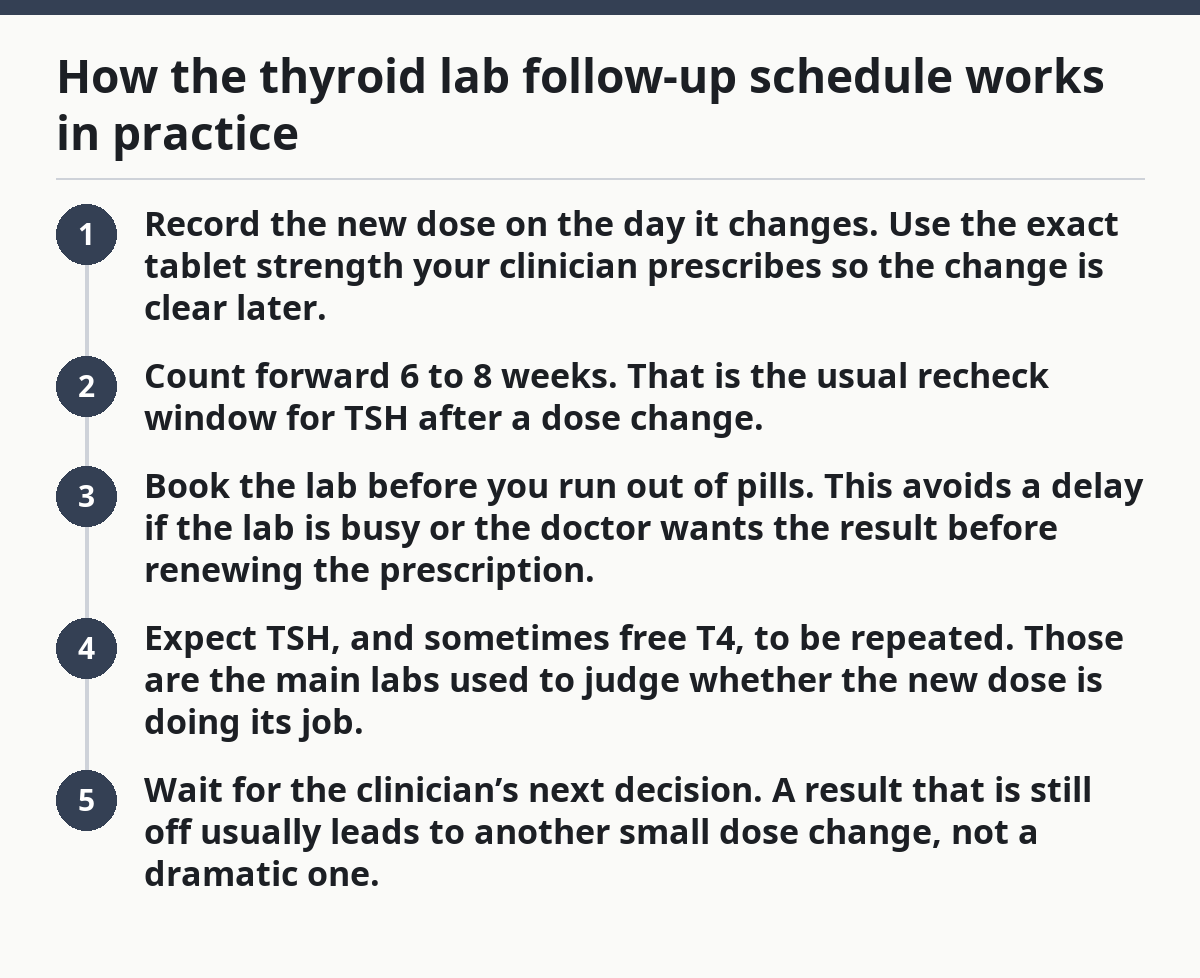
The thyroid lab follow-up schedule starts with the prescription change and ends with a repeat blood test that shows whether the dose needs another adjustment. A simple workflow usually looks like this:
- Record the new dose on the day it changes. Use the exact tablet strength your clinician prescribes so the change is clear later.
- Count forward 6 to 8 weeks. That is the usual recheck window for TSH after a dose change.
- Book the lab before you run out of pills. This avoids a delay if the lab is busy or the doctor wants the result before renewing the prescription.
- Expect TSH, and sometimes free T4, to be repeated. Those are the main labs used to judge whether the new dose is doing its job.
- Wait for the clinician’s next decision. A result that is still off usually leads to another small dose change, not a dramatic one.
The setting matters. A person who gets labs at a large outpatient lab may need an appointment several days ahead, while a same-day clinic draw can be easier to schedule. Either way, the point is to line up the lab date with the body’s response time.
The biggest mistake here is checking too soon. That usually leads to noise, not clarity. Another common mistake is waiting until symptoms become obvious before scheduling the test. Symptoms lag behind the lab in some people, so the blood test can be the earlier warning sign.
A practical target is to make the next lab date part of the dose-change visit itself. If the change happens on a Monday, the follow-up plan should already exist by the end of that appointment, even if the exact calendar day gets chosen later.
Why 6 to 8 weeks is the standard, not 2 weeks
Six to 8 weeks is the standard because TSH does not settle instantly after a levothyroxine change. The pituitary gland needs time to respond to the new thyroid hormone level, and the lab should catch that new baseline rather than a temporary swing. A test at 10 to 14 days can still be too early to guide a dose decision.
This is especially important when the change is modest, such as a 12.5 mcg or 25 mcg adjustment. Small changes are common in thyroid care, and they need enough time to show up clearly on labs. If the interval is too short, the result may look only partly improved and tempt a premature second change.
A 6- to 8-week delay also reduces back-and-forth prescribing. Without that wait, a person can end up with a dose adjusted twice before the first change has fully taken effect. That creates confusion, especially if one result is drawn at an off time or if the person has changed brands.
This schedule is not perfect for every situation. A thyroid doctor may check sooner in special cases, such as pregnancy, severe symptoms, or unusual lab patterns. But for routine outpatient care, the standard window is used because it is the most reliable compromise between speed and accuracy.
People want a fast answer, and thyroid treatment rarely gives one. It is still best to ask the thyroid doctor about the right timing for a particular case rather than assume an early test will be useful. The blood test has to be timed to the biology, not to the calendar.
A reasonable rule is simple: if the dose changed today, the next TSH is usually a 6- to 8-week job, not a 1-week job.
When thyroid labs are checked sooner or later than usual
Thyroid labs are checked sooner or later than usual only when the clinical situation changes, not because the normal schedule is wrong. A thyroid doctor may recheck earlier than 6 weeks if the person is pregnant, very symptomatic, hospitalized, or taking a medication change that raises concern about absorption or dose effect. The exact timing depends on the case.
A shorter interval can make sense when the stakes are higher. Pregnancy is the clearest example, because thyroid hormone needs can shift quickly and the margin for delay is smaller. In that setting, the doctor may prefer tighter follow-up and more frequent lab monitoring than the routine schedule.
A later check can make sense when the change was very small, when the person is still stabilizing after a recent adjustment, or when the plan is to wait for a pattern rather than a single result. That said, waiting too long can leave someone undertreated or overtreated for months, which is why long gaps should be deliberate rather than accidental. A clinician should help decide whether a longer wait is appropriate.
There are also cases where free T4 gets more attention than TSH, especially early after a change or in special clinical settings. That does not replace the usual follow-up logic; it just changes which marker carries more weight. In many routine cases, though, TSH remains the main guide and free T4 is supportive rather than the only number.
The key point is that “6 to 8 weeks” is a default, not a law of nature. If the plan is different, it should be different for a reason. A person should not assume that a delayed lab means the clinician forgot, and a person should not assume that an early lab means the body has already settled.
This is one place where timing and interpretation belong together. A lab drawn at the right time can still be hard to read, which is why the interpretation page on this site exists as a separate guide.
What to expect if the result is still off
If the result is still off, the usual next step is another small dose change and another 6- to 8-week recheck. That is the normal rhythm of thyroid dose adjustment, especially with levothyroxine. The goal is not to overhaul treatment every time the numbers miss the target by a little.
A high TSH after the new dose usually suggests the dose is still too low, while a low TSH can suggest it is too high. Free T4 may help confirm the picture, but clinicians may look at it alongside TSH rather than treating it as the only number. The blood test result matters most when it matches the dosing history and the timing of the draw.
One common mistake is expecting the first follow-up to be the final answer. Sometimes it is. Often it is not. A person may need one more adjustment, then another recheck 6 to 8 weeks later. That back-and-forth is not failure; it is how dose-finding works.
Another mistake is changing the dose on the person’s own, then trying to “test around” the change. That can distort the result and make the next decision less precise. The safer move is to keep the dose steady until the planned lab date unless the thyroid doctor gives new instructions.
If the result is only slightly off, the clinician may keep the same dose and recheck at the usual interval. If it is far off, the plan may change faster. Either way, the follow-up should be tied to the lab value and the dose history, not just to symptoms alone.
How to plan your next blood test without losing the thread
The best way to plan the next blood test is to set the next lab date the same day the dose changes. That keeps the thyroid lab follow-up schedule from slipping into “sometime next month,” which is how missed rechecks happen. For most people on levothyroxine, the target is still 6 to 8 weeks.
A simple planning method works well:
- Write down the dose and start date.
- Add the follow-up window: 6 weeks first, 8 weeks as the outer edge.
- Choose a lab site that can draw TSH and free T4 if needed.
- Put the appointment on the calendar before you leave the visit.
- Save the result date so you can match it to the dose change later.
The downside of planning too loosely is obvious: the test happens after the body has already drifted in the wrong direction for longer than necessary. The downside of planning too early is also real: the result may not be useful. The schedule exists to avoid both problems.
A person who has had several dose changes in a short span may need more careful note-keeping than someone who has been stable for years. In that case, a phone note, pill bottle photo, or medication list can help the thyroid doctor see the exact sequence. That matters because a blood test only makes sense when the dose history is clear.
This is also where trust in the plan helps. If the doctor says “come back in 6 to 8 weeks,” that is not a brush-off. It is the testing window that gives the lab the best chance of telling the truth.
The bottom line on thyroid lab rechecks after a dose change
For most people, thyroid labs should be rechecked 6 to 8 weeks after a levothyroxine dose change, with TSH as the main marker and free T4 sometimes added. That timing is the standard because it gives the body enough time to respond and keeps the result useful for follow-up planning.
It is wrong for someone who wants an immediate answer after a 1-week test, and it is wrong for someone who keeps pushing the lab farther out because the symptoms feel manageable. The right timing is the one that fits the hormone’s pace.
If the schedule is unclear, the safest move is to ask the thyroid doctor which exact week they want the blood test drawn and which labs they want repeated. That question can prevent a wasted draw and a wasted month.
Why do doctors wait before retesting thyroid labs?
Doctors wait because thyroid levels change slowly after a dose adjustment. The TSH response usually needs about 6 to 8 weeks to settle into a new pattern, so an earlier blood test can be misleading. A test too soon may reflect the old dose more than the new one. Reliable guidance from the American Thyroid Association and NICE supports this approach.
Which labs are usually repeated after a medication change?
TSH is usually the main lab repeated after a thyroid medication change, and free T4 is often checked too. The exact combination depends on the diagnosis, the size of the dose change, and the doctor’s monitoring plan. Some situations rely more heavily on one test than the other.
What if my symptoms change before my next test?
A symptom change before the next test does not automatically mean the dose is wrong, but it is worth telling the thyroid doctor. New palpitations, marked fatigue, tremor, or a sudden shift in how you feel can change the plan, even if the original recheck date was 6 to 8 weeks away.
Drafted with AI; not yet reviewed by a person.