Can You Take Levothyroxine with Antacids or Acid Reducers?

Last updated: November 20, 2026
Levothyroxine and antacids or acid reducers can interfere with each other, so timing matters. If you are asking about levothyroxine and antacids, talk to a qualified professional about your own medicines before changing how you take them. The sections below sort out what separates, what doesn’t, and when the timing trick stops being enough.
Quick answer: what usually works and what doesn’t
Levothyroxine is often taken at least 4 hours apart from antacids that contain calcium carbonate, aluminum hydroxide, or magnesium hydroxide, because these products can reduce absorption.
That 4-hour window is the usual rule of thumb, not a one-size-fits-all guarantee. Proton pump inhibitors and H2 blockers are different because they change stomach acid, not just tablet contact.
Key takeaways
- Antacids can get in the way of levothyroxine absorption.
- The exact risk depends on the ingredient, not just the label saying “acid relief.”
- Acid reducers may matter even when you never take them at the same moment.
- A pharmacist can help you sort out the timing on the exact products you use.
- If your prescription or product list is changing, ask a qualified professional before adjusting your routine.
What levothyroxine is doing in your stomach
Levothyroxine works best when it dissolves and moves through the stomach under predictable conditions. Acid-reducing medicines can change that environment, and antacids can bind or trap the tablet before it moves on.
When you take your thyroid pill and then reach for a chewable antacid because your chest feels hot after dinner, that may not be harmless if the antacid sits too close to the levothyroxine dose.
A few terms help here:
- Antacid: a medicine that neutralizes stomach acid, often using calcium, aluminum, or magnesium salts.
- Proton pump inhibitor (PPI): a medicine like omeprazole that lowers acid by blocking acid pumps in the stomach lining.
- H2 blocker: a medicine like famotidine that lowers acid by blocking histamine signals in the stomach.
The mechanism matters because timing helps most with contact problems, while acid change can affect the whole stomach environment for hours. That’s why a simple “take them apart” answer solves some cases and misses others.
- Common antacid ingredients to watch: calcium carbonate, aluminum hydroxide, magnesium hydroxide
- Common acid reducers to watch: omeprazole, pantoprazole, famotidine
- Usual separation target for many antacids: 4 hours
- Main question: does the product change stomach acid, bind the drug, or both?
Can you take levothyroxine with antacids?
Levothyroxine and antacids can be taken on the same day, but they should usually not be taken at the same time.
If the front label only says “acid relief,” the active ingredient still matters most. The ingredient decides whether spacing is a good idea.
Antacids are not all the same:
- Calcium carbonate can interfere with levothyroxine absorption.
- Aluminum hydroxide can do the same.
- Magnesium hydroxide can also interfere.
The usual practical move is to separate levothyroxine from these products by 4 hours. That is a common clinical rule, but it is still a general rule. People with thyroid disease can have different blood test responses, and some routines need a different plan from a pharmacist or prescriber.
- Check the “active ingredient” line, not just the brand name
- Look for mixed products that combine acid relief with other ingredients
- Watch chewables, tablets, liquids, and combination cold products
- If the product contains calcium, aluminum, or magnesium, spacing is usually the first thing to ask about
Which acid reducers matter more: PPIs or H2 blockers?
Proton pump inhibitors and H2 blockers can matter even when you do not swallow them near your levothyroxine dose, because they change stomach acidity for a longer stretch.
If you take levothyroxine early and later start omeprazole or famotidine for reflux, the pills may be hours apart, but the stomach setting is still different. That is the part many generic articles miss.
Here’s the rough split:
- PPIs such as omeprazole and pantoprazole lower acid more strongly and for longer.
- H2 blockers such as famotidine and cimetidine also reduce acid, but by a different route.
- The effect on levothyroxine can vary by person and by how stable their thyroid levels are.
This is why timing alone sometimes helps less with acid reducers than with plain antacids. If thyroid lab results have drifted after starting a PPI or H2 blocker, the issue may be more than “take them 4 hours apart.”
For a deeper label-safety view, this page fits the hub on supplements, ingredients, and thyroid label safety.
- PPIs: longer acid suppression
- H2 blockers: shorter but still meaningful acid suppression
- Levothyroxine: absorption can shift when stomach conditions change
- Best next step: ask a pharmacist to compare your exact product names
For related guidance, see the pages on thyroid medication timing, antacid ingredients, omeprazole and other PPIs, and famotidine and H2 blockers.
How to space levothyroxine and acid medicines
Levothyroxine and acid medicines are usually spaced by hours, not by guesswork.
If you want a simple routine that won’t turn breakfast into a puzzle, keep the timing concrete and the plan consistent.
- Identify the exact medicine. Read the active ingredient on the box or bottle, such as calcium carbonate, aluminum hydroxide, magnesium hydroxide, omeprazole, or famotidine. Verify the ingredient name, not the brand. If the ingredient list is unclear, that is a problem.
- Pick one levothyroxine time. Choose a daily time you can repeat, such as early morning or bedtime. Verify that the time is consistent. If the dose keeps moving around by several hours, the routine is unstable.
- Separate antacids by at least 4 hours. Keep calcium carbonate, aluminum hydroxide, and magnesium hydroxide products well away from levothyroxine. Verify the gap on both sides of the dose. If the antacid is taken too close, the spacing plan is broken.
- Check the label for combination products. Some heartburn, cold, or stomach products mix ingredients. Verify whether the tablet or liquid includes more than one active ingredient. If you see more than one acid-related ingredient, the interaction risk may be harder to judge.
- Keep PPIs and H2 blockers on a fixed schedule. These medicines are often taken daily at a set time. Verify you are not changing the schedule every few days. If symptoms are driving random timing changes, absorption can become harder to predict.
- Track symptoms and refill changes. Write down new reflux medicines, dose changes, and any thyroid symptoms you notice. Verify the pattern over 2 to 4 weeks. If symptoms begin after a medicine change, that is worth a pharmacist review.
- Ask about thyroid lab follow-up. If a new acid reducer starts or stops, follow-up testing may be needed under the direction of the prescribing clinician. Verify whether the plan includes lab timing. If no one is tracking labs, the routine may be drifting unseen.
A pharmacist can usually spot the ingredient and the timing issue fast, especially when a bottle list is messy or partly OTC.
When the usual timing rule is not enough
The usual timing rule is not enough when the acid medicine changes your stomach environment all day or when your medication list keeps changing.
If you have already tried spacing doses but your thyroid levels still seem unstable, that does not automatically mean the levothyroxine is not working. The setup may have changed in a way timing alone cannot fix.
New PPI use: starting or stopping a proton pump inhibitor can shift stomach acid enough to change levothyroxine absorption — get the full medicine list reviewed by a pharmacist or prescriber.
Frequent antacid use: taking antacids most days makes spacing harder to maintain — ask about a structured schedule instead of guessing each dose.
Combination products: a tablet that mixes acid relief with other ingredients can be easy to misread — confirm the active ingredient before taking it with levothyroxine.
Swallowing trouble or vomiting: if the pill is not staying down or is coming back up, timing advice may not help — seek clinical advice promptly.
Recent thyroid lab changes: a shift in thyroid blood work after a medicine change suggests the routine may need adjustment — do not keep improvising without review.
Unknown ingredient list: if you cannot tell what the product contains, you cannot safely judge the interaction — bring the package to a pharmacist.
Common mistakes people make with antacids and thyroid medicine
Levothyroxine and antacid mistakes are usually boring, repeatable, and avoidable.
If the label says “gentle relief,” the dose can get taken without a second thought. The mistake is rarely dramatic; it is usually small timing slips that happen every day.
-
Taking the antacid right after levothyroxine.
This can reduce absorption. The better move is to separate them, usually by 4 hours for calcium, aluminum, or magnesium antacids. -
Assuming every acid medicine behaves the same.
A chewable antacid and a daily PPI are not the same tool. The consequence is confusion about why thyroid control seems off. The fix is to identify the exact ingredient. -
Looking only at brand names.
Two products with different names can contain the same active ingredient. That can lead to double-checking the wrong thing. Read the active ingredient line. -
Changing the schedule every few days.
Levothyroxine works best with a steady routine. Constant changes make it harder to tell what is causing symptoms or lab shifts. Pick one repeatable plan and keep it. -
Ignoring a pharmacist’s review.
A pharmacist can catch ingredient overlap, duplication, and timing conflicts. That same error can stay in place for months if nobody checks the package list. Bring the full medicine list, including OTC products.
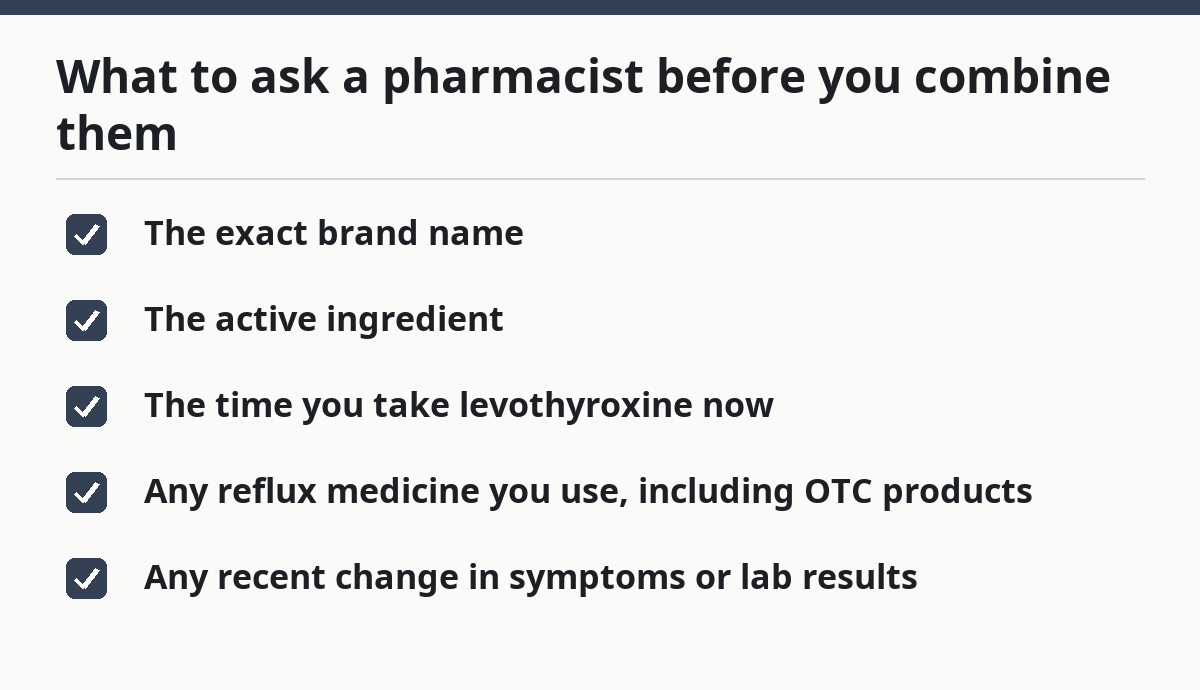
What to ask a pharmacist before you combine them
Levothyroxine and acid reducers are worth a pharmacist question when the label is fuzzy or the routine is changing.
If you are standing in the pharmacy aisle with two boxes and no clear answer on the front, a pharmacist can sort it out in plain language.
Bring these details:
- The exact brand name
- The active ingredient
- The time you take levothyroxine now
- Any reflux medicine you use, including OTC products
- Any recent change in symptoms or lab results
A good question sounds like: “Is this antacid or acid reducer something I need to separate from levothyroxine, and if so, by how long?” That gets to the point faster than asking whether a product is “safe” in the abstract.
One useful authority page to know is the American Thyroid Association patient information on levothyroxine, and the U.S. FDA medication guides for prescription acid reducers. If a source page is not certain, the organization name alone is still useful.
Do antacids block levothyroxine absorption?
Yes, antacids can block or reduce levothyroxine absorption, especially products with calcium carbonate, aluminum hydroxide, or magnesium hydroxide.
The effect is usually about interference in the gut, not a true allergy or a permanent failure of the thyroid medicine. That is why spacing is the first fix people ask about. If you use antacids often, a pharmacist can help you sort the timing and product ingredients.
Can I take omeprazole with levothyroxine?
You can take omeprazole and levothyroxine on the same day, but omeprazole may still change how well levothyroxine is absorbed.
The issue is stomach acid, not just pill contact. Omeprazole is a proton pump inhibitor, so it lowers acid for longer periods. If thyroid control changes after starting it, that is a good reason to ask a pharmacist or prescriber to review the medicine list.
How far apart should I take antacids and thyroid medicine?
A common separation is 4 hours for antacids with calcium carbonate, aluminum hydroxide, or magnesium hydroxide.
That timing helps reduce direct interaction in the stomach. It is not a guarantee for every person or every product, and it does not solve every acid-reducer issue. If you use the antacid often, ask for a specific schedule that fits your day.
Drafted with AI; not yet reviewed by a person.