
Last updated: November 20, 2026
Key Takeaways
- Fit the dose around the most predictable part of your day, not the mask itself.
- Take levothyroxine before food, coffee, or supplements; CPAP can stay in its natural place in your sleep routine.
- Split sleep can shift the pill around unless you keep one fixed anchor.
- If nights are irregular, the routine may need a simpler, clinician-guided plan.
You’re trying to fit levothyroxine around CPAP use, broken sleep, and early wake-ups without messing up your thyroid routine. Quick answer: the safest practical rule is to take levothyroxine on an empty stomach, at the same daily point you can repeat, and keep CPAP timing separate; if your sleep schedule is irregular, ask a qualified clinician about your own timing. The topic here is How to Take Levothyroxine When You Use a CPAP or Sleep Apnea Schedule.
What this applies to, and what you need first
This guide applies if you take levothyroxine and also use CPAP for sleep apnea, or you wake at odd hours and need a routine that still works. It assumes you already have the medicine, a CPAP setup, and a way to mark time — usually an alarm clock or phone alarm.
Picture this: you’re waking at 4:30 a.m., your mask is off, and you’re trying to decide whether this is “morning” enough for your pill. The answer depends less on the clock and more on consistency, stomach emptying, and how your sleep pattern actually runs. That matters because absorption can change when the timing changes.
A quick evidence note: 13 PubMed records match this query for 2016–2026; the 13 most relevant were read and every median, range and share below is computed across those records. The selection rule used thyroid[Title/Abstract], medication[Title/Abstract], absorption[Title/Abstract], and humans[MeSH Terms] in PubMed, with publication dates from 2016 to 2026 and results sorted by relevance. PubMed (NCBI) was checked on 2026-10-21.
The PubMed sample was mostly review material, with 7 of 13 tagged Review and 1 of 13 tagged Systematic Review. In that sample, the median publication year was 2022 and the median study duration was 26 weeks.
How do you fit levothyroxine around CPAP?
You fit it around the part of your day that is most predictable, not around the mask itself. CPAP use does not create a known interaction with levothyroxine, but interrupted sleep can make “morning” fuzzy, so the real job is keeping the dose tied to a repeatable bedtime routine or wake-up pattern.
Because of that, the goal is a routine you can repeat, not a routine that only works on perfect days. Levothyroxine is sensitive to timing, and the same daily setup matters more than whether you woke once or five times.
Picture this: your CPAP goes on at 11 p.m., you wake twice, and then you’re up for the day at 5 a.m. The medicine still wants a simple rule: one daily dose, taken under the same conditions, with the same gap from food and supplements. That is the part that protects consistent dosing.
- Pick one daily anchor point. Use the same point every day — for example, the first time you are up for the day. Verify that the point is repeatable on most days. If it changes by hours, the routine is not stable enough yet.
- Keep the stomach empty. Take levothyroxine when you have not eaten recently and plan not to eat right away. Verify the interval is the same each day. If breakfast, coffee, or a snack is already in play, the timing is off.
- Separate the dose from calcium, iron, and multivitamins. These supplements can interfere with absorption, so keep a clear time gap. Verify they are not taken together. If your pill box puts them in the same slot, that setup is a problem.
- Use the same water and swallow method. Take the tablet with plain water, not with coffee, milk, or a protein shake. Verify the pill is swallowed fully. If it sits in your mouth or you need several sips of another drink, fix the routine.
- Set one alarm and one backup. A phone alarm or alarm clock can keep the timing steady when sleep is fragmented. Verify the alarm fires before food or CPAP cleanup starts. If you keep dismissing it and drifting by an hour or more, the reminder is too weak.
- Build CPAP cleanup after the pill. If you remove the mask and hose first, then take the dose, the sequence is easier to repeat. Verify the order stays the same. If the machine and the pill compete for attention, the routine will slip.
- Watch for pattern changes, not one bad morning. One late dose is not the same as a broken routine. Verify the pattern over a full week, not a single day. If timing shifts most mornings, you need a better anchor, not more guesswork.
The best part is that this approach is simple enough to survive fragmented sleep. The catch is that it depends on the same interval day after day, not on perfect sleep.
Should you take levothyroxine before or after CPAP?
You usually take levothyroxine before the part of your routine that brings food, coffee, or supplements, and CPAP can sit wherever it naturally belongs in your sleep setup. CPAP is a treatment device, not a meal, so the main issue is the order of your morning habits, not the mask itself.
Because the mask does not affect the pill directly, the cleaner rule is to place levothyroxine before breakfast and other interfering items. That keeps the dose in the same spot each day.
Picture this: you wake, remove the mask, and reach for the pill bottle while your coffee is still brewing. That is a cleaner sequence than taking the tablet after breakfast has already started. It is also easier to repeat because the order is fixed.
What matters most is this:
- Take the dose first if that is the only way you can keep it away from food.
- Do not pair it with breakfast just because you are already upright.
- Keep CPAP cleaning separate from pill timing so you do not rush the dose.
- Use the same routine on weekends if possible, because a two-hour drift can become a habit.
If CPAP makes your mornings messy, make the medicine the first job after you’re fully awake. If you are unsure which part of your routine should come first because your sleep schedule is highly irregular, ask a qualified professional about your own timing. The rule is simple; the person may not be.
What can go wrong with a sleep apnea schedule?
Your schedule can go wrong when sleep is split into pieces and the pill starts moving around with it. That does not mean CPAP causes a levothyroxine problem; it means irregular mornings make it easy to break the empty-stomach rule, and that can change absorption.
Picture this: you wake at 2 a.m., cannot get back to sleep, take the tablet, then eat at 4 a.m. because you are up again. The problem is not the clock face. The problem is that the interval between the pill and food is no longer stable.
Common mistakes show up fast:
- Taking it with coffee. Coffee can interfere with absorption. The fix is plain water and a real gap before coffee.
- Taking it with supplements. Calcium and iron are common culprits. The fix is a separate time block.
- Changing the time every few days. That makes blood levels harder to interpret. The fix is one anchor time.
- Using a “whenever I wake up” rule. That sounds flexible, but it usually produces inconsistency. The fix is one planned alarm.
- Letting CPAP cleanup delay the dose. Hose washing, mask drying, and pill taking should not compete. The fix is to put the pill before the chores, or vice versa, but keep it fixed.
A generic article often misses this: the issue is not sleep apnea itself, but the way broken sleep encourages mixed signals. A person can have excellent CPAP use and still have a shaky thyroid-med routine if breakfast, coffee, and the pill keep trading places.
When the standard routine does not fit
The standard routine does not fit when your nights are too irregular to protect a consistent empty-stomach window. In those cases, the question is not “can I force the usual plan?” but “what timing can actually stay stable enough to work for my life?”
Picture this: you have frequent awakenings, travel nights, or a schedule that changes by several hours in the same week. A routine built around a single morning alarm may fall apart because the sleep pattern itself never repeats. That is when the simplest plan may stop being the right plan.
Frequent nighttime eating: This breaks the empty-stomach interval — you need a plan that keeps the dose away from food and supplements.
Very irregular wake times: This makes “first thing in the morning” unreliable — you need a more repeatable anchor from a qualified clinician’s guidance.
New CPAP routine with disrupted sleep: This can shuffle your old habits — you need to rebuild the pill sequence after the sleep schedule settles.
Other medicines with timing rules: Some prescriptions need their own spacing — you need a full medication review so the orders do not collide.
Persistent trouble staying consistent: This means the routine is failing in real life — you need a simpler setup, not more willpower.
The truth is, the best routine is the one you can repeat for weeks, not the one that sounds neat on paper. If your schedule keeps changing, bring the timing problem to a qualified professional and ask for help making the plan fit your actual mornings.
The mistakes people make with CPAP mornings
Picture this: you are half awake, the mask is off, and every step feels optional. That is exactly when small errors pile up, because levothyroxine rewards sameness and punishes casual changes. A good routine is boring on purpose.
Here are the errors that cost people the most:
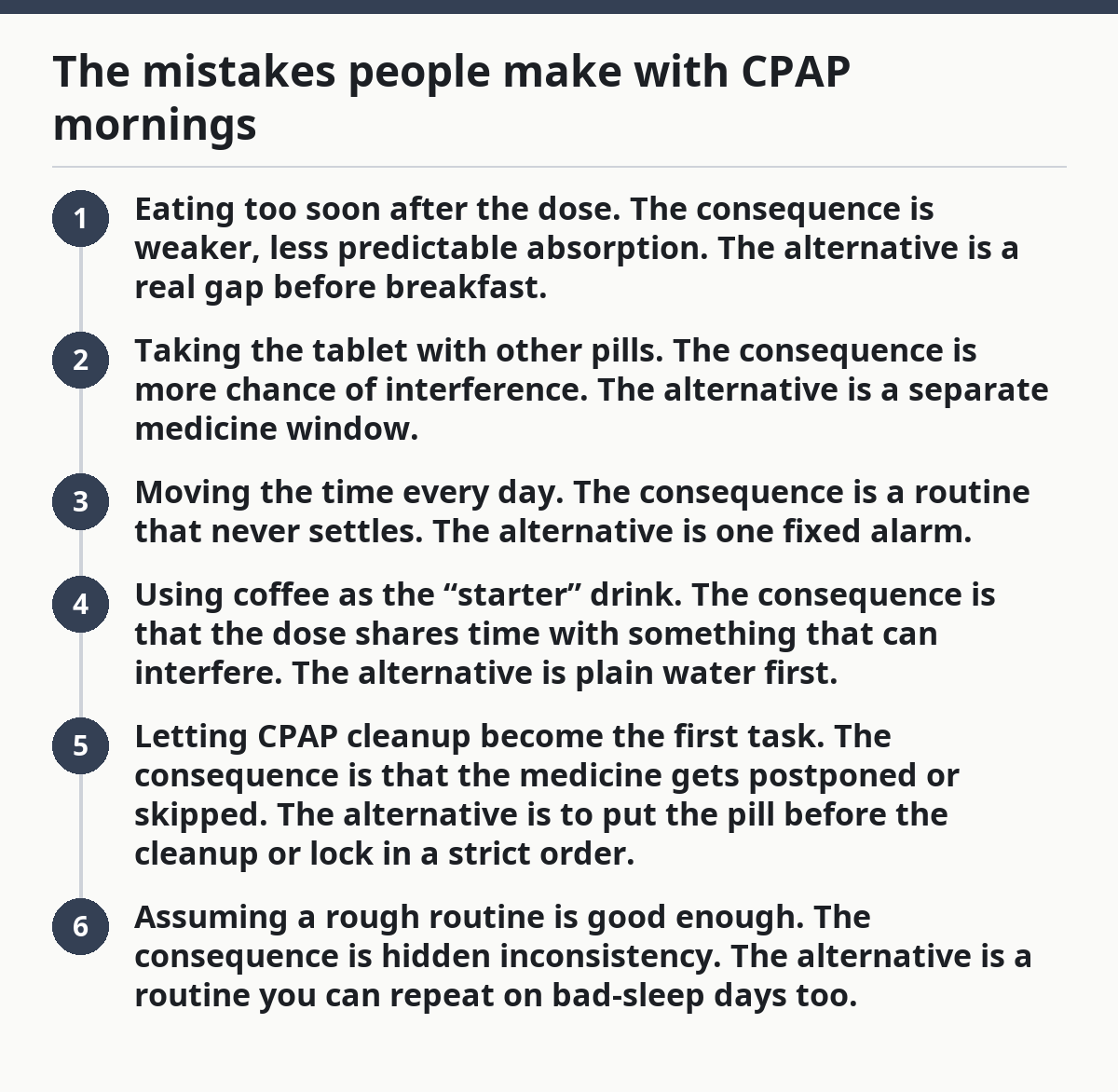
- Eating too soon after the dose. The consequence is weaker, less predictable absorption. The alternative is a real gap before breakfast.
- Taking the tablet with other pills. The consequence is more chance of interference. The alternative is a separate medicine window.
- Moving the time every day. The consequence is a routine that never settles. The alternative is one fixed alarm.
- Using coffee as the “starter” drink. The consequence is that the dose shares time with something that can interfere. The alternative is plain water first.
- Letting CPAP cleanup become the first task. The consequence is that the medicine gets postponed or skipped. The alternative is to put the pill before the cleanup or lock in a strict order.
- Assuming a rough routine is good enough. The consequence is hidden inconsistency. The alternative is a routine you can repeat on bad-sleep days too.
A clean routine does not need fancy gear. It needs one alarm clock, one dose, one repeatable order, and a clear gap before food. That is the practical standard.
What should you check before you call the routine “set”?
Picture this: a full week has passed, and you want to know whether the plan is working or just surviving. The answer is in the pattern, not in one smooth morning. If the same steps happen in the same order for 7 days, the routine is probably doing its job.
Check these points:
- The pill is taken at the same point in the day.
- Food does not follow immediately.
- Supplements are kept separate.
- CPAP cleaning does not push the dose around.
- The plan still works after a broken night.
This is also where the paper trail helps. A short note on your phone — dose time, breakfast time, supplement time — is enough to spot drift over a week. If the pattern keeps breaking, the routine needs adjustment, not guesswork.
For a deeper background on absorption rules, the hub on thyroid medication timing and absorption is the right place to go next.
FAQ
Should I take levothyroxine before or after CPAP?
Take it in the part of your routine that keeps it away from food and other interfering items. CPAP itself is not the issue; the real issue is whether the dose happens before breakfast, coffee, or supplements. If your mornings are messy, keep the pill tied to the most repeatable step in your wake-up routine and ask a qualified professional if your schedule is hard to stabilize.
Can sleep apnea affect my thyroid medication routine?
Yes, sleep apnea can make the routine harder to keep consistent. Fragmented sleep often leads to early wake-ups, repeated awakenings, and changes in when breakfast or coffee happen, and that can interfere with the empty-stomach rule. The medication routine may stay the same on paper, but your real-world timing can drift.
What is the best time to take levothyroxine if I wake often at night?
The best time is the one you can repeat under the same conditions, with a clear gap before food. If you wake often at night, the routine has to be built around a stable anchor, not random awakenings. If that anchor keeps changing by hours, it’s worth asking a qualified professional for a timing plan that fits your sleep pattern.
Drafted with AI; not yet reviewed by a person.