Last updated: November 20, 2026
Quick answer: thyroid supplement safety depends on the label, the dose, and your medicines; if you already take levothyroxine, liothyronine, or another thyroid drug, review the product first with a qualified clinician. Thyroid supplement safety and interactions — The Complete Guide is about that exact decision point. Thyroid supplements can be unsafe when they contain iodine, glandular material, or minerals that interfere with thyroid medicine. The sections below sort out the main ingredients, the common interaction traps, and the situations where you should avoid them.
The short answer on thyroid supplement safety
Thyroid supplements are not automatically safe, even when they sit on a health-store shelf with calm labels and botanical names.
Picture this: you’re standing in a pharmacy aisle, holding a bottle that promises “thyroid support,” and you already take levothyroxine, liothyronine, or another thyroid medicine. That is the exact moment when timing, ingredients, and hidden iodine can matter. The topic here is thyroid supplement safety and interactions, and the label alone is not enough.
The best-known risk is that some products contain ingredients that can push thyroid function too far, while others can make your medicine work poorly. Iodine, kelp, glandular extracts, selenium, and iron each create different problems. A product can be a 10-minute purchase and a long-term problem.
Here’s the catch: the label rarely tells you the whole story. Some products use blends, proprietary mixes, or “thyroid support” language that hides the real active ingredients, so you need to read the Supplement Facts panel, not just the front. One bottle can list 12 ingredients and still leave out the amount that matters most.
Key takeaways
- “Thyroid support” does not mean “safe with thyroid disease.”
- Iodine, kelp, and glandular ingredients are the main red flags.
- Calcium, iron, magnesium, and fiber can reduce absorption of thyroid medicine.
- Professional guidance matters because the same product can be harmless for one person and risky for another.
What’s actually in a thyroid supplement?
Most thyroid supplements are built around 3 ingredient types: iodine sources, vitamins or minerals, and glandular or herbal extracts.
Picture this: you flip the bottle over and see kelp, bladderwrack, selenium, zinc, ashwagandha, and “thyroid glandular.” That mix is common, and each item raises a different safety question. One label can hold three separate risk categories.
The first problem is iodine. The body needs iodine to make thyroid hormone, but too much can trigger or worsen thyroid dysfunction in people who are sensitive. Kelp products are especially unpredictable because natural seaweed can vary a lot in iodine content. The National Institutes of Health Office of Dietary Supplements has a detailed fact sheet on iodine: https://ods.od.nih.gov/factsheets/Iodine-HealthProfessional/ The fact sheet is useful because it shows why dose matters.
The second problem is glandular material. These products are sold as thyroid support, but they may contain animal-derived tissue. That raises quality concerns, possible contamination concerns, and the possibility that the product is acting more like an unregulated hormone source than a simple supplement. For a deeper regulatory overview, the U.S. Food and Drug Administration explains supplement oversight here: https://www.fda.gov/food/dietary-supplements The FDA page is a good starting point because supplement oversight is different from drug approval.
The third problem is added botanicals and minerals. Ashwagandha, for example, has case reports and small studies suggesting a possible effect on thyroid hormone levels, but the evidence is not strong enough to treat it as predictable or safe for every user, so consult a professional before using it if you have thyroid disease. Selenium can be helpful in some contexts, but excess selenium has its own toxicity risk. No magic there.
The usual ingredient groups
- Iodine/kelp/bladderwrack: can raise thyroid hormone production in some people, but can also destabilize thyroid disease.
- Glandulars: may contain animal tissue and pose quality or hormone-content concerns.
- Minerals and vitamins: sometimes supportive, sometimes interaction-heavy, especially with thyroid medicine.
- Herbs: the effect can be inconsistent, product quality varies, and data are often limited.
Which thyroid supplement ingredients are most likely to cause trouble?
Iodine, kelp, and glandular extracts are the ingredients most likely to create real harm or confusion.
Picture this: you’re trying to “support” your thyroid and the bottle lists a dozen ingredients, but the one line that matters most is the iodine amount. That single number can be the difference between a minor helper and a problem. If the label is vague, the risk is harder to judge.
Iodine is the most obvious risk. People with autoimmune thyroid disease, nodules, or a history of thyroid dysfunction can react badly to large or sudden iodine changes. That does not mean iodine is always bad; it means the margin for error is narrow. The American Thyroid Association has patient-facing guidance on iodine and thyroid disease: https://www.thyroid.org/iodine-deficiency/ That guidance is relevant because excess iodine can be a trigger in susceptible people.
Kelp is tricky because it is a natural source of iodine, but “natural” does not mean consistent. One batch may be modest, another may be heavy enough to overwhelm the system. That variability is why kelp-based thyroid products deserve extra caution. A natural source can still deliver an unpredictable dose.
Glandular extracts are a separate concern. They may contain tissue from bovine or porcine thyroid glands, and the more a product behaves like a hormone product, the more serious the safety conversation becomes. That is a better fit for medical review than casual self-treatment. A clinician can help judge whether the product is even appropriate.
Red-flag ingredients
- Kelp or bladderwrack if you already have thyroid disease.
- Iodine when the product does not clearly explain the amount and source.
- Thyroid glandular if the product sounds closer to hormone support than general nutrition.
- Ashwagandha if you have a history of thyroid swings or autoimmune disease.
- “Proprietary blend” if the label hides exact amounts.
How do thyroid supplements interact with thyroid medication?
The biggest interaction problem is that some supplements reduce the absorption of levothyroxine and related medicines.
Picture this: you take your thyroid pill in the morning, then grab a multivitamin, calcium chew, iron tablet, coffee, and a “thyroid support” capsule before work. That stack can turn a clean routine into a messy absorption problem. One pill, one cup of coffee, and one supplement can be enough to change the timing equation.
Calcium and iron are the classic offenders. They can bind thyroid medicine in the gut and keep it from being absorbed well. Magnesium, aluminum-containing antacids, and high-fiber supplements can create similar timing issues. This is a mechanism problem, not a mystery: the medicine never gets where it needs to go.
Food and drink matter too. Coffee can interfere with absorption for some people if the timing is too tight, and fiber supplements can slow things down. The exact spacing advice varies by product and by person, which is why clinicians often review the full medication list instead of just the thyroid prescription. A spacing plan is part of the treatment plan.
The safest general principle is not “never take supplements.” It is “check for spacing conflicts and interaction conflicts before you stack products on top of thyroid medicine.” That is especially important if your thyroid lab values have been unstable. When the numbers move, timing becomes even more important.
Common interaction categories
- Calcium: can reduce absorption when taken too close to thyroid medicine.
- Iron: same problem, same mechanism.
- Magnesium and antacids: may interfere with uptake.
- Fiber supplements: can slow absorption in some people.
- Soy-heavy products: may matter for absorption in some cases and deserve a medication review.
Can thyroid supplements affect lab tests?
Yes, some thyroid supplements can distort lab results or make them harder to interpret.
Picture this: you finally get a blood test, but your supplement routine has been changing behind the scenes. Now the lab number may reflect the product, the timing, or the combination—not just your thyroid status. One test can be misleading if the supplement changed last week.
Iodine intake can shift thyroid labs by changing how the thyroid behaves. Selenium, biotin-containing products, and glandular supplements can also complicate interpretation. Biotin is especially notorious because it can interfere with some immunoassays and make results look misleading. The American Association for Clinical Chemistry has explained biotin interference in lab testing in professional materials, and that issue is well recognized in clinical chemistry. A supplement with biotin can be a lab problem even if you feel no different.
This is one reason professionals often ask about supplements before ordering or interpreting thyroid panels. A “normal” result after a new supplement does not always mean the supplement is harmless, and an “off” result does not always mean the thyroid suddenly changed on its own. Timing matters because lab values can move after a product change.
Lab issues worth flagging
- Biotin can interfere with some assays.
- Iodine changes can shift thyroid function.
- Glandular products can muddy the picture.
- Recent supplement changes can make a single blood draw hard to interpret.
What about supplements for hypothyroidism versus hyperthyroidism?
The risks are different, but neither condition gets a free pass.
Picture this: one person is trying to raise a sluggish thyroid, while another is trying to keep an overactive thyroid from getting worse. The same bottle can be a bad idea in both cases, just for different reasons.
For hypothyroidism, the most common mistake is assuming that more iodine or more “thyroid support” will fix symptoms. It might not. In some people, extra iodine does nothing useful; in others, it can make thyroid function more unstable. If the hypothyroidism is being treated with prescription medicine, the interaction issue becomes even more important. A supplement that seems mild can still upset a stable routine.
For hyperthyroidism, the concern is sharper. Anything that may stimulate thyroid activity, increase iodine load, or confuse lab monitoring can be a problem. Even “natural” products can be a poor fit if the thyroid is already overactive. If the gland is already pushing too hard, adding unknown stimulation is a bad trade.
The clearest way to think about it is this: if thyroid disease is already diagnosed, the supplement question is not “can I take it because it’s natural?” It is “does this ingredient have a plausible way to make my current situation worse?” That question is more useful than the marketing copy.
Different risks by condition
- Hypothyroidism: interaction with medicine, iodine overload, lab confusion.
- Hyperthyroidism: possible worsening of overactivity, monitoring problems, and avoidable stimulation.
- Autoimmune disease: some ingredients may be less predictable and deserve closer review.
How should you read a thyroid supplement label?
You should read the Supplement Facts panel first, then the front label, because the front label can be marketing and the back label is where the risk lives.
Picture this: the bottle says “thyroid support,” “adrenal + thyroid,” or “metabolism formula,” but the real question is whether it contains iodine, kelp, glandulars, biotin, or large mineral doses. That’s the part that changes the safety profile. The marketing can look calm while the ingredient list is not.
Start with the ingredient list. Look for iodine in micrograms, not just a vague claim of “thyroid support.” Check whether the source is kelp, potassium iodide, or another form. Then look for calcium, iron, magnesium, and zinc, because those may matter if you take prescription thyroid medicine. One mineral can be enough to change the schedule.
Next, check for glandular ingredients and proprietary blends. If the label hides the exact amounts, that is a warning sign. A product that won’t tell you what is inside is asking for trust without giving you much back. Specific numbers matter more than slogans.
One more thing: the “other ingredients” list matters too. Dyes, fillers, and capsule materials are usually less important than the active ingredients, but they still matter if you have allergies or sensitivities. A short list is easier to evaluate than a dense one.
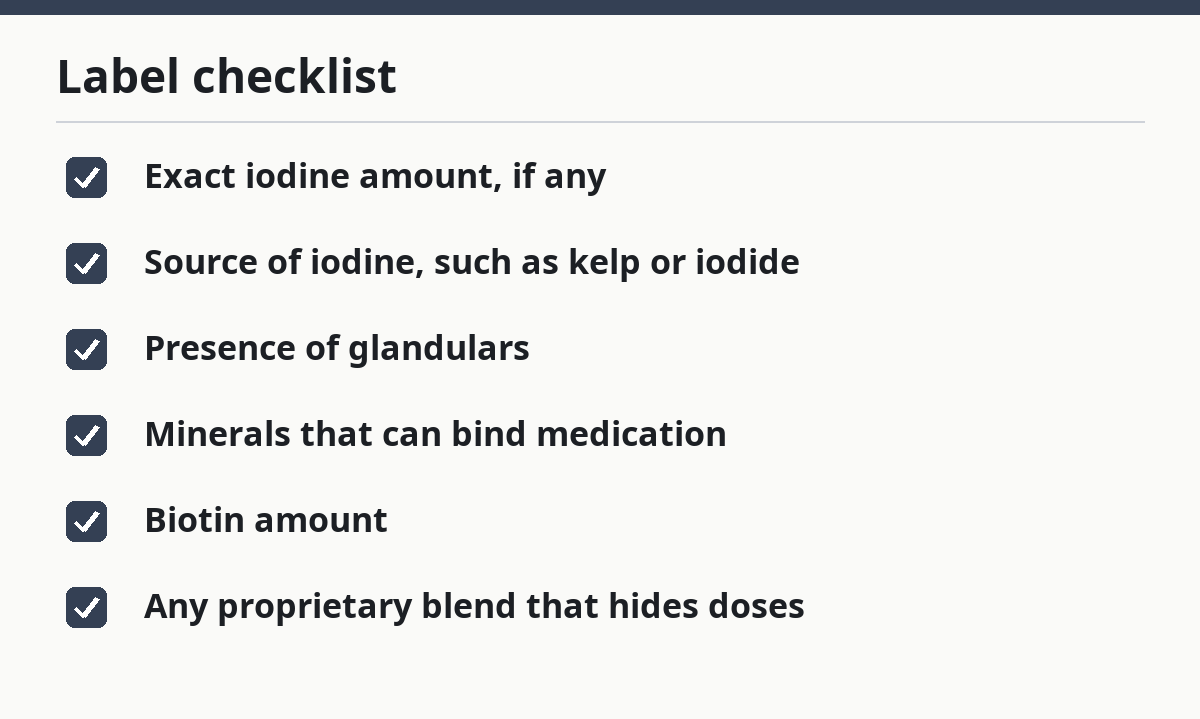
Label checklist
- Exact iodine amount, if any
- Source of iodine, such as kelp or iodide
- Presence of glandulars
- Minerals that can bind medication
- Biotin amount
- Any proprietary blend that hides doses
When should someone avoid a thyroid supplement entirely?
You should avoid thyroid supplements entirely until you get professional guidance if you have thyroid disease, take thyroid medicine, are pregnant, or have a history of unusual iodine reactions.
Picture this: you have a prescription thyroid medication in one hand and a “natural” thyroid formula in the other. That is not a good place for improvisation, especially if your labs have changed before or if you’ve had a sensitivity to iodine. A quick purchase can become a slow problem.
Pregnancy is a special case because iodine needs and thyroid function both matter a lot, and the wrong supplement can complicate both. People with autoimmune thyroid disease also need extra caution because immune-related thyroid problems can be sensitive to changes in iodine or supplement ingredients. The safest move is to ask before starting, not after a lab changes.
Avoid thyroid supplements outright if the product contains glandular material and the label is vague, if the iodine content is unclear, or if you are already taking multiple supplements that affect absorption. The interaction pile-up is where simple products become complicated fast. A stack of three products can act like one big interaction.
Avoid entirely until reviewed if you have
- Existing thyroid disease
- Thyroid prescription medication
- Pregnancy or planned pregnancy
- A history of iodine sensitivity
- A supplement stack that already includes calcium, iron, or biotin
What should you ask a clinician or pharmacist?
You should ask about ingredient conflicts, medication timing, and lab interference, not just whether a supplement is “fine.”
Picture this: you bring the bottle to the visit and ask a yes-or-no question. That is not enough. The useful questions are the ones that expose the interaction map. One bottle can create more than one issue.
Ask whether the product contains iodine, kelp, glandulars, or biotin. Ask whether it can interfere with your thyroid medication, and if so, how far apart they should be taken. Ask whether it could alter thyroid blood tests or make a recent lab result hard to read. That conversation is often more useful than asking whether a bottle is “natural.” Specific questions lead to better advice.
If you use other medications, mention them too. Calcium, iron, antacids, cholesterol medicines, and some stomach medications can all matter in a thyroid routine. The pharmacist may spot a timing issue that the front label never hinted at. A review can catch problems before you buy another bottle.
Bring these details to the visit
- Product name and full label
- All prescription and OTC medicines
- Any biotin, calcium, or iron use
- Recent thyroid lab results
- Any symptom change after starting the supplement
The practical verdict on thyroid supplement safety
Thyroid supplements are safest when they are simple, clearly labeled, and reviewed against your medicines and diagnosis.
Picture this: you want a single clean answer before you buy, keep, or stop a bottle. Here it is — the more a product looks like a thyroid hormone workaround, the more careful you should be. That rule is practical because the label often hints at the risk.
Choose a thyroid supplement only after you know what is in it, what it can interact with, and whether your thyroid status makes it a bad fit. Iodine, kelp, glandulars, and biotin are not harmless decoration. They are the ingredients that most often change the safety conversation. One ingredient can change the whole plan.
The clearest line is this: if you already take thyroid medicine or have diagnosed thyroid disease, treat any “thyroid support” product as a potential interaction until a qualified professional has looked at the label. That is the safest default, and it avoids the most common mistakes. It also keeps the focus on the actual dose and the actual ingredients.
Bottom line by situation
- No thyroid disease, no thyroid medicine: still check iodine and glandular ingredients.
- On thyroid medicine: watch absorption conflicts and timing.
- Diagnosed thyroid disease: get the label reviewed before use.
- Pregnant or planning pregnancy: avoid guessing; get professional guidance first.
Can I take iodine if I have thyroid disease?
Not safely on guesswork. Iodine needs vary by person, and thyroid disease can make the response to iodine unpredictable. The NIH iodine fact sheet and the American Thyroid Association both note that too much iodine can be a problem in susceptible people. That means the dose matters every time.
Do thyroid supplements help with fatigue?
Sometimes people feel better after correcting a real deficiency, but fatigue has many causes and thyroid supplements are not a general fix. If thyroid disease, anemia, sleep problems, or medication side effects are involved, a supplement can miss the real issue entirely. Fatigue deserves a diagnosis, not a guess.
Is kelp safer than synthetic iodine?
No. Kelp is still an iodine source, and its iodine content can vary enough to make it hard to judge. The source being natural does not make the dose predictable. A seaweed capsule can still deliver an unclear amount.
Can I take a thyroid supplement with levothyroxine?
Sometimes the issue is not the supplement itself but the timing and ingredients. Calcium, iron, magnesium, fiber, and some other components can interfere with absorption, so the full label and your medication schedule matter. A pharmacist or clinician should review the combination. One spacing error can undermine the dose.
What is the biggest hidden risk in thyroid supplements?
The biggest hidden risk is that the product may contain more iodine or hormone-like material than the front label suggests. That can change thyroid function, distort lab tests, or interfere with prescription medicine without much warning.
Drafted with AI; not yet reviewed by a person.