
How to Build a Thyroid-Friendly Grocery List for a Family Household

Last updated: November 19, 2026
Quick Answer: To build a Thyroid-Friendly Grocery List for a Family Household, start with 3 to 5 proteins, 5 to 7 produce items, 2 to 4 grains or starches, 2 to 3 dairy or fortified alternative choices, and 6 to 10 pantry basics. This guide shows how to build a Thyroid-Friendly Grocery List for a Family Household around protein, vegetables, fruit, dairy or fortified alternatives, whole grains, and a few reliable pantry staples, then trim the foods that make thyroid care harder for your household. If thyroid disease or treatment is part of the picture, speak with a qualified clinician about the person’s own needs before making major diet changes, and see guidance from the American Thyroid Association or the NIH Office of Dietary Supplements. A shared grocery list can still work for the whole family without turning every meal into a separate project.
Key takeaways
- Start with a short core list: protein, produce, grains, dairy or a substitute, and pantry basics.
- Keep the household plan simple enough that one dinner can fit more than one person’s needs.
- Use label checks for iodine, sodium, and added sugar instead of guessing from package names.
- Make small swaps first; a pantry overhaul is often not the easiest first move.
- If symptoms, medication timing, or other health issues change the picture, get personal advice rather than relying on a generic list.
Who is this list for?

This list is for a family that wants one grocery system that supports thyroid-friendly eating without forcing everyone onto separate meals. It assumes there is already a basic home kitchen, a regular grocery trip, and a willingness to cook simple family meals with repeat ingredients.
Therefore, it is not a substitute for personal medical advice. A person with thyroid disease, pregnancy, celiac disease, kidney disease, or several food restrictions may need a different plan than the rest of the household, and that is normal. The point of a family list is to make the shared foods useful, not to make every plate identical.
Because direct research on household grocery planning is limited, the nutrition research here is still modest. On PubMed, 14 human records matched this subject for 2016–2026; the 14 most relevant were read, and the median publication year was 2020. Five of those were reviews. On ClinicalTrials.gov, 5 trials were registered for this term; 2 were completed, 2 were recruiting, and 1 was not yet recruiting, with a median planned enrolment of 234 participants. Those figures, computed on 2026-11-10, are a reminder that household food planning often has to work with limited direct evidence and practical judgment.
What should go on the list?
A thyroid-friendly grocery list should center on foods that make balanced family meals easy to repeat across the week. Rather than treating it as a strict menu, think of it as a short list of categories that supports breakfast, lunch, dinner, and meal prep.
Use these anchors:
- Protein: eggs, fish, chicken, turkey, beans, lentils, tofu if it fits the person’s plan
- Vegetables: leafy greens, carrots, peppers, broccoli, cauliflower, tomatoes, onions
- Fruit: berries, apples, oranges, bananas
- Grains and starches: oats, rice, potatoes, whole-grain bread or pasta
- Dairy or alternatives: milk, yogurt, cheese, or a fortified substitute
- Pantry staples: olive oil, canned beans, canned fish, tomato sauce, broth, herbs, spices
- Meal prep helpers: frozen vegetables, pre-washed greens, frozen fruit, bulk grains
However, a generic grocery list often fails because it chases “thyroid superfoods” and forgets weeknight reality. That leads to a cart full of specialty items and no parts for actual meals. A better list is built from foods the household will eat more than once, and it works best when it overlaps with the family’s usual meal planning and grocery list template.
How do you build the list step by step?

Build the list by choosing one category at a time, checking each item against the meals the family already makes, and keeping the cart easy to repeat next week.
- Write the protein column first: Pick 3 to 5 proteins for the week, such as eggs, chicken, beans, and yogurt, and verify each one can appear in at least 2 meals; a problem is buying only one protein that the household does not usually eat.
- Add produce second: Choose 5 to 7 fruits and vegetables, with at least 2 frozen options for backup, and verify the mix includes one leafy green and one orange or red vegetable; a problem is buying fresh produce that spoils before Friday.
- Choose the grain base: Select 2 to 4 staple carbs like oats, rice, potatoes, or whole-grain bread, and verify they work for breakfast and dinner; a problem is choosing only specialty grains that do not fit family meals.
- Fill the dairy or alternative slot: Add 2 to 3 items such as milk, yogurt, or a fortified alternative, and verify they are usable in both breakfast and snacks; a problem is buying a substitute that the household will not drink or cook with.
- Stock the pantry basics: Add 6 to 10 shelf-stable items, including olive oil, canned beans, broth, spices, and tomato sauce, and verify at least half can support meal prep; a problem is a pantry full of single-use jars.
- Check the label details: Read sodium, added sugar, and ingredient lists on packaged foods, and verify the item is not relying on a long list of additives to do the job; a problem is assuming “healthy” on the front means sensible on the back.
- Plan 2 reusable meals: Match the list to 2 dinners that can become leftovers, and verify the ingredients overlap instead of creating separate shopping piles; a problem is a list that only works for one recipe at a time.
- Review the cart against the budget and time: Keep the final list tight enough for one regular store trip, and verify the household can cook the ingredients on a weeknight; a problem is a “good” list that takes 3 hours to prep.
Overall, the method above is less about perfection than about repeatability. A family household usually does better with 10 to 20 dependable items than with a giant list of one-off foods. That is especially true when one person is watching thyroid-related nutrition and everyone else still needs normal family meals.
What pantry staples work best?
The pantry staples that work best are the ones that make 10-minute meals possible on a busy night. A pantry that supports thyroid-friendly eating does not need rare powders or expensive specialty products; it needs steady basics that can fill gaps.
A useful starter pantry often includes canned beans, canned tuna or salmon, oats, rice, pasta, broth, tomato sauce, olive oil, nuts, seeds, and dried herbs. Frozen vegetables matter too, because they keep the list flexible when fresh produce runs out. For many households, that mix is enough to build breakfast, lunch, and dinner from the same shelf.
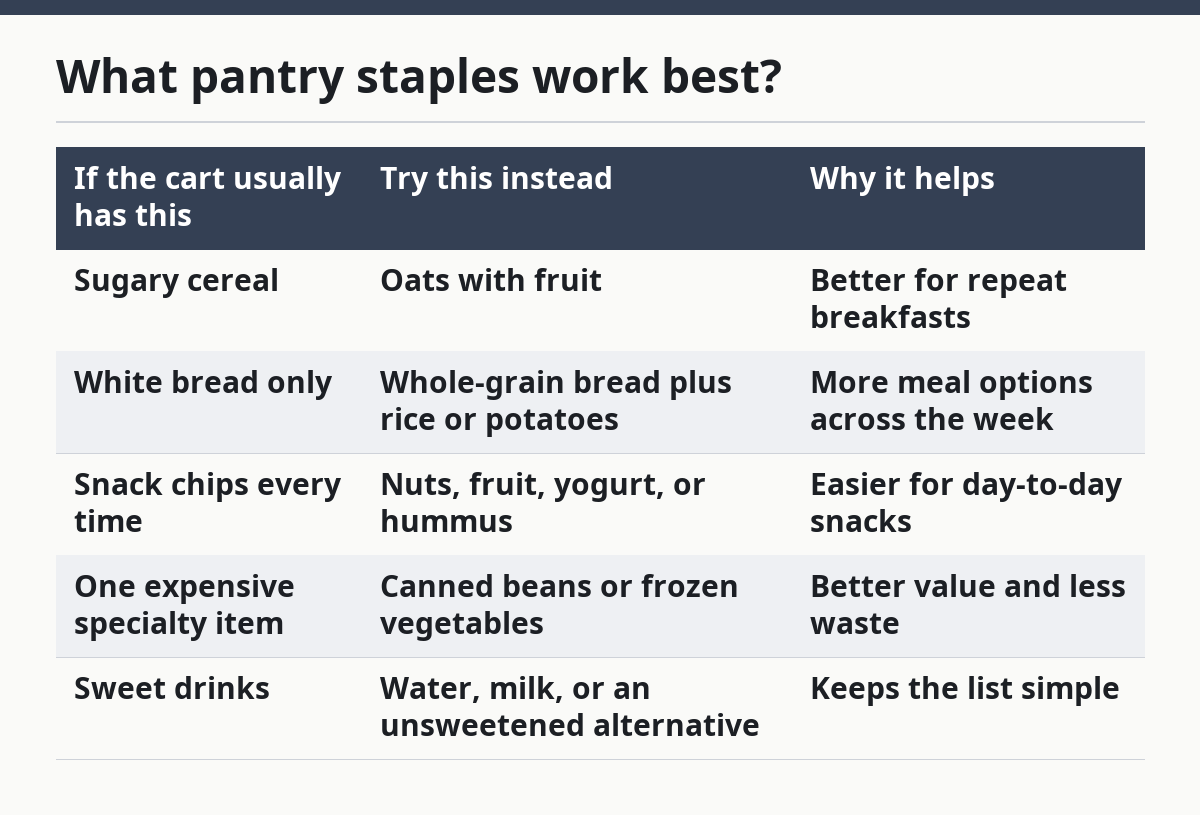
For example, here is a simple comparison of common household swaps:
| If the cart usually has this | Try this instead | Why it helps |
|---|---|---|
| Sugary cereal | Oats with fruit | Better for repeat breakfasts |
| White bread only | Whole-grain bread plus rice or potatoes | More meal options across the week |
| Snack chips every time | Nuts, fruit, yogurt, or hummus | Easier for day-to-day snacks |
| One expensive specialty item | Canned beans or frozen vegetables | Better value and less waste |
| Sweet drinks | Water, milk, or an unsweetened alternative | Keeps the list simple |
Likewise, a trade-off matters here: pantry staples are convenient, but they can become boring if the list is too narrow. The fix is not to abandon them. The fix is to keep a few rotating seasonings, such as garlic, cumin, pepper, paprika, or Italian herbs, so the same staples do not taste the same every night.
What should you limit or swap?
Limit the foods that crowd out the basics, and swap them only when the household will actually use the replacement. A thyroid-friendly list is not built on fear; it is built on balance, and research in this area is still limited enough that rigid rules often go farther than the evidence.
Meanwhile, common swaps include moving from snack-heavy packaged foods to plain ingredients, choosing lower-sugar breakfast foods, and keeping high-sodium convenience items as occasional backups rather than the base of the cart. If a label has a long ingredient list and little real food value, it usually belongs lower on the list. If a food is useful but not perfect, it may still stay on the list in a smaller amount.
The point is to make family meals easier to assemble, not to make shopping morally clean. A household that removes every convenient item tends to rebound hard and buy takeout later in the week. A household that keeps 2 or 3 convenience foods and uses them intentionally is usually more sustainable.
When does the standard approach not fit?
The standard approach does not fit when one person in the home has a medical reason for a more specific plan. In those cases, a shared grocery list still works, but the details may need professional input.
Pregnancy is part of the picture: Nutrient needs and food safety priorities change — get individualized guidance before reshaping the whole list.
Celiac disease or a gluten-free diagnosis is part of the picture: The household needs careful label checks and cross-contact awareness — use a stricter system than a generic thyroid list.
Kidney disease is part of the picture: Protein, sodium, and mineral choices may need adjustment — do not rely on a general grocery template.
Medication timing is already a problem: Some foods and supplements can interfere with routine scheduling — ask a clinician or pharmacist before changing breakfast habits.
The family includes a very selective eater: A rigid “thyroid foods only” cart usually backfires — keep 2 or 3 familiar safe foods while you build around them.
For these situations, it is less helpful to force the same shopping plan on everyone. They are not reasons to give up on a shared list. They are reasons to make the list less generic and more personal. The wrong move is to assume that one household food pattern fits every thyroid situation, because that is where generic advice turns unhelpful.
What mistakes should you avoid?
The most common mistakes are small, but they create big problems by the end of the week. A thyroid-friendly grocery list fails when it gets too narrow, too fancy, or too disconnected from real meals.
-
Buying specialty foods first: This often leads to a high-cost cart with no full meals in it. The better move is to buy protein, produce, grains, and pantry basics first.
-
Ignoring the rest of the family: A list that works for one person but not the household gets rejected fast. Choose shared foods that can be served in different combinations.
-
Skipping frozen items: That creates waste when fresh produce spoils. Frozen vegetables and fruit keep the list useful for the full week.
-
Checking front labels only: Words like “natural” or “healthy” do not tell the whole story. Check the ingredient list and nutrition panel.
-
Making every meal special: Too many separate recipes make meal prep harder than it needs to be. Reuse ingredients across 2 or 3 meals instead.
-
Leaving out snacks: A few planned options prevent that scramble when people need food between meals. Keep fruit, yogurt, nuts, or hummus on hand.
In short, the right alternative is a short, repeatable list with enough variety to avoid burnout. That usually works better than a dramatic pantry reset.
How can meal prep stay simple for the family?
Meal prep stays simple when the grocery list supports only a few repeatable building blocks. A good list should let one protein become dinner, lunch leftovers, and a next-day breakfast or snack without much extra work.
Since the list is built around overlap, think in 3 parts: a cooked protein, a roasted or raw vegetable, and a grain or starch. Add one sauce or seasoning pattern, then repeat it in different forms. For example, rice, beans, and vegetables can become a bowl one night and a wrap or side dish the next day.
Ultimately, the best measure of success is whether the household still has usable food on day 4 or day 5. If every ingredient needs a separate recipe, the list is too complicated. If the same ingredients can build 2 or 3 meals, the list is working.
For broader context on thyroid nutrition for special diets and conditions, the hub page is the better place to start once the household list is set.
How do I shop for one thyroid patient in a family?
Therefore, shop for the whole household first, then make one or two targeted adjustments for the person with thyroid needs. That usually means keeping the same base foods and changing portion style, label checks, or timing details rather than buying an entirely different cart. If a medical condition changes the plan, a clinician or dietitian can help refine it, and the Mayo Clinic thyroid overview is a useful starting point for general background.
What pantry staples work for a thyroid-friendly household?
Meanwhile, pantry staples that work well are the ones that turn into meals fast: oats, rice, canned beans, canned fish, broth, tomato sauce, olive oil, nuts, seeds, and dried herbs. Frozen vegetables help too, even though they live in the freezer, because they make the pantry less fragile when fresh food runs out.
How can I keep meals simple for everyone at home?
So, keep meals simple by choosing ingredients that overlap across breakfast, lunch, and dinner. One protein, one grain, and one or two vegetables can cover several meals if the household repeats them with different seasonings. A short list is easier to use than a long one, and a used list beats a perfect one sitting in a notebook.
Drafted with AI; not yet reviewed by a person.