How to Decide Between Food and Supplements for Selenium

Last updated: November 19, 2026
Quick answer: for most people, food is the better first choice for selenium, and supplements are a backup when meals are unreliable or a qualified professional recommends one. If you have a thyroid concern, speak with a qualified professional about your own case before you change intake. This guide explains How to Decide Between Food and Supplements for Selenium using the practical question: can you keep selenium steady from meals, or do you need a supplement?
Key takeaways
- Food is the safer first choice for most people because it brings selenium with protein, fat, and other nutrients in one package.
- Supplements make more sense when diet is irregular, food access is limited, or a clinician wants a more controlled intake pattern.
- Brazil nuts can deliver a lot of selenium in a small serving, which is useful but also the reason they are easy to overdo.
- Fish and eggs are steadier food options for meal planning than brazil nuts because they fit into normal meals more easily.
- Human research on selenium intake, food sources, and supplements exists, but it is not a huge trial literature; the practical question is still how to make intake consistent in real life.
What is the real choice here?
The real choice is not “food or supplement” in the abstract; it is “Can I get selenium from meals in a way I can keep up?” Studies and guidance on selenium are usually about consistency, not just total amount, and the available human literature is still handled mostly through reviews rather than a large run of new trials. For background reading, see the NIH Office of Dietary Supplements selenium fact sheet and the NHS selenium page.
That matters because a limited evidence base usually pushes the safest answer toward a practical one rather than a dramatic one.
Food wins when you can make selenium part of normal meals. Supplements win when you cannot rely on meals, or when a professional is trying to avoid the swings that come from guessing with food alone.
How do I compare food and supplements for selenium?
Food usually wins on everyday safety and habit-building, while supplements usually win on control and convenience. The right pick depends on whether you need a nutrient strategy that fits a plate or a capsule, and on whether you can keep selenium intake steady from week to week.
| Criteria | Food sources | Selenium supplements | Winner for this condition |
|---|---|---|---|
| Daily routine fit | Fits into breakfast, lunch, or dinner | Fits into a pill routine | Food, if meals are stable |
| Control over intake | Varies with food choice and portion size | More controlled, depending on product form | Supplements, if steady intake is the goal |
| Risk of accidental overdoing it | Higher with brazil nuts because they can concentrate selenium | Higher if a person stacks products without checking labels | Neither, if the person does not track intake |
| Nutrient package | Comes with protein, fat, and other nutrients | Selenium only, not a full food matrix | Food |
| Meal planning ease | Fish and eggs are easy to plan around | Easier when travel or appetite makes meals hard | Supplements |
| Variety | Uses regular foods already in the kitchen | Uses one product form | Food, for long-term adherence |
| Label complexity | No supplement label to decode | Label matters a lot, especially for form and amount | Food, for simplicity |
| Backup option when diet is weak | Weak if the diet is inconsistent | Stronger as a fallback | Supplements |
| Best fit for a thyroid nutrition plan | Useful as part of a broader eating pattern | Useful only when a professional wants supplement-based intake | Food first |
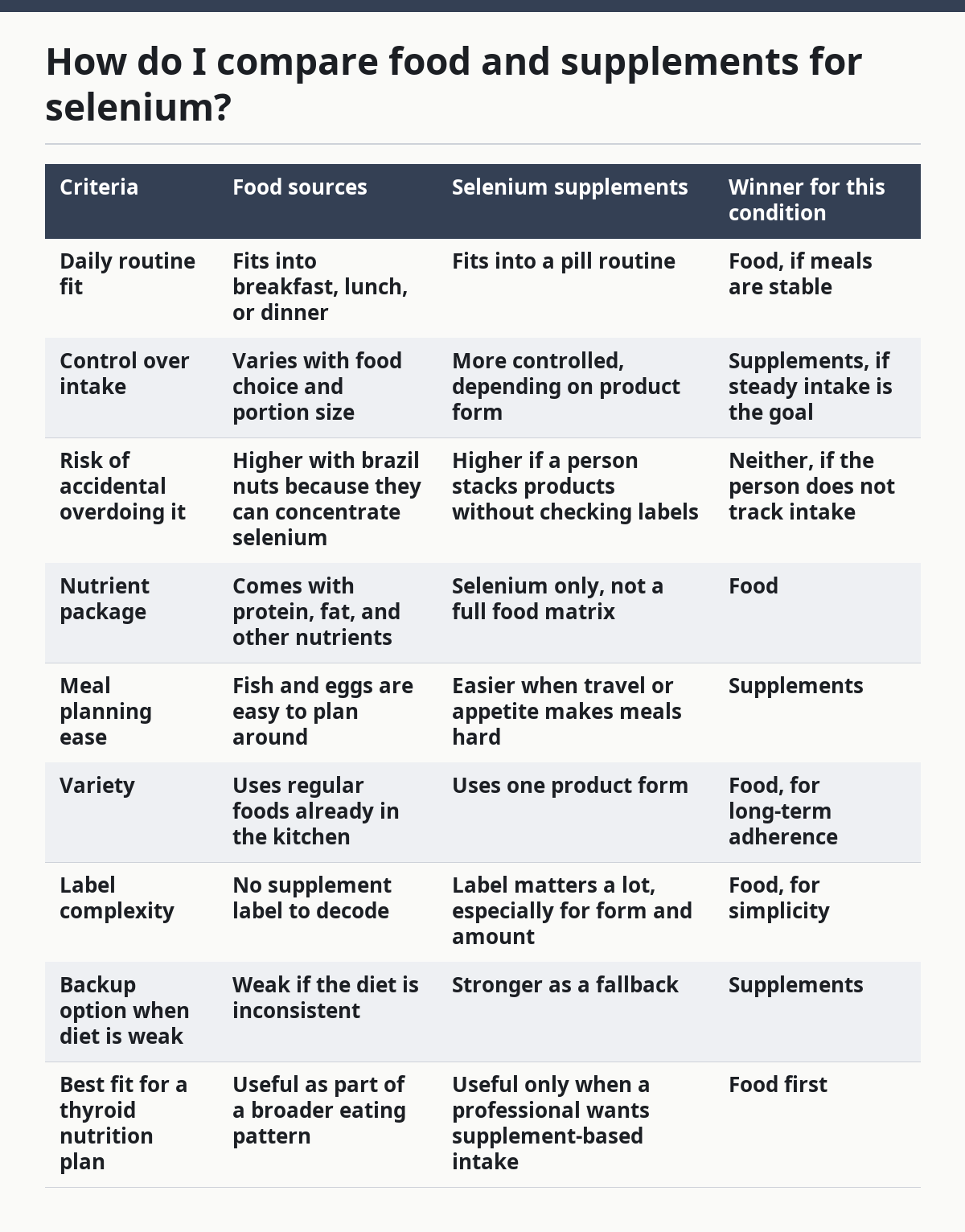
That table shows the core trade-off: food gives you broader nutrition and less label burden, while supplements give you more control. The downside of food is inconsistency; the downside of supplements is that they are easy to overtrust.
Two reliable sources often used for baseline nutrition guidance are the NIH Office of Dietary Supplements and the NHS pages on selenium-rich foods. I am not linking a supplement label guide here because this page is not the label-reading page; that topic belongs elsewhere in the site’s thyroid nutrition cluster and supplements-and-nutrient-gaps.
Why does food win for most people?
Food wins for most people because it is easier to fit into a normal day and harder to misuse by accident. Selenium from brazil nuts, fish, and eggs comes attached to a meal, which makes it easier to keep intake in the same lane as the rest of your diet.
Brazil nuts are the clearest example of both the advantage and the problem. They are rich in selenium, which makes them efficient, but that same concentration means the margin for error is smaller than with fish or eggs. A handful of nuts is not the same as a tidy meal plan; that is why food-based selenium works best when the food is predictable.
Fish and eggs are steadier choices for regular meal planning. They are easier to slot into lunch or dinner than brazil nuts are to “dose” by hand, and they usually feel like part of an actual meal rather than a nutrient workaround.
- List the selenium foods you already eat, such as fish, eggs, and brazil nuts.
- Check how often they appear in a normal week rather than on your best week.
- Choose food first if those foods already show up without effort.
- Reassess only if the pattern keeps breaking down because of travel, budget, appetite, or a restrictive diet.
The weakness of a food-first plan is that it can drift. If your meals change every day, the selenium you get from them will change too.
When do selenium supplements win?
Selenium supplements win when consistency matters more than food variety. That is most useful when meals are missed, food choices are limited, or a clinician wants a more predictable intake pattern than food planning can give.
This is the part many generic articles get wrong: a supplement is not “better” just because it is concentrated. Concentration can be a benefit if it solves a real problem, but it can also be a drawback if it turns one nutrient into one more thing to track. Selenium supplements are also a poor fit for anyone who tends to collect products without reading labels, because stacking one supplement with other fortified products is where trouble starts.
There are different supplement forms on the market, but this page is not the place to compare labels or thyroid-specific brands. The important decision here is more basic: do you need a product, or do you need a meal plan?
A stronger case for supplements is not “I want the best one.” It is “I cannot rely on food intake to stay steady, and I need a more controlled option.” If that is not the problem, the supplement is probably the wrong tool.
What are the honest trade-offs?
The honest trade-off is between flexibility and control. Food gives you flexibility and a better overall nutrition pattern; supplements give you control and less dependence on appetite, access, or cooking.
How to decide in 4 steps
Food wins if you can answer yes to the first two steps and no to the last two.
- Check your meals for regular selenium foods such as brazil nuts, fish, and eggs.
- Judge whether that pattern is steady enough from week to week.
- Ask whether a capsule is needed because food is unreliable, not because it sounds simpler.
- Review the plan with a qualified professional if you have a thyroid issue, a restrictive diet, or a history of taking multiple supplements.
The main drawback of this process is that it takes honesty. If you only look at one good day of eating, food may seem enough when it is not. If you only look at one bad week, a supplement may seem necessary when it is not.
When should the answer flip?
The answer flips when food is a poor fit for the real life in front of you. If you travel often, skip meals, or cannot keep a stable grocery routine, supplements can be the more practical choice even though they are less complete than food.
The answer can also shift if brazil nuts are the only selenium food you would realistically eat. That is a narrow path, not a broad plan, because the point of selenium intake choices is steadiness. A plan built on one food can be harder to keep consistent than a plan built on a single supplement.
Here are the clearest exception scenarios:
- Limited food access: Supplements may be the only realistic way to keep intake steady.
- Very irregular meals: A pill may fit better than trying to force selenium into missed meals.
- Dietary restrictions: If fish or eggs are off the table, food options shrink fast.
- Multiple supplement use: Neither choice is ideal until the total intake picture is checked, because stacking products can become a problem.
A supplement is not the default answer in any of these cases; it is the workaround when food planning has failed.
The verdict: which one should you pick?
Choose food if you can build selenium into ordinary meals with brazil nuts, fish, or eggs and keep that pattern steady. Choose selenium supplements if meals are unreliable, food choices are narrow, or a qualified professional has asked for a more controlled intake pattern. Neither if you are already taking several products and do not know how much selenium is in the total stack.
This page fits the broader thyroid nutrition for supplements and nutrient gaps hub because selenium is one piece of a larger meal plan, not a stand-alone fix. The right choice is the one you can repeat without guessing.
Is food enough for selenium?
Food is often enough when selenium-rich items already show up in a normal eating pattern. Brazil nuts, fish, and eggs can cover that role without adding another pill to the day, but the real question is consistency, not theory.
If your meals are regular, food is usually the cleaner first choice. If your meals are irregular, food may not be enough in practice even if it looks fine on paper.
Who should avoid selenium supplements?
People who already take several supplements, or who do not know the selenium content of their full stack, should be cautious with selenium supplements. The risk is not the capsule alone; it is the combined intake from more than one product.
A qualified professional should also review the choice when there is a thyroid issue, a restrictive diet, or a reason to avoid guessing. That review matters more than brand hype or a label claim.
How do I choose food versus a supplement for selenium?
Choose food if you can eat selenium-rich foods regularly and without much effort. Choose a supplement if you need control, portability, or a backup because meals are not dependable.
If you are still unsure, start by listing your actual weekly meals, then ask a qualified professional to help judge whether that pattern is enough for your situation.
Drafted with AI; not yet reviewed by a person.