Last updated: November 20, 2026
Quick answer: thyroid lab test reference ranges are lab-specific, and the cutoff on the report is the one to use. Thyroid Lab Test Reference Ranges tell you what numbers a lab calls “normal,” and they can differ from one lab to another even for the same test. The table and steps below show what labs usually report for TSH, free T4, free T3, and thyroid antibodies, and why the cutoffs change.
Key Takeaways
- A lab range is a comparison band, not a diagnosis.
- TSH, free T4, free T3, TPO antibodies, and thyroglobulin antibodies each get their own reference interval.
- Different labs can report different “normal” limits because they may use different machines, methods, populations, and units.
- A result inside the lab range can still be worth discussing if the report, the trend, or the test method looks odd.
- The number on the page is only one part of the thyroid picture; the test name and the lab’s own reference interval matter just as much.
What thyroid lab reference ranges actually are
Thyroid lab reference ranges are the numbers a lab uses to label a result as inside or outside its expected band. For Thyroid Lab Test Reference Ranges, the point is simple: one lab can print a different cutoff from another and still be correct. Picture this: you open a portal, see “normal,” and still feel lost because another lab would have printed a slightly different cutoff. That’s the whole problem in one line.
A reference interval is built from a set of people or samples the lab uses as its comparison group. It is not a promise that everyone with a result inside the band feels well, and it is not a diagnosis by itself. Labs also report results in specific units, such as mIU/L for TSH or ng/dL and pmol/L for thyroid hormones, so the number only makes sense beside the lab’s own range.
Here’s the catch: the same test can carry different limits depending on the assay. For a reader comparing reports from two clinics, that means the word “normal” can shift even when the biology has not changed.
Typical thyroid tests that usually come with a reference interval include:
- TSH
- Free T4
- Free T3
- TPO antibodies
- Thyroglobulin antibodies
One report may list a single range, while another may split results by method or age band. That is normal lab practice, not a typo.
Which thyroid tests usually include a reference range?
The main thyroid tests usually include a reference range for each analyte, but the kind of range is not the same for every test. Picture this: you’re looking at a panel after a routine blood draw, and each line has its own units, flag, and cutoff. The page is not one test; it is a small stack of tests.
TSH, free T4, and free T3 are usually compared to a numeric interval that tells you whether the result sits inside the lab’s expected band. Antibody tests are different. TPO antibodies and thyroglobulin antibodies may be reported as negative, positive, or above a lab-specific threshold, and that threshold can vary by assay.
A common mistake is assuming every thyroid test works like cholesterol, where higher or lower is judged against a single universal target. It doesn’t. Each test has its own lab logic.
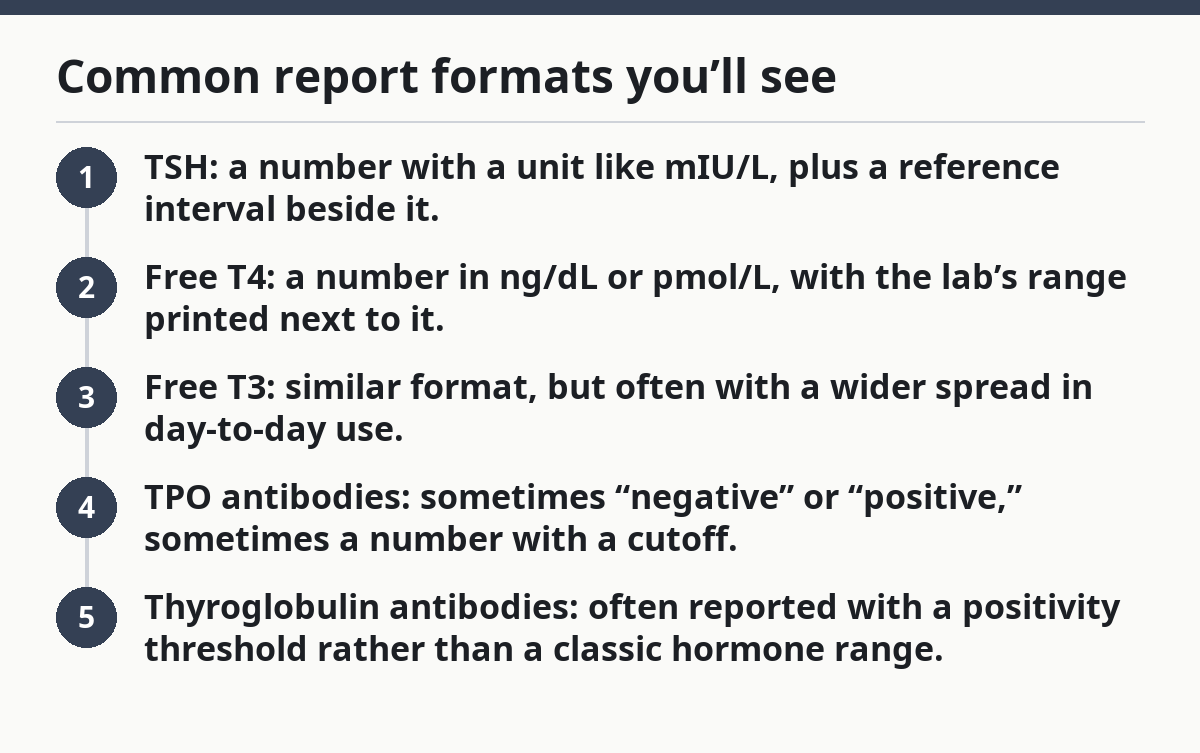
Common report formats you’ll see
- TSH: a number with a unit like mIU/L, plus a reference interval beside it.
- Free T4: a number in ng/dL or pmol/L, with the lab’s range printed next to it.
- Free T3: similar format, but often with a wider spread in day-to-day use.
- TPO antibodies: sometimes “negative” or “positive,” sometimes a number with a cutoff.
- Thyroglobulin antibodies: often reported with a positivity threshold rather than a classic hormone range.
A report can also mark a result with an H or L flag even when the number seems close to the cutoff. That flag comes from the lab’s own interval, not from a universal thyroid rule.
Why do thyroid lab ranges differ between labs?
Thyroid lab ranges differ because labs do not all use the same test method, equipment, calibration, or reference population. Picture this: two people get blood drawn on the same day, but one sample runs on one analyzer and the other runs on a different platform. The results may both be valid and still not match perfectly.
There are several reasons:
- Different assay methods. One lab may use an immunoassay platform that reads slightly differently from another.
- Different calibration and reagents. Small manufacturing differences can shift the cutoff.
- Different reference populations. A lab may build its range from healthy adults, local patients, or a narrower subgroup.
- Different units. One report may use pmol/L; another may use ng/dL or mIU/L.
- Different lab policies. Some labs use a broader interval; others tighten it to catch more abnormal results.
The truth is, reference intervals are lab-built tools, not laws of nature. That is why two reports from two systems can disagree on whether a result is just inside or just outside the range. A difference of a few tenths can matter to the printer, while the underlying clinical picture stays the same.
The best part, for readers, is that most labs print their own range right on the report, so you do not have to guess. Compare the result only to the interval on that same page.
What that means on a real report
- A TSH of 4.2 may be flagged high in one lab and still fall inside another lab’s interval.
- A free T4 near the low end may be normal by one method and borderline by another.
- An antibody result may be called negative in one place and “equivocal” in another because the cutoff differs.
That is why copied ranges from the internet are a bad shortcut. They may be close, but they are not your lab’s number.
What labs usually report for TSH, free T4, and free T3
Labs usually report TSH, free T4, and free T3 as numeric results paired with the lab’s own reference interval. Picture this: you’re scanning a thyroid report and want to know which lines are the main ones. These three are the core hormone tests, and each one tells a different part of the story.
TSH is the pituitary signal, so it often gets the most attention on the page. Free T4 and free T3 are the circulating hormones measured in blood. Even when the numbers are all on one report, they are not interchangeable.
Here’s the practical part: the exact interval varies, so I’m not giving you a fake universal range. A lab might print one set of cutoffs for adults and a different set for children, pregnant patients, or a specific assay. The number beside the result is the one that counts.
Read the report in this order
- Find the test name first, not the flag.
- Read the unit next so you know what kind of number you’re looking at.
- Check the reference interval printed by that lab.
- Compare the result to that interval, not to a website screenshot.
- Look for method notes if the lab adds them; they can explain odd cutoffs.
- Keep the report with the same lab’s prior results so you can compare like with like.
A second common mistake is mixing units across reports. A free T4 written in pmol/L will not line up with a result in ng/dL without conversion. That error costs people time and confusion, and sometimes it makes a normal result look strange.
What about TPO antibodies and thyroglobulin antibodies?
TPO antibodies and thyroglobulin antibodies are usually reported with a positivity threshold, not just a classic hormone-style range. Picture this: you reach the antibody lines and the wording shifts from “within range” to “negative” or “positive.” That change is normal, and it matters.
These tests look for antibodies that may be present in some thyroid conditions. Labs may report them in units such as IU/mL or as a qualitative result with a cutoff. The exact threshold depends on the assay, so one lab’s “negative” line may not match another lab’s.
Do not force antibody results into the same frame as TSH or free T4. They answer a different question. Hormone tests measure the thyroid axis; antibody tests look for immune markers. The report format reflects that difference.
What to watch for on the page
- A lab may print “negative” instead of a range.
- Another may print a numeric cutoff such as “less than” a set value.
- Some labs may note equivocal or borderline results.
- The same sample can be labeled differently by another lab’s method.
A limit around antibodies is not a treatment target in the same way a hormone level might be used in clinical care, so consult a professional if you are unsure how to interpret it. It is a lab signal, and the meaning depends on the full report. That is why these tests are best read with the exact lab printout in hand, not from memory.
If you want the broader context for thyroid testing and appointment prep, the hub page on thyroid testing, labs, and appointment prep — The Complete Guide is the right next stop.
How to read the lab’s reference interval without overreading it
You read the lab’s interval as a comparison band, not as a verdict on its own. Picture this: you have the report in front of you and the urge to jump straight to the flag. That’s a bad habit. The better move is slower and more exact.
Use this simple sequence:
- Match the test name to the printed interval.
- Confirm the units so you don’t compare unlike numbers.
- Check the lab’s cutoff rather than a web range.
- Note the flag if the result is marked high or low.
- Look for method notes that explain unusual wording or split ranges.
- Keep the same lab when possible if you are tracking a trend over time.
This matters because a result can be technically inside range and still be close to the edge. It can also be outside one lab’s interval and inside another’s. That does not make the report wrong. It means the report is anchored to a specific method and population.
One more honest limitation: a reference interval alone does not tell you why a thyroid result looks the way it does. It only tells you where the number sits relative to that lab’s comparison group. That is useful, but it is not the whole story.
Why the same thyroid number can look different on two reports
The same thyroid number can look different on two reports because the labs may not be measuring it the same way. Picture this: you compare a test from January with one from June and the “normal” line moved. Nothing mystical happened. The method changed, or the lab updated its interval.
This is common with thyroid testing because assay design keeps improving, and labs do update their ranges. A report may also be affected by how the sample was handled, what analyzer was used, and which reference group the lab selected. Even the same lab can update its interval after a method change.
That is why a copied “normal range” from a forum post can mislead you. The better habit is to read the interval on the report itself and keep the old report nearby if you’re comparing results over time. Same test name is not the same test method.
The main reasons ranges move
- A new analyzer or reagent lot
- A revised reference population
- Different age or pregnancy bands
- A change in reporting units
- A lab policy update after method validation
The table on the report is the authority for that sample. If the range looks unfamiliar, the report itself is still the first source to trust for the cutoff. A lab’s printed interval is the rule for that page.
Why do thyroid lab ranges differ between labs?
They differ because labs may use different machines, reagents, calibration steps, reference groups, and units. One lab can also update its interval after changing methods. The number is valid in the context of that lab’s report, so the cutoff on the page matters more than a copied online range.
What does it mean when my result is inside the lab range?
It means your number falls within that lab’s comparison band for that test. It does not explain symptoms, trends, or why the result sits where it does. The result is still best read with the test name, units, and the printed reference interval together.
Which thyroid tests usually include a reference range?
TSH, free T4, and free T3 usually include a numeric reference interval. TPO antibodies and thyroglobulin antibodies may be reported as negative, positive, or above a lab-specific cutoff. The exact format depends on the assay and the lab’s reporting style.
Drafted with AI; not yet reviewed by a person.