
Last updated: November 20, 2026
Quick Answer: You can sometimes take thyroid supplements with acid reducers, but not always at the same time. If a product depends on stomach acid for absorption, antacids, famotidine, or omeprazole can reduce how well it works. Ask a qualified clinician or pharmacist about your own product before you change anything.
Thyroid supplements and acid reducers can clash because stomach acid helps some ingredients break down and absorb, so the mix can blunt the effect of the supplement. This guide sorts out which combinations are usually a problem, which are less likely to matter, and what to watch for with antacids, famotidine, omeprazole, and calcium carbonate in the context of Can You Take Thyroid Supplements with Acid Reducers?
Can you take thyroid supplements with antacids or acid reducers?
Usually, not at the same time if the thyroid supplement depends on stomach acid for absorption. Antacids and acid reducers can raise stomach pH, which may leave some ingredients less dissolved and less available to the body.
The exact risk depends on the supplement, not just the label. A product marketed for “thyroid support” may contain minerals, seaweed, glandular ingredients, or amino acids, and those ingredients do not all behave the same way in the stomach. PubMed search results show a wider body of human-study records on thyroid supplements from 2016–2026, but the exact intersection with this question is limited. PubMed (NCBI) also shows a mix of review and study designs in that broader set, which is another reason a blanket answer is too blunt.
Studies suggest that acid suppression matters most when a supplement contains ingredients that need an acidic environment to dissolve. That’s the catch. A blanket yes-or-no answer is too blunt for this topic, and the wrong assumption can mean the supplement simply doesn’t do what the label implies.
Key takeaways
- Acid reducers can change how well some thyroid supplements dissolve.
- Antacids are the bigger concern when they contain calcium carbonate or other minerals that can interfere in the gut.
- Famotidine and omeprazole both reduce stomach acid, but they do it in different ways.
- If a product contains seaweed, minerals, or glandular material, check first with a pharmacist or clinician.
- A pharmacist or clinician can help sort out the exact ingredients in the bottle you own.
Which thyroid supplement ingredients are most likely to be affected?
Ingredients that rely on a low-acid stomach are the ones most likely to be affected. That matters because “thyroid supplement” is a broad label, not a single ingredient.
Picture this: you’re standing in the pharmacy aisle with a bottle that says thyroid support, and you’re also buying antacid tablets for heartburn. The label looks simple, but the ingredient list may hide the real issue. Some products are built around minerals, iodine-rich ingredients, kelp, or glandular extracts, and those can behave differently once stomach acid is turned down.
- Mineral-based formulas: Minerals can bind with other compounds in the gut, and some need acidic conditions to break apart well.
- Seaweed or kelp products: These bring iodine into the picture, but they also vary a lot from brand to brand.
- Glandular supplements: These are animal-derived and may not be standardized in the same way as a single-nutrient product.
- Complex blends: The more ingredients packed into one capsule, the harder it is to predict the acid-related effect.
A common mistake is to assume all thyroid supplements act like the same thing. They do not. The ingredient label matters more than the front of the bottle, and a product with a “support” claim may still contain 5 or more active ingredients that each have their own absorption quirks. Because of that, it is safer to review the full label with a pharmacist or clinician before combining it with an acid reducer.
How should you think about antacids, famotidine, and omeprazole?
Think of them as three different ways to reduce acid, not one single category. Antacids neutralize acid already in the stomach, while famotidine is an H2 blocker and omeprazole is a proton pump inhibitor, or PPI; both lower acid production, but by different routes.
Picture this: you take an antacid after a heavy meal, or you take famotidine at night, or you use omeprazole every morning for reflux. The stomach environment changes in each case, and that can matter for a supplement that expects acid to help it dissolve. The less acid available, the more you should question whether the supplement will behave the same way.
A useful rule is simple:
- Antacids are the quickest pH change.
- Famotidine lowers acid output for a while.
- Omeprazole can suppress acid more deeply and for longer.
That does not mean every thyroid supplement fails with every acid reducer. It means the risk of reduced absorption is more believable when acid suppression is stronger or more sustained. If you only take an antacid once in a while, the effect may be different from daily omeprazole use. The truth is, the schedule matters as much as the label.
What should you check before you mix them?
Check the exact ingredient list, the type of acid reducer, and whether the product is meant to be swallowed whole. Those three things tell you much more than the word “thyroid” on the front.
Picture this: you have two bottles on the counter, one for heartburn and one for thyroid support, and you’re not sure whether the combo is safe or pointless. That is where careful reading pays off. Many people look only at the brand name and miss the form, the minerals, or the capsule type.
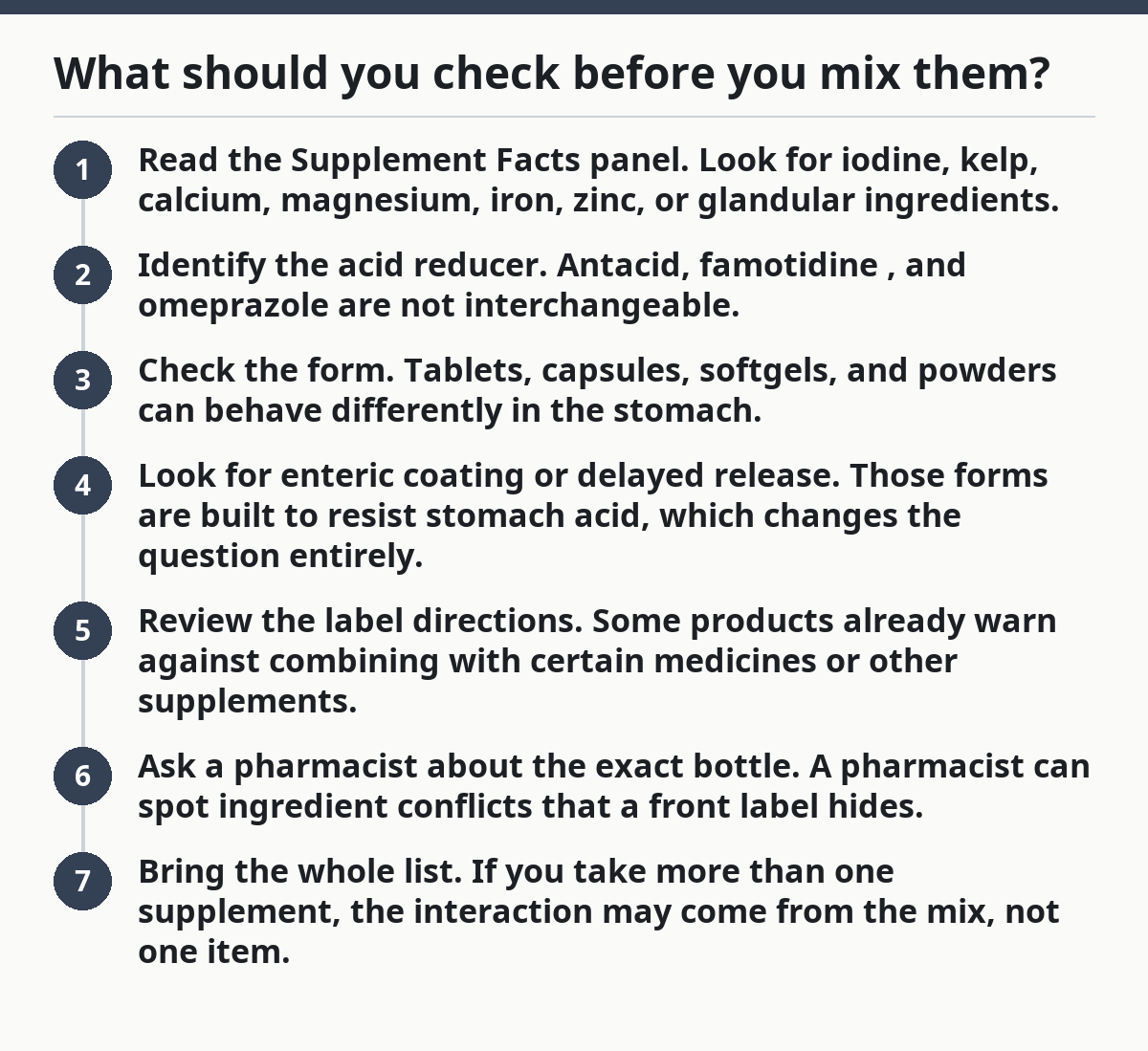
Use this quick check:
- Read the Supplement Facts panel. Look for iodine, kelp, calcium, magnesium, iron, zinc, or glandular ingredients.
- Identify the acid reducer. Antacid, famotidine, and omeprazole are not interchangeable.
- Check the form. Tablets, capsules, softgels, and powders can behave differently in the stomach.
- Look for enteric coating or delayed release. Those forms are built to resist stomach acid, which changes the question entirely.
- Review the label directions. Some products already warn against combining with certain medicines or other supplements.
- Ask a pharmacist about the exact bottle. A pharmacist can spot ingredient conflicts that a front label hides.
- Bring the whole list. If you take more than one supplement, the interaction may come from the mix, not one item.
If the label is vague, that is a warning sign. A product that cannot tell you what is inside is a poor candidate for trial and error, especially when you are already using an acid reducer.
Should you separate antacids from thyroid supplements?
Often yes, but the right gap depends on the product and the reason you take it. Separation can reduce the chance that the antacid changes the supplement’s dissolution in the stomach.
Picture this: you need an antacid after dinner, and you usually take your thyroid supplement at bedtime. If both land in the stomach together, the pH change and mineral content of the antacid can work against absorption. Calcium carbonate is the name to watch because it is a common antacid ingredient and calcium salts can be part of the problem.
A practical approach is to avoid taking them together unless a clinician or pharmacist has confirmed that your specific product is fine with that schedule. The interval is not one-size-fits-all, because different products and different stomach conditions behave differently. The more your supplement depends on acid, the more cautious that spacing should be.
If you also use famotidine or omeprazole, spacing may not solve everything, because those drugs change the stomach environment for longer than a single antacid tablet. In that case, the question is less about timing and more about whether the supplement is a good fit at all.
When the standard advice does not apply
Standard advice does not apply if the product is an enteric-coated, delayed-release, or heavily mineralized formula. Those products need a closer look because the stomach may be part of the design problem, not just the timing problem.
Picture this: you’re using a long-term reflux medicine and a “thyroid support” capsule that contains several minerals and botanical ingredients. That is not a routine spacing issue. It is a case where the supplement’s behavior in the gut may already be unpredictable, and acid suppression can make that more obvious.
Stop and get qualified help if any of these are true:
- You use omeprazole daily: this means sustained acid suppression — ask a pharmacist or clinician whether your supplement still makes sense.
- You use antacids often: repeated neutralization can keep stomach acid higher or lower in cycles — check whether the timing is masking poor absorption.
- Your supplement contains calcium carbonate or similar minerals: this may change how the product dissolves — confirm the exact ingredient list.
- Your bottle is enteric-coated or delayed-release: the release pattern is part of the product design — do not guess at timing.
- You have ongoing reflux, ulcers, or other stomach symptoms: this suggests the stomach environment is already changing — bring the full picture to a clinician.
Once the product type is clear, the answer usually gets simpler. But the wrong assumption can waste a bottle, and that is the mild outcome. The more serious one is taking a supplement for months and getting nothing useful from it.
The mistakes people make with thyroid supplements and acid reducers
People usually make the same few mistakes, and each one has a cost. Most of them come from treating “thyroid supplement” like a single, standard product.
Picture this: you grab an antacid for heartburn, keep taking your support supplement, and assume the two will sort themselves out. That is how simple timing errors turn into long stretches of poor absorption or confusing symptoms.
- Taking both at once: the supplement may dissolve poorly — separate them or ask a pharmacist what the bottle needs.
- Ignoring calcium carbonate: this ingredient is easy to miss — read the antacid label, not just the front box.
- Assuming famotidine and omeprazole are the same: they are both acid reducers, but not the same kind — the duration and strength differ.
- Trusting the front label only: “thyroid support” does not tell you the ingredient chemistry — check the Supplement Facts panel.
- Treating every supplement as harmless: some blends are more complex than a single vitamin — complexity increases uncertainty.
- Changing several products at once: then you can’t tell what caused the problem — change one thing at a time with professional input.
These are not theoretical mistakes. They are the kind that make a person think a supplement “doesn’t work,” when the real issue is that the stomach never had a fair chance to absorb it.
What does the research say, in plain terms?
Research suggests the question is real, but the evidence is broader than this exact pairing. PubMed shows human-study records for the wider thyroid-supplement topic from 2016–2026, and the 100 most relevant include a mix of reviews and clinical studies, which shows how uneven the literature is.
Picture this: you want a clean, one-line answer from the literature, but the evidence base is scattered across ingredient types, outcomes, and study designs. That is why a cautious answer is more honest than a dramatic one. Across the abstracts reported in that broader set, the median publication year was 2021, the median stated dose was 10 mg, and the median study duration was 26 weeks.
The practical read is this: the literature supports concern about absorption and ingredient behavior, but it does not give a neat universal rule for every supplement. That is why a product-by-product check beats a blanket assumption. For broader ingredient safety context, the hub on thyroid supplements and ingredient safety covers the other side of the label.
FAQ
Do acid reducers affect thyroid supplement absorption?
They can. Acid reducers may change stomach pH, and that can alter how some thyroid supplement ingredients dissolve and absorb. The effect varies by product and by the specific medicine, so famotidine and omeprazole are not identical cases. If the supplement contains minerals, kelp, or glandular ingredients, it deserves a closer look.
Should I separate antacids from thyroid supplements?
Often, yes. Separating them can reduce the chance that the antacid changes how the supplement behaves in the stomach, especially with calcium carbonate-based antacids. The right timing depends on the product, so a pharmacist can help if the label is unclear or if you use antacids often.
Which supplements need stomach acid to absorb?
Some mineral-based and complex supplements rely more on stomach acid than others. Products with calcium, magnesium, iron, zinc, kelp, or glandular ingredients may be more sensitive to acid changes, but the exact effect varies. If a product is enteric-coated or delayed-release, the stomach’s role changes again, so the label matters.
Drafted with AI; not yet reviewed by a person.