What Zinc Deficiency Can Look Like in Thyroid Patients

Last updated: November 19, 2026
Quick Answer: In thyroid patients, zinc deficiency can look like a thyroid flare, but the clue is often the pattern, not one symptom. Notice taste or smell changes along with skin, hair, appetite, or infection issues? Ask a clinician about testing. The topic is What Zinc Deficiency Can Look Like in Thyroid Patients.
Key Takeaways
- Zinc deficiency can hide behind common thyroid-like symptoms.
- Taste and smell changes are especially useful clues.
- Testing helps sort zinc issues from thyroid symptoms.
- Zinc supplements may help, but only with a clinician’s guidance.
Zinc deficiency in thyroid patients can show up as taste changes, smell changes, more frequent infections, skin and hair problems, low appetite, and sometimes fatigue that looks like “just thyroid trouble.” It is easy to miss because these signs overlap with hypothyroidism, so the clue is usually the pattern, not one symptom. For background on zinc status and deficiency, see the National Institutes of Health Office of Dietary Supplements and the Mayo Clinic.
The clue is the pattern, not one symptom
At first, zinc deficiency can look pretty ordinary, which is why it gets blamed on thyroid disease, stress, or aging. In people with thyroid disease, the better question is not “Do I have one zinc symptom?” but “Do I have several of the classic ones together, especially taste or smell changes?”
Zinc supports immune function, wound repair, skin turnover, and the enzymes involved in thyroid hormone-related processes. So a low-zinc state can muddy the picture when someone already has thyroid symptoms. Fatigue alone is weak evidence. A sore tongue plus poor taste, or hair shedding plus frequent colds, tells a more convincing story.
A few signs are especially worth noticing:
- Food tastes “flat,” metallic, or weaker than it used to
- Smell seems muted, especially with strong odors
- Colds or mouth sores seem to linger
- Skin becomes rough, dry, or slow to heal
- Hair sheds more than expected, often over weeks to months
These signs do not prove zinc deficiency. They do mean the question deserves attention, especially if thyroid labs are not explaining everything.
A generic mineral article often misses this: thyroid patients may have normal or near-normal routine labs and still be worth checking for zinc if the symptom pattern fits. That is why the right next step is not self-diagnosis, but a targeted conversation and, when appropriate, testing. The broader decision framework belongs with the hub on thyroid nutrient testing and deficiency decisions.
What zinc deficiency can look like in thyroid patients
Zinc deficiency can mimic a thyroid flare when the real issue is a nutrient gap. The overlap is real. But the details still matter.
Here is the symptom pattern that often shows up:
- Taste changes: food loses its edge; salt, sweet, or bitter may seem muted
- Smell changes: you notice weaker smell recognition or need stronger odors to detect them
- Skin changes: dry, rough, irritated skin; cracks at the corners of the mouth
- Hair changes: shedding, thinner-looking hair, slower regrowth
- Mouth changes: soreness, ulcers, or a coated tongue
- Immune changes: more frequent infections or slow recovery from minor illness
Those last two—taste and smell—are especially useful because they are not the first symptoms people expect from thyroid disease. Someone saying, “My thyroid has been off for months and now my coffee barely tastes like coffee,” is waving a different flag than someone with fatigue alone. It’s a tell.
Timing helps too. Thyroid symptoms often shift gradually and may cluster around medication changes, dose adjustments, or unstable thyroid hormone levels. Zinc deficiency can also unfold slowly, but reduced appetite, mouth irritation, and taste or smell changes often stand out more sharply than classic hypothyroid complaints.
The most common mistake is assuming every symptom must have one cause. That can cost time. If thyroid medication is adjusted repeatedly while zinc status is ignored, the person may stay stuck with symptoms that are not being addressed. Better to ask whether the pattern fits a nutrient deficiency as well as thyroid dysfunction.
Honestly, I would be especially cautious about brushing off zinc if there is also low appetite, vegetarian or low-animal-protein eating, digestive issues, or a history of restrictive dieting. Those are not proof, but they raise the odds enough to make testing worth discussing with a clinician.
How to check whether zinc is part of the problem
Testing is the cleanest way to separate zinc deficiency from thyroid symptoms that look similar. It is not perfect, but it beats guessing from symptoms alone.
A practical approach looks like this:
-
List the exact symptoms before the visit.
Write down taste changes, smell changes, mouth sores, infections, skin changes, and hair shedding, and note how long each has lasted, such as 2 weeks or 3 months. That gives the clinician a pattern instead of a vague complaint. -
Bring a full supplement list.
Include multivitamins, hair/skin/nails formulas, cold remedies, and any zinc lozenges. A product with 15 mg or 30 mg of zinc can matter just as much as a prescription-style supplement. -
Ask which zinc test fits the situation.
Serum zinc is commonly used, but it has limits because inflammation and recent meals can affect the result. A clinician may also look at copper status if zinc supplements are being considered. -
Review thyroid labs at the same time.
TSH, free T4, and sometimes free T3 help show whether thyroid hormone status is stable or still changing. Zinc symptoms can overlap with under-treated thyroid disease, so both questions may need a clinician’s review. -
Decide whether a supplement trial makes sense.
If testing and history point toward low zinc, the clinician may suggest short-term supplementation and follow-up rather than indefinite self-treatment.
No single lab number explains everything. Zinc status is influenced by recent intake, inflammation, and overall nutrition. That is why the history matters as much as the result.
For authoritative background on zinc status and deficiency assessment, the National Institutes of Health Office of Dietary Supplements and the Mayo Clinic both provide useful overviews. Those sources are helpful because they explain why symptoms alone are not enough, and why testing is usually interpreted in context.
Food sources and the everyday habits that can help
Food sources can help correct mild zinc shortfalls, but they may not be enough if deficiency is already established or absorption is poor. That is the trade-off: food is safer and steadier, but slower.
Zinc is found in seafood, meat, poultry, dairy, beans, nuts, seeds, and fortified foods. Oysters are especially high in zinc, while beef, crab, and pumpkin seeds are common practical sources. For a thyroid patient who eats little animal protein, the day-to-day risk is not that zinc is impossible to get; it is that the intake pattern may be inconsistent enough to fall short.
A simple food strategy beats chasing “thyroid superfoods”:
- Include a zinc-rich food at one meal daily
- Pair plant sources with a protein base instead of relying on snacks alone
- If appetite is low, choose smaller but denser options such as yogurt, eggs, or seeds
- If digestion is poor, discuss whether absorption issues could be part of the problem
I would not recommend treating zinc deficiency as a reason to overhaul the entire diet at once. That can make follow-through harder. A smaller change—say, adding one zinc-rich protein source at breakfast for 2 to 3 weeks—is easier to keep.
Food is not the right answer for everyone. If someone has persistent taste changes, poor wound healing, or repeated infections, food alone may be too slow. That is especially true if the person already has another reason for low intake, such as nausea, restrictive eating, or gastrointestinal disease. In those cases, a clinician can decide whether a measured supplement plan is appropriate.
This is also where the page on thyroid nutrient testing and deficiency decisions becomes useful, because the question is not just “What should I eat?” It is “Which nutrient issue is likely enough to test, and which one needs a more direct fix?”
Zinc supplements: when they help and when they can backfire
Zinc supplements can help when deficiency is likely, but they can also create problems if used casually or for too long. That is the main reason to be careful.
The most common supplement mistake is taking zinc because it “sounds thyroid-related.” That can backfire in two ways. First, it may hide the real reason for symptoms if the person actually needs thyroid dose review, iron evaluation, or another workup. Second, too much zinc over time can interfere with copper balance, which is one reason long-term self-supplementation is a bad idea.
A few rules matter:
- Do not stack multiple zinc-containing products without checking the label
- Be cautious with daily high-dose use unless a clinician is following it
- If a supplement causes nausea, take it only as directed or stop and ask about an alternative form
- If you already take a multivitamin, count that zinc before adding another product
This is not the place for one-size-fits-all dosing advice. Dose depends on age, diet, other supplements, lab context, and whether there is a true deficiency. If a clinician recommends zinc, follow the plan and ask when to recheck symptoms or labs, usually after a short interval rather than indefinitely.
People often overcorrect here. A supplement is not “better” just because it is natural. Zinc is useful, but it is still a biologically active mineral with downsides if misused.
Who this is not for: someone with unexplained symptoms who has never had thyroid labs, someone already taking several supplements without review, or someone with ongoing stomach upset that makes pills hard to tolerate. Those situations need a proper assessment, not a zinc guess.
Who should ask for zinc testing
Zinc testing is most worth discussing when thyroid symptoms and zinc-type symptoms overlap. It is not something every thyroid patient needs automatically, but it becomes more reasonable when the pattern is specific.
People who may want to ask about testing include those with:
- Taste changes or smell changes
- Mouth sores, tongue soreness, or cracked skin around the mouth
- Recurrent infections
- Hair shedding that feels out of proportion to thyroid control
- Low appetite or unintentional weight loss
- A diet low in zinc-rich foods
- Digestive issues that could affect absorption
- Repeated supplement use without clear improvement
If one of these applies, the question is not “Do I definitely have zinc deficiency?” The better question is whether zinc is plausible enough to test before making another thyroid adjustment.
Testing is also reasonable when the thyroid picture is messy. If TSH is improved but symptoms persist, zinc deficiency is one of the few nutrient issues that can show up in a way patients can describe clearly, especially through taste and smell. That makes it a practical part of the differential diagnosis, not an afterthought.
I would not use zinc testing as a substitute for checking the basics. Thyroid disease still needs proper management, and symptoms like fatigue, dry skin, and hair loss can come from many causes. Zinc is one possibility among several, but one that is easy to miss when no one asks about taste or smell.
If the symptoms are mild and isolated, food changes may be enough to watch first. If they are persistent, clustered, or getting worse, testing is the cleaner move.
What to do next without guessing
A careful next step is to match the symptom pattern to the right test or diet change rather than treating every thyroid symptom as thyroid-only. If taste changes, smell changes, immune problems, and skin or hair changes are all in play, zinc deserves a real look.
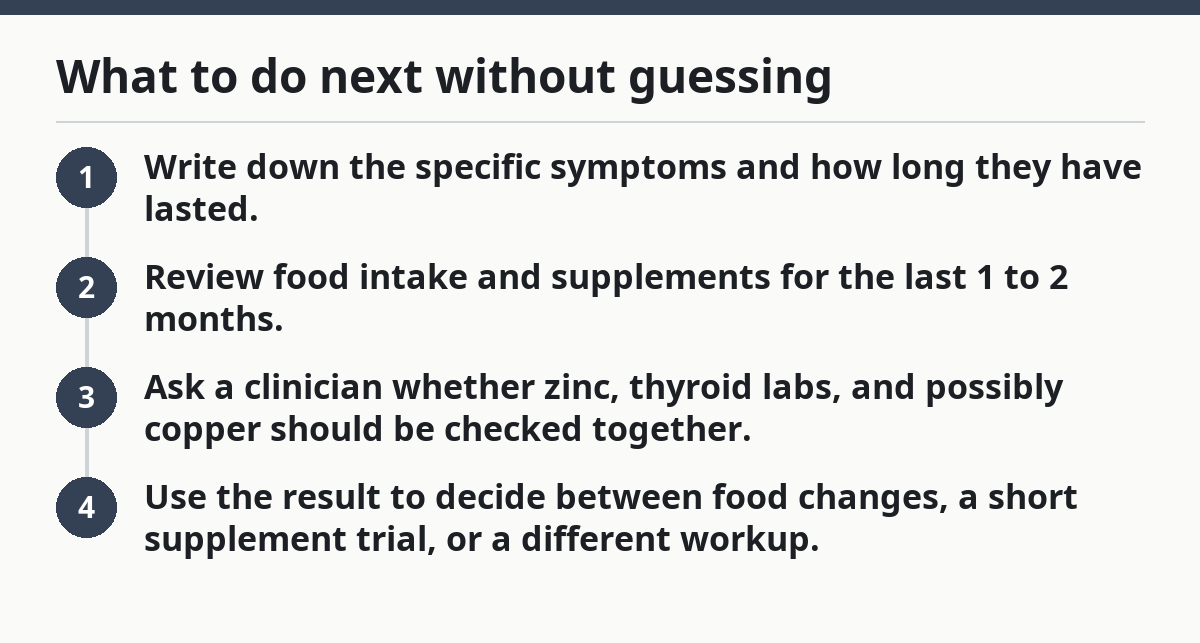
A practical next step is simple:
- Write down the specific symptoms and how long they have lasted.
- Review food intake and supplements for the last 1 to 2 months.
- Ask a clinician whether zinc, thyroid labs, and possibly copper should be checked together.
- Use the result to decide between food changes, a short supplement trial, or a different workup.
The honest limitation is that zinc deficiency is easy to suspect and hard to prove from symptoms alone. That is why the combination of pattern recognition and testing matters. If the pattern is not there, zinc is less likely to be the answer. If it is there, a targeted check can save a lot of trial and error.
Can low zinc affect thyroid function?
Yes, low zinc can interfere with processes that support normal thyroid hormone activity, which is why it matters in thyroid patients. That does not mean zinc deficiency is the only cause of thyroid symptoms, and it does not replace thyroid medication or thyroid lab monitoring. It is one piece of the picture, not the whole diagnosis.
How do you test for zinc deficiency?
Zinc deficiency is usually checked with blood testing, often serum zinc, interpreted alongside symptoms and the rest of the clinical picture. The test is useful, but it is not perfect because recent intake and inflammation can affect results. A clinician may also look at related factors such as copper status and thyroid labs.
Is zinc deficiency common in thyroid disease?
It can be a meaningful issue in thyroid disease, but it is not something I would assume is present in every patient. The more useful clue is the pattern of taste changes, smell changes, skin or hair issues, and recurrent infections. That combination is more informative than a thyroid diagnosis by itself.
Drafted with AI; not yet reviewed by a person.