Thyroid nutrient testing and deficiency decisions: The Complete Guide

Last updated: November 19, 2026
Quick Answer: In most cases, 1 targeted test — usually ferritin first — is more useful than a broad nutrient panel for thyroid symptoms. Thyroid nutrient testing and deficiency decisions work best when symptoms, diet, pregnancy, medications, or autoimmune thyroid disease make a real deficiency plausible.
Thyroid nutrient testing and deficiency decisions help answer one narrow question: which nutrient gaps are worth checking before or during thyroid treatment, and which ones are better handled by diet or a standard multivitamin. The short version is that testing is most useful when symptoms, diet, medications, or lab patterns make a real deficiency plausible; otherwise, broad “thyroid panels” of nutrients often create noise, not clarity.
A practical guide should start with the difference between nutrients that can genuinely change thyroid hormone production or conversion — iodine, iron, selenium, and sometimes vitamin B12 or vitamin D — and nutrients that are popular in thyroid forums but rarely need testing first. I write from endocrinology-focused medical knowledge, not from having run these tests myself, and the biggest mistake I see is overcorrecting one number without checking the rest of the clinical picture.
Key takeaways
- Thyroid nutrient testing is most useful when there is a reason to suspect a deficiency, not as a blanket screen.
- Iodine, iron, selenium, vitamin B12, and vitamin D are the nutrients most often discussed in thyroid care, but they are not equally worth testing in every person.
- Low ferritin can matter even when hemoglobin is normal, because iron is involved in thyroid hormone synthesis and in feeling tired for many reasons.
- Too much iodine can worsen thyroid problems, especially in people with Hashimoto’s thyroiditis or nodular thyroid disease.
- Selenium can help in select cases, but taking it blindly is not a free win; excess selenium has real toxicity risk.
- The best decision is usually to test when symptoms, diet, pregnancy, autoimmune thyroid disease, anemia, GI disease, or medication use make deficiency plausible; skip broad supplement chasing when they do not.
What thyroid nutrient testing is actually for
Thyroid nutrient testing is for deciding whether a specific deficiency is likely enough to treat, not for proving that every thyroid symptom comes from nutrition. That distinction matters because fatigue, weight change, hair loss, constipation, and brain fog overlap with anemia, sleep apnea, depression, perimenopause, celiac disease, and medication effects.
The thyroid does need nutrients to work properly. Iodine is required to make thyroid hormone. Iron supports thyroid peroxidase, the enzyme involved in hormone synthesis. Selenium is part of the enzymes that help convert T4 into the more active T3 and that protect the gland from oxidative stress. Vitamin B12 and vitamin D do not make thyroid hormone directly, but deficiencies are common enough in people with autoimmune disease that they can muddy the picture.
The problem is that nutrient testing can be both useful and misleading. A normal serum iodine level does not always reflect total intake, so diet and supplement history still matter. Selenium testing is not routine in many clinics, and a clinician may rely more on diet and risk factors than on a single blood value. Ferritin, by contrast, is often one of the most actionable tests because low stores are common and treatable; NIH ODS and ATA guidance both support looking at intake in context.
One clean rule helps here: if a nutrient deficiency would change the treatment plan, test first. If the likely treatment is simply a balanced diet or a standard prenatal, testing may not add much. For example, before starting iodine in someone with Hashimoto’s disease, the question is not “can iodine support the thyroid?” but “is there a real deficiency, and is supplementation more likely to help or harm?”
The American Thyroid Association and the National Institutes of Health Office of Dietary Supplements both publish practical guidance on these nutrients, and those sources are more trustworthy than supplement advertising or social-media thyroid protocols.
Which nutrients are worth testing first?
Iron, iodine, and vitamin B12 are usually the first nutrient questions to answer, while selenium and vitamin D are more situational. That order is not random: it reflects how often deficiency occurs, how interpretable the test is, and how directly the result changes care.
Iron deserves special attention because low ferritin can coexist with a normal hemoglobin. A person can have iron deficiency without full-blown anemia, especially with heavy menstrual bleeding, vegetarian diets, frequent blood donation, pregnancy, celiac disease, or inflammatory bowel disease. In thyroid care, low iron can worsen fatigue and can also interfere with thyroid hormone synthesis. Ferritin is the most useful first test in that setting, with transferrin saturation or a full iron panel added when the story is unclear.
Iodine is trickier. In many countries, deficiency is less common than it used to be because of iodized salt and fortified foods, but risk still rises in people who avoid dairy, seafood, and iodized salt, or who follow very restrictive diets. Testing can be considered in pregnancy, in people with a strong dietary reason to suspect low intake, or when there is concern about excess from supplements or seaweed products. The catch is that iodine status is hard to judge from a single casual test, so results need context.
Vitamin B12 is worth checking when there is autoimmune thyroid disease plus neurologic symptoms, macrocytosis, vegan or vegetarian eating, metformin use, or long-term acid-suppressing medication use. It does not “fix the thyroid,” but a missed B12 deficiency can mimic or magnify hypothyroid symptoms. If the serum B12 is borderline, methylmalonic acid or homocysteine may help clarify the picture.
Selenium testing is not routine for most people with thyroid disease. In many cases, the question is dietary exposure rather than laboratory proof. Selenium can be low in people with limited food variety or specific malabsorption issues, but indiscriminate supplementation is not harmless. This is one place where a lab can be less helpful than a careful history.
Vitamin D often enters the conversation because deficiency is common and autoimmune disease clusters with it, but vitamin D is not a thyroid-specific test. It may be worth checking for broader bone, immune, or general health reasons. It should not be used as a substitute explanation for true thyroid dysfunction.
When ferritin matters more than hemoglobin
Ferritin matters more than hemoglobin when symptoms look like iron deficiency but the CBC is still normal. That is one of the most common missed patterns in thyroid workups, because a normal hemoglobin can lull both patient and clinician into thinking iron status is fine.
Ferritin reflects iron stores, not immediate oxygen-carrying capacity. Low ferritin can show up before anemia develops, which is why it deserves attention in people with fatigue, hair shedding, restless legs, brittle nails, heavy periods, or known blood loss. In a thyroid workup, this matters because persistent tiredness after a TSH result is corrected may have nothing to do with thyroid hormone at all.
The decision point is practical. If ferritin is low, the next question is why: menstrual blood loss, low intake, frequent donation, pregnancy, GI blood loss, celiac disease, H. pylori, or inflammatory disease. Treating with oral iron without asking that question can delay the real diagnosis. If ferritin is normal but the clinical picture still screams iron deficiency, the rest of the iron panel can help, especially transferrin saturation and serum iron, though those numbers fluctuate more than ferritin.
There is also a thyroid-specific trade-off. Iron supplements can interfere with levothyroxine absorption if taken too close together. That means a person on thyroid replacement who starts iron without spacing the doses may look “undertreated” on labs when the real problem is an absorption conflict. In practice, levothyroxine is usually taken apart from iron by several hours, and the prescribing clinician should give exact timing instructions.
This is why ferritin is often the single most useful nutrient test in thyroid-related fatigue. It is not because ferritin explains all thyroid symptoms. It is because low iron stores are common, correctable, and clinically relevant even when the rest of the CBC looks ordinary.
Iodine testing: useful, but only in the right setting
Iodine testing is useful when intake is clearly uncertain, but it is usually not the first test to order in routine hypothyroidism. The main reason is that iodine sits at both ends of the problem: too little can impair hormone production, and too much can aggravate thyroid dysfunction in susceptible people.
People often overfocus on iodine because it is the obvious thyroid nutrient. That instinct is understandable and sometimes wrong. In regions with iodized salt, many people get adequate iodine without supplements. Extra seaweed, kelp capsules, “thyroid support” blends, and high-dose iodine drops can push intake far above what the thyroid can handle. In people with Hashimoto’s thyroiditis, nodular thyroid disease, or a history of thyroid autonomy, excess iodine can worsen dysfunction rather than improve it.
So when does testing make sense? It makes sense when diet is restrictive enough to raise suspicion of low intake, when pregnancy makes iodine adequacy more important, or when there is a supplement history that suggests possible excess. It also makes sense when the question is not “is iodine the cause of symptoms?” but “is iodine exposure part of the reason thyroid labs are unstable?”
The limitation is that iodine status is not always easy to interpret. Urinary iodine is often used in population studies, but a one-time spot urine is a blunt tool for an individual patient. That is why a clinician may care more about diet history, prenatal use, iodized salt intake, and supplement exposure than about a single number.
The honest call: iodine testing is worth considering when intake is uncertain or excess is plausible. It is not the default answer for every thyroid complaint, and iodine supplementation without a reason is one of the more common ways people make thyroid disease worse.
Selenium, vitamin B12, and vitamin D: when the extra tests change the plan
Selenium, vitamin B12, and vitamin D are worth checking when the result will change management, not just when they are trendy in thyroid groups. That is the right filter because these nutrients can be relevant without being universally important.
Selenium is the easiest to over-romanticize. It plays a real role in thyroid enzyme function, and there are settings where deficiency is plausible, especially with poor dietary variety or malabsorption. But if there is no specific risk factor, testing is often less useful than people assume. The downside of guessing is that selenium supplements are not benign at high intake. Excess can cause nail changes, hair loss, gastrointestinal upset, and a garlic-like breath odor, and chronic overuse can be harmful.
Vitamin B12 is a better bet for testing when autoimmune thyroid disease coexists with neurologic symptoms, anemia patterns, vegan eating, or medication exposures that lower B12 absorption. A low or borderline result can explain fatigue, numbness, balance issues, tongue pain, or memory complaints that otherwise get unfairly attributed to thyroid disease alone. The test is useful because replacement is straightforward once deficiency is confirmed.
Vitamin D is a broader health marker than a thyroid marker. Low vitamin D is common enough that many clinicians check it when the patient has autoimmune disease, low sun exposure, bone concerns, or recurrent musculoskeletal pain. But vitamin D deficiency should not be treated as the hidden master switch for thyroid symptoms. A low number may matter, but it rarely explains the full thyroid picture on its own.
If I had to rank these by practical value in a thyroid workup, I would usually put B12 ahead of selenium and vitamin D when the symptom pattern or risk factors fit. Selenium only climbs the list when diet, geography, or malabsorption makes deficiency plausible. Vitamin D belongs in the workup when broader health reasons justify it, not because every thyroid symptom needs it.
The honest side-by-side
Thyroid nutrient testing is usually more valuable when it is targeted than when it is broad, because targeted testing turns into a clear action plan. A broad panel can help if the history is confusing, but it also increases the chance of chasing small abnormalities that do not matter.
| Criteria | Targeted nutrient testing | Broad supplement-style screening | Winner for this condition |
|---|---|---|---|
| Best use | Checks only the nutrients suggested by diet, symptoms, or risk factors | Looks for a wide set of “possible thyroid deficiencies” at once | Targeted testing, when a real clinical clue exists |
| Risk of false leads | Lower, because each result has a reason to matter | Higher, because small abnormalities are easier to overread | Targeted testing |
| Actionability | Usually higher; a low ferritin, B12, or iodine concern changes the plan | Often weaker; more labs, fewer clear decisions | Targeted testing |
| Value in thyroid autoimmunity | Strong when paired with ferritin, B12, and diet history | Mixed; may find issues, but can miss the main ones | Targeted testing |
| Use in pregnancy | Useful when intake is uncertain or anemia risk is present | Can be excessive unless specific risks exist | Targeted testing |
| Use with heavy menstrual bleeding | Very useful, especially ferritin and CBC | Less efficient if iron loss is the obvious issue | Targeted testing |
| Use with restrictive diets | Useful if vegan, low seafood, no iodized salt, or low animal intake | Can still help, but may overreach | Targeted testing |
| Cost and clutter | Usually less costly and easier to interpret | More likely to generate extra follow-up labs | Targeted testing |
| Best for | People with a clear symptom pattern or risk factor | People with vague symptoms and no clear clue | Targeted testing if any clue exists; broad screening only if the history is genuinely messy |
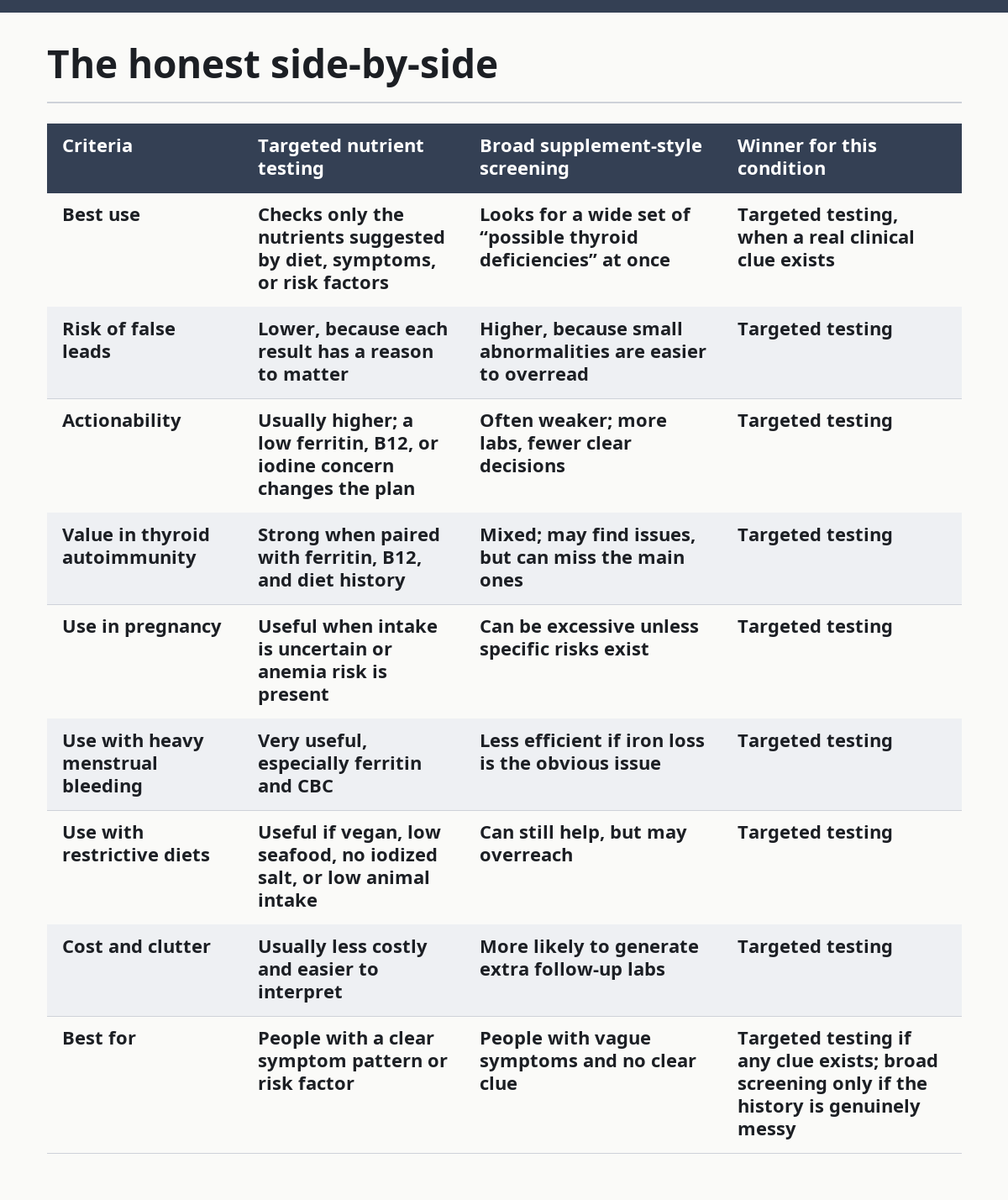
The table points to the same conclusion I would give in clinic: test the nutrient that has a believable reason to be low, not every nutrient that sounds thyroid-related. That does not mean the broader panel is never useful. It means broad screening should be the exception, not the reflex.
What the results should change — and what they should not
Thyroid nutrient results should change treatment only when the deficiency is real, the symptom pattern fits, and the correction is safe. That is the standard that keeps people from turning one lab into a lifelong supplement stack.
A low ferritin should prompt a search for the cause and a plan for iron repletion, often with follow-up testing. A low B12 should prompt replacement and a closer look at absorption problems, diet, or medication causes. A credible iodine deficiency may justify dietary correction or prenatal adjustment, but not indiscriminate high-dose iodine. Selenium deficiency may justify short-term repletion under supervision, but not years of supplementation by default.
Just as important, a normal result should stop the chase. If ferritin, B12, iodine exposure, and thyroid labs are all reasonable, the next step is not “try more supplements.” The next step is to look for other causes of symptoms: under-replaced thyroid hormone, sleep disorders, depression, perimenopause, celiac disease, chronic inflammation, or medication side effects.
There is a specific risk in thyroid nutrition spaces: people interpret every symptom as proof of a hidden deficiency. That can lead to overtreatment, especially with iodine or selenium, and can delay diagnosis of the real problem. High iodine exposure is the classic example of a supplement that sounds helpful but can destabilize a vulnerable thyroid. The same caution applies to iron, which should not be taken casually if the diagnosis is unclear or if the person has a condition that raises iron overload risk.
The clean decision rule is simple. Treat confirmed deficiency. Monitor after correction. Do not keep escalating supplements just because symptoms remain. Persistent symptoms after a reasonable correction plan deserve a wider differential diagnosis, not a bigger bottle.
When should I ask for thyroid nutrient tests?
I should ask for thyroid nutrient tests when there is a concrete reason to suspect a deficiency, not just because I have thyroid symptoms. The strongest reasons are heavy periods, pregnancy, vegetarian or vegan eating, low seafood or iodized-salt intake, autoimmune thyroid disease, GI disorders, metformin use, acid-suppressing medication use, or persistent fatigue after thyroid labs have already been addressed.
The most efficient first pass is often ferritin with a CBC, plus B12 if the risk profile fits. Iodine and selenium are more selective and usually depend on diet, supplement history, or pregnancy. Vitamin D belongs in the conversation when broader health factors justify it, but it should not crowd out the more actionable tests.
A clinician can also use prior thyroid labs to guide the workup. For example, a person with unstable TSH after starting iron, calcium, or a multivitamin may need absorption timing reviewed before more nutrient labs are ordered. A person with Hashimoto’s disease and a kelp supplement habit needs a supplement review as much as a lab order.
The practical answer is this: if a result would change what is prescribed, ask for the test. If the likely advice would be the same either way, the test may not be worth much.
Which deficiency is most likely to matter for thyroid symptoms?
Low iron stores are often the most actionable deficiency for thyroid symptoms because ferritin can be low even when hemoglobin looks normal. That makes iron deficiency easy to miss and easy to misattribute to thyroid under-treatment.
That does not mean iron explains everything. It means iron is common, relevant, and measurable. In real decision-making, ferritin often gives the best return on a thyroid-related lab order, especially in menstruating adults, people with fatigue, and those with hair shedding or restless legs.
Iodine comes next in importance, but with a warning label. Too little iodine is a problem in specific settings, yet too much iodine is also a problem, particularly in autoimmune or nodular thyroid disease. Selenium and B12 matter in narrower situations, and vitamin D belongs in a broader health assessment more than in a pure thyroid workup.
If a reader wants the shortest possible rule, this is it: start with ferritin and CBC when symptoms and history fit; add B12 when neurologic symptoms, anemia patterns, or risk factors exist; think hard before taking iodine or selenium without testing or a clear dietary reason; and do not let a nutrient story replace actual thyroid management.
What if the answer changes the treatment plan?
The answer changes the treatment plan only when the deficiency is confirmed and the risk of correction is lower than the risk of ignoring it. That sounds obvious, but it is the part people skip.
Three example decision paths show why. If ferritin is low and the person has heavy periods, iron replacement plus evaluation of blood loss is the right move. If B12 is low in a person taking metformin or following a vegan diet, replacement is warranted and the cause should be documented. If iodine intake is uncertain in pregnancy, the decision may involve diet review, prenatal content, and avoidance of excessive extra iodine rather than a high-dose add-on.
The flip side is just as important. If a person with Hashimoto’s starts kelp because of “thyroid support,” that is not an evidence-based response to fatigue. If a normal ferritin is followed by endless new supplements because symptoms persist, the plan has drifted away from medicine and toward guesswork.
The article’s core recommendation is plain: use nutrient testing to support a diagnosis and a treatment decision, not to create a supplement identity. That is the cleanest way to avoid both under-treatment and over-treatment.
What are the exceptions that change the verdict?
The overall verdict flips when the person is pregnant, has malabsorption, has heavy bleeding, has autoimmune thyroid disease plus supplement exposure, or has already started thyroid medication that is not behaving predictably. Those are the cases where nutrient testing is more likely to change management quickly.
Pregnancy is the most important exception because iodine and iron needs matter more, and under-correction carries more consequence. Malabsorption is another: celiac disease, bariatric surgery, inflammatory bowel disease, and chronic diarrhea all raise the odds that nutrient labs will be genuinely useful. Heavy menstrual bleeding is a direct reason to prioritize iron studies even if thyroid labs are only mildly abnormal.
Supplement exposure is its own exception. Someone taking kelp, iodine drops, or a “thyroid glandular” product needs review for excess iodine and contamination risk, not just deficiency screening. Likewise, people on levothyroxine who also take iron, calcium, or magnesium need timing review because absorption can fall if these are taken too close together.
These exceptions matter because they move the situation from “nice to know” to “likely to change treatment.” That is when nutrient testing earns its place.
The verdict: which nutrients to test first and which to skip
Choose ferritin and CBC first if fatigue, hair loss, heavy periods, or restless legs are part of the story. Choose B12 next if there are neurologic symptoms, vegan eating, metformin use, or autoimmune thyroid disease with anemia-like complaints. Neither iodine nor selenium should be the default first test if the diet is ordinary and there is no supplement history pointing that way.
Choose iodine testing or iodine-focused review if intake is uncertain, pregnancy is in play, or supplement use makes excess plausible. Choose selenium testing only when diet or malabsorption makes deficiency believable, and only if the result will change the plan. Skip broad “thyroid nutrient panels” if the history gives no clear clue, because they often add confusion without improving care.
Choose the wider workup entirely if thyroid symptoms persist after reasonable thyroid treatment and the nutrient tests are unrevealing. At that point, the next answer is usually not another supplement. It is a better search for the real cause.
Why do thyroid nutrient tests keep coming back normal when I feel bad?
Normal nutrient tests do not mean the symptoms are imaginary; they mean the cause is probably elsewhere. Fatigue, brain fog, constipation, and hair loss overlap with thyroid disease, iron deficiency, sleep problems, mood disorders, perimenopause, and medication effects.
If ferritin, B12, and thyroid labs are reasonable, the next step is usually a broader medical review rather than more supplement testing. A normal result is useful because it narrows the field.
Should I start iodine or selenium just in case?
No, not as a default. Iodine can worsen thyroid dysfunction when intake is already adequate or when autoimmune disease is present, and selenium can be harmful in excess.
These nutrients should be based on diet history, pregnancy status, supplement exposure, or a clinician’s judgment. If the reason to take them is only “they’re for the thyroid,” that is too vague to be a good decision.
Is ferritin more useful than a full iron panel?
Ferritin is often the most useful first test because it reflects iron stores. A full iron panel can help when inflammation, chronic disease, or mixed results make ferritin harder to interpret.
If the person has symptoms, heavy periods, or fatigue, ferritin usually gives the clearest first answer. If the result and the clinical picture do not match, then the rest of the iron studies can add context.
Does vitamin D testing help thyroid treatment?
Vitamin D testing can help overall care, but it is not a thyroid-specific test. It may be reasonable when there is autoimmune disease, low sun exposure, bone concern, or a reason to evaluate broader nutritional status.
A low vitamin D level should be corrected if found, but it should not be treated as the main explanation for thyroid symptoms unless the rest of the workup supports that conclusion.
Can nutrient testing replace thyroid medication changes?
No, nutrient testing cannot replace appropriate thyroid treatment. A low ferritin, low B12, or iodine problem may worsen symptoms, but it does not substitute for correcting under-treated hypothyroidism or monitoring TSH and free T4 when that is indicated.
The safest approach is to treat both layers correctly: the thyroid problem and any confirmed nutrient deficiency. If symptoms persist after both are addressed, the cause is probably not a missing vitamin alone.
Drafted with AI; not yet reviewed by a person.