
Thyroid Medications and Absorption Logistics: The Complete Guide

Last updated: November 20, 2026
Quick answer: For many people, thyroid medications and absorption logistics come down to one number: 30 to 60 minutes before breakfast, or at least 3 hours after the last meal at bedtime. Thyroid pills can fail for one boring reason: they do not get absorbed well when food, coffee, calcium, iron, or other meds are too close to the dose. This guide shows the timing rules, the common clashes, and the cleanest way to fit levothyroxine into a real day.
Key Takeaways
- Keep thyroid medicine on the same schedule each day and away from the main absorption blockers.
- Levothyroxine is affected by stomach and intestinal contents, so timing often matters more than intention.
- Most absorption problems come from a short list of everyday items, often from the kitchen or bathroom.
- Bedtime dosing can work well when it is consistently 3 or more hours after the last meal.
Thyroid medications and absorption logistics — The Complete Guide starts with one practical fact: the routine around the pill often matters as much as the drug itself. I write on endocrine medication routines and adherence patterns, so the logistics behind thyroid dosing are the part I care about most.
The one thing that makes thyroid medicine work
Thyroid medicine works best when the dose is taken the same way every day and kept away from the main blockers of absorption. The drug matters, but the routine around it often matters more.
Picture this: you take your pill at 7 a.m., then make coffee, eat toast, and swallow a multivitamin before leaving the house. That can look normal in a busy morning, but it can also turn a good dose into a weak one. The fix is usually simpler than people think.
- Keep levothyroxine on an empty stomach when possible.
- Separate it from calcium, iron, magnesium, bile-acid binders, and some antacids.
- Pick a schedule you can repeat for months, not a perfect plan you’ll abandon by Friday.
| Practical rule | Why it matters | Usual target |
|---|---|---|
| Empty stomach dose | Food can reduce absorption | 30 to 60 minutes before breakfast |
| Bedtime dose | Avoids breakfast conflict | At least 3 hours after the last meal |
| Calcium or iron gap | These bind the drug in the gut | Usually 4 hours apart |
| Consistent timing | Limits dose swings | Same time, same routine |
| Same product if possible | Different formulations can behave differently | Stick with one brand or one generic when your clinician agrees |
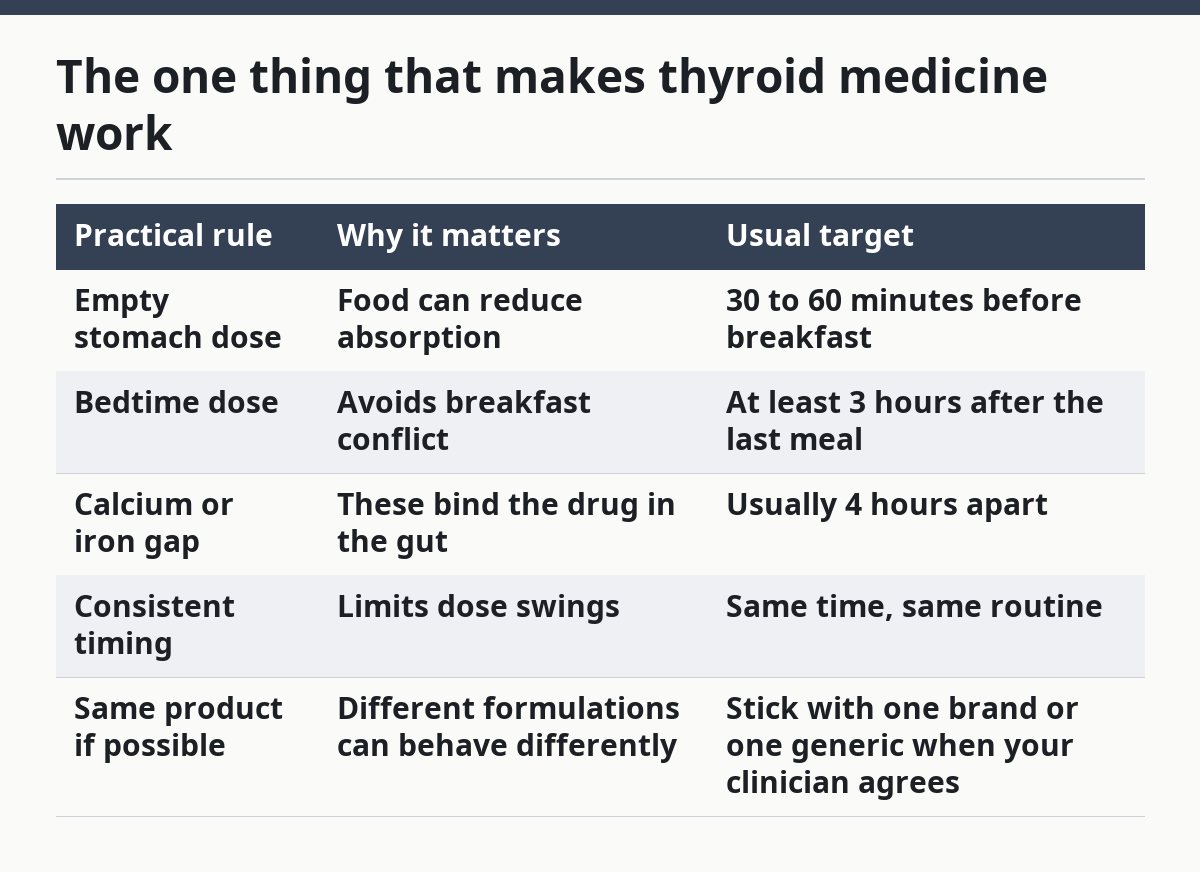
A consistent pattern is not about perfection. It is about giving the medicine the same conditions often enough that the lab results can stay steady.
Why timing beats willpower
Timing beats willpower because levothyroxine is sensitive to the contents of the stomach and small intestine, and those contents change fast. A tablet taken alone can behave very differently from the same tablet taken with breakfast, coffee, or a supplement.
Because of that, the right question is not whether you “try hard enough.” It is which window in your day is easiest to protect.
- Morning routine: take it with water, wait before coffee and food.
- Bedtime routine: take it well after dinner, then leave it alone.
- Mixed routine: if your schedule changes daily, the drug can change with it.
The National Institutes of Health Office of Dietary Supplements and the U.S. Food and Drug Administration both discuss how supplements and medicines can interfere with each other; the American Thyroid Association also gives patient guidance on levothyroxine timing. A 2021 ATA-endorsed clinical discussion and FDA medication labeling for levothyroxine products point in the same direction: consistency is the goal.
Food does not always stop thyroid medicine from working
Food can reduce absorption enough to matter over time, especially if the meal is close to the dose every day. The same is true for high-fiber breakfasts, soy-heavy meals, and some protein shakes, which is why “I only changed breakfast” can still shift lab results.
Here’s the catch:
- A small one-off mistake is not the same as a pattern.
- A daily mistake becomes the pattern.
- Lab changes usually follow the pattern, not the apology.
What to avoid near the dose
The biggest absorption problems come from a short list of common items, and most of them live in the bathroom cabinet or kitchen drawer. If you remember only one rule, make it this: separate levothyroxine from binders and minerals.
Picture this: you swallow your thyroid pill with a calcium chew, a ferrous sulfate tablet, and a latte. Each item alone may seem harmless. Together, they can pull the dose off target.
The usual blockers
- Calcium supplements: carbonate and citrate can interfere.
- Iron supplements: a classic cause of poor absorption.
- Magnesium and aluminum antacids: these can bind the drug.
- Sucralfate and bile-acid binders: strong interference is possible.
- Coffee: especially when taken right after the pill.
- Fiber supplements: can get in the way if timing is tight.
- Soy products: can matter when they crowd the dose every day.
The American Thyroid Association patient materials and FDA medication labeling for levothyroxine products consistently warn about these conflicts. A simple daily gap often solves more than adding a higher dose does.
How much separation makes sense?
For calcium and iron, the usual advice is 4 hours apart. For breakfast and coffee, many clinicians advise waiting 30 to 60 minutes after the tablet, and some people do better with a longer gap if labs stay unstable.
A few practical examples:
- Pill at 6:30 a.m., coffee at 7:15 a.m.: better than taking both together.
- Pill at 7 a.m., calcium at lunch: usually cleaner.
- Pill at bedtime, snack at 10 p.m.: too close for many people.
That is why the gap matters more than good intentions.
Can you take thyroid medication at night?
Yes, bedtime dosing can work well if it is consistently 3 or more hours after the last meal. For some people, this is easier than the morning routine because coffee, breakfast, and supplements are no longer competing with the dose.
Picture this: you forget breakfast half the week, but dinner is predictable. A bedtime schedule may fit your life better and reduce the number of things that can go wrong before 8 a.m.
The reason bedtime dosing helps is simple: the stomach is less crowded. That often means fewer clashes with food, calcium, iron, and morning coffee.
| Bedtime dosing | Morning dosing |
|---|---|
| Easier if mornings are chaotic | Easier if evenings are irregular |
| Less coffee conflict | Easier to remember with a routine |
| Needs a clear gap after dinner | Needs a clear gap before breakfast |
| Can be hard if you snack late | Can be hard if you rush out the door |
Bedtime dosing is not “better” for everyone. It is better for the person who can actually keep the gap.
Who usually does well with bedtime dosing
- Shift workers whose mornings are unpredictable.
- Parents who never get a calm breakfast window.
- People who take several morning supplements.
- Anyone who can reliably stop eating 3 hours before bed.
Who may dislike bedtime dosing
- People who snack late.
- People whose evenings are full of pills already.
- People who fall asleep early and forget the dose.
If bedtime dosing adds stress, it is the wrong fit.
Liquid, softgel, and tablet forms are not interchangeable
The answer is not always the same for every person, and that matters when absorption is a problem. Tablets, softgels, and liquid levothyroxine can behave differently in the gut, especially when stomach acid is low or the schedule is messy.
Picture this: you have taken the same tablet for years, then start a new acid-reducing medicine or develop chronic reflux. Suddenly, the old routine stops working as well. The form of the drug may matter more than the brand name on the box.
Why the form can matter
- Tablets usually need the cleanest stomach conditions.
- Softgels may be less fussy in some people.
- Liquid levothyroxine can help when swallowing or absorption is difficult.
A 2021 ATA-endorsed clinical discussion and product labeling for several levothyroxine forms make the same broad point: formulation changes can change dosing needs, so labs matter after any switch. The American Thyroid Association and FDA both support that practical caution.
The catch with switching forms
Changing from one form to another is not a casual swap. If a clinician changes the product, the dose often needs follow-up labs because absorption can shift even when the milligram number looks the same on paper.
This is where people get burned:
- They switch because the pharmacy ran out.
- They keep the old dose without rechecking labs.
- They blame the thyroid, when the formulation changed.
That is a bad trade.
What if you take other meds every day?
Then the logistics matter even more, because thyroid medicine has to fit around the rest of your schedule. The cleanest plan is the one that creates the fewest collisions with calcium, iron, antacids, and bile-acid binders.
Picture this: your morning cabinet has blood pressure pills, a multivitamin, a calcium tablet, and a thyroid pill. That is a scheduling problem, not a motivation problem.
A simple spacing map
| Medicine or supplement | Main issue | Common spacing rule |
|---|---|---|
| Calcium | Binds levothyroxine | Separate by 4 hours |
| Iron | Binds levothyroxine | Separate by 4 hours |
| Magnesium antacids | Can interfere | Separate; ask clinician for exact timing |
| Bile-acid binders | Strong reduction in absorption | Often need wide spacing |
| Proton pump inhibitors | May affect absorption in some people | Labs may need closer follow-up |
The FDA labeling for levothyroxine products and major endocrine guidance both emphasize medication review when thyroid levels drift. That is not bureaucratic noise. It is the core of the problem.
The safest habit
Keep one master list of everything you take, including:
- prescription drugs,
- over-the-counter antacids,
- vitamins,
- protein powders,
- calcium gummies,
- and iron.
The point is not to be dramatic. The point is to catch the small item that changes the lab.
The real difference between a good routine and a bad one
A good routine protects absorption; a bad one turns thyroid dosing into a guessing game. The difference is not fancy. It is timing, repetition, and fewer collisions with food and minerals.
Picture this: two people take the same levothyroxine dose. One waits before breakfast and keeps calcium at lunch. The other takes the pill with coffee and a multivitamin most days, then wonders why the dose keeps changing. Same drug. Different logistics. Very different result.
| Criteria | Good routine | Bad routine | Winner for stable labs |
|---|---|---|---|
| Timing with food | Clear gap before or after meals | Doses taken with meals | Good routine |
| Timing with calcium/iron | Separated by hours | Taken together | Good routine |
| Daily consistency | Same schedule most days | Random timing | Good routine |
| Need for dose changes | Less likely from avoidable errors | More likely | Good routine |
| Convenience | Slight planning required | Feels easy at first | Bad routine short-term |
| Long-term predictability | Higher | Lower | Good routine |
| Risk of confusion | Lower | Higher | Good routine |
The verdict is blunt: the routine often matters more than the tablet.
What a good routine looks like
- One dose, one time, every day.
- Water only with the dose.
- Breakfast, coffee, calcium, and iron kept away from that window.
- Labs rechecked after any change in product, schedule, or supplement use.
What a bad routine looks like
- Pill with coffee on weekdays, empty stomach on weekends.
- Calcium chews in the same 10-minute window.
- Skipping days and doubling up later without a plan.
That is how numbers drift.
When to rethink the plan entirely
You should rethink the plan when the current routine keeps breaking, because some absorption problems are not solved by “try harder.” If you have repeated lab swings, reflux treatment, or a hard-to-control medication schedule, the answer may be a different form, a different time, or a closer review of everything you take. If the problem persists, consult a clinician, pharmacist, or endocrinology professional for individualized advice, because the right fix depends on the full medication list and lab pattern.
Picture this: you did the timing right for months, but your labs are still off. That is not a moral failure. It is a clue that the setup needs a second look.
Exception scenarios where the usual advice changes
-
You use a stomach acid medicine daily.
Some people still absorb levothyroxine well, but others do not. If labs shift after starting a proton pump inhibitor, the timing or formulation may need review. -
You have a gut disorder or bariatric surgery history.
Celiac disease, inflammatory bowel disease, and post-surgical changes can alter absorption. Tablets may be less reliable here. -
You take iron or calcium for a real reason and cannot move them much.
If the supplements are medically necessary and the gap is impossible, a clinician may consider a different formulation or closer monitoring. -
You keep missing the morning window.
If the routine is the problem, a bedtime schedule may be the better fit.
That is the whole game: fit the dose to the life, not the life to the dose.
The verdict: the cleanest way to handle thyroid absorption
Choose morning dosing if you can reliably wait 30 to 60 minutes before coffee or breakfast and keep calcium or iron for later. Choose bedtime dosing if mornings are chaotic but you can keep a 3-hour food gap after dinner. Neither if your schedule changes every day and you keep mixing the pill with minerals, because that setup will keep sabotaging labs.
The safest default is a plain one: one dose, one pattern, one clean gap. That is what keeps thyroid medication from becoming a monthly puzzle.
FAQ
Can I take levothyroxine with coffee?
Not ideally. Coffee close to the dose can reduce absorption, so many clinicians advise waiting after the tablet rather than swallowing them together. If coffee is nonnegotiable, a bedtime schedule may be easier to keep consistent.
How far apart should I keep calcium and thyroid medicine?
A 4-hour gap is the usual rule of thumb. Calcium can bind levothyroxine in the gut, which makes the thyroid dose less available. If your supplement schedule is fixed, ask about moving the thyroid pill instead of squeezing both into the morning.
Does food always stop thyroid medicine from working?
No, but food can reduce absorption enough to matter if the pattern is repeatable. A single mistake is less important than taking the pill with meals every day. That is why the schedule matters more than a perfect one-off dose.
Is bedtime better than morning for thyroid pills?
Bedtime is better for some people, not all. It works well when you can avoid food for 3 hours beforehand and keep the dose consistent. Morning is better if you already have a stable breakfast routine and can keep supplements away from that window.
What should I do if I changed brands or forms and my labs shifted?
That switch can change absorption, even if the dose on the bottle looks the same. The usual move is to tell the prescriber and recheck labs after the change, because a formulation switch can explain a new dose mismatch.
Drafted with AI; not yet reviewed by a person.