Thyroid Fine Needle Aspiration: What It Is and Why It Is Done
Last updated: November 20, 2026
Key Takeaways
- Thyroid fine needle aspiration is a small needle biopsy used to sample thyroid nodule cells.
- A thyroid biopsy is often recommended when a nodule is not comfortable to watch alone.
- Thyroid fine needle aspiration is usually a short outpatient visit with a fine needle and a bandage.
- Needle biopsy results can show whether cells look benign, suspicious, or unclear, but they do not answer every thyroid question.
Thyroid Fine Needle Aspiration: What It Is and Why It Is Done is the biopsy doctors use to check a thyroid nodule that looks suspicious or needs more detail. It uses a thin needle, not surgery, and it helps tell which nodules need closer review. The sections below explain what happens in the room, why it gets ordered, and what the procedure can and cannot answer. For a broader overview of thyroid nodules, see the American Thyroid Association thyroid nodule guidance and the National Cancer Institute thyroid cancer screening page.
What thyroid fine needle aspiration actually is
Thyroid fine needle aspiration is a needle biopsy of the thyroid gland, usually done to sample cells from a lump or nodule. It is a small procedure, but it plays a big role because many thyroid nodules are found by chance and do not need the same workup.
Picture this: you have a thyroid nodule on an imaging test, and the next question is not “What treatment do I need?” It is “Do these cells need a closer look?” Fine needle aspiration answers that question by taking a tiny sample for pathology report review. If you are unsure whether your imaging result calls for biopsy, ask a clinician.
The sample is usually taken with a very thin needle, often under radiology guidance such as ultrasound. That guidance helps the clinician place the needle into the right spot, especially when the nodule is small, deep, or partly cystic. The goal is to collect cells, not remove the whole nodule.
- It is a biopsy, not surgery.
- It is aimed at cells, not the whole lump.
- It is often done in an outpatient setting.
- It is commonly used for a thyroid nodule biopsy decision.
The term can sound dramatic. It usually is not. The main point is to get enough tissue detail to decide whether the nodule needs more follow-up.
Why is a thyroid biopsy recommended?
A thyroid biopsy is recommended when a thyroid nodule has features that make simple watchful waiting less comfortable. The point is not to biopsy every lump in sight. It is to sort out the ones that deserve a closer look. If the next step is unclear, a professional can help weigh the risks and benefits.
Picture this: you are staring at a report that says “thyroid nodule,” and the next line mentions size, texture, or a change seen on imaging. That is the moment a clinician may bring up fine needle aspiration. The biopsy is used because imaging can suggest risk, but it cannot give cell-level detail.
Common reasons for referral include:
- A thyroid nodule with suspicious imaging features
- A nodule that is large enough to raise concern or cause symptoms
- A nodule that has grown over time
- A thyroid nodule in someone with a higher-risk history
- A lump that needs a needle biopsy results pathway instead of simple follow-up
The truth is, many thyroid nodules are benign. Fine needle aspiration is still used because the next step should match the level of concern, and a biopsy can prevent both overreaction and delay.
You may also hear this framed as “Why not just watch it?” Here’s the catch: watchful waiting is reasonable for some nodules, but it is not the same as a tissue check when the imaging or exam raises doubt. A biopsy is a tool for sorting, not a promise of treatment. A clinician can help decide which path fits the result.
- It helps avoid guessing.
- It helps focus follow-up.
- It can keep a patient from having a bigger procedure too soon.
For background on thyroid blood work and how it fits into the bigger picture, the hub on thyroid lab testing and interpretation gives the lab side of the story without mixing it into the biopsy question. The American Thyroid Association explains thyroid blood tests and how they fit with nodule care.
What happens during thyroid fine needle aspiration?
Thyroid fine needle aspiration usually takes a short outpatient visit, uses a fine needle, and ends with a bandage rather than stitches. The procedure is straightforward, but the details matter because people often worry about the wrong part.
Picture this: you are on an exam table, the neck is exposed, and a clinician is lining up a small needle with an ultrasound image. That setup is normal. It is done so the sample can come from the right area of the nodule and the pathologist can get the best possible cells.
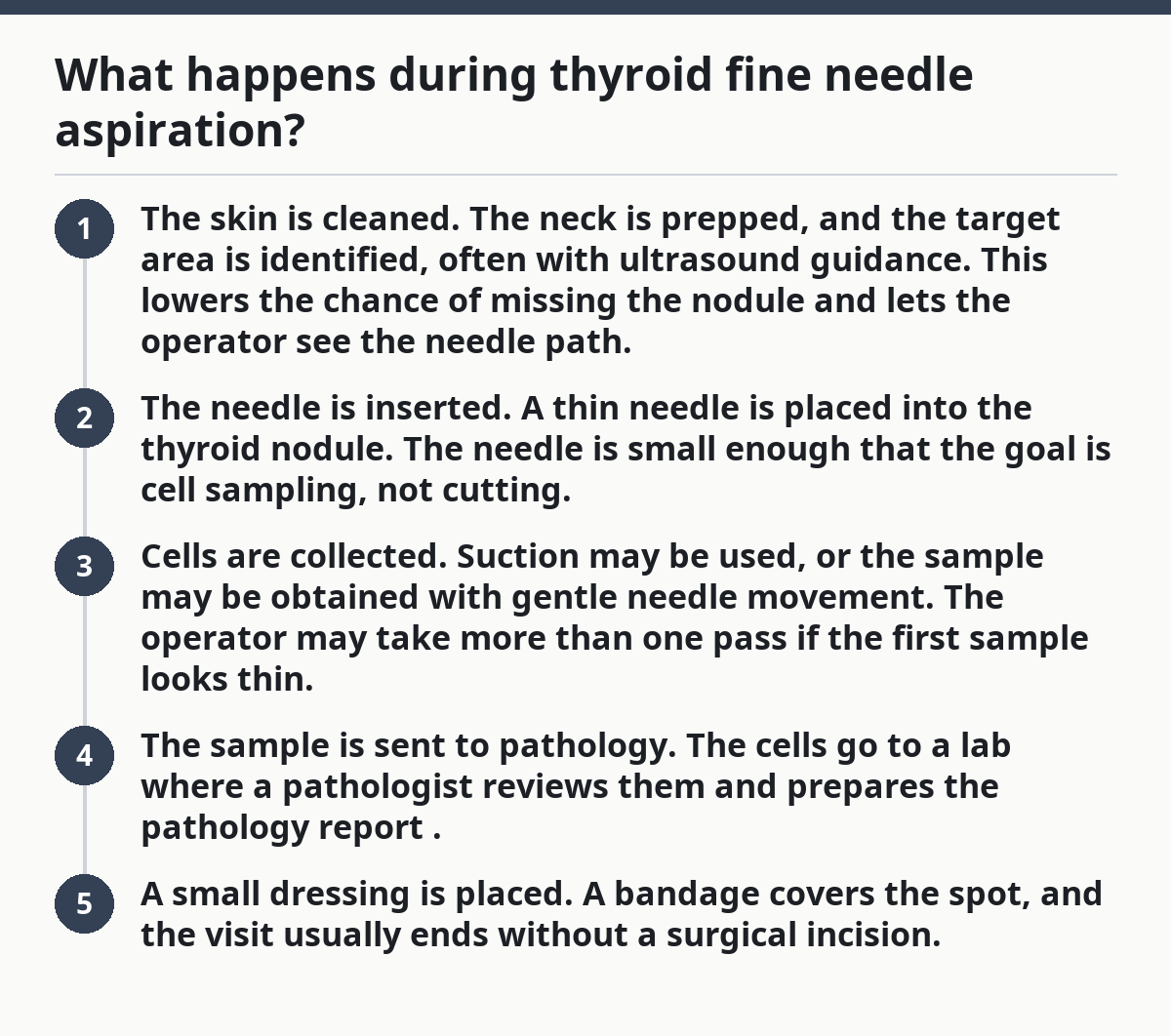
- The skin is cleaned. The neck is prepped, and the target area is identified, often with ultrasound guidance. This lowers the chance of missing the nodule and lets the operator see the needle path.
- The needle is inserted. A thin needle is placed into the thyroid nodule. The needle is small enough that the goal is cell sampling, not cutting.
- Cells are collected. Suction may be used, or the sample may be obtained with gentle needle movement. The operator may take more than one pass if the first sample looks thin.
- The sample is sent to pathology. The cells go to a lab where a pathologist reviews them and prepares the pathology report.
- A small dressing is placed. A bandage covers the spot, and the visit usually ends without a surgical incision.
Some people expect a long recovery. Usually, there is no downtime the way there is after an operation. The main concern is getting a useful sample and avoiding a “nondiagnostic” result, which happens when too few cells are collected to read well.
- The needle is thin.
- The sample is small.
- The result depends on cell quality.
- Ultrasound guidance often makes the process more accurate.
A generic article often skips this part and leaves people wondering if they are having surgery. They are not. It is a biopsy with a needle, and the whole logic of the procedure depends on that distinction.
What needle biopsy results can and cannot tell you
Needle biopsy results can tell whether the sampled cells look benign, suspicious, or unclear, but they do not answer every thyroid question. That limitation matters because people often expect one biopsy to settle everything.
Picture this: the sample is gone, the waiting starts, and the first thought is, “Will this tell me everything?” No. It tells a very specific thing: what the sampled cells look like under the microscope. It does not replace the rest of the thyroid workup.
A pathology report may say the sample is:
- Benign
- Nondiagnostic or inadequate
- Indeterminate or unclear
- Suspicious
- Malignant
Those labels guide the next step, but the next step is outside this page. This article is about the procedure itself and why it is done, not about choosing treatment after the report comes back. If you need help interpreting the report, a clinician should review it with you.
Here’s the catch: a biopsy only samples part of a nodule. If the needle misses the area of concern, the result may not match the whole nodule. That is why imaging guidance, sample quality, and the clinician’s judgment all matter.
- Good sampling improves the odds of a useful report.
- A small sample can still be enough.
- A report can be limited by what the needle reached.
- The biopsy does not measure thyroid hormone function.
People sometimes assume a normal biopsy means the nodule can never matter again. That is too neat. Follow-up may still be needed depending on the size of the nodule, its appearance, and the reason the biopsy was ordered in the first place. A biopsy gives information, not final closure for every case.
What are the common reasons for referral?
Common reasons for referral include a thyroid nodule that needs sorting, a growth that has changed, or an imaging picture that deserves cell-level review. The referral is usually about risk management, not panic.
Picture this: your clinician has already seen the nodule on an exam or scan, and now the question is whether the finding belongs in the “watch it” pile or the “sample it” pile. Fine needle aspiration is the tool used to make that call more concrete.
Typical referral reasons include:
- A nodule seen on imaging that has suspicious features
- A palpable lump that needs a thyroid nodule biopsy
- A nodule that has grown since the last check
- A history that makes the nodule less easy to ignore
- A plan to use radiology guidance for better sampling
This is not a procedure for every thyroid bump. Many nodules are found incidentally and are followed without biopsy. That restraint is part of the point. Biopsy is used when the balance shifts enough that a tissue sample makes sense.
As a result, the procedure is often chosen precisely because it avoids bigger steps. A well-targeted needle sample can spare someone an operation that would be unnecessary for a benign nodule. On the flip side, skipping biopsy when the nodule warrants it can leave too much uncertainty in place.
Two trustworthy places to read more about the background are the American Thyroid Association and the National Cancer Institute, both of which discuss thyroid nodules and biopsy in patient-facing or clinical guidance. For another overview, see the Mayo Clinic page on thyroid nodules.
What should you expect after the procedure?
You should expect a small bandage, mild soreness, and a wait for the report rather than a long recovery. That is the normal post-procedure picture for thyroid fine needle aspiration.
Picture this: the needle is out, the spot is covered, and you are looking for signs of what comes next. In most cases, the aftercare is simple. The main job is to leave the site alone, watch for unusual swelling or bleeding, and wait for the lab read.
Common aftereffects are usually limited to:
- Mild tenderness at the puncture site
- A little bruising
- A short wait for the pathology report
- A follow-up visit if the sample was limited
What catches people off guard is that the biopsy’s value is not in the minute it takes to do. It is in the report that follows. If the sample is adequate, the result can help guide the next conversation with the thyroid team.
A generic article often skips the emotional part: waiting is hard. That is true even for a small procedure. The practical answer is that the procedure itself is brief, but the real payoff comes later, when the sample is read and placed in context.
Thyroid fine needle aspiration in plain terms
Thyroid fine needle aspiration is a needle biopsy used to check a thyroid nodule when the image or exam makes a closer look worthwhile. It is done to get cells for a pathology report, not to remove the nodule or make a treatment decision on its own.
Picture this: you want one test that can narrow down uncertainty without jumping straight to surgery. That is the role of fine needle aspiration. It is a sampling tool, usually guided by radiology, and it is used because cell detail matters when a lump needs a more careful read.
The limits are just as important as the benefits:
- It samples part of the nodule, not all of it.
- It depends on having enough cells.
- It answers a narrow question, not the whole thyroid story.
- It is not the same thing as surgery.
That is the honest trade-off. It is useful because it is small, targeted, and informative. It is incomplete because it is a sample, not a full removal. That is exactly why clinicians use it when they do.
What is a thyroid FNA?
A thyroid FNA is a fine needle aspiration of the thyroid gland. It uses a thin needle to collect cells from a thyroid nodule for microscopic review, usually after imaging or an exam suggests the nodule should be checked more closely.
Does a thyroid nodule always need a biopsy?
No, a thyroid nodule does not always need a biopsy. Many nodules are watched instead, especially when they do not look suspicious and do not raise concern in the rest of the evaluation.
Is fine needle aspiration the same as surgery?
No, fine needle aspiration is not the same as surgery. It is a needle biopsy done through the skin, usually without an incision, and it is used to collect cells rather than remove the nodule.
Drafted with AI; not yet reviewed by a person.