Euthyroid Sick Syndrome: Why Thyroid Labs Can Look Abnormal During

Last updated: November 20, 2026
Quick Answer: Euthyroid sick syndrome can make thyroid labs look abnormal for days to weeks during severe illness, even when the thyroid gland itself is not the problem. Your thyroid labs can look wrong during a bad illness even when the thyroid gland itself is fine. Euthyroid sick syndrome is the usual name for that pattern, and it can make TSH, free T3, and free T4 hard to read in the hospital. This article explains why that happens, what doctors look for, and when the numbers usually settle back down.
Key Takeaways
- Euthyroid sick syndrome usually means illness, not thyroid disease, is driving the lab changes.
- Illness can shift thyroid labs by changing hormone use, conversion, and signaling during stress.
- The usual approach is to read the whole clinical picture, not just one value.
What euthyroid sick syndrome means in plain language
Euthyroid sick syndrome: Why Thyroid Labs Can Look Abnormal During Illness means illness, not thyroid disease, is driving the lab changes. The body is under stress, and the thyroid panel can shift for days to weeks even if the thyroid gland is not the problem.
Picture this: you’re in a hospital bed with pneumonia, a broken hip, or after major surgery, and a blood draw shows a low free T3 with a strange TSH. That result can point away from the thyroid and toward the illness itself. Here’s the catch: the pattern can look dramatic on paper.
This syndrome is also called non-thyroidal illness. It shows up most often in serious illness, especially in the hospital, and it can confuse anyone who expects thyroid tests to behave like a simple on-off switch.
- The thyroid is not always the main cause.
- The lab pattern can change fast.
- The result may reverse when the illness improves.
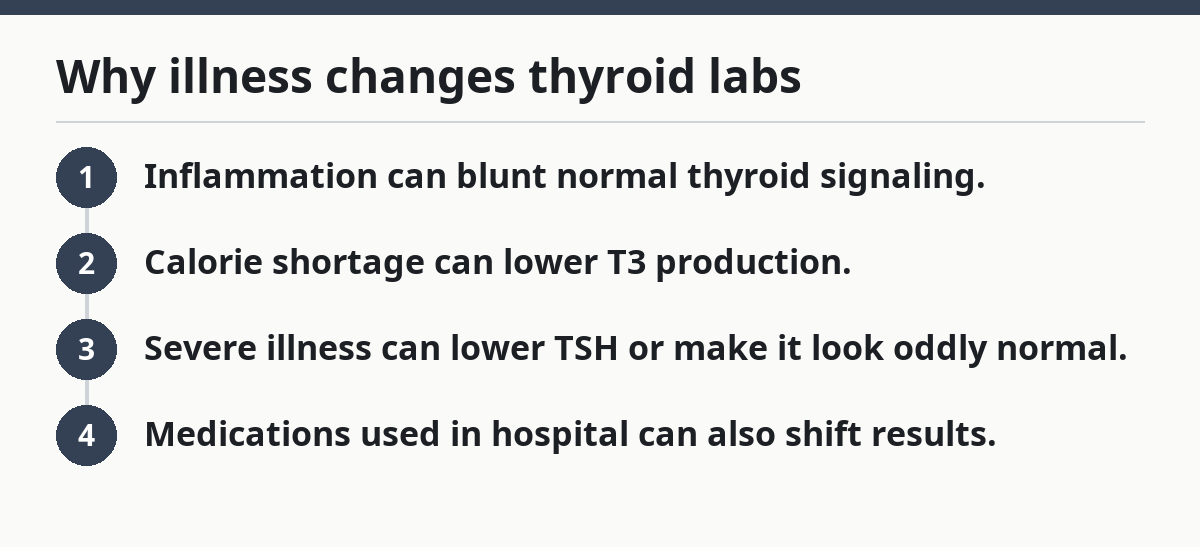
Why illness changes thyroid labs
Illness changes thyroid labs because the body shifts hormone use, hormone conversion, and hormone signaling during stress. The biggest change is often in how much T4 gets converted to T3, which can lower free T3 without meaning the thyroid has failed.
Picture this: you’re dealing with infection, poor intake, or inflammation, and the body starts conserving energy. The thyroid axis responds by changing hormone levels and transport proteins, so the blood test no longer reflects a steady, healthy baseline. The truth is, the lab is measuring stress physiology as much as thyroid function.
A few things can push the numbers around:
- Inflammation can blunt normal thyroid signaling.
- Calorie shortage can lower T3 production.
- Severe illness can lower TSH or make it look oddly normal.
- Medications used in hospital can also shift results.
That last point matters. Steroids, dopamine, and some other hospital drugs can move TSH or thyroid hormone levels. A 2022 review in Endocrine notes that medication and critical illness can both affect interpretation. So can major surgery, intensive care, and organ failure. A single thyroid panel drawn in the middle of that mess can mislead if it is read like an outpatient screening test.
A generic article often misses this: the lab pattern is not random. It follows the body’s stress response, and that response can be temporary. Not harmless, not meaningless — just context-dependent.
Which thyroid tests look abnormal, and how
The tests most often affected are free T3, free T4, and TSH, and the changes do not always move together. In mild illness, free T3 often drops first. In more serious illness, TSH and free T4 can shift too.
Picture this: you see a result and think, “That looks like hypothyroidism.” But the pattern may be more mixed than that. One number is low, another is normal, and a third is hard to interpret because the body is in acute stress. That is why one lab line rarely tells the whole story.
Common patterns include:
- Low free T3 with normal or low-normal TSH
- Low free T4 in more severe illness
- Low, normal, or sometimes slightly high TSH during recovery
- A pattern that changes over days to weeks
The recovery phase can be confusing. TSH may rise before it settles, which can look like underactive thyroid if the timing is ignored. That is one reason follow-up testing after recovery is often more useful than a rushed diagnosis during illness.
A 2021 review in Clinical Medicine and Endotext both describe this recovery pattern, including the way TSH can rebound before the axis stabilizes. A bad chest infection, sepsis, or a post-op state does not act like a routine outpatient thyroid visit. Different setting, different meaning.
How doctors separate illness-related changes from thyroid disease
The usual method is to look at the whole clinical picture, not just one value. That means the reason for the test, the severity of the illness, the medication list, and whether the numbers fit classic thyroid disease.
Picture this: you’re admitted with a fever, low blood pressure, and poor appetite, and the thyroid panel comes back odd. The question is not “Is this one number abnormal?” The real question is whether the pattern fits a true thyroid disorder or a temporary illness effect. That distinction changes the next step.
A practical approach often looks like this:
- Check why the test was ordered. If the patient is acutely ill, interpretation changes.
- Look at the pattern, not one value. A low free T3 alone is common in illness.
- Review medications and hospital treatments with a clinician. Some drugs alter TSH, so a professional should help interpret the panel. See Endotext and the 2022 Endocrine review.
- Ask whether symptoms match thyroid disease. Fatigue alone does not settle it.
- Repeat testing later if needed. Results often make more sense after recovery.
Timing matters. If the patient is still in the hospital or in the middle of a severe illness, the lab may not be ready to answer the thyroid question. If the person is recovering, repeat tests after the acute phase can help show whether the abnormality was temporary.
For readers who want the broader framework, the hub on thyroid lab testing and interpretation goes into how TSH, free T4, and free T3 are usually read together in everyday practice. See also our guide to thyroid testing and our page on TSH interpretation for the basics.
Common traps that lead to the wrong conclusion
- Treating one abnormal number as proof of thyroid disease; a clinician should review the full picture.
- Ignoring severe illness, surgery, or infection; Endotext recommends context-based interpretation.
- Reading a recovery-phase TSH as if it were a stable baseline
- Forgetting that hospital drugs can distort the panel
Those mistakes can lead to unnecessary alarm. They can also lead to the wrong treatment path. A thyroid panel is not a standalone verdict when the body is acutely sick.
When it resolves, and why timing matters
Euthyroid sick syndrome often improves when the illness improves, and the lab changes may fade over days to weeks. The timeline depends on how severe the illness was and whether the person is still under stress.
Picture this: you’re no longer febrile, the appetite is back, and the hospital problem is settling. That is the point when the thyroid numbers may start to drift back toward baseline. A lab drawn too early can still show the aftermath of illness, not true thyroid status.
The timing issue creates two common problems:
- A result drawn too soon can look worse than it is.
- A repeat drawn during recovery can briefly look “off” in a different direction.
A rising TSH during recovery does not automatically mean new hypothyroidism. Sometimes it is the axis rebounding after stress. The result needs context, especially if the patient had a major illness within the last few weeks.
A section like this often gets watered down into “it gets better.” That misses the real point. The recovery curve is uneven, and the numbers can lag behind the person’s actual improvement. So a follow-up test is usually about timing as much as diagnosis.
Can euthyroid sick syndrome mimic thyroid disease?
Yes, euthyroid sick syndrome can mimic both underactive and overactive thyroid patterns on lab work, which is why it causes so much confusion. A low TSH or a low free T3 can look like a thyroid problem when the real driver is acute illness.
Picture this: you see a panel that seems to point in the wrong direction, and you worry the thyroid gland has suddenly changed. The lab pattern can resemble true disease, but the setting matters. Hospital illness, inflammation, and medication effects can produce a look-alike result.
Here’s the practical distinction:
- True thyroid disease tends to fit a consistent pattern over time.
- Euthyroid sick syndrome tends to appear during serious illness and shift as the illness changes.
- Recovery can briefly muddy the picture even more.
That is why one abnormal panel during hospitalization should not be treated as if it came from a stable outpatient screening visit. The same number can mean something very different in a person with pneumonia than in a healthy person at a routine checkup.
What a reader should remember before worrying about the labs
Euthyroid sick syndrome is a temporary lab pattern tied to illness, not a stand-alone diagnosis of thyroid failure. It most often shows up as a shift in TSH, free T3, and free T4 during a hospital stay or another severe stress state.
Picture this: the body is fighting one problem, and the thyroid panel gets caught in the crossfire. That is the core idea. The lab can be abnormal because the body is sick, not because the thyroid gland suddenly stopped working.
Keep these points in mind:
- The pattern is common in serious illness.
- Free T3 is often the first number to fall.
- TSH can look low, normal, or briefly high during recovery.
- The result often matters more after the acute illness passes.
This is one of those topics where the context is the diagnosis. A thyroid result without the illness story can send a reader in the wrong direction fast.
What is euthyroid sick syndrome?
Euthyroid sick syndrome is an illness-related change in thyroid blood tests without primary thyroid disease. It usually appears during serious illness, especially in the hospital, and can involve low free T3, changes in TSH, and sometimes altered free T4. The numbers can look abnormal even though the thyroid gland is not the main problem.
Can illness change thyroid test results?
Yes, illness can change thyroid test results. Severe infection, surgery, inflammation, poor nutrition, and some hospital medicines can shift TSH, free T3, and free T4 for days to weeks. That is why thyroid labs drawn during acute illness need to be read in context, not as if they came from a routine wellness visit.
Does euthyroid sick syndrome mean I have thyroid disease?
No, not by itself. This pattern often means the body is reacting to illness, not that the thyroid gland has failed. The diagnosis depends on the overall picture and often becomes clearer after recovery, when repeat labs can show whether the abnormality was temporary.
Drafted with AI; not yet reviewed by a person.