
Thyroid Medication Routines and Adherence: The Complete Guide

Last updated: November 20, 2026
Key Takeaways
- The most repeatable routine is usually the one people can keep through ordinary days without extra friction.
- Thyroid medication adherence often slips because mornings, meals, travel, shift work, and label instructions collide.
- Many papers focus on timing because it is a common pressure point, not because dose is the only issue.
- A simple routine usually works better for daily adherence, while a tightly timed routine suits narrower instructions.
Thyroid medication routines and adherence — The Complete Guide is about making thyroid medicine fit real life, not ideal life. The practical goal is a routine you can repeat every day, with a plan for food, supplements, and missed doses. The steps below answer what matters most, where adherence slips, and what to ask a qualified professional about your own situation.
The evidence base is broad: 958 PubMed records match this topic for 2016–2026 (PubMed, NCBI; computed 2026-11-02). The 100 most relevant records were read, and every median, range, and share below comes from those records; the search was widened because the narrow subject had too little published on it, so these figures describe the wider subject rather than this exact question. ClinicalTrials.gov lists 13 trials for the term, and the first 13 were read.
Thyroid medication routines and adherence: the routine that works best for most people
The routine that works best for most people is the one they can repeat the same way every day, because adherence usually fails on friction, not on willpower. Studies suggest routine quality matters more than clever tricks, and the published record here is mostly reviews rather than many direct trials.
Picture this: you’re standing in the kitchen with a pill bottle, coffee, and a phone alarm all hitting at once, and you need a plan that still works on rushed weekdays. The simplest answer is to build one medication moment and protect it with the same cue every day. That’s where consistency beats complexity.
A common pattern in the literature is a once-daily oral routine with attention to timing around food and other medicines, but the exact timing question depends on the specific thyroid drug and the person’s other prescriptions. The median abstract dose figure in the records is 50 mg (PubMed, NCBI), but that is only a study figure, not a recommended dose. The median study duration is 26 weeks.
- Use one fixed cue, like waking up or brushing teeth.
- Keep the pill in one place you actually see.
- Match it with the same part of the day.
- Protect the gap from food and supplements your clinician flagged.
- Use a reminder only if the reminder is something you will keep noticing.
Here’s the catch: routine only helps if the routine is realistic. A perfect plan that fails three mornings a week is worse than a simple one you can keep for months. For practical routines, the advice from the American Thyroid Association and patient-facing NHS guidance both emphasize consistency and label-specific spacing, rather than a single universal clock time. American Thyroid Association and NHS.
What makes thyroid medication hard to take on time?
Thyroid medication adherence is hard because the barriers are ordinary: early mornings, meals, travel, shift work, and confusing label instructions. PubMed’s relevant sample is mostly review articles, which fits a topic where practical habits matter and direct trial data are thinner.
Picture this: you meant to wait before breakfast, but the day started fast, the coffee started early, and now you’re guessing whether you should take the pill late or skip it. That moment matters because missed timing can become a pattern, and patterns are what really erode adherence.
The literature here points to a few recurring barriers:
- People forget when the routine changes, especially on weekends or travel days.
- Food and drink timing can make the day feel rigid, so the routine gets abandoned.
- Other pills and supplements create confusion about spacing.
- Busy mornings make “later” turn into “never.”
- Different advice from different sources can make the plan feel unsafe to change.
A generic article would say “set an alarm.” That’s not enough. The real problem is not the alarm; it’s whether the alarm fits your kitchen, commute, and medication list. Guidance from MedlinePlus also stresses taking levothyroxine in a consistent way and checking instructions if anything about the routine changes. MedlinePlus: Levothyroxine.
What should you do with food, coffee, and other medicines?
The safest practical rule is to keep thyroid medicine on a routine that leaves clear space from food, coffee, and certain supplements, but the exact spacing depends on the product and your clinician’s advice. Studies suggest this is one of the main adherence pressure points, which is why many papers focus on timing rather than dose alone.
Picture this: you wake up, take a pill, and then wonder if breakfast in 10 minutes ruins everything. That’s the kind of question that turns a stable routine into daily anxiety, and anxiety is bad for adherence.
I would treat the “food and supplement” issue as a planning problem, not a memory problem, and you should confirm the plan with a clinician or pharmacist if the instructions are unclear. Put the medicine where the day has a natural pause. If mornings are chaotic, ask a qualified professional whether a different daily window makes more sense for your situation and your exact prescription.
Common friction points include:
- Coffee before the pill becomes a habit.
- Calcium, iron, and multivitamins get taken in the same sweep as everything else.
- Breakfast timing changes on workdays.
- Weekend brunch wipes out the routine.
- Travel makes the usual kitchen cue disappear.
The truth is, this is not about being perfect. It’s about creating one repeatable chain of events that survives real life. If the chain is too strict, people break it. For spacing questions, the British National Formulary-style advice reflected in major patient resources is consistent about separating levothyroxine from interfering supplements when instructed to do so. NHS.
Which routine fits a person who keeps missing doses?
The best routine for someone who misses doses is the one tied to an event that already happens every day, not the one that sounds most “medical.” In the ClinicalTrials.gov set, 4 of 13 trials are completed, 3 of 13 are recruiting, and the median planned enrolment is 108 participants, which tells you this is still an active but not crowded evidence space.
Picture this: you have taken the pill for a week, then missed two days during a work trip, and now you’re not sure whether to restart with the same timing or build a new cue. That is a routine design problem, not a character flaw.
The simplest adherence supports are the ones that leave fewer decisions on the table. A pillbox can help if you need a visual check. A phone alarm can help if you respond to alarms. A kitchen note can help if your morning is one room and your medicine is in another.
- Best for forgetful routines: a fixed daily cue with a visible pill location.
- Best for schedule changes: a backup reminder that travels with you.
- Best for people with many meds: a written spacing plan approved by a clinician or pharmacist.
- Worst fit: a routine that depends on memory alone.
The first 13 ClinicalTrials.gov records were read because the term has only 13 registered trials. Of those, 8 of 13 are at N/A for phase, 1 of 13 is Phase 2, and 1 of 13 is Phase 4. That mix suggests the topic is practical and still under active study, but not backed by a large body of phase-specific intervention work.
The honest side-by-side: simple routine vs tightly timed routine
A simple routine wins for most day-to-day adherence problems, while a tightly timed routine wins only when the medication instructions leave no flexibility. The decision changes with food timing, other medicines, and how likely you are to keep the routine for months.
Picture this: you’re choosing between “take it the same way every morning” and “build a strict timing rule that controls breakfast, coffee, and supplements.” Both can work in the right setting, but only one will survive a real week for many people.
| Criteria | Simple routine | Tightly timed routine | Winner for this condition |
|---|---|---|---|
| Ease of repetition | Easier to repeat | Harder to repeat | Simple routine for busy mornings |
| Risk of confusion | Lower | Higher | Simple routine for people juggling many meds |
| Fit with food timing | Depends on the plan | Stronger control | Tightly timed routine when timing is the main issue |
| Travel days | More flexible | More fragile | Simple routine for frequent travelers |
| Day-to-day burden | Lower | Higher | Simple routine for long-term adherence |
| Best use case | Stable daily habit | Specific spacing needs | Depends on the prescription |
| Forgetfulness resistance | Moderate | Can be high if strict | Tightly timed routine for rule-followers |
| Dropout risk | Lower when life is irregular | Higher when life is irregular | Simple routine for shift workers |
| Need for professional guidance | Still needed | More often needed | Tightly timed routine if other drugs are involved |
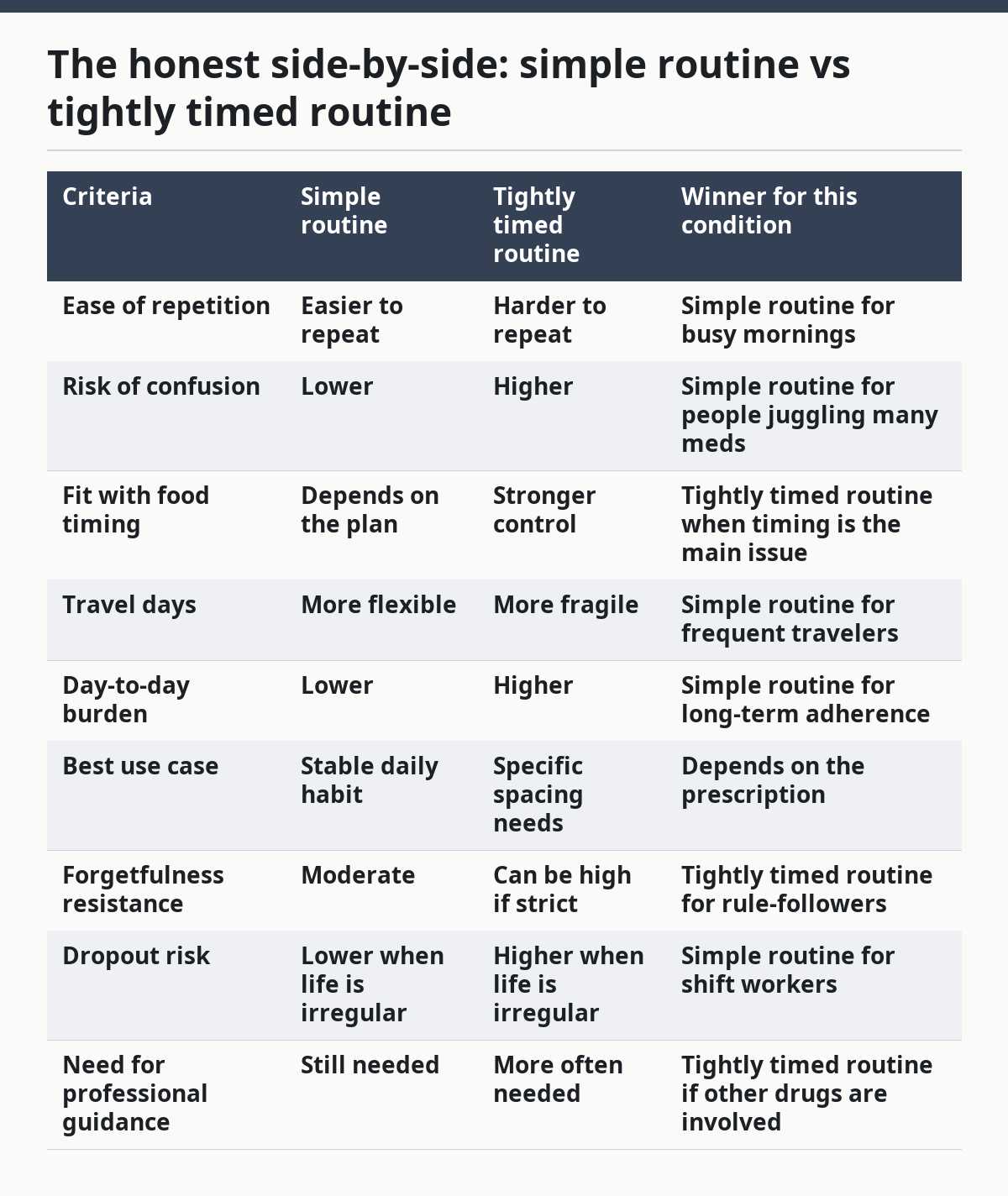
The reason this comparison matters is simple: the routine should match the level of constraint in the prescription, not your wish for a perfect system. A person who can keep a precise spacing rule should not be told to “simplify” for no reason, and a person with chaotic mornings should not be pushed into a rigid routine that keeps breaking. That is also the practical message across patient guidance from the American Thyroid Association and the NHS, which both stress consistency and instruction-specific timing. American Thyroid Association.
What the research actually says, and what it does not say
The research says adherence is a real problem, but it does not hand out one universal routine that fits every thyroid medication user. The sample here is mostly review work, with only 1 clinical trial, 1 randomized controlled trial, and 1 meta-analysis among the 100 most relevant PubMed records, so strong head-to-head proof is limited.
Picture this: you want a clear answer, but the literature keeps giving you patterns instead of a single rule. That is frustrating, yet it’s also useful, because it tells you where the certainty ends and where a clinician’s advice matters most.
A few points are fair to say from the published record:
- Timing and consistency matter because routine failure is a common reason adherence slips.
- Medication burden matters because more moving parts mean more mistakes.
- The evidence base is broad, but many papers are reviews rather than large trials.
- Specific dose advice should come from the prescription and the clinician, not from an article.
The median publication year in the read sample is 2021 (PubMed, NCBI). That means the conversation is current enough to reflect recent practice, but not so new that there is a large wave of definitive trials behind it. For background on levothyroxine use and monitoring, the FDA label is a useful source for the medication class itself. FDA label for Synthroid.
When should you ask a professional to change the plan?
You should ask a qualified professional when the routine is failing, when your schedule is irregular, or when another medicine or supplement is making the timing confusing. That’s the right move because thyroid medication routines are not one-size-fits-all, and this is a health topic where the details matter.
Picture this: you’ve built a routine, but your work shift changed, your supplement list grew, or your mornings now start before sunrise. That’s the point where a quick fix from the internet can cause more confusion than help.
A clinician or pharmacist can help check for:
- timing conflicts with other prescriptions
- supplement overlap
- morning routines that are too rigid to keep
- patterns of missed doses
- signs that the plan needs simplification rather than more rules
The strongest practical advice is simple: bring the exact bottle, the exact schedule, and the exact problem. “I keep missing it” is less useful than “I miss it on workdays because breakfast starts earlier now.” If you want a broader medication-adherence framework, the World Health Organization’s chronic-care adherence guidance explains why regimen complexity and daily-life barriers matter so much. WHO adherence report.
What breaks adherence the fastest?
The fastest way to break adherence is to make the routine depend on perfect mornings. That sounds obvious, but it is where many plans fail, especially when the day starts with travel, childcare, shift work, or a second medication with its own timing rule.
Picture this: the alarm goes off, the pill is somewhere else, breakfast is already happening, and you are now deciding whether to bend the routine. That decision, repeated often, is how people drift off plan.
The practical fixes are usually boring, and that’s a good thing:
- Put the medicine where the day starts.
- Attach it to the same activity each day.
- Write down the spacing rule if there is one.
- Keep a backup plan for travel days.
- Review the plan if the schedule changes.
The biggest mistake is to assume the hard part is remembering the pill. Usually, the hard part is remembering the whole chain around the pill. That is why routine design matters more than motivation slogans.
What questions should you ask your clinician or pharmacist?
You should ask about the timing rule, the food rule, and the supplement rule for your specific prescription. The page cannot safely give you a dose or a personal treatment plan, but it can help you ask better questions.
Picture this: you’re sitting at the kitchen table with the bottle in front of you and no clear plan for the rest of the day. That’s the right moment to get specific answers, not vague reassurance.
Ask these questions:
- Can I take this at the same time every day, or does timing need to be stricter?
- What food or drink timing matters for my prescription?
- Which supplements need to be spaced away from it?
- What should I do if I miss a day?
- Is there a routine that fits my shift work or travel?
Those five questions are more useful than most generic internet advice because they turn a vague habit into a plan. They also give the clinician enough detail to adjust the routine instead of guessing.
FAQ
What is the best time to take thyroid medicine?
The best time is the one that fits your prescription and that you can repeat consistently. The exact timing depends on the medicine, food habits, and other drugs or supplements, so a clinician or pharmacist should confirm what applies to you.
Can I take it with coffee or breakfast?
That depends on the specific thyroid medicine and the instructions you were given. Coffee and breakfast are common routine breakers, so many people need a clear spacing plan rather than guesswork.
What should I do if I miss a dose?
You should check the label and ask a qualified professional if you are unsure, because missed-dose advice can vary by medication. Don’t improvise a new schedule without checking the instructions for your exact prescription.
Why do people have trouble staying adherent?
They usually have trouble because mornings are busy, timing rules feel strict, and other pills or supplements crowd the same part of the day. The problem is often routine design, not lack of concern.
Do reminders actually help?
Reminders can help if you notice them and if they match your real schedule. A reminder that fires at the wrong time, or one you ignore, won’t fix a routine that’s already too hard to keep.
Drafted with AI; not yet reviewed by a person.