
Last updated: November 20, 2026
Quick answer: usually no—green tea or matcha right with levothyroxine is a bad bet, because tea timing can get in the way of absorption. The safer move is to separate your dose from tea, and the sections below explain how to handle green tea, matcha lattes, black tea, and milk add-ins. If your routine is complicated, speak with a qualified clinician about your own situation.
What this answer applies to
This applies to people taking levothyroxine who want to know whether green tea or matcha can sit in the same morning routine. It assumes you already have a prescribed tablet or capsule and you want a practical timing rule, not a chemistry lecture.
13 PubMed records match this query for 2016–2026; the 13 most relevant were read and every median, range and share below is computed across those records, using the selection rule: thyroid[Title/Abstract] AND medication[Title/Abstract] AND absorption[Title/Abstract] AND humans[MeSH Terms], filtered to PubMed, publication date, 2016–2026, sorted by relevance, sample read 13; computed on 2026-10-21. The sample included 13 PubMed records, with 7 (53%) Review records and 1 (7%) Systematic Review record, while the median publication year was 2022 and the median study duration was 26 weeks across the durations stated in the abstracts.
The pattern in the literature is not a neat “yes” or “no.” Tea is less studied than coffee, and most of the useful guidance comes from what is known about levothyroxine absorption, tea compounds, and timing around the dose. The FDA also advises taking levothyroxine consistently on an empty stomach, which is why the tea question matters in the first place. FDA levothyroxine guidance
Key takeaways
- Tea is not the same as water, and morning tea can be a problem for some people on levothyroxine.
- Matcha is still tea, but it is more concentrated than a weak cup of green tea.
- Milk in tea matters because it adds another variable, even when the tea itself seems harmless.
- If your thyroid labs have been unstable, timing is worth tightening before changing the dose.
- A clinician should help if your routine includes several add-ins, GI trouble, or other medicines.
Does green tea interfere with levothyroxine?

Green tea can interfere with levothyroxine timing, so it is smarter not to take them together. The concern is not just caffeine; tea leaves also bring plant compounds such as tannins, and tea is a drink that often gets paired with milk or food. For a more conservative reading, ask a qualified clinician or pharmacist whether your own tea habit could affect absorption. StatPearls: Levothyroxine
Picture this: you wake up, swallow levothyroxine, and reach for a mug of green tea before the kettle is even cool. That feels harmless, but the dose is meant to absorb cleanly, and tea can make that less predictable. In practice, the safer routine is the one that keeps tea clearly outside the dose window. American Thyroid Association: Hypothyroidism
The field does not give one universal tea rule the way it does for some medicines, but the practical advice is simple:
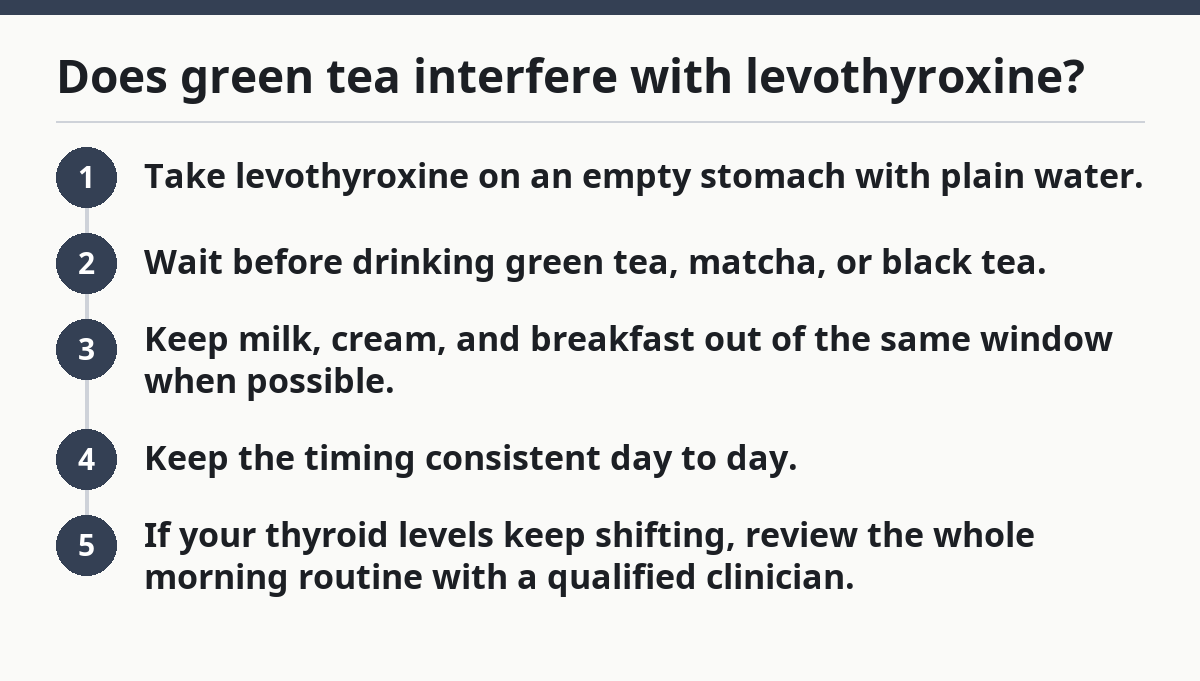
- Take levothyroxine on an empty stomach with plain water.
- Wait before drinking green tea, matcha, or black tea.
- Keep milk, cream, and breakfast out of the same window when possible.
- Keep the timing consistent day to day.
- If your thyroid levels keep shifting, review the whole morning routine with a qualified clinician.
Here’s the catch: green tea is not just a flavored liquid. It can be strong, lightly brewed, iced, or mixed with lemon, honey, or milk, and each version changes what lands in your stomach.
- Weak tea is not the same as a concentrated cup.
- Iced tea can still count if it is the first drink after the dose.
- Bottled tea may include sugar, milk solids, or other additives.
- Herbal blends are a different product and should not be assumed safe.
Is matcha different from coffee for thyroid medication?
Matcha is different from coffee in one important way: it is powdered tea, not brewed coffee, so the whole leaf ends up in the cup. That makes it a more concentrated tea exposure, and it is safest to treat it as something to discuss with a qualified professional rather than as “just a latte.” If you want the most cautious approach, ask a pharmacist or clinician how long to separate it from levothyroxine. PubMed on levothyroxine absorption factors
Picture this: you are trying to make your morning easier by swapping coffee for matcha, then pouring it into milk and swallowing your tablet on the same schedule. That sounds tidy, but matcha lattes create two variables at once: tea compounds and milk.
The truth is, a matcha habit can hide a lot of absorption noise. A plain cup of green tea may seem light, while a café matcha can be thick, sweetened, and mixed with dairy or oat milk. That combination makes it harder to know what is affecting the medication.
A few practical differences matter:
- Matcha is concentrated. You are consuming the powdered tea leaf, not a strained infusion.
- Latte format adds milk. Dairy can complicate timing beyond the tea itself.
- Portion size varies. A small cup and a large café drink are not the same exposure.
- Sweeteners matter less than the timing. Sugar does not fix the absorption problem.
If you are trying to simplify your routine, matcha is not the safer “shortcut” version of tea. It may be the more complicated one.
How should you time tea after a levothyroxine dose?

Tea should be separated from levothyroxine, and the safest practical habit is to leave a clear gap before your first cup. That gap matters even more when the drink is a matcha latte or a black tea with milk. For many people, the main goal is consistency, not perfection, so it helps to keep the same morning pattern every day and check the timing with a clinician if your labs are unstable. NHS levothyroxine advice
Picture this: the pill is down, you have 10 minutes before you need to leave, and the mug is already on the counter. This is where routines go wrong, because small morning habits repeat 365 days a year and can affect lab stability.
Use this order as a working routine:
- Take levothyroxine first thing, before breakfast, with plain water only.
- Leave tea, matcha, black tea, and milk drinks alone for a separate morning window.
- Keep the same gap every day, not just on weekdays.
- Check whether your tea is plain or mixed with milk, cream, or a breakfast pastry.
- Watch for a pattern of missed or inconsistent doses, because that can look like a food problem.
- Keep a note of any new supplements, since they can muddy the picture.
- Bring the full routine to a clinician if your TSH has been hard to stabilize.
What tells you the routine is working? Your morning pattern stops changing every few days, and you are no longer stacking tea, milk, and breakfast right after the tablet. What signals a problem? You keep taking the dose with beverages, or you cannot keep the timing consistent enough to know what is happening.
What about black tea and milk add-ins?
Black tea is not a free pass, and milk add-ins can make the timing messier. If black tea is your default, treat it with the same caution you would give green tea or matcha, especially if it is the first drink after the dose. If you are unsure whether your usual cup is simple enough, a pharmacist or clinician can help you set a safer rule for your schedule. British Thyroid Foundation: levothyroxine
Picture this: you do not drink “tea” in a generic way. You drink chai with milk, a breakfast tea with splash of dairy, or a latte with a tea base. That detail matters, because milk changes the routine and can create overlap with breakfast foods.
A few real-world versions are worth sorting out:
- Black tea alone: still tea, still worth separating from the dose.
- Tea with milk: now the drink includes another ingredient that can complicate timing.
- Tea with a full breakfast: the whole morning window is no longer clean.
- Tea shop drinks: these often bundle sugar, milk, and flavor shots.
The more ingredients you add, the less helpful it is to pretend the cup is “just tea.” If your thyroid medication has been stable for years and nothing else has changed, one cup is less likely to be the whole story. If your routine changed recently, that is where the review should start.
What mistakes do people make with tea and levothyroxine?
People usually make the same few mistakes, and each one makes the dose harder to trust. The biggest issue is not a single sip; it is the habit of pairing the tablet with whatever happens to be on the counter.
Picture this: you are trying to be consistent, but your mornings vary by the day—green tea on Monday, matcha on Tuesday, milk tea on Wednesday, breakfast on Thursday. That kind of rotation is hard on medication timing, and the tablet can only do its job when the routine is clean.
Common mistakes include:
-
Taking the tablet with tea. This makes the absorption window less predictable.
– Better option: keep tea outside the dose window. -
Using matcha as if it were a light drink. Matcha is concentrated tea, not a tiny side note.
– Better option: treat it as a meaningful beverage, not a splash. -
Adding milk right away. Dairy turns the tea into a mixed drink with more variables.
– Better option: separate the milk drink from the medication. -
Changing the routine every few days. Inconsistent timing makes it hard to tell what is affecting lab results.
– Better option: pick one morning pattern and stick to it. -
Blaming tea for everything. Sometimes the real issue is missed doses, new supplements, or a broader schedule change.
– Better option: review the full morning, not just the mug.
A routine that looks “close enough” can still be too messy for a medicine that depends on steady absorption.
When does the standard advice need a closer look?
The standard advice needs a closer look when your mornings are already crowded or your thyroid results have been difficult to stabilize. In those cases, tea timing is not the whole story, but it can still be part of the problem.
Picture this: you have a capsule, a latte, a second medication, and a breakfast window that changes by shift. That is not a simple routine, and simple rules stop being simple when other medicines and GI issues enter the picture.
These situations deserve extra attention:
- You take other morning medicines. Timing conflicts can stack up fast.
- You use a matcha latte daily. Milk plus concentrated tea is a more complex habit.
- You switch between tea types. Green tea, black tea, and matcha are not identical.
- You have stomach or bowel issues. Absorption can be less predictable for reasons beyond tea.
- Your thyroid lab pattern keeps changing. That is a sign to review the whole routine.
What this often means is not that tea is the only culprit, but that your schedule may be too variable to judge one drink on its own. Write down exactly what you drink, when you drink it, and what else is in the cup for a week. That gives a clinician something concrete to work with instead of vague morning habits.
What does a good morning routine look like?
A good morning routine keeps levothyroxine separate from tea, milk, and breakfast long enough that the dose has a fair shot at being absorbed. It is boring on purpose, and that is the point.
Picture this: you want a routine you can repeat on a workday, a weekend, and a travel morning without guessing. That means one medicine, one drink, one clean window, instead of a moving target.
A strong routine usually has these traits:
- The dose is taken the same way each day.
- Tea is not the first drink after the tablet.
- Matcha lattes do not sit in the same slot as the dose.
- Milk drinks are kept outside the medication window.
- The routine is easy enough to repeat for weeks, not just a few mornings.
If you are already linking out to the broader issue of thyroid medication timing, the hub on thyroid medication timing and absorption is the right place for the bigger picture. This page stays with tea, because tea has its own traps.
FAQ
Does green tea interfere with levothyroxine?
Yes, green tea can interfere with levothyroxine timing if it is taken too close to the dose. The issue is practical rather than dramatic: tea is not plain water, and the combination can make absorption less reliable for some people. A consistent gap is the safer pattern, especially if your labs have been hard to steady.
Is matcha different from coffee for thyroid medication?
Yes, matcha is different because it is powdered tea and is often served with milk or other add-ins. That makes it a tea problem, not a coffee problem, and the extra ingredients can complicate the morning routine. Matcha lattes are especially awkward if they come right after the tablet.
How long should I wait to drink tea after my dose?
Wait long enough that tea is clearly not part of the dose window, and keep that gap the same every day. The exact timing can vary by clinician advice and by your own medication routine, so ask a qualified professional about your situation if you are unsure.
Drafted with AI; not yet reviewed by a person.