Can You Follow a Gluten-Free Diet with Hashimoto’s Without Missing Key

Last updated: November 19, 2026
Quick answer: yes — you can follow a gluten-free diet with Hashimoto’s without missing key nutrients, but 3 nutrients deserve the most attention: fiber, iron, and B vitamins. If you have Hashimoto’s thyroiditis, talk with a qualified clinician or registered dietitian about your own labs and food pattern before you make big changes.
Key takeaways
- A gluten-free pattern can fit Hashimoto’s, but the swap needs a plan, not just a label change.
- The most common nutrition gaps to watch are iron, B vitamins, and fiber.
- Gluten-free grains can help, but many packaged gluten-free foods are lower in fiber than their wheat-based versions.
- A practical approach is to build meals around naturally gluten-free foods, then check labels for fortified or enriched options when needed.
- If you already have anemia, low ferritin, gut symptoms, or several food limits, get individualized advice before cutting gluten further.
What does the evidence actually show?
The evidence does not say every person with Hashimoto’s needs a gluten-free diet, and that is the first honest point. PubMed lists 14 human records matching this topic for 2016–2026; the 14 most relevant were read, and every median, range, and share below is computed across those records, with the search and read dates recorded on 2026-11-10. In this small set, 5 were reviews, and the median publication year was 2020. ClinicalTrials.gov lists 5 registered trials for this term; 2 are completed, 2 are recruiting, and 1 is not yet recruiting, with a median planned enrolment of 234 participants.
That pattern matters because it shows a field with interest, not a settled rule. Studies suggest some people with Hashimoto’s may choose gluten-free eating for symptom or antibody-related reasons, but the research base is not strong enough to treat gluten-free eating as a universal treatment; if you are considering it, discuss the change with a qualified clinician or dietitian. The safer question is narrower: if you remove gluten, how do you keep the rest of the diet strong enough to support thyroid care? The American Thyroid Association notes that dietary changes should be individualized, especially when other nutrition concerns are present.
The answer starts with the nutrients most likely to slip. Iron, B vitamins, and fiber are the three that deserve the most attention here. A gluten-free diet can still be nutrient-dense, but it often changes grain choices, bread choices, and breakfast habits in ways that quietly lower intake. That is why this page sits in the larger thyroid nutrition for special diets and conditions hub; the hub covers the wider pattern, while this page stays on nutrient adequacy.
Who is this for, and who is it not for?
This is for someone with Hashimoto’s thyroiditis who wants to cut gluten and still eat enough iron, B vitamins, and fiber. It assumes the reader can read a food label, knows the difference between a grain and a protein food, and is willing to plan meals instead of guessing at each meal.
It is not for someone who wants to self-treat new symptoms by removing gluten and skipping follow-up; if that is the situation, a qualified professional should help sort out what is driving the symptoms. It is also not a good fit if the diet is already very narrow, if there is known anemia, if weight loss is unplanned, or if gut symptoms are severe enough that eating becomes hard. In those cases, a professional can help sort out whether the issue is gluten, another food, or a broader nutrition problem. The NIDDK also advises medical guidance when diet changes are being used to manage ongoing digestive symptoms.
A gluten-free diet also gets harder when it is built around packaged replacements. Many gluten-free breads, crackers, and baked goods are low in fiber and may not be fortified the way wheat products often are. If the plan is mostly substitutes, nutrient gaps become more likely than if the plan is built from naturally gluten-free foods.
Which nutrients matter most?
Iron, B vitamins, and fiber matter most because they are the easiest to miss when gluten foods disappear. Iron is a concern when bread and cereal used to be a regular source, and that matters more if ferritin has already been low. B vitamins can be an issue because many grain products are fortified in the standard diet, while gluten-free versions are not always enriched the same way.
Fiber deserves special attention because it is not just a digestion detail. Fiber comes from grains, beans, vegetables, fruit, nuts, and seeds, and gluten-free eating can cut back on the grain side fast if the replacement is rice crackers or refined starches. A lower-fiber diet may leave a person feeling less full and can make bowel habits less regular.
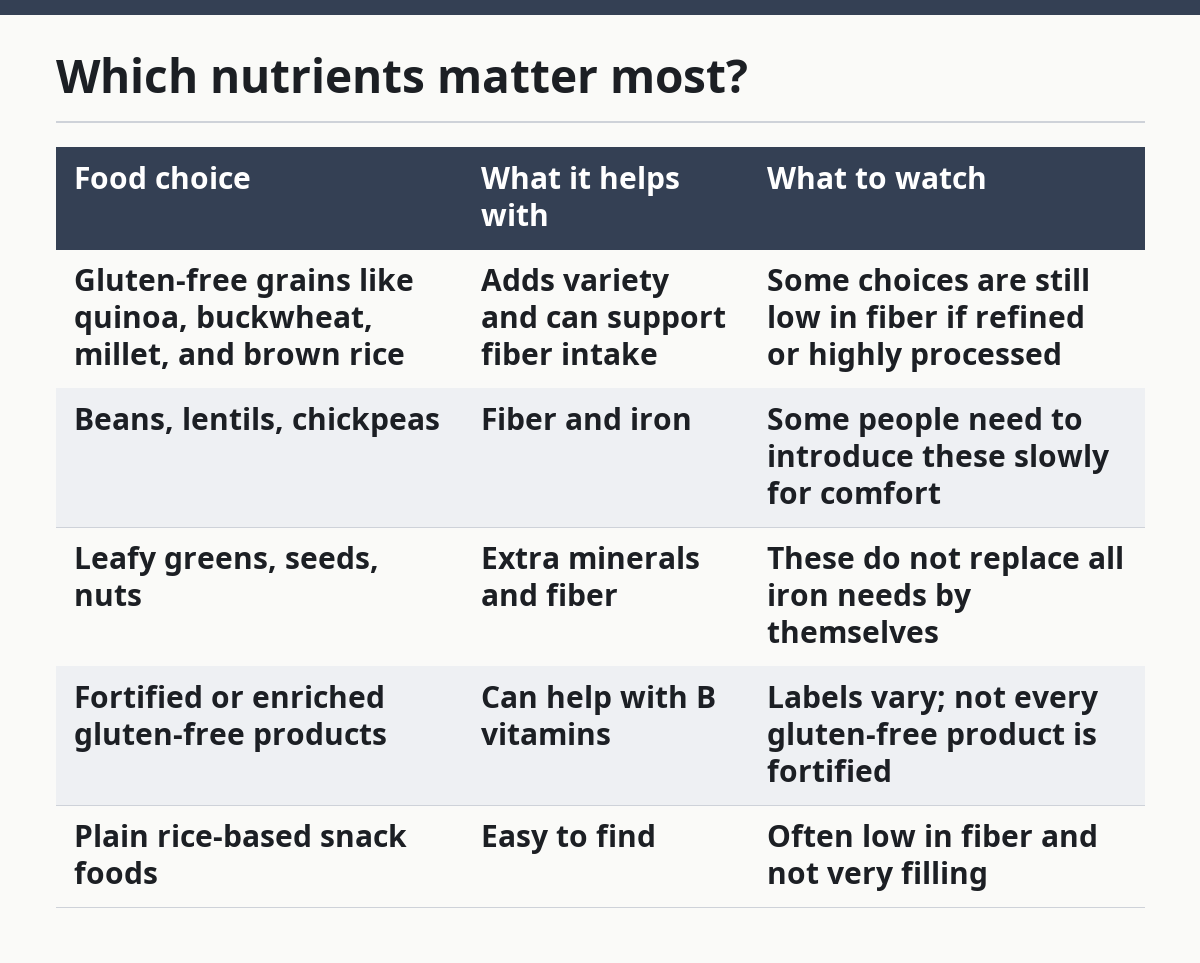
The table below shows the practical trade-offs.
| Food choice | What it helps with | What to watch |
|---|---|---|
| Gluten-free grains like quinoa, buckwheat, millet, and brown rice | Adds variety and can support fiber intake | Some choices are still low in fiber if refined or highly processed |
| Beans, lentils, chickpeas | Fiber and iron | Some people need to introduce these slowly for comfort |
| Leafy greens, seeds, nuts | Extra minerals and fiber | These do not replace all iron needs by themselves |
| Fortified or enriched gluten-free products | Can help with B vitamins | Labels vary; not every gluten-free product is fortified |
| Plain rice-based snack foods | Easy to find | Often low in fiber and not very filling |
If a gluten-free diet is done well, it does not have to be nutrient-poor. If it is done by subtraction alone, it often is.
How do you build a gluten-free plate without gaps?
You build it by replacing what gluten foods used to provide, not by swapping one packaged product for another. A simple plate can still work if each meal has a protein food, a high-fiber plant food, and a gluten-free grain or starch that actually adds nutrition.
Here is a practical sequence that keeps the focus on nutrient adequacy:
- Start with the grain you are removing. Identify the wheat, barley, or rye food that was doing a job in your day, such as toast, cereal, pasta, or sandwich bread. Verify whether it was helping with breakfast, fiber, or fortified B vitamins. A problem shows up when the replacement is only a gluten-free cookie or cracker.
- Pick a gluten-free grain with substance. Choose quinoa, buckwheat, millet, brown rice, or certified gluten-free oats if oats fit your plan and your clinician agrees they are appropriate. Verify that the grain is naturally gluten-free or clearly labeled gluten-free. A problem shows up when “gluten-free” means mostly starch.
- Add an iron source at least once or twice across the day. Use beans, lentils, chickpeas, meat, poultry, fish, tofu if it is part of the person’s diet plan, or iron-fortified products when available. Verify that the meal includes an iron-containing food rather than only vegetables and starch. A problem shows up when fatigue and low intake meet each other.
- Put fiber on purpose into each meal. Add vegetables, fruit, beans, seeds, or whole gluten-free grains. Verify that at least one part of the meal still has texture and chew. A problem shows up when the day becomes soft foods, refined snacks, and juice.
- Check B vitamin coverage. Choose fortified gluten-free products when they are available, and use eggs, dairy if tolerated, legumes, meats, and leafy greens as part of the pattern. Verify that the label shows enrichment or fortification when that is the reason for buying it. A problem shows up when the diet depends on unfortified white rice products.
- Read the label every time on packaged food. Look for gluten-containing ingredients and for plain statements that the item is gluten-free. Verify the ingredient list, not just the front-of-pack claim. A problem shows up when a “healthy” snack contains hidden gluten or offers little more than starch and sugar.
- Repeat a simple meal plan for 3 to 5 days before changing it. Keep a short rotating list of breakfasts, lunches, and dinners that cover the same nutrient bases. Verify that the pattern includes a fiber source, an iron source, and at least one grain with more than empty calories. A problem shows up when every meal is built from scratch and nutrient gaps are easy to miss.
This is not about perfect eating. It is about making sure the foods that replace gluten are doing some work.
What should you read on labels?
You should read labels for both gluten and nutrient quality, because a gluten-free label alone does not tell you much. A product can be gluten-free and still be low in fiber, low in protein, and poor in B vitamins.
Start with the ingredient list. If wheat, barley, rye, malt, or any ingredient made from those grains appears, the product is not a fit for a gluten-free diet. Then look for a clear gluten-free statement and check whether the product is enriched, fortified, or made from whole grains. A package that says “gluten-free” on the front can still be mostly refined starch in the back. The FDA’s gluten-free labeling rule is helpful here, but it does not guarantee the food is nutrient-dense.
The trap is not hard to spot once you know it. Crackers, snack bars, breakfast cereals, and breads are the common places where people assume a food is nourishing because it is specialized. A better test is whether the product adds fiber or B vitamins, or whether it only fills space on the plate.
If you have Hashimoto’s and are trying to keep meals simple, label reading becomes a short routine, not a moral test. First, check gluten. Then, check whether the product actually helps with fiber, iron support, or B vitamin intake. If it does none of those, it may still fit sometimes, but it should not run the whole diet.
When does a gluten-free plan need extra help?
A gluten-free plan needs extra help when the diet is already narrow or when symptoms make eating harder. That is especially true if there is known iron deficiency, low ferritin, digestive trouble, unintended weight loss, or food fear after repeated diet changes. In those situations, the issue is not just gluten; it is the risk of missing the nutrients the body still needs.
Known anemia or low ferritin: this raises the chance that iron intake is already too low — get individualized medical and diet advice before removing more food groups.
Several foods already off-limits: a narrow pattern can become nutrient-poor quickly — work with a dietitian so the plan still includes iron, B vitamins, and fiber.
Severe digestive symptoms: this can make beans, whole grains, and many fiber foods hard to tolerate at first — use a clinician to sort out the cause before forcing a high-fiber push.
Unplanned weight loss: this suggests the current pattern is not covering energy needs — do not rely on gluten-free substitutes alone.
Very heavy dependence on packaged gluten-free foods: this often means low fiber and weak micronutrient coverage — shift toward whole foods and ask for help if meal planning is hard.
This is where the standard advice changes. A broad “just go gluten-free” approach is too thin when the person already has nutritional risk. The plan may still be gluten-free, but it needs a tighter eye on iron, B vitamins, and total food intake.
What mistakes do people make most often?
The most common mistake is replacing gluten foods with gluten-free junk foods and calling it a health change. The consequence is a diet that may be lower in fiber and no better for nutrient intake than before. The alternative is to use gluten-free grains, beans, vegetables, and other real foods as the base.
A second mistake is assuming every gluten-free product is fortified. The consequence is missing B vitamins that standard grain products often provide. The alternative is to read the package and choose products that actually add nutrients, not just a gluten-free label.
A third mistake is forgetting iron-rich foods after bread and cereal disappear. The consequence is a higher chance of running short if the rest of the diet is light on iron. The alternative is to put iron foods into meals on purpose, especially if fatigue or past low iron has been part of the picture.
A fourth mistake is cutting gluten without checking the rest of the diet for fiber. The consequence is constipation, poor fullness, and a bland meal pattern. The alternative is to build meals around beans, vegetables, fruit, nuts, seeds, and whole gluten-free grains.
A fifth mistake is treating the plan as all-or-nothing; a qualified clinician or dietitian can help you avoid that. The consequence is burnout after a few weeks, then a return to random eating. The alternative is a repeatable 3- to 5-day meal rotation with a short list of reliable breakfasts, lunches, and dinners.
How do you make this work in real life?
You make it work by planning meals around four anchors: a protein food, a fiber food, a gluten-free grain or starch, and a check on iron or B vitamins. That can be done with simple meals, but it is harder if the day depends on snacks and packaged bars. A routine that repeats 2 or 3 breakfasts and lunches is often easier to sustain than a new menu every day.
The biggest trade-off is convenience. A gluten-free diet can be safe and nutrient-aware, but the easiest products to buy are not always the best foods to rely on. The more a meal looks like plain rice, plain crackers, or a sweet baked item, the more likely it is to miss the nutrients that gluten-free eating can lose.
That is why the details matter. A bowl with quinoa, beans, vegetables, and seeds does more for nutrient coverage than a basket of gluten-free snack foods. A sandwich on enriched gluten-free bread may be useful, but it should still be paired with something that adds fiber and iron.
A person with Hashimoto’s does not have to choose between gluten-free and nourished. The better choice is a gluten-free diet that is built with the same care as any other therapeutic food pattern: enough iron, enough B vitamins, enough fiber, and enough repetition to make it stick.
Is gluten-free necessary for Hashimoto’s?
No, gluten-free is not universally necessary for Hashimoto’s. Studies suggest the idea is still being studied, and the human evidence is mixed rather than settled. Some people choose it for symptom reasons or because they have another reason to avoid gluten, but it is not a blanket rule for everyone with Hashimoto’s.
What nutrients are hardest to get on a gluten-free diet?
Iron, B vitamins, and fiber are the main nutrients that can fall short on a gluten-free diet. That risk goes up when the diet leans on refined starches and packaged substitutes instead of beans, vegetables, gluten-free whole grains, and fortified foods. The exact gap depends on the rest of the diet.
How do I avoid nutrient gaps if I cut gluten?
Plan each meal around a protein food, a fiber source, and a gluten-free grain or starch that actually adds nutrition. Check labels for gluten and for fortification, and do not let snack foods replace meals. If you already have anemia, gut symptoms, or a very narrow diet, ask a qualified professional for personal guidance.
Drafted with AI; not yet reviewed by a person.