What to Do If You Take Levothyroxine Too Close to Calcium, Iron

Last updated: November 20, 2026
Key Takeaways
- This applies if levothyroxine is taken with calcium, iron, magnesium, or a multivitamin containing any of them.
- Usually, do not double the dose; go back to proper spacing next time.
- The main mistakes are same-morning mineral use, treating magnesium as harmless, and missing combination products.
- If overlap keeps happening, the usual spacing advice may need individual review.
Who this applies to — and what it assumes
This page is for the question What To Do If You Take Levothyroxine Too Close to Calcium, Iron, or Magnesium. If you take levothyroxine and also use a calcium pill, an iron supplement, a magnesium product, or a multivitamin that contains those minerals, this applies to you. It assumes you already know the names on your bottles and that the problem is timing, not a missing dose or a wrong prescription.
The concern is mineral supplement separation: minerals can bind to levothyroxine in the gut and reduce how much gets absorbed. That effect is a drug-interaction issue, not a sign that anything is “wrong” with the tablet itself. The standard spacing advice often used in practice is to keep levothyroxine and these minerals apart by several hours, but the exact window can vary by product and by the person taking it.
Speak to a qualified professional about your own situation, especially if you have thyroid cancer follow-up, take several medicines, or have had dose changes before. A timing mistake once is not the same as a pattern, and repeated overlap deserves a review.
Here’s the catch:
- Calcium includes calcium carbonate and calcium citrate, plus many antacids and bone-health products.
- Iron may appear as ferrous sulfate, ferrous fumarate, or “gentle iron.”
- Magnesium may sit in constipation products, sleep gummies, or “calm” powders, not just stand-alone tablets.
If you need the broader routine, the hub on thyroid medication timing and daily routines is the better next stop.
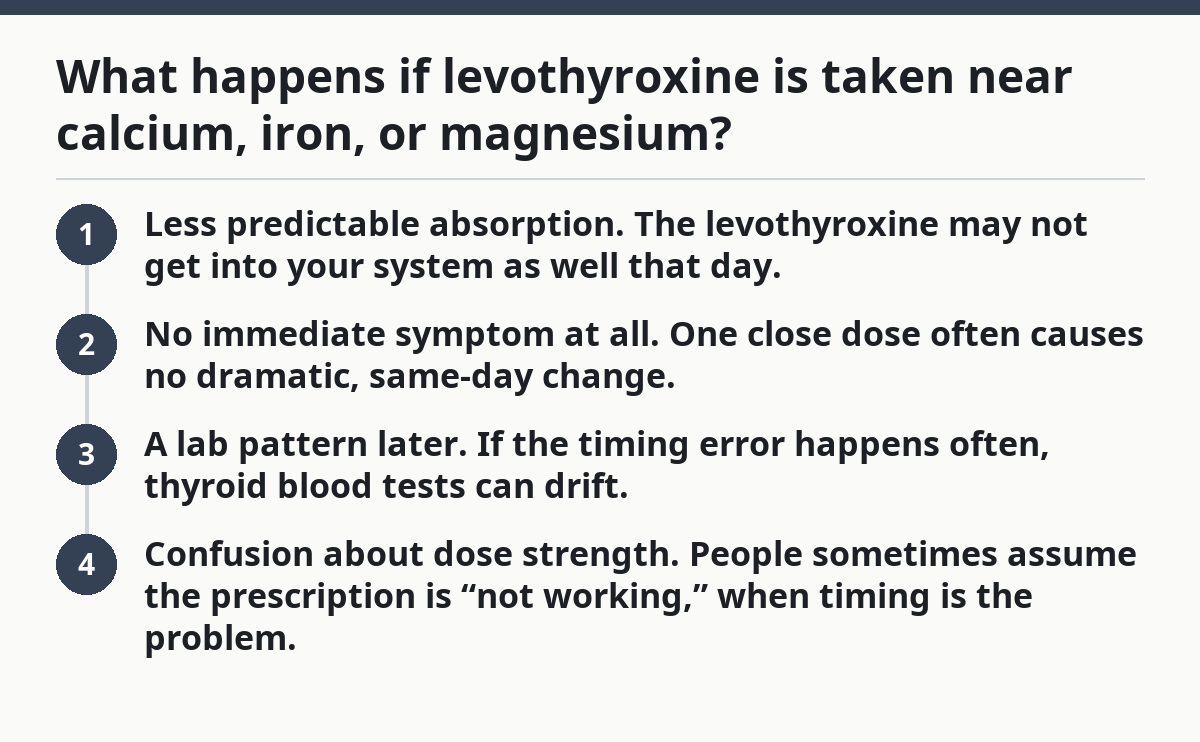
What happens if levothyroxine is taken near calcium, iron, or magnesium?
It can lower levothyroxine absorption for that dose. That does not mean one close pairing always causes a visible problem, but studies and prescribing guidance consistently treat calcium and iron as common interaction risks, and magnesium is handled the same way in many spacing instructions.
Picture this: you took levothyroxine with breakfast, then swallowed calcium at lunch, or you took iron at the same time because both bottles were on the counter. The issue is not the clock itself; it’s the overlap in the gut where the drug and mineral can interfere with each other.
What that can lead to:
- Less predictable absorption. The levothyroxine may not get into your system as well that day.
- No immediate symptom at all. One close dose often causes no dramatic, same-day change.
- A lab pattern later. If the timing error happens often, thyroid blood tests can drift.
- Confusion about dose strength. People sometimes assume the prescription is “not working,” when timing is the problem.
A few practical points matter here:
- The concern is strongest with same-time dosing.
- The risk is usually less when there is a clear separation window.
- A single mistake is usually handled differently from a repeated routine.
If you want a source to check against, look at the U.S. National Institutes of Health’s Office of Dietary Supplements pages for calcium and iron, and standard levothyroxine prescribing information from the product label or a national medicines authority. Those sources consistently flag mineral interactions.
What should you do right after a timing mistake?
You should usually not double the levothyroxine dose and should return to proper spacing for the next dose. That is the safest general move for a one-off timing error, because trying to “fix” the overlap by stacking extra tablets can create a different problem.
Picture this: you realize after the fact that you took levothyroxine with a calcium tablet, or you remember that your iron capsule went down 20 minutes later. The goal is not panic; it’s to avoid making the day more complicated.
Follow these steps:
- Check what was taken. Confirm whether the product was calcium, iron, magnesium, or a multivitamin that contains one of them. Verify the label strength and the exact time. If you can’t identify the mineral, consult a pharmacist, prescriber, or clinician and treat it as a possible interaction; the NIH Office of Dietary Supplements lists calcium and iron as common interaction concerns.
- Do not take an extra levothyroxine tablet. One close dose does not usually call for a make-up dose. If you are unsure because you missed a full levothyroxine dose, use the missed-dose instructions from your own prescription label or ask a pharmacist.
- Separate the next mineral dose from levothyroxine. Use a gap of several hours, following your medicine label or clinician’s instructions. The common rule is a wide buffer, often around 4 hours, but product-specific directions matter.
- Return to one consistent routine. Keep levothyroxine tied to the same daily anchor, such as waking time. If you shift it to bedtime, keep that timing steady and away from evening supplements.
- Watch for repeated overlap. One mistake matters less than a pattern. If calcium, iron, or magnesium keeps landing near levothyroxine, write the times on a note or phone alarm so the schedule stops drifting.
- Check for hidden minerals. Read multivitamins, antacids, sleep aids, and constipation products. “Magnesium” or “calcium” may be in the ingredient list even when the front label does not make it obvious.
- Ask before changing the dose. If you have frequent overlaps, changing the levothyroxine dose on your own is the wrong fix. A clinician may want to review timing first, then thyroid labs if the pattern continues.
The first thing to verify is the gap in hours. The second is whether the supplement was a one-time product or a daily habit. If there is stomach upset, confusion about the bottle, or repeated missed spacing, that’s a sign to get help sorting the routine rather than improvising.
How long should calcium, iron, or magnesium be kept away?
They should be kept away for several hours, with many clinicians using a 4-hour separation as a practical rule for mineral supplements and levothyroxine. That said, the exact window can vary with the product and with the person, so the package insert or a pharmacist’s advice should take priority if it differs.
Picture this: you take levothyroxine at 6 a.m., then calcium at breakfast because that is when you remember it. Or you take iron at bedtime because that feels easier. The timing plan only works if it fits the same day, every day, without constant guesswork.
A simple pattern helps:
- Levothyroxine first, on an empty stomach if that is how it was prescribed.
- Calcium, iron, and magnesium later, after a clear interval.
- The same interval every day, not a different one on workdays and weekends.
A fixed routine helps because the dose matters and the clock matters too. A 4-hour gap is easy to remember, and it keeps the overlap from becoming accidental.
If you are trying to make this practical, the routine is often the whole solution. You do not need a perfect life to make this work; you need a fixed routine and a buffer. Even a paper note on the medicine cabinet can help more than memory alone.
Two caveats matter:
- Mixed products count. A calcium-magnesium tablet still counts as both minerals.
- Multivitamins count too. Many contain iron or calcium in smaller amounts that still matter for spacing.
If your label or pharmacist gives a different separation window, follow that rather than a general rule from a blog. For thyroid medication, small routine details can make a real difference over time.
What are the most common mistakes people make?
The most common mistakes are taking mineral supplements in the same morning window as levothyroxine, assuming magnesium is harmless, and forgetting that combination products count. Those errors can turn a simple schedule into a weekly guessing game.
Picture this: you move your thyroid pill to “before breakfast,” then keep calcium at breakfast, iron at lunch, and magnesium at night — but on busy days all three drift closer together. The problem is not intelligence; it is an unplanned routine.
Common mistakes and what to do instead:
- Taking calcium with breakfast after a morning levothyroxine dose. This can reduce absorption that day. Use a consistent gap of several hours instead.
- Putting iron in the same pill organizer slot as levothyroxine. That invites same-time dosing. Keep them in separate slots or separate routines.
- Treating magnesium as if it never interacts. Many magnesium products are still managed with spacing rules. Check the label and separate it the same way unless told otherwise.
- Ignoring multivitamins. The body does not care that the mineral is hidden inside a “women’s formula” or “bone support” label. Read the ingredient list.
- Changing the levothyroxine time every few days. The routine gets unstable, and so does absorption. Pick one time and keep it.
- Trying to compensate with extra tablets. That can create overshoot later. The better move is spacing, not self-correction.
If the same mistake keeps happening, the fix is usually behavioral, not medical. Set alarms, move the supplement to a different room, or tie the mineral to lunch instead of breakfast.
When does the standard spacing advice need a closer look?
It needs a closer look when the overlap is frequent, the supplement is part of a medical treatment plan, or the levothyroxine schedule is already complicated. In those cases, the usual “just separate them” advice may need tailoring.
Picture this: you take calcium for bone health, iron for anemia, or magnesium for constipation, and the bottle says to take it daily. Now the routine has two medicines that both want a specific time of day. That is where a pharmacist or prescriber can help you map the doses without guesswork.
These situations deserve extra attention:
- You take calcium or iron more than once a day. Multiple doses make spacing harder and raise the chance of overlap.
- You use a combination supplement. A product that contains both calcium and magnesium can complicate timing.
- Your levothyroxine instructions are already specific. Some people are told to take it fasting; others have individualized routines.
- You have thyroid cancer follow-up or recent lab changes. Tight control matters more when the dosing target is narrow.
- You have ongoing stomach problems or take acid-reducing medicine. Absorption can already be less predictable, so timing matters even more.
A qualified professional can help decide whether the issue is the supplement, the schedule, or both. That is a better move than changing doses on a hunch.
When should you stop trying to manage it on your own?
You should stop improvising and get help when the timing mistake is repeated, the label is unclear, or the thyroid plan depends on close monitoring. The problem is then bigger than one missed gap.
Picture this: you are checking three bottles, two alarms, and a pill organizer before breakfast, and you still do not know what to do. That is the point where a pharmacist or clinician can untangle the schedule faster than trial and error.
Repeated same-day overlap: This means the interaction is no longer accidental — it has become the routine. — Ask a pharmacist or prescriber to redesign the timing.
Unknown ingredient list: If you cannot tell whether a supplement contains calcium, iron, or magnesium, the risk is hard to judge. — Bring the bottle in or read the full label with a professional.
Recent thyroid lab changes: If your dose has already been adjusted, timing mistakes can make the picture harder to interpret. — Tell the prescriber before making more changes.
Multiple interacting medicines: Some medicines and supplements stack timing problems. — Get a full medication review instead of adjusting one bottle at a time.
Ongoing symptoms or concern: If you feel your thyroid medicine is “off” after repeated overlaps, that needs a review. — Do not self-adjust the dose; ask for guidance and possible lab follow-up.
This is the point where “good enough” can stop being good enough. The safer move is to get the schedule reviewed before the pattern becomes entrenched.
FAQ
How long should I wait after calcium before levothyroxine?
You should separate them by several hours, and many clinicians use a 4-hour gap as a practical rule. If a product label or pharmacist gives a different window, follow that. The main goal is to avoid taking them together or back-to-back, because that can reduce levothyroxine absorption.
What happens if I take iron too close to levothyroxine?
Iron can reduce how much levothyroxine your body absorbs from that dose. One close pairing often does not cause an obvious immediate problem, but repeated overlap can interfere with thyroid control over time. If this happens often, ask a pharmacist or clinician to review the timing plan rather than changing the dose yourself.
Drafted with AI; not yet reviewed by a person.