
Last updated: November 20, 2026
Quick Answer: For most thyroid medication users, 1 routine matters most — keep dosing consistent, separate known interfering minerals, and review any diet change with a qualified professional. You take thyroid medicine and keep hearing that food, coffee, calcium, iron, and soy can mess with it. This guide for Thyroid Nutrition for Medication Users: The Complete Guide lays out what to eat, what to keep apart, and what to ask a qualified professional about your own situation.
The thyroid-nutrition evidence is narrower than most readers expect: 16 PubMed records match this topic for 2016–2026; the 16 most relevant were read and every median, range, and share below is computed across those records, published or indexed through 2026-11-09 (PubMed, NCBI; selection: thyroid[Title/Abstract] AND nutrition[Title/Abstract] AND medication[Title/Abstract] AND humans[MeSH Terms], PubMed, publication date 2016–2026, sort by relevance, sample read 16). You’ll see what is known, what is only suggestive, and where common internet advice goes too far. For medication interaction basics, the FDA also advises using the exact label instructions for levothyroxine products and asking a clinician or pharmacist when timing is unclear (FDA Levothyroxine Drug Safety Information).
Key Takeaways
- Thyroid medication users usually need steady habits, not extreme diet rules.
- The biggest nutrition issue is often absorption timing with food, coffee, calcium, iron, and some supplements.
- Studies in this area are limited; the most relevant sample had a median publication year of 2020 and a median study duration of 16 weeks (PubMed, NCBI; computed on 2026-11-09).
- A mixed, nutrient-dense diet is usually the safer default than cutting out entire food groups.
- A qualified clinician should review your medicine name, lab pattern, and other drugs before any major change.
- The thyroid nutrition discussion is usually about timing, not bans. That distinction matters because the same food can be fine at one time of day and inconvenient at another.
- Want a simple benchmark? Many of the interaction questions in practice are about minutes to hours, not permanent food removal. Ask about your own prescription rather than guessing.
What matters most if you take thyroid medicine?

Picture this: a morning pill, a rushed breakfast, and a long trail of internet rules. Timing comes first in practice; food quality and supplement spacing come after. That order solves most avoidable problems without turning meals into a science project.
What matters most is not “thyroid superfoods” but whether the medicine gets into your system the way it should. Reviews and clinical studies in the PubMed sample focused more on absorption, nutrient status, and dietary patterns than on any single miracle food. That is why a simple routine often helps more than a restrictive menu.
That routine usually means:
- taking the medicine in the same way each day
- keeping calcium and iron away from the dose
- being careful with coffee and breakfast timing
- not stacking multiple supplements without checking for overlap
Many readers worry about kale, soy, or gluten first. They miss the bigger snag: inconsistent dosing habits. A stable routine helps your clinician interpret labs and symptoms more clearly, because changing both medication timing and diet at once muddies the picture. The same is true if you switch brands; even small routine changes can make a chart harder to read. Honestly, that messes with the signal fast.
For the average reader, the practical point is plain: the nutrition plan only helps if the medication plan is stable. Change the time, the dose, and the breakfast pattern all in the same week, and you lose the chance to tell what actually helped.
Which foods and supplements can interfere with thyroid medication?
Think competition for absorption, not “bad foods.” Picture this: you take your tablet, then coffee, then a multivitamin, then breakfast, all before the workday starts. The main issue is competition for absorption, and the usual troublemakers are calcium, iron, coffee, high-fiber meals, and some mineral-heavy supplements.
This is where generic articles often get sloppy. They act as if every food “boosts” or “blocks” the thyroid. That is too broad. What matters is whether a food or supplement changes how the medicine is absorbed, and that effect varies by product, timing, and dose form. The ATA/Endocrine Society guidance on thyroid hormone replacement also treats spacing and adherence as core issues rather than treating food rules as one-size-fits-all.
Common examples to ask about with a clinician or pharmacist:
- Calcium supplements: often separated from thyroid medicine because they can bind medications in the gut.
- Iron supplements: often separated for the same reason.
- Coffee: some people are told to wait before drinking it after the pill.
- High-fiber meals: can matter when breakfast lands too close to the dose.
- Mineral blends: magnesium, calcium, and iron may hide in one capsule.
A useful rule of thumb is simple: if a supplement label lists a mineral, treat it as a possible timing issue until a professional says otherwise. That includes “bone support,” “prenatal,” “hair and nails,” and similar blends. If your medication schedule is already tight, a pharmacist can help map the spacing in plain language. The safer move is not to guess from the front label; it is to check the Supplement Facts panel and ask whether the product should be taken at a different time. The back label tells the real story.
Here’s the trade-off: a supplement may be useful nutritionally and still awkward for your medication schedule. That does not make it forbidden. It means timing matters, and the routine has to keep the two from colliding.
Does a thyroid diet need to be low-iodine, low-gluten, or low-soy?

Blanket rules are the internet’s favorite shortcut. Picture this: three blog posts, three banned food groups. The answer is not automatically; those diets only make sense in specific situations, and the wrong restriction can make meals harder without helping your medicine.
Iodine is the clearest example of why blanket advice fails. Thyroid function depends on iodine, but more is not always better, and the right intake depends on the condition, the medicine, and sometimes the reason the medicine was prescribed. The NIH Office of Dietary Supplements notes that iodine needs are not the same for everyone, and that both too little and too much can matter. That is a medical question, not a DIY nutrition trend.
Gluten is another place where the internet runs ahead of the evidence. Some people with thyroid disease also have celiac disease or gluten sensitivity, and in those cases gluten avoidance may be part of a broader treatment plan. But a thyroid medicine user does not need to remove gluten just because thyroid disease is on the chart. If celiac disease is suspected or already diagnosed, follow the clinician’s plan for testing and diet rather than self-diagnosing based on thyroid symptoms alone.
Soy gets similar treatment online. The better reading is more cautious: soy foods may matter more for medication timing than for total avoidance, and the impact appears to depend on how much is eaten and how close it is to the dose. Tofu at dinner is a very different issue from soy-heavy breakfast right after a tablet. In practice, the question is usually frequency plus timing, not an automatic yes-or-no ban.
Here’s the catch:
- No food group is universally banned
- Specific diagnoses change the rules
- Timing often matters more than removal
- A restrictive diet can create its own nutrition gaps
The section most generic guides skip is this one: if a reader strips out dairy, grains, soy, fruit, and seafood all at once, the menu gets small fast. That can backfire, especially if the person is already dealing with low appetite, fatigue, or another condition that makes cooking harder. It can also make it harder to tell whether a symptom comes from the diet, the medicine, or something else entirely.
What should you eat to support thyroid health without causing medication problems?
Once the timing questions are handled, the day-to-day diet gets simpler. Picture this: you want food that helps, not a checklist that turns every plate into a risk. The answer is balanced meals with enough protein, fiber, and key micronutrients, while keeping the medication itself on a clean, repeatable schedule.
That sounds plain, but plain is the point. Thyroid nutrition advice gets better when it stops chasing single nutrients and starts protecting consistency. In the PubMed sample, the median publication year was 2020 and the median abstracted study duration was 16 weeks (PubMed, NCBI; computed on 2026-11-09), which is a reminder that the published work is still fairly limited and often short.
A practical plate usually looks like:
- protein from eggs, fish, poultry, beans, yogurt, or tofu if it fits your plan
- vegetables and fruit for fiber and overall nutrient intake
- whole grains if tolerated and appropriate
- healthy fats in ordinary portions
- iodine-containing foods only within your clinician’s guidance if iodine is an issue
What does that mean in real life? Breakfast can be simple and still work. Dinner can include fish or dairy without turning the whole day into a medication puzzle, as long as the dose timing is handled sensibly. A bowl of oatmeal is not a problem by itself; a bowl of oatmeal right on top of the pill may be. Close timing can be a sneaky little gremlin.
The biggest mistake is copying an extreme “thyroid diet” that cuts entire categories on day one. That often creates more stress than benefit. If you already have food allergies, celiac disease, diabetes, kidney disease, or another condition that affects diet, the right pattern may be very different from the generic version. For a quick planning check, think in numbers: one medication routine, two or three meal anchors, and a consistent supplement schedule usually beats a dozen special rules.
What does the research actually say, and what is still uncertain?
The evidence is more specific than internet claims, and less dramatic than people hope. Picture this: you want a clean answer, but the literature is thinner than the blogosphere makes it sound. The answer is studies suggest modest, specific effects rather than broad miracle changes, and the certainty is limited by small samples, mixed diets, and short follow-up.
Here’s the useful part of the evidence picture, using the PubMed sample described above. Of the 16 most relevant records read, 1 (6%) was tagged “Observational Study,” 1 (6%) was tagged “Review,” and 1 (6%) was tagged “Systematic Review” as recorded by the NLM (PubMed, NCBI; computed on 2026-11-09). That mix tells you the field is not full of large, long randomized trials. It also tells you to be cautious when a headline sounds more certain than the underlying studies are.
The practical consequence is straightforward:
- some food and supplement interactions are well known
- many nutrition claims are still based on limited or indirect evidence
- individual response varies by medication, gut health, and other drugs
- symptoms and labs may not move in lockstep
So if a website promises that one food will “fix” your thyroid numbers, that claim is too strong. The safer reading is that nutrition can support treatment and help avoid absorption problems, but it does not replace medical care. If you have changing symptoms, changing labs, or another medication added to the mix, a clinician should review the whole picture. The American Thyroid Association’s patient guidance similarly emphasizes individualized management, not a universal food rule.
The studies in this space also often look at nutrition as a broad category, not a single yes/no food rule. That means the best advice is usually the least dramatic one: keep the medicine routine stable, don’t stack supplements blindly, and ask about any major diet change before you commit to it. A result that looks “good” on paper can still be the wrong change if it causes new timing problems.
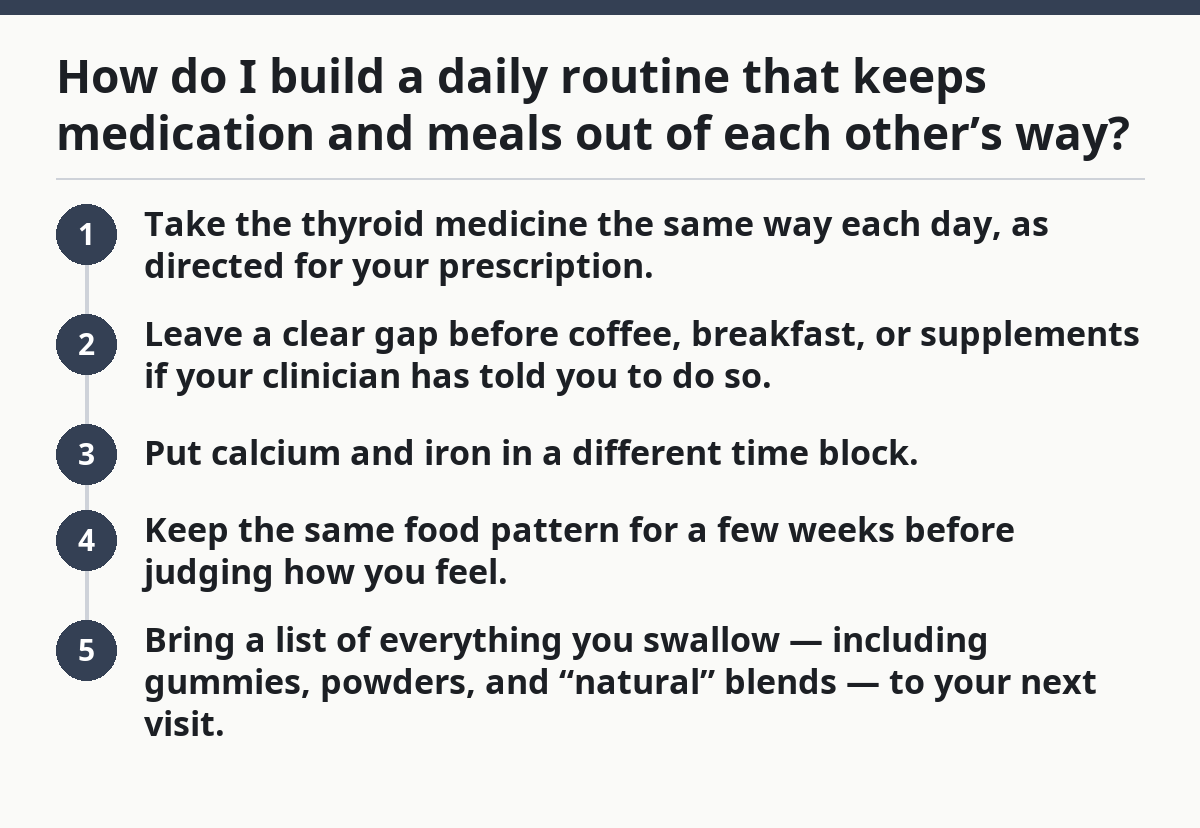
How do I build a daily routine that keeps medication and meals out of each other’s way?
The day-to-day fix is mostly about sequencing. Picture this: you want breakfast, coffee, and supplements without having to memorize a lab manual. The answer is one consistent medication routine plus separated minerals and a predictable meal pattern.
A clean routine beats a perfect one. If you miss a timing rule every other day, the diet plan around it stops mattering much. This is why clinicians often care more about your actual habits than about a theoretically ideal menu. A pattern that you can follow seven days a week is more useful than an ideal that lasts three. That math stops working fast.
A workable structure often looks like this:
- Take the thyroid medicine the same way each day, as directed for your prescription.
- Leave a clear gap before coffee, breakfast, or supplements if your clinician has told you to do so.
- Put calcium and iron in a different time block.
- Keep the same food pattern for a few weeks before judging how you feel.
- Bring a list of everything you swallow — including gummies, powders, and “natural” blends — to your next visit.
One useful tool is a written schedule on the fridge or phone. Not fancy. Just clear. If you take multiple medicines, the schedule can prevent the common problem of mixing a thyroid tablet with a multivitamin or a bone supplement because both are sitting on the same counter. It also helps if someone else in the household organizes pills or meals for you, because the routine becomes visible instead of assumed.
The best part? Once the routine is stable, you can stop thinking about thyroid food rules every meal. That frees you to focus on the real question: are your symptoms improving, staying flat, or changing in a way that needs review? If the answer is unclear after a few weeks, the schedule itself may need to be adjusted before the diet does.
When should you get personal advice instead of following generic tips?
This is where the general advice stops. Picture this: you’ve followed the internet rules, but your labs, symptoms, or medication list still don’t make sense. The answer is now if you’ve changed doses, added new drugs, started supplements, or have another condition that affects digestion or nutrient use.
Some cases need a tailored plan because the same food advice won’t fit everyone. A person with celiac disease, pregnancy, bariatric surgery, kidney disease, osteoporosis risk, or multiple daily medications may need a different spacing strategy or a different set of nutrient targets. That’s not overcaution; it’s common sense. In those situations, the question is not “Which thyroid diet is best?” but “Which plan fits the medication, the diagnosis, and the rest of the meal pattern?”
Bring these details to a qualified professional:
- the exact thyroid medicine name
- when you take it
- what you eat or drink near the dose
- all supplements, including minerals and herb blends
- any other prescription or over-the-counter drugs
- recent lab results if you have them
There are also situations where generic advice can mislead. If you already have a strict diet for another diagnosis, adding more restrictions can shrink your food choices too much. If you’re trying to improve fatigue by eating less, that can backfire. If you use a supplement because a label says “thyroid support,” that product may contain ingredients that complicate your medication routine rather than help it. The label may sound reassuring, but the ingredient list is what matters. Watch the fine print.
This is not for: anyone who wants a one-size-fits-all list. Thyroid nutrition with medication use is about matching the schedule and diet to the person, not forcing the person into a blog template. When the plan fits the real day, it is easier to follow and easier to evaluate.
What should a reader do with all this?
Turn the advice into a simple checkable plan. Picture this: you want one clear next step, not another page of rules. The answer is keep your medication routine steady, separate known problem supplements, and get personal guidance before making major diet cuts.
A good first move is to audit the day you actually live, not the day you wish you lived. Write down the exact time you take your medicine, when you drink coffee, and what supplements sit beside the sink. That list often reveals the problem faster than more reading does. If the pill is always followed by coffee within minutes, that is a timing question. If a multivitamin is taken with breakfast, that is another timing question. The numbers do not need to be perfect; they need to be visible.
Then use this simple filter:
- if a change affects absorption, ask about timing
- if a change cuts out a food group, ask why
- if a change adds a supplement, check for mineral overlap
- if symptoms are getting worse, do not guess at the cause
The strongest takeaway from the current evidence is not a dramatic diet rule. It’s that thyroid medication users do better when nutrition is steady, spacing is deliberate, and advice is matched to the actual prescription and health history. That is a smaller promise than the internet likes to make, but it is a safer one. For most people, a repeatable plan matters more than a perfect one.
Frequently asked questions
Can I drink coffee with thyroid medication?
Not without checking timing with a qualified clinician or pharmacist for your specific medicine. Coffee is one of the common things discussed because it may interfere with absorption if taken too close to the dose. If your routine is already fixed, ask whether your current timing is adequate before changing your morning habit. Many people only need a timing adjustment, not a full coffee ban.
Do I need to avoid dairy if I take thyroid medication?
No, not as a blanket rule. The issue is usually timing, not permanent avoidance. Dairy can matter more when it lands too close to the medication, especially if calcium is the main concern. If dairy is a major part of your breakfast, ask whether moving it later is enough.
Are calcium and iron always a problem?
They can be, because they’re common mineral culprits in absorption discussions. That does not mean you must avoid them entirely; it means the timing and formulation matter. A pharmacist can help sort out how far apart your specific medicines should be. If your supplement contains both minerals, the spacing question matters even more.
Should I cut out soy?
Not automatically. Soy is better treated as a timing and quantity question than a universal ban. If soy is a big part of your diet, bring that up with a clinician so the advice fits your actual meals and medication schedule. One serving at the right time is not the same as several servings clustered around the dose.
Is a thyroid “cleanse” worth trying?
No generic cleanse belongs ahead of proper medical review. These plans often cut too much food, add unnecessary supplements, or ignore the real issue: medication timing. If you’re worried about your thyroid symptoms, a qualified professional is the right place to start.
Drafted with AI; not yet reviewed by a person.