
Last updated: November 20, 2026
Quick answer: store levothyroxine in a cool, dry, dark place; for most homes, that means a bedroom drawer or hallway cabinet rather than a bathroom. If you’re not sure about your own home setup, speak with a qualified pharmacist or clinician about the bottle you have. In How to Store Levothyroxine at Home: Bathroom, Bedroom, and Kitchen Conditions Compared, the safest place is usually the one that limits moisture, heat, and light.
Key Takeaways
- Keep levothyroxine in its original bottle in a dry, room-temperature place with the cap closed and the label intact.
- Bathroom cabinets are usually the weakest choice because shower and bath humidity can reach the bottle repeatedly.
- Bedroom storage is often the most practical, while kitchen storage works only if heat and moisture are kept away.
- Kitchens are a poor fit when the bottle is near heat, grease, steam, or sunlight.
What this guide covers, and what it assumes
This guide applies to levothyroxine tablets kept at home in a prescription bottle with the desiccant packet still inside if your pharmacy supplied one. It assumes you already have the medicine, the labeled bottle, and a place that stays reasonably stable day to day. It also assumes you want the practical answer: where to keep it so temperature exposure, humidity, and light exposure stay low.
The catch is that home storage is not just about “not hot.” Bathroom cabinets can be damp after showers, bedroom drawers can sit near lamps or radiators, and kitchen drawers can live beside ovens, kettles, or sunny counters. None of those is ideal if the medicine is repeatedly exposed to heat and moisture.
Not even close.
The best home spot is the one that stays dry, shaded, and far from cooking steam. If you keep the tablets in the original bottle, closed tightly, and out of reach of children, you’ve already handled the biggest common risks. This article also points readers to the hub on thyroid medication timing and daily routines for the routine side of things.
How should you store levothyroxine at home?
Store levothyroxine in its original bottle in a dry, room-temperature place with the cap closed tight and the label intact. A bottle that stays out of steam, off the windowsill, and away from appliances that heat up is the simplest setup. If the tablets still look unchanged and the bottle stays dry, the storage setup is doing its job.
Picture this: you’re choosing between a bathroom cabinet, a bedside table, and a kitchen drawer, and all three seem convenient. Convenience is not the same as stability. The better choice is the spot that gives the tablets the least moisture, the least heat, and the least light across an ordinary week.
- Keep the tablets in the original prescription bottle. Leave the pharmacy label on and keep the desiccant packet inside if one came with the bottle. Verify that the cap closes fully and that the bottle is not cracked. A loose lid or a damaged bottle means the tablets can absorb more moisture.
- Choose a location that stays dry. Pick a drawer, cabinet, or closet shelf that does not collect steam, sink splash, or condensation. Verify the space feels dry to the touch and does not smell damp. If the area fogs up after showers or dishwashing, it is the wrong place.
- Keep it away from heat sources. Place the bottle away from the oven, stove top, toaster, radiator, heater vent, or sunny windowsill. Verify the spot does not warm up when the room heats. If the drawer or shelf feels warm after cooking, move the bottle.
- Protect it from light exposure. Store the bottle in an opaque cabinet or closed drawer, not in a clear organizer on the counter. Verify the tablets are not sitting in direct sunlight for part of the day. If you can see the bottle glowing in sun, the location is too bright.
- Use a stable bedroom or hallway spot if needed. A bedside table drawer, dresser drawer, or hallway cabinet often works better than a bathroom. Verify the room does not get hot from a lamp, sun patch, or heater. If the medicine sits beside a diffuser, humidifier, or lamp, relocate it.
- Keep it out of reach of children and pets. Store the bottle where small hands cannot open it and where the cap cannot be knocked to the floor. Verify the location is high enough or locked enough for your household. If a child can reach it, the setup is unsafe.
- Avoid decanting into loose pill cases unless a clinician or pharmacist has told you it is okay for your situation. Decanting means moving tablets out of the labeled bottle into another container. Verify the new container is dry, clean, and tightly sealed; if not, moisture and mix-ups become more likely. A pill box on a humid counter is a poor trade.
If you need one sentence for the rule of thumb, use this: original bottle, dry room, closed drawer. That is the standard most people can actually keep up.
Is the bathroom cabinet a bad place for levothyroxine?
Yes, a bathroom cabinet is usually the weakest choice because humidity from showers and baths can repeatedly expose the bottle to moisture. The bottle may look fine from the outside, but the air inside a bathroom changes fast, and tablets do not care whether the steam came from a ten-minute shower or a long bath.
Picture this: you open the bathroom mirror after a hot shower and the glass is fogged. That same damp air can reach a medicine bottle on the shelf, especially if the cap is not perfectly tight. The problem is not one wet morning. It’s the repeated cycle.
A bathroom can sometimes work only if it stays unusually dry, far from the sink and shower, and the bottle remains tightly closed in a cabinet that does not fog up. Even then, it is still the first place I would move a levothyroxine bottle out of if there is any better option.
The first move is simple.
- Move it to a bedroom drawer or hallway cabinet.
- Keep the cap closed after every use.
- Leave the desiccant packet in place if it came with the bottle.
- Check for dampness around the cap or label.
If the label curls, the cap feels sticky, or the bottle spends time near steam, the bathroom setup has already slipped.
Which is better: bedroom, bathroom, or kitchen?
The bedroom is usually best, the bathroom is usually worst, and the kitchen is only acceptable if you can keep the bottle far from heat and moisture. That ranking comes down to simple environmental control: bedrooms are easier to keep cool and dry, bathrooms are humid, and kitchens combine heat, steam, and bright light in one busy room.
Picture this: you’re standing in your bedroom and can choose a bedside table drawer, a dresser, or a top shelf in a closet. Any of those can be better than a bathroom cabinet, as long as the area stays cool and dark. A kitchen drawer near the sink or stove is a different story.
Here’s how the three rooms compare in practice:
- Bedroom: Often the best fit because it stays dry and away from steam.
- Bathroom: Poor fit because humidity changes every time water runs.
- Kitchen: Mixed at best; safe only if it is far from the stove, kettle, dishwasher, and sunny window.
If the bedroom has a radiator or a lamp that heats the drawer, that advantage disappears. If the kitchen drawer is next to the oven, that option also drops out. The room matters, but the exact spot inside the room matters more.
What goes wrong in kitchens and bedrooms?
Kitchen storage fails when the bottle sits near heat, grease, steam, or sunlight. Bedroom storage fails when the bottle is placed next to a heater, lamp, humidifier, or sunny window. In both rooms, the mistake is the same: the location seems ordinary, but the microclimate around the bottle is not.
Picture this: you tuck the bottle into a kitchen drawer because it feels convenient, then cook pasta, boil water, and run the dishwasher that evening. The bottle does not need to be wet to be affected; repeated warmth and humidity can still make the spot less suitable over time.
The mistakes I see most often are plain:
- Counter storage. The bottle gets light exposure and can be reached by children or pets.
- Drawer beside the stove. Heat rises, and the drawer warms during cooking.
- Shelf above a dishwasher or kettle. Steam collects where you least want it.
- Bedside table next to a lamp or heat vent. The room feels calm, but the air around the bottle isn’t.
- Transfer to a decorative container. The medicine loses its label, its seal, and sometimes its desiccant packet.
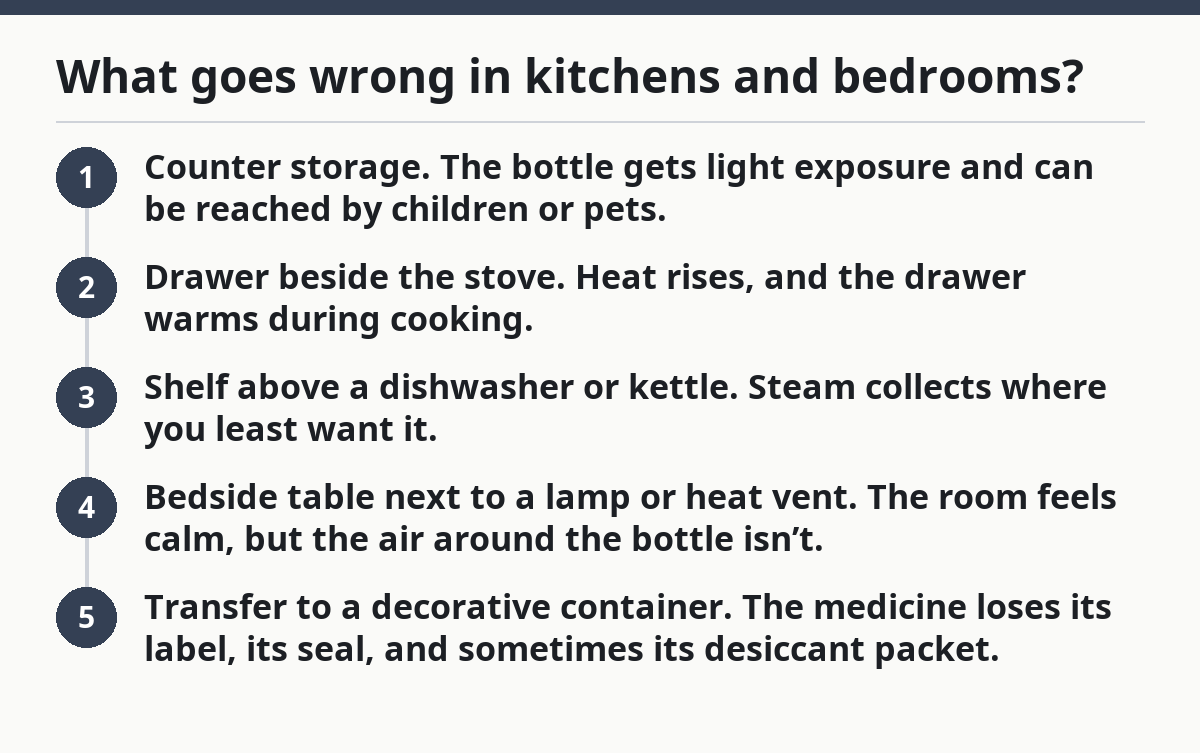
The fix is not fancy. Move the bottle farther from the source of heat or moisture, then leave it where the air stays boring.
When should you keep the bottle in the original container?
Keep levothyroxine in the original bottle unless a pharmacist has told you a different container is appropriate for your specific setup. The original bottle protects the label, helps prevent mix-ups, and is usually the most realistic way to keep the tablets dry and correctly identified.
Picture this: you open a pill sorter and several white tablets look nearly the same. The label is gone, the bottle is gone, and the batch information is gone. That is exactly why decanting deserves caution even when it seems tidy on the counter.
Use the original container when any of these are true:
- You need the pharmacy label for identification.
- The home is humid or changes temperature often.
- Children, guests, or roommates may handle the medicine.
- You do not have a dry, sealed alternative container.
A pill case can make sense for short-term organization in some routines, but it is not automatically a better storage container. If it is not tightly sealed, not clearly labeled, or not kept in a dry place, it can do more harm than good.
When should you stop using the current storage spot?
Stop using the current storage spot when the environment is warm, damp, bright, or easy to access by a child. On a health topic like this, the safer move is to relocate the bottle and ask a pharmacist if the tablets or packaging need review. Here are the clearest warning signs:
The bottle was stored in a bathroom during regular showers: repeated humidity exposure may be the problem — move it to a drier room and keep the cap closed.
The bottle sat beside a stove, kettle, radiator, or sunny window: heat or light exposure may be higher than it should be — switch to a cooler, shaded drawer or cabinet.
The cap no longer closes tightly: the seal is weaker, so moisture can enter more easily — replace the bottle or ask the pharmacy about a new container.
The desiccant packet is missing and the bottle seems damp inside: the tablets may be exposed to more moisture than intended — contact the dispensing pharmacy for guidance.
A child or pet can reach the bottle: the location is not secure — move it to a locked or higher spot right away, and ask a pharmacist or clinician if you need help choosing a safer storage place.
You transferred tablets into a non-labeled organizer and can’t verify them easily: mix-ups become more likely — return to the original bottle and check with a pharmacist before any further change.
A rough rule helps here: if you would not keep dry spices there for a month, it is probably not a good home for levothyroxine either.
What a good setup looks like day to day
A good setup looks ordinary: a closed bottle, a dry drawer, no sun on the cap, and no steam nearby. You should be able to reach the medicine without moving it past a sink, stove, or heater. If the bottle lives there for weeks and still stays clean, dry, and labeled, the storage is doing what it should.
Picture this: you open a bedroom drawer, see the bottle upright, and close it again. No fog, no warmth, no clutter. That is the goal. The best storage is the kind you barely have to think about because the room itself is doing the work.
Two quick checks help:
- The bottle does not feel warm.
- The label is readable and dry.
- The cap stays shut.
- The area is not in direct light.
If any of those fail, the spot needs changing. A better drawer beats a convenient bad habit every time.
FAQ
Can levothyroxine be stored in the bathroom?
Levothyroxine can be stored in a bathroom only if that bathroom stays very dry, but that is not the best setup. Bathroom humidity from showers and baths is the main problem, especially if the bottle sits near the sink or stays open. A bedroom drawer or hallway cabinet is usually a better choice.
Does heat ruin levothyroxine?
Heat can make levothyroxine storage less reliable, so it should be kept away from ovens, radiators, sunny windows, and other warm spots. The medicine should stay in a stable, cool place rather than a location that heats up during cooking or in afternoon sun. If a storage spot feels warm, move it.
Should levothyroxine stay in the original bottle?
Yes, levothyroxine should usually stay in the original bottle because the label, seal, and desiccant packet help with identification and protection. A different container can increase mix-up risk and may expose the tablets to more humidity if it is not tightly sealed. A pharmacist can advise if a different setup is appropriate for a specific household.
Drafted with AI; not yet reviewed by a person.