What to Do If a Thyroid-Friendly Diet Leaves You Low on Protein

Last updated: November 20, 2026
Key Takeaways
- A thyroid-friendly diet can miss protein when it relies on “safe” foods that are easy to digest but low in protein.
- Build each meal around one protein anchor, then add thyroid-friendly sides.
- Foods you already tolerate, prepared simply, are often the most workable protein choices.
- Low protein needs professional help when it’s linked to weight loss, poor appetite, swallowing trouble, digestive disease, or unstable thyroid disease.
If a thyroid-friendly diet leaves you low on protein, the fix is usually to add protein-rich foods back into meals and snacks without abandoning the rest of the plan. Don’t guess at this alone—speak with a qualified clinician about your own thyroid condition and diet, and see the American Thyroid Association, NIDDK, and NIH Office of Dietary Supplements for patient guidance. The steps below settle what to eat, what to pair, and when low protein is a bigger problem. What to Do If a Thyroid-Friendly Diet Leaves You Low on Protein is a practical way to keep the diet pattern while closing the protein gap.
Who this applies to, and what it assumes
This applies if you eat in a thyroid-friendly way and keep ending up short on protein, especially when meals lean heavily on fruit, vegetables, soups, and low-calorie foods. It assumes you already know the broad thyroid-diet basics and now need a practical fix for the protein gap in What to Do If a Thyroid-Friendly Diet Leaves You Low on Protein.
Picture this: you’re eating “clean,” but lunch is a salad, dinner is vegetables and rice, and by 4 p.m. you’re dragging. That pattern matters because protein helps steady meals and makes it easier to build balanced plates. It also matters because low protein can overlap with thyroid symptoms, so the food pattern can hide the real problem.
The short version is simple: keep the thyroid-friendly parts that work, then add protein at each meal and snack. That usually means eggs, Greek yogurt, beans, fish, poultry, tofu, cottage cheese, or other protein foods that fit your plan. The right choice depends on what you already tolerate, what you avoid, and whether you’re vegetarian, dairy-free, or on a more restricted pattern.
A useful benchmark from the Academy of Nutrition and Dietetics is that protein foods belong across the day, not all at once. A 3-ounce portion of meat, poultry, or fish, or a cup of beans, is a familiar reference point. If your current meals never get close to that, the fix is probably structural, not cosmetic.
What a thyroid-friendly diet often misses
A thyroid-friendly diet can miss protein when it gets built around “safe” foods that are easy to digest but light on grams of protein. That often means fruit, plain oatmeal, toast, rice, cooked vegetables, and broths crowding out the foods that actually carry the protein load.
Picture this: breakfast is coffee and toast, lunch is soup, and dinner is a small grain bowl with vegetables. It looks tidy on a plate. It may still leave you underfed on protein, especially if each meal has only a token serving of protein food.
Here’s the catch: thyroid-friendly does not have one fixed meaning. Some people are avoiding highly processed foods. Some are avoiding goitrogen-heavy raw crucifers in large amounts. Some are watching weight changes or appetite. Those goals can shrink protein unless you plan for it on purpose.
- Eggs: fast, compact protein for breakfast.
- Greek yogurt: useful when you need a snack that carries more protein than fruit alone.
- Beans and lentils: good for vegetarian meals, but they need a larger portion than many people expect.
- Fish, chicken, turkey, tofu, tempeh, cottage cheese: easier ways to move a meal from “light” to actually balanced.
The common mistake is treating protein as optional if the rest of the diet looks healthy, but a clinician or dietitian should help if symptoms or restrictions make the pattern hard to correct. A plate can be full of micronutrients and still leave you short on the macronutrient that helps meals hold together.
How do I add protein without changing the whole diet?
You add protein by building each meal around one protein anchor, then filling in the rest with thyroid-friendly sides. That’s often the most practical way to fix a shortfall without turning your whole diet upside down.
Picture this: you already have a routine, and the last thing you want is a brand-new meal plan. You don’t need one. You need a repeatable pattern that works at breakfast, lunch, dinner, and snack time.
Use this sequence for the next 7 days:
- Pick one protein anchor at each meal. Choose eggs, Greek yogurt, cottage cheese, beans, lentils, fish, chicken, tofu, or tempeh. Verify that the plate has a real protein food, not just grains or vegetables. If the “anchor” is only a spoonful or garnish, it’s not enough.
- Build breakfast first. Add 2 eggs, Greek yogurt, or cottage cheese to the first meal of the day. Check that breakfast contains both protein and a carb, since protein alone can feel thin and unsatisfying. If breakfast leaves you hungry again in 1 to 2 hours, it probably needs more food.
- Upgrade snacks to 10–20 grams of protein when possible. Use Greek yogurt, roasted edamame, cheese, a hard-boiled egg, or hummus with a protein-rich side. Verify that the snack is more than produce plus a cracker. If the snack disappears in two bites and you’re still looking for food, it was too small.
- Make lunch a true meal, not a side dish. Add beans to soup, chicken to salad, tofu to rice bowls, or tuna to a wrap. Check that lunch includes a visible serving of protein, not just a topping. If lunch still leaves you shaky or ravenous, the portion is likely too light.
- Use beans strategically. Add lentils to stew, black beans to grain bowls, or chickpeas to salads. Verify the serving size is meaningful, because a few spoonfuls won’t close a gap. If beans cause gas or bloating, reduce the amount and split them across the day.
- Plan dinner around the protein first. Put the fish, chicken, tofu, or beans on the plate before the vegetables and starch. Check that the protein portion is not the smallest item on the plate. If dinner is mostly vegetables, the balance is off.
- Repeat two or three easy combinations. Keep a short list of meals you can make in 10–15 minutes: eggs and toast, Greek yogurt with fruit and nuts, bean chili, tuna on crackers, tofu stir-fry. Verify that each one can be made without a long recipe. If it’s too complicated for a weekday, you won’t keep it up.
- Review the pattern after 3 to 7 days. Look at whether you’re less hungry between meals, less tempted to graze, and better able to hit protein at breakfast and lunch. If nothing changes, the issue may be total intake, not just protein placement, and a dietitian can help sort that out.
A simple principle helps here: do not try to “save” protein for dinner. Most people do better when it’s spread across the day, because breakfast and lunch are where the gap usually starts.
What foods raise protein without upsetting thyroid management?
The safest answer is foods you already tolerate, prepared in plain ways, with enough protein to matter. That means eggs, Greek yogurt, beans, fish, poultry, tofu, tempeh, and cottage cheese are usually better tools than protein bars loaded with sugar alcohols or ultra-processed fillers.
Picture this: you want something easy, but you also want it to sit well and fit a thyroid-friendly routine. That’s where food quality and digestibility matter more than hype.
A few practical pairings work well:
- Eggs + toast + fruit for breakfast
- Greek yogurt + berries + seeds for a quick snack
- Beans + rice + salsa for a simple vegetarian bowl
- Chicken or tofu + vegetables + potatoes for dinner
- Tuna or salmon + crackers + cucumbers for lunch
- Cottage cheese + fruit when you need something fast
The truth is, “thyroid-friendly” can mean different things for different people. If you avoid soy, tofu won’t be your answer. If dairy bothers you, Greek yogurt and cottage cheese may not work. If beans bloat you, smaller portions may be easier than forcing a huge serving.
For trustworthy background, the NIDDK and NIH Office of Dietary Supplements both publish plain-language nutrition information that can help you separate food advice from internet noise. The American Thyroid Association also has patient education on thyroid care and diet topics. Use those sources as a check, not as a replacement for your own care plan. See the NIDDK and NIH ODS pages for general nutrition reference points, and check the American Thyroid Association for thyroid-specific patient education.
What to check before going further
Before you change more food choices, check whether the problem is truly protein and not something that only looks like it. Fatigue, weakness, constipation, poor appetite, weight change, and brain fog can overlap with thyroid issues, low iron, low B12, low calorie intake, and poor sleep.
Picture this: you think you need more protein, but your meals are also too small overall. That changes the fix. A protein-heavy snack won’t help much if the full day is still underfueled.
- Are you missing protein at breakfast, not just dinner?
- Are your meals low in total food volume?
- Are you relying on vegetables, fruit, soup, and crackers as the base of the day?
- Are you vegetarian, dairy-free, or avoiding several protein foods at once?
- Are you having GI symptoms that make beans, dairy, or high-fat foods hard to eat?
If the answer to more than one of those is yes, the issue is probably a planning gap. If symptoms are strong or getting worse, the food fix should sit beside medical review, not replace it.
When should low protein be handled by someone else?
Low protein needs professional help when it’s tied to weight loss, poor appetite, swallowing trouble, digestive disease, or a thyroid condition that is not stable. In those cases, food changes alone may not solve the real issue.
Picture this: you’re eating less because food feels unappealing, or you’re losing weight without trying. That is not a “just add eggs” problem. It may need a proper evaluation.
Unplanned weight loss: It can mean you’re not getting enough total energy, not just protein — speak with a qualified clinician or dietitian soon.
Persistent diarrhea or vomiting: These can block absorption and make food plans fail — get medical guidance rather than pushing harder on diet alone.
Trouble swallowing: This can make protein foods hard or unsafe to eat — ask for an evaluation before you keep experimenting.
Strong fatigue that doesn’t improve with meals: Fatigue can come from thyroid levels, iron, B12, sleep, or another cause — don’t assume protein is the whole answer.
Multiple food restrictions: If you avoid dairy, soy, beans, gluten, and meat, the plan gets narrow fast — a dietitian can help prevent gaps.
Recent thyroid medication changes: If appetite, energy, or digestion shifted after a change, the timing may matter — raise it with the prescriber.
The mistake here is trying to solve a medical nutrition problem with a snack list. Sometimes that works. Sometimes it just delays the real fix.
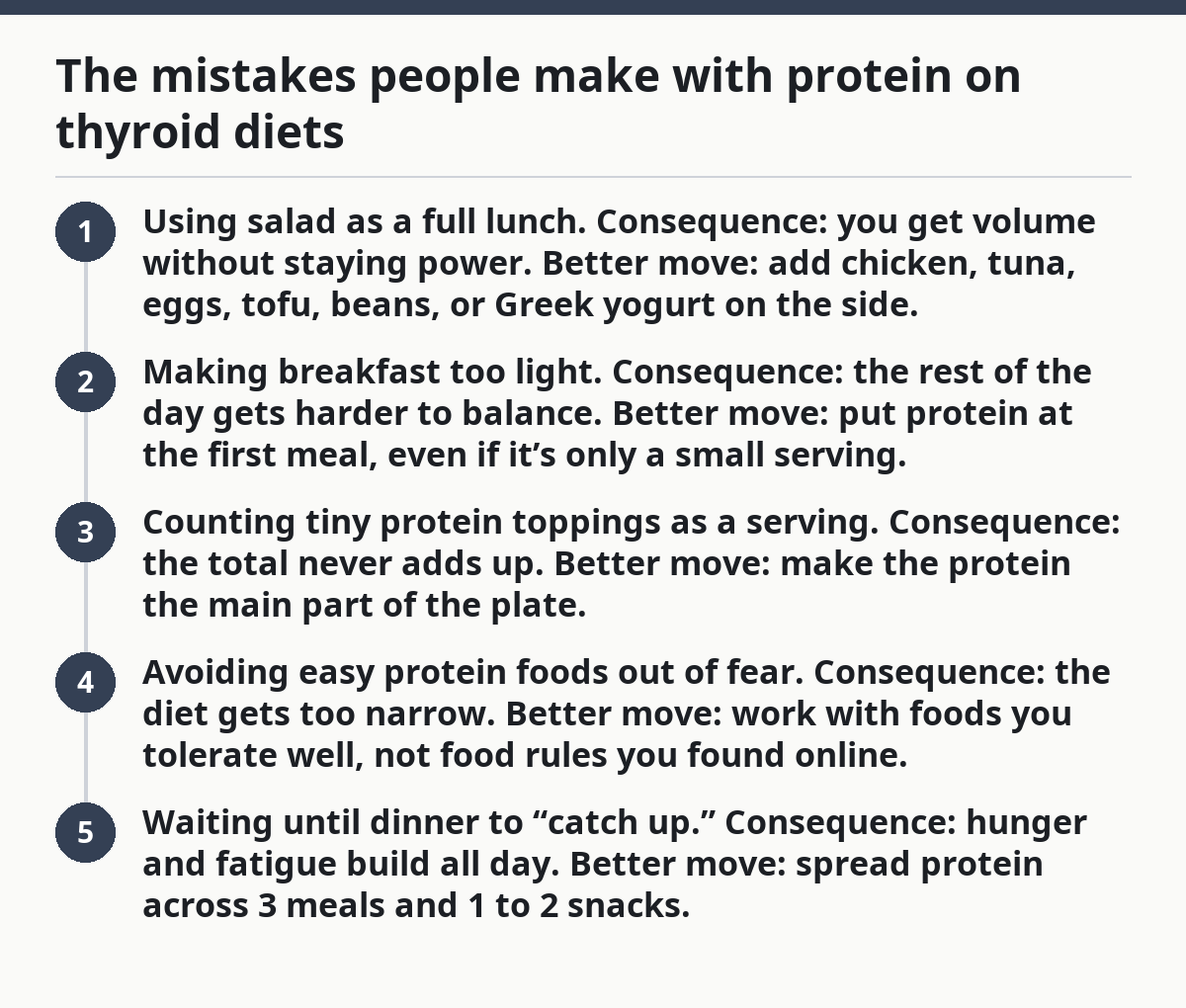
The mistakes people make with protein on thyroid diets
The biggest mistake is assuming a “healthy” plate automatically has enough protein. It often doesn’t, and the result is meals that look disciplined but leave you underfed.
Picture this: you’re proud of eating mostly vegetables and whole foods, but by midafternoon you’re drained and reaching for anything within arm’s reach. That is often a meal-pattern problem, not a willpower problem.
- Using salad as a full lunch. Consequence: you get volume without staying power. Better move: add chicken, tuna, eggs, tofu, beans, or Greek yogurt on the side.
- Making breakfast too light. Consequence: the rest of the day gets harder to balance. Better move: put protein at the first meal, even if it’s only a small serving.
- Counting tiny protein toppings as a serving. Consequence: the total never adds up. Better move: make the protein the main part of the plate.
- Avoiding easy protein foods out of fear. Consequence: the diet gets too narrow. Better move: work with foods you tolerate well, not food rules you found online.
- Waiting until dinner to “catch up.” Consequence: hunger and fatigue build all day. Better move: spread protein across 3 meals and 1 to 2 snacks.
A practical rule helps: if a meal would still be complete without the protein food, it probably needs more protein.
How do I know the plan is working?
The plan is working when meals hold you longer, snacks become less urgent, and you can eat protein at more than one time of day without forcing huge portions. That usually shows up within 3 to 7 days if the problem was mostly meal balance.
Picture this: breakfast stops feeling like a placeholder, lunch actually carries you to dinner, and you’re not panicking at 3 p.m. That’s a good sign the structure is better.
Look for these changes:
- Less “crash” between meals
- Less constant grazing
- Better tolerance of balanced plates
- Easier meal planning
- More variety without losing the thyroid-friendly pattern
If you’re still exhausted, still losing weight, or still unable to eat enough, the problem may be bigger than protein. That’s the point where a clinician or registered dietitian can help sort out thyroid status, intake, and any other nutrient gap. This hub on thyroid nutrition for supplements and nutrient gaps is the right next stop when food alone isn’t covering the bases.
How much protein do thyroid patients need?
There isn’t one number that fits every thyroid patient. Protein needs vary by body size, age, activity level, overall intake, and whether there’s weight loss or another medical issue, so the best answer is individualized guidance from a qualified clinician or dietitian.
Can low protein worsen fatigue?
Low protein can contribute to fatigue, but it is not the only possible cause. Fatigue also overlaps with thyroid hormone levels, low iron, low B12, poor sleep, low calorie intake, and illness, so protein is only one piece of the picture.
Drafted with AI; not yet reviewed by a person.