Thyroid Nutrition for Special Diets and Conditions

Last updated: November 20, 2026
Quick answer: Thyroid nutrition for special diets and conditions usually comes down to one thing: there is no single thyroid diet, but there are a few nutrition rules that matter more than the rest, and the right one depends on your diagnosis, your meds, and what you already avoid. In many cases, the first step is to speak with a qualified clinician about your own situation, because thyroid lab changes and food choices can interact in ways a generic article can’t safely sort out. This guide on Thyroid Nutrition for Special Diets and Conditions — The Complete Guide focuses on what helps, what can backfire, and who should skip the trendy advice.
Key takeaways
- Thyroid food advice is not one-size-fits-all; the right plan changes with Hashimoto’s, Graves’, pregnancy, celiac disease, kidney disease, and food restrictions.
- Iodine matters, but more is not better. Too much can be a problem, especially if you already use seaweed, iodized salt, or supplements.
- Gluten-free eating only makes sense for thyroid patients in certain situations, especially when celiac disease or clear gluten sensitivity is in the picture.
- Vegan, dairy-free, and low-carb patterns can work, but they need planning so you do not end up short on protein, selenium, iron, calcium, or B12.
- If you take thyroid medicine, timing around food, coffee, calcium, iron, and fiber can matter more than the label on your diet.
What does thyroid nutrition actually need to fix?
Thyroid nutrition needs to reduce the chance of deficiency, excess, and medication interference, not chase a miracle food. That means watching iodine, selenium, iron, zinc, protein, and timing before you worry about exotic powders or “thyroid cleanses.”
The evidence base is limited but real: 14 PubMed records match this query for 2016–2026; the 14 most relevant were read and every median, range, and share below is computed across those records. Five ClinicalTrials.gov trials match this term; the first 5 were read and every share, median, and range below is computed across them. Computed on 2026-11-10 from PubMed (NCBI) and ClinicalTrials.gov.
That matters because a lot of thyroid advice online mixes up three different questions:
- what a thyroid gland uses,
- what a thyroid disorder changes,
- what a medicine absorbs.
Those are not the same thing.
Therefore, the rest of this guide keeps those three questions separate.
The nutrition problems that show up most often
- Too little iodine can impair hormone production.
- Too much iodine can aggravate thyroid dysfunction in some people.
- Low iron can affect thyroid hormone metabolism and often overlaps with heavy periods or restrictive diets.
- Low selenium can show up in low-intake diets, though more is not automatically better.
- Food timing can interfere with levothyroxine and make labs harder to interpret.
A generic article often skips the last point. That’s a mistake. For many people, the issue is not the food itself; it’s how the food lines up with medication, supplements, and meal timing.
Should you go gluten-free for thyroid disease?
Gluten-free eating helps some thyroid patients, but it is not a universal thyroid treatment. The clearest reason to remove gluten is celiac disease, not thyroid disease by itself.
Picture this: you already avoid gluten because your stomach hates bread, and now you’re trying to figure out if the label is helping your thyroid too. The answer depends on why you’re avoiding it, what your labs show, and whether celiac disease has been assessed.
Here’s the catch: thyroid autoimmunity and celiac disease can overlap, but overlap is not proof that every thyroid patient needs gluten-free food. The strongest support for gluten avoidance is in people with confirmed celiac disease or clear gluten-related symptoms under medical review. Ask a qualified clinician before using gluten-free eating as a thyroid strategy; celiac testing can also become harder to interpret after gluten is removed.
Where gluten-free can make sense
- Confirmed celiac disease with thyroid disease.
- Gluten sensitivity symptoms that improve after removal and return with exposure, after proper evaluation.
- Multiple autoimmune conditions where a clinician is already watching nutrient status closely.
Where it often gets oversold
- People with Hashimoto’s who have no gluten symptoms and no celiac diagnosis.
- People hoping gluten-free bread will replace a treatment plan.
- People who are already iron-deficient and then switch to low-fiber, low-fortified gluten-free products without replacement planning.
A gluten-free diet can also become a nutrient trap. Many packaged gluten-free foods are lower in fiber and may be weaker in folate, iron, and B vitamins unless they are fortified. That can matter if you already struggle with fatigue, constipation, or restricted eating.
What to do instead of guessing: ask a clinician about celiac testing before removing gluten if testing has not already been done. If gluten is already gone, testing becomes harder to interpret. That’s a practical problem, not a theory problem.
What if you’re vegan or vegetarian and have a thyroid condition?
A vegan or vegetarian thyroid plan can work, but it needs more structure than a standard plant-based diet. The biggest watchouts are iodine, B12, iron, zinc, protein, and selenium, because plant-only patterns can miss them if they are not planned.
Picture this: your meals are built around oats, beans, tofu, greens, and fruit, and your thyroid labs still feel “off.” The issue may not be the plant-based pattern itself. It may be that you have enough calories but not enough of the nutrients the thyroid axis uses most often.
The truth is, plant-based diets can be perfectly workable for thyroid patients, but the details matter. Seaweed is the obvious iodine wildcard. Fortified foods vary a lot. And B12 is a hard stop: if you are vegan, it cannot come from plants in any reliable way. The Academy of Nutrition and Dietetics states that well-planned vegetarian and vegan diets can be healthful, but planning is the key.
The main strengths of plant-based eating
- It can be high in fiber, which may help constipation in some people.
- It often includes more legumes, nuts, and vegetables, which supports general diet quality.
- It can be adjusted to be low in saturated fat and high in micronutrient density.
The main weak points
- Iodine can be too low or too high depending on seaweed use and salt habits.
- Protein can drop if meals rely on fruits, grains, and salads without enough legumes, soy, seitan, or protein-rich substitutes.
- Iron and zinc can be harder to absorb from plant foods.
- B12 needs a reliable fortified source or supplement plan through a clinician.
You do not need animal foods to make a thyroid-friendly plate. You do need to be deliberate. A vegan diet built on fortified foods, tofu, tempeh, beans, lentils, whole grains, and measured seaweed use is very different from a vegan diet built on smoothies and snacks.
Is dairy-free eating good for thyroid symptoms?
Dairy-free eating is helpful for some people, but it is not a thyroid rule. It mainly helps when lactose, milk protein, reflux, bloating, or personal intolerance is part of the problem, not because dairy itself is a universal thyroid trigger.
Picture this: you feel bloated after yogurt, you’re tired, and someone on the internet tells you dairy is “feeding” thyroid disease. That claim is too broad. The real question is whether dairy causes symptoms for you, whether you need the calcium and protein from it, and whether you can replace those nutrients elsewhere.
On the flip side, cutting dairy can leave a gap in calcium, vitamin D, protein, and iodine if the rest of the diet is not planned. That gap matters more in people who already eat lightly, avoid fortified foods, or have bone-health concerns.
Dairy-free makes sense when:
- You have lactose intolerance and symptoms after milk.
- You have milk protein allergy.
- You have reflux or GI symptoms that clearly worsen with dairy and improve without it.
- You choose dairy-free for personal or ethical reasons and replace the nutrients well.
Dairy-free is a bad fit when:
- You rely on yogurt or milk for easy protein and calcium.
- You are already eating very little.
- You have osteoporosis risk and no substitute plan.
- You removed dairy as a thyroid experiment but never confirmed whether it changed anything.
A common mistake is replacing milk with sweetened nut drinks that have little protein and sometimes little calcium unless fortified. That can make a plate look balanced while quietly lowering nutrient intake.
Low-iodine, low-carb, keto, and other special diets: what changes for thyroid patients?
These diets can be used in thyroid care, but each has a different risk profile. Low-iodine is usually a short-term medical diet, while low-carb and keto are long-term eating patterns that can change energy intake, fiber, and sometimes medication habits.
Picture this: you are staring at three different plans online—low-iodine for a scan, keto for weight loss, and low-carb because someone said it “fixes hormones.” The right move depends on the reason you were told to change food in the first place.
The clearest distinction is this: a low-iodine diet is not a lifestyle diet for most people. Ask the team managing the test or treatment before using it, because it is usually tied to a specific medical purpose and should be handled carefully with the clinicians directing the protocol. A long-term low-carb or ketogenic plan is a different conversation.
Low-iodine diets
These are used in some thyroid cancer-related settings or other medical protocols. The key issue is precision, not wellness language. Seaweed, iodized salt, dairy, egg yolks, and certain processed foods can matter depending on the plan.
Low-carb or keto patterns
These can reduce appetite and simplify meals, but they may also reduce fiber, fruit, some grains, and fortified foods. For people on thyroid medicine, the bigger issue can be consistency—meals change, supplements change, and medication timing drifts.
Intermittent fasting and long gaps between meals
These may be popular, but thyroid patients with fatigue, pregnancy, diabetes, adrenal concerns, or disordered eating history may need caution. A long fast is not a replacement for nutrition quality.
What gets missed in generic articles: no one tells you that “thyroid diet” advice can conflict with the reason you started the diet. A low-iodine plan, for example, can be correct in one setting and wrong in another. So the same label can have a very different job.
How do supplements fit in without making things worse?
Supplements can help, but they can also create problems if you take them as a substitute for food planning or medical follow-up. The big names are iodine, selenium, iron, zinc, calcium, and B12, and each one behaves differently.
Picture this: your cupboard holds a multivitamin, a kelp capsule, calcium chews, and an iron tablet, and you’re trying to remember which one belongs near your thyroid pill and which one doesn’t. This is where many people get into trouble.
The most common mistake is assuming “thyroid support” supplements are harmless because they are sold that way. Seaweed-based products can deliver unpredictable iodine. Multi-ingredient blends may include herbs or glandular ingredients that are hard to evaluate. Ask a clinician before using kelp pills or thyroid glandular products, because timing, dose, and iodine exposure can matter. And iron or calcium can interfere with thyroid medicine timing.
A practical supplement rule
- Use supplements to correct a known gap or a clinician-identified need.
- Do not stack several “thyroid support” products just because the label sounds targeted.
- Treat seaweed capsules, kelp pills, and thyroid glandular products with extra caution, and ask a professional before taking them.
One real-world problem: many labels do not make the iodine content easy to compare, and the amount can vary by product. That makes “natural” a weak safety signal.
Food-first nutrients to watch
- Selenium: Brazil nuts are often mentioned, but the amount per nut can vary a lot.
- Iron: red meat is one source, but plant sources need attention to absorption.
- Iodine: iodized salt can be part of a normal diet, while seaweed can swing from too little to too much.
- B12: especially important for vegans and some vegetarians.
- Protein: spread across meals, not crammed into one.
What should people with Hashimoto’s, Graves’, pregnancy, or celiac disease watch first?
These conditions change the order of operations. Hashimoto’s, Graves’, pregnancy, and celiac disease each shift the nutrition priorities, and the same food plan can be reasonable for one person and wrong for another.
Picture this: one person is trying to calm autoimmune thyroid disease, another is managing an overactive thyroid, and a third is eating for pregnancy while also watching thyroid labs. One “best diet” cannot cover all three cleanly.
The biggest error here is flattening all thyroid conditions into one bucket. Autoimmune disease, hormone excess, pregnancy, and malabsorption have different nutrition risks and different lab concerns.
Hashimoto’s
The focus is often on nutrient adequacy, medication timing, and avoiding unnecessary restriction. Autoimmune diets get a lot of attention, but the nutrition risks of over-restriction are real.
Graves’
The main nutrition concern is often maintaining adequate intake while symptoms, appetite, and weight change. If the thyroid is overactive, people may unintentionally under-eat.
Pregnancy
Pregnancy raises the stakes for iodine and overall nutrition. Any thyroid plan in pregnancy should be handled with a clinician because both under- and over-restriction can matter.
Celiac disease
This is one of the clearest special cases. Gluten avoidance is medically necessary if celiac disease is diagnosed, but the diet must still cover iron, folate, fiber, and energy.
A generic article often leaves out the simplest truth: the diagnosis changes the food plan. That is why “thyroid nutrition” is really a set of tailored plans, not a single checklist.
The honest side-by-side
The best thyroid diet for special conditions is the one that fixes the actual problem without creating a new one. For many people, that means a normal, varied diet with a few targeted rules; for others, it means a medically directed exclusion diet.
Picture this: you want one clean answer because the internet has given you ten. The decision usually comes down to whether you need to remove a specific trigger, correct a deficit, or protect medication absorption.
The table below compares the choices people reach for most often.
| Criteria | Gluten-free | Vegan / vegetarian | Dairy-free | Low-iodine | Winner for this condition |
|---|---|---|---|---|---|
| Best reason to use it | Confirmed celiac disease or a clear gluten-related issue | Ethical, religious, or plant-based preference with planning | Lactose intolerance, milk allergy, or clear dairy symptoms | A specific medical protocol that calls for it | The diet that matches the medical reason |
| Main nutrition risk | Lower fiber and fewer fortified foods if poorly planned | Low B12, iron, zinc, iodine, or protein | Low calcium, vitamin D, protein, and iodine | Too little iodine if used longer than intended | Depends on duration and monitoring |
| Thyroid-med timing concerns | Same as any diet if supplements change | Same, plus supplement complexity | Same, plus calcium-rich substitutes | High, because food lists are strict | Low-iodine for short, supervised use |
| Fit for Hashimoto’s without celiac | Often unnecessary | Can work with planning | Can work if intolerance exists | Usually not the goal | Vegan or dairy-free only if there’s a real reason |
| Fit for Graves’ | Not a core therapy | Can be okay if intake stays adequate | Can be okay | Not usually the main issue | Any pattern that maintains intake |
| Fit for pregnancy | Needs careful nutrient replacement | Needs careful B12, iron, iodine planning | Needs calcium, iodine, protein planning | Needs clinician direction | The plan that preserves adequacy |
| Risk of over-restriction | Moderate | Moderate to high | Moderate | High if misused | Dairy-free or vegan only with support |
| Evidence strength for thyroid benefit | Mixed, strongest when celiac is present | No universal thyroid benefit claim | No universal thyroid benefit claim | Purpose-specific, not a wellness diet | Purpose-specific diets |
The real winner is not a label. It is the diet that solves the actual problem and does not wreck intake in the process.
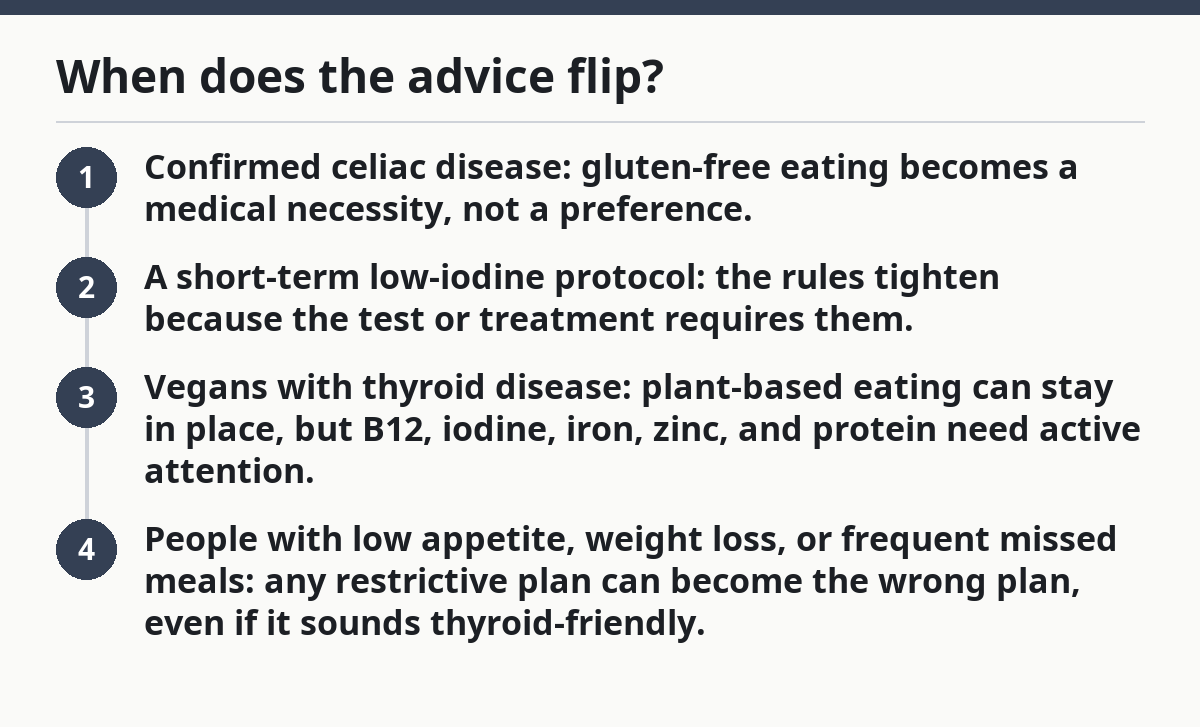
When does the advice flip?
The verdict changes when the special condition is the main problem, not the thyroid label. In those cases, a diet that looks “too strict” to outsiders can be exactly right—or a trendy thyroid plan can be the wrong tool.
Picture this: your chart says thyroid disease, but your daily life says celiac disease, pregnancy, or a medication schedule that keeps getting interrupted. Those are the scenarios that change the answer fast.
Here are the flip cases:
- Confirmed celiac disease: gluten-free eating becomes a medical necessity, not a preference.
- A short-term low-iodine protocol: the rules tighten because the test or treatment requires them.
- Vegans with thyroid disease: plant-based eating can stay in place, but B12, iodine, iron, zinc, and protein need active attention.
- People with low appetite, weight loss, or frequent missed meals: any restrictive plan can become the wrong plan, even if it sounds thyroid-friendly.
A lot of bad advice comes from ignoring the bigger condition. The thyroid is not always the first domino. Sometimes it is the one sitting next to the real one.
What should you ask before changing your diet?
You should ask three questions before you cut a food group: Why am I removing it, what nutrient replaces it, and how will it affect my medicine? Those questions prevent most avoidable mistakes.
Picture this: you are about to remove gluten, dairy, or iodine-rich foods because a post said so. Stop there and check the purpose, because food change without a target often creates more confusion than relief.
Use this short screen:
- Is there a diagnosis that supports the change?
- Am I replacing the nutrients I’m losing?
- Have I checked timing with thyroid medicine and supplements?
- Will this plan still work during pregnancy, travel, or a flare?
- Is the restriction temporary or long term?
That list sounds simple because it is. The hard part is sticking to it when the internet makes every elimination diet sound like a cure.
FAQ
Do I need to avoid iodine if I have thyroid disease?
No, not by default. Iodine is necessary for thyroid hormone production, but both too little and too much can be a problem, and the right amount varies by condition and diet. Ask a qualified clinician before making a low-iodine or high-seaweed plan.
Is gluten-free eating good for Hashimoto’s?
Sometimes, but not for everyone. The clearest reason is celiac disease or a clear gluten-related problem, not Hashimoto’s alone. If you remove gluten without a reason, you can also lose fiber and fortified grains unless you replace them carefully.
Can I stay vegan with a thyroid condition?
Yes, if the diet is planned well. The main watchouts are B12, iodine, iron, zinc, and protein, and seaweed can make iodine swing too low or too high. A clinician or dietitian can help make that pattern safer for your labs and symptoms.
Should I take thyroid supplements from the store?
Be careful with them. Many “thyroid support” products mix iodine, herbs, or glandular ingredients in ways that are hard to judge, and some can interfere with medication timing or nutrient balance. Use supplements for a clear reason, not because the label sounds thyroid-specific.
Is dairy-free eating better for thyroid symptoms?
Not automatically. It helps most when dairy itself causes symptoms, such as lactose intolerance or milk allergy. If you cut dairy, make sure you still get enough calcium, vitamin D, protein, and iodine from other foods or fortified products.
Drafted with AI; not yet reviewed by a person.