Calcium or Iron Supplement Labels and Thyroid Medication

Last updated: November 20, 2026
Key Takeaways
- The main task is to spot the few label details that affect thyroid medication timing.
- Form matters because it changes how easy the product is to use and what else it contains.
- The elemental amount per serving is the number that tells you the real dose.
- Clear timing instructions are easier to trust than vague ones.
Calcium or iron supplement labels can hide the one thing that matters most with thyroid medication: elemental amount, form, and any timing warning.
Speak to a qualified professional about your own situation, especially if you take levothyroxine or another thyroid drug.
The topic here is What to Look For on a Calcium or Iron Supplement Label When You Take Thyroid Medication, and the steps below show which words on the supplement facts panel actually matter and which ones are just noise.
What this label check is for — and who should slow down

Picture this: you already take thyroid medication in the morning, and now you’re holding a bottle of calcium or iron. You need to know whether the label gives you enough detail to keep the mineral away from your thyroid pill, and whether the product hides extra ingredients that complicate that plan.
This guide is for anyone reading a mineral supplement label review for calcium or iron while using thyroid medication. It assumes you already know the medication name, the supplement type, and that separation matters for absorption. It does not replace advice for people with kidney disease, pregnancy, anemia workups, osteoporosis treatment, or thyroid dose changes; if any of those apply, consult a pharmacist, clinician, or another qualified professional before changing timing. The National Institutes of Health Office of Dietary Supplements and the American Thyroid Association both advise checking supplement use with a health professional when medicines and mineral timing may interact. NIH ODS Calcium Fact Sheet American Thyroid Association thyroid hormone treatment
The evidence base is real but uneven. A PubMed search over the 2016–2026 period returns many records on mineral supplements, thyroid drugs, and label reading, but the question still lacks one neat universal rule. That is why this article focuses on label details rather than a single fixed formula.
- The label question is narrow.
- The health context is not.
If the product is a prescription mineral, or if the thyroid medication label itself gives specific timing directions, that instruction wins. If the situation is messy, a pharmacist or clinician can sort it out faster than guesswork can.
What to look for on the supplement facts panel
Picture this: you flip the bottle around and find a dense panel full of numbers, salts, and “other ingredients.” The job here is not to read every line. The job is to spot the parts that affect how much mineral you’re really taking and whether the tablet is likely to interfere.
Elemental calcium or elemental iron is the number that counts, not just the salt name. A label might say calcium carbonate, calcium citrate, ferrous sulfate, or ferrous gluconate; the important number is the amount of actual calcium or iron, usually listed in milligrams.
- Find the Supplement Facts panel, not the front label.
- Look for the mineral name plus the elemental amount in mg.
- Check whether the mineral is calcium, iron, or both.
- Read the serving size and see how many tablets or capsules make one serving.
- Check whether the bottle says “with food,” “on an empty stomach,” or “take at a different time than prescription medicines.”
- Look for added ingredients that may matter, such as magnesium, fiber, or antacids.
- Confirm the form: tablet vs capsule and any chewable, liquid, or extended-release format.
- If the timing instructions are vague, treat that as a problem, not a green light; ask a pharmacist or clinician if you are unsure. For spacing guidance, the NIH ODS and the American Thyroid Association both recommend checking medication instructions carefully. NIH ODS Iron Fact Sheet American Thyroid Association thyroid and pregnancy
The label usually tells you enough to know whether the product is simple or messy. The bad part is that many front labels hide the real dose behind salt names.
Does the form of calcium matter for thyroid medication?

Yes — the form matters because labels can change how easy the product is to take and how much extra stuff rides along with it. Calcium carbonate, calcium citrate, and calcium phosphate are not the same on a shelf, even though they all deliver calcium.
Picture this: you’re comparing two calcium bottles and one is a plain tablet while the other is a chewable with flavoring and extra minerals. The question isn’t which sounds friendlier. The question is which label is simpler to separate from your thyroid medication.
A plain tablet is often easier to read, but it may have binders and coatings that slow the page of the label, not the medicine in your body. A capsule can be shorter on additives, though some capsules still hide fillers or blended minerals. Liquid calcium can be easier for people who cannot swallow pills, but it often needs extra checking for sugar, flavors, or other minerals.
- Carbonate products often list a higher elemental percentage on the label.
- Citrate products may be easier to fit into a routine because they are commonly sold in more flexible formats.
- Chewables can carry sweeteners, flavorings, or added calcium salts.
- Extended-release products deserve a slower read because they change how the mineral is released across time.
The real label issue is not the chemistry quiz. It is whether the product gives a clear mineral amount and a clean ingredient list. If the label is crowded, the product is harder to manage with thyroid medication. That’s a practical problem, not a theory problem.
Which mineral amounts and serving sizes matter most?
The amount that matters is the elemental amount per serving, because that is what tells you what one serving actually delivers. A bottle may advertise 1,200 mg of calcium carbonate, but the Supplement Facts panel may list a different amount of elemental calcium.
Picture this: the front of the carton says one thing, the panel says another, and you only want to know what the body sees. That is exactly why the serving size matters. Two tablets per serving is not the same as one tablet per serving, even if the bottle looks identical from the shelf.
When you read the panel, check three numbers together:
- Serving size
- Elemental mineral amount
- Number of servings per container
If a label says iron in one place and a salt name in another, the elemental number is the one to write down. If the serving is two tablets, each tablet may only be half the listed amount. If the label makes you do mental math on the spot, that is a warning sign.
The label should also make clear whether the product is a single mineral or a blend. Blends are harder to manage when you take thyroid medication because they can hide other minerals that may also need separation. A clean panel is easier to use than a “bone support” or “blood builder” blend with five moving parts.
What timing instructions on the bottle are worth trusting?
Timing instructions matter most when they are specific, consistent, and easy to follow. Labels that say “take with food” or “separate from thyroid medication” are doing useful work; labels that say “ask your doctor” without any details are not giving you much.
Picture this: you need a supplement you can fit around a thyroid pill taken on a regular schedule. The label should help you build that schedule, not force you to guess at it every morning.
Look for wording like this:
- “Take with food”
- “Do not take within a certain window of prescription medicines”
- “Take in divided doses”
- “Use only as directed”
A clear warning beats a vague promise. If the bottle has no timing note at all, that does not mean it is safe to take next to thyroid medication; consult a pharmacist or clinician before assuming the timing is fine. The NIH ODS and the American Thyroid Association both advise using professional guidance when supplement timing could affect medication use. NIH ODS Magnesium Fact Sheet American Thyroid Association thyroid disease patients
This is where a pharmacist can save you trouble. The exact spacing can vary by product and by person, and thyroid medication labels may already carry instructions that override the supplement bottle. The safest move is to treat both labels as active instructions, not background text.
What extra ingredients can make the label harder to trust?
Extra ingredients matter because they can turn a simple calcium or iron supplement into a crowded formula with more chances for confusion. Common extras include magnesium, fiber, antacids, herbal blends, sweeteners, and flavor systems.
Picture this: the bottle promises calcium, but the panel also lists magnesium, zinc, inulin, and a “bone complex.” Now you are not reading one mineral label anymore. You are reading a mixed product that may need more scrutiny.
Watch for these label patterns:
- Multiple minerals in one serving
- Antacid-style ingredients mixed into a calcium product
- Fiber blends or thickening agents in liquid formulas
- Herbal add-ons that do not belong in a simple mineral product
- “Proprietary blend” language that hides exact amounts
If the label hides doses behind a blend, that is a problem. If the bottle is meant to do three jobs at once, it may be harder to separate from thyroid medication. A plain mineral product is often easier to manage than a multitasking one.
One more thing: some products add vitamins like vitamin D or vitamin C. Those are not automatically a problem, but they make the label less straightforward. The more crowded the formula, the more careful the timing check has to be.
When the label is a red flag, stop and get help
Picture this: you have the bottle in hand, but the label is vague, the serving size is odd, or the product mixes several minerals together. That is the point to pause. A label that is hard to interpret is not a label you should force into a routine with thyroid medication.
The product is a blend: It may contain more than one mineral that can complicate timing — choose a simpler single-ingredient product or ask a pharmacist.
The elemental amount is unclear: You cannot tell how much calcium or iron one serving provides — do not guess.
The label has no timing guidance: The bottle gives you no help with separation — check the thyroid medication instructions or ask a professional.
The product is chewable or liquid with extras: Flavors, sweeteners, and added minerals can make it harder to sort out — compare with a plain tablet or capsule.
The serving size is unusual: If one serving equals several pills, the label math becomes easy to misread — verify the panel before using it.
The formula includes antacid-like ingredients: That can change how the product behaves in practice — get specific guidance before pairing it with thyroid medication.
The consequence of skipping this step is simple: you may take a product that is harder to space from thyroid medication than it looked on the front of the bottle. That is a label problem first, and a health problem second.
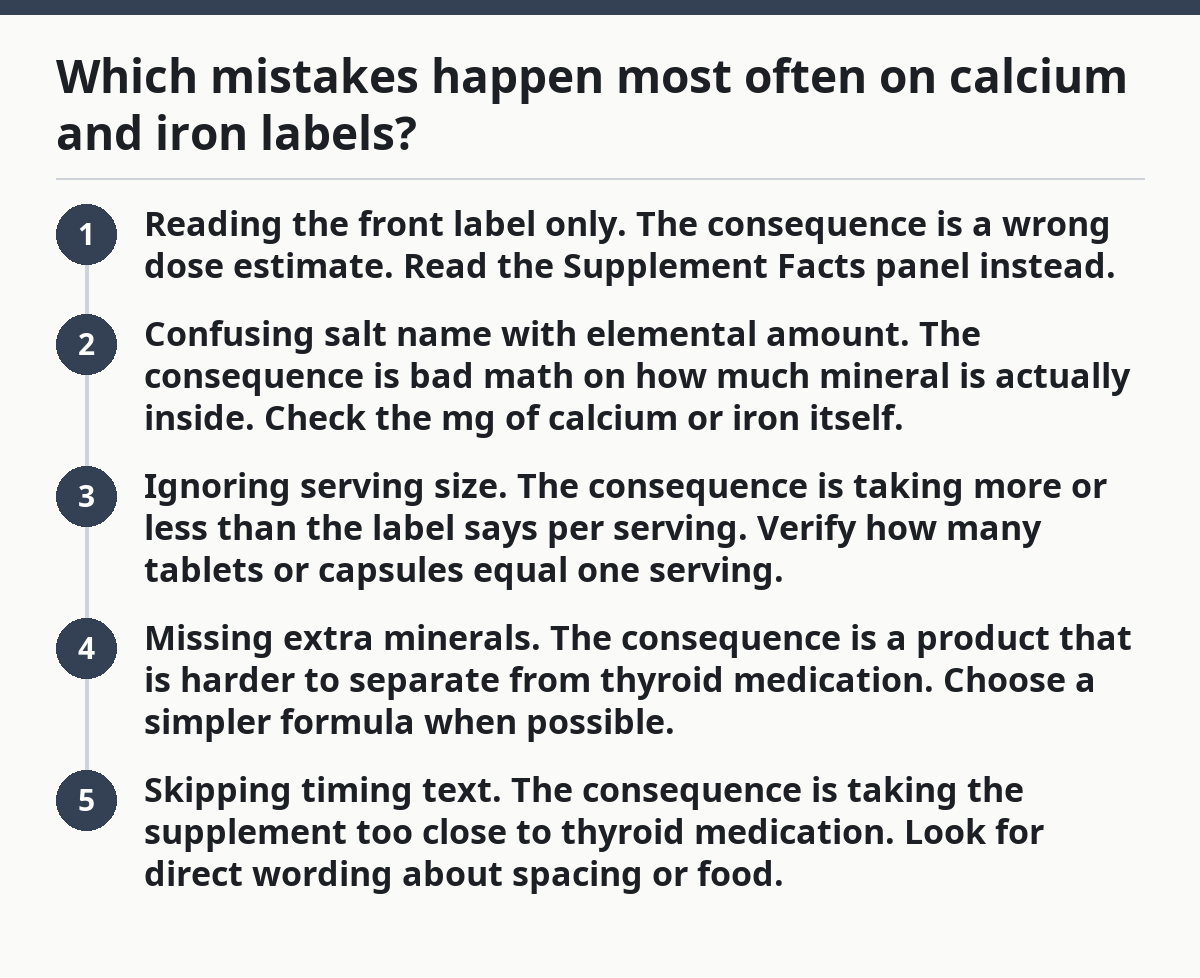
Which mistakes happen most often on calcium and iron labels?
People usually make the same five errors, and each one starts with rushing the label. The good news is that every one of them is preventable with a slower read of the Supplement Facts panel.
Picture this: you’re standing in the pharmacy aisle and the front label says “high potency.” That phrase sounds useful, but it does not tell you what you need to know. The panel does.
-
Reading the front label only.
The consequence is a wrong dose estimate. Read the Supplement Facts panel instead. -
Confusing salt name with elemental amount.
The consequence is bad math on how much mineral is actually inside. Check the mg of calcium or iron itself. -
Ignoring serving size.
The consequence is taking more or less than the label says per serving. Verify how many tablets or capsules equal one serving. -
Missing extra minerals.
The consequence is a product that is harder to separate from thyroid medication. Choose a simpler formula when possible. -
Skipping timing text.
The consequence is taking the supplement too close to thyroid medication. Look for direct wording about spacing or food.
A clean label is easy to use twice a day. A crowded label asks for interpretation every time, and that is where mistakes start.
How this fits with the rest of the thyroid supplement label story
This label check is one piece of a bigger “thyroid-friendly supplements and label reading” routine. It focuses on calcium and iron products because those are common, visible, and easy to misread, but the same habit helps with other supplements too.
Picture this: you’ve already found one supplement that seems workable. The next step is not to assume all mineral labels behave the same way. It’s to build the same reading habit for every new bottle that lands in your cabinet.
The simple sequence is: read the Supplement Facts panel, find the elemental amount, check serving size, look for timing language, and scan for extra ingredients. If one of those pieces is missing, the label is not giving you a full answer. That is why the habit matters more than the brand.
The evidence behind this article is broader than one product or one brand, and that is why the label-reading step matters so much. The practical rule is still the same: check the numbers, check the timing, and check the extras before you rely on the bottle.
What should I check before buying iron?
Check the elemental iron amount, the serving size, and whether the product has a simple ingredient list. The supplement facts panel should make it obvious how much iron you get per serving, not force you to translate a salt name by guesswork.
Picture this: you are holding two iron bottles that look similar from the front. One lists a clear amount on the panel; the other uses dense wording and a crowded formula. The clearer label is easier to manage with thyroid medication, because it leaves less room for timing mistakes and hidden extras.
Does the form of calcium matter for thyroid medication?
Yes, because the form can change how easy the product is to read and manage. A tablet, capsule, chewable, or liquid may all deliver calcium, but the label can be much easier or much harder to interpret depending on the format.
Picture this: one bottle is a plain tablet with a short panel, and another is a chewable with flavorings and added minerals. The simpler label is usually easier to separate from thyroid medication because it tells you less that you have to decode.
Drafted with AI; not yet reviewed by a person.