Last updated: November 20, 2026
Key Takeaways
- Keep biotin, extra supplements, hard exercise, and recent illness in mind before the draw.
- Bring a full supplement list, since vitamins and blends can affect timing and interpretation.
- Skip strenuous exercise for about 24 hours before the test unless your clinician says otherwise.
- Tell the clinician about fever, flu, COVID, stomach bugs, or other recent acute infections.
Before a thyroid blood test, avoid biotin, nonessential supplements, hard exercise, and taking medicine at the wrong time. This guide on what to avoid before a thyroid blood test shows what can skew thyroid blood test prep and what to leave alone before you walk into the lab.
What should I avoid before a thyroid blood test?
Avoid anything that can make your numbers harder to read, especially biotin, extra supplements, strenuous exercise, and recent illness. A thyroid blood test is meant to reflect your baseline, not the effect of a workout, a cold, or a pill you took 30 minutes ago.
Picture this: you’re about to leave for the lab, and your normal morning routine includes coffee, a multivitamin, a run, and your thyroid tablet. That mix is where most avoidable mistakes start. The goal is simple—show up in the condition your clinician expects to measure, not in a temporarily altered state.
If you want the broader prep picture, the hub on thyroid testing, labs, and appointment prep fits here. This page stays on the common things people miss beyond biotin.
- Skip nonessential supplements the day of the test unless your clinician told you otherwise.
- Avoid a hard workout right before the draw.
- Do not guess about thyroid medicine timing if you were given instructions.
- Reschedule if you are sick and your clinician wants a clean baseline.
The catch is that some things matter a lot for one person and hardly at all for another. A person getting a routine check after a dose change may need a different setup than someone having a one-off lab panel for symptoms. Follow the instructions attached to your own order when they are specific.
Which supplements can interfere besides biotin?
Other supplements can matter, and the safest move is to bring a full list rather than treating vitamins as harmless by default. Iron, calcium, magnesium, selenium, and iodine are the names people forget most often, especially when they come in a multivitamin or “hair, skin, and nails” product.
Picture this: you take three capsules in the morning because they feel routine, not because you think of them as medicine. That is exactly how a pre-test error happens. Some supplements can change how a thyroid pill is absorbed, while others can affect the lab picture enough to make the result less useful.
A clean way to handle this is to separate what you take daily from what you only take sometimes:
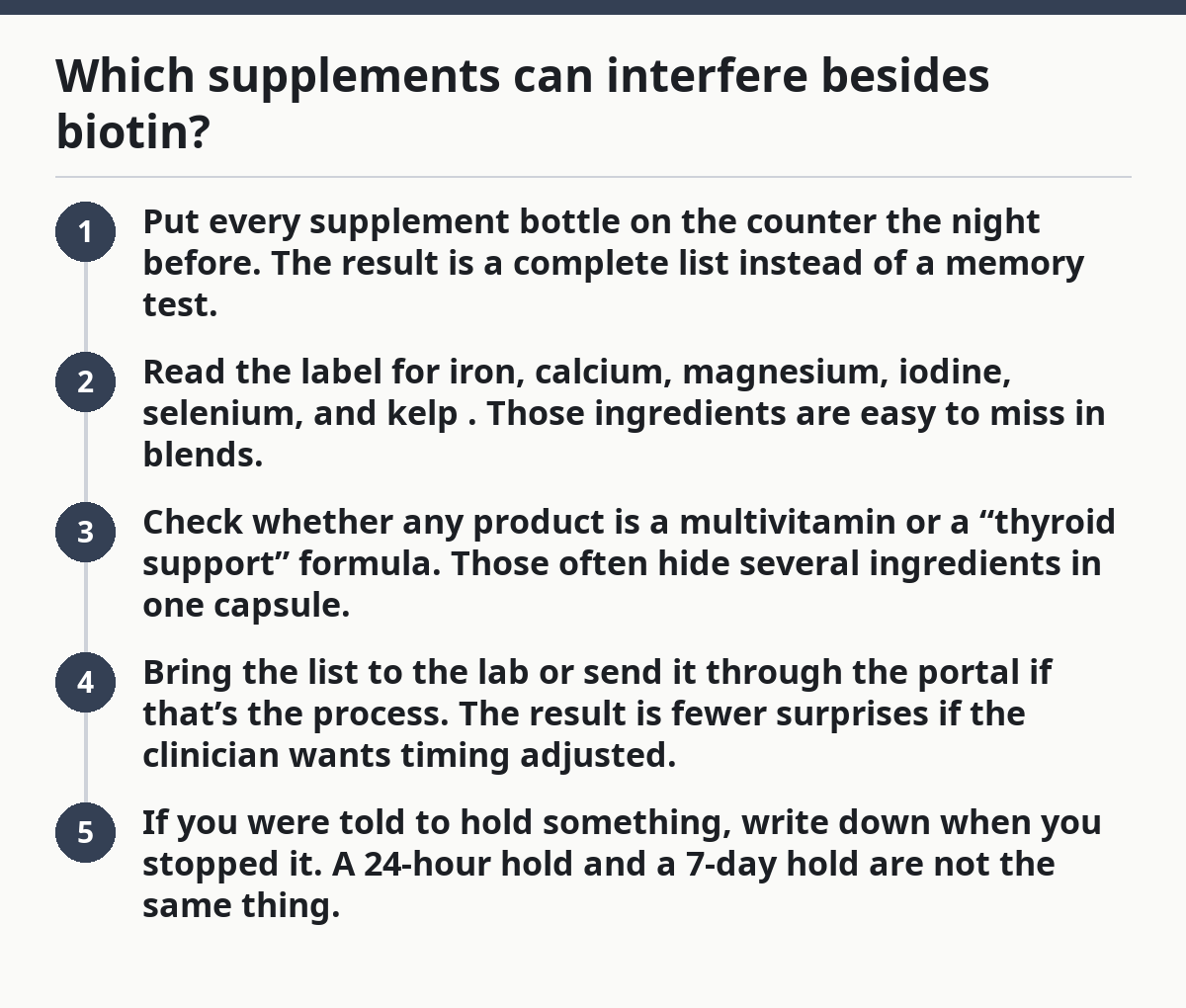
- Put every supplement bottle on the counter the night before. The result is a complete list instead of a memory test.
- Read the label for iron, calcium, magnesium, iodine, selenium, and kelp. Those ingredients are easy to miss in blends.
- Check whether any product is a multivitamin or a “thyroid support” formula. Those often hide several ingredients in one capsule.
- Bring the list to the lab or send it through the portal if that’s the process. The result is fewer surprises if the clinician wants timing adjusted.
- If you were told to hold something, write down when you stopped it. A 24-hour hold and a 7-day hold are not the same thing.
Two practical points matter here. First, do not invent your own washout period because a forum said so. Second, do not stop prescription medicine unless the prescriber has told you to. Supplements are often the easy part; the hard part is keeping the timing straight.
For a general overview of supplement safety, the NIH Office of Dietary Supplements has individual fact sheets, and the American Thyroid Association has patient material on thyroid testing and treatment timing. Those are better starting points than random blog advice; if the situation is unclear, ask a pharmacist or clinician and use these sources as references: NIH Office of Dietary Supplements, American Thyroid Association.
Should I exercise before a thyroid blood test?
Avoid strenuous exercise for about 24 hours before a thyroid blood test unless your clinician gave different instructions. A hard workout can nudge some lab values and also leave you dehydrated, shaky, or running late, which makes the draw less clean.
Picture this: you do a long run, then head straight to the lab with a racing pulse and a water bottle. The blood draw will still happen, but your body is no longer in its normal resting state. That can muddy the picture, especially if the test is part of a dose check or symptom workup.
What counts as a problem here is not a normal walk to the car. It is the kind of session that leaves you winded, sore, or drenched in sweat:
- heavy lifting
- interval training
- a long run
- a spin class that pushes your heart rate for most of the session
- a sport practice that runs hard for an hour or more
On the flip side, light movement is usually not the issue. A short walk, gentle stretching, or getting dressed and out the door is not the same thing as a full workout. If your blood test is paired with other labs, such as fasting glucose or lipids, exercise can also make the morning feel rougher than it needs to be.
The best part is that this is one of the easiest mistakes to avoid, provided you plan ahead. If your appointment is at 8 a.m., make the workout the day before, not the same morning. If you already exercised hard, tell the lab staff or the ordering office so they can judge whether the timing still works.
What if I’ve been sick recently?
Recent illness can affect thyroid blood test results, so fever, flu, COVID, stomach bugs, and other acute infections are worth mentioning before the draw. Your thyroid can look different during and after an illness, even if the problem has nothing to do with your thyroid.
Picture this: you booked the test because you finally had a free morning, but you spent the last week coughing, sleeping badly, and barely eating. That is not a normal baseline. Even a short illness can make a result harder to interpret, especially if the test is trying to sort out fatigue, weight change, or a medication dose.
A few details help the clinician decide whether the timing still makes sense:
- Symptoms in the last 1-2 weeks, such as fever or severe fatigue
- Recent antibiotics or steroids
- A new infection with vomiting or diarrhea
- A major sleep disruption from being sick
- A recent hospital visit
If you still have symptoms on the day of the lab, call the ordering office or the lab site before you go. Some testing plans stay useful even during illness, but the chart note matters. The wrong date can make a normal fluctuation look like a thyroid problem, or hide one.
Here’s the catch: “recent” does not mean the same thing for every illness. A mild cold that already cleared is not the same as a high fever two days ago. If the test is being used to adjust levothyroxine, the timing matters even more, because the result may guide a dose change that should be based on your usual state.
Should I take thyroid medicine before the blood test?
Take your thyroid medicine only the way your prescriber told you, because the right answer depends on the test and the goal. For many routine blood draws, people are told to wait until after the blood is drawn, but that instruction is not universal.
Picture this: you wake up, reach for your pill, and then remember the lab is in an hour. That is the moment to check the instructions, not to improvise. Thyroid medicine timing can matter because the result may be used to judge your steady state, and a dose taken right before the draw can complicate that read.
Use this simple order of operations:
- Read the lab instructions from the ordering office. The result is a rule you can trust instead of a guess.
- If the instruction says hold the morning dose, take it after the blood draw.
- If the instruction says take it as usual, do that at the normal time.
- If the instruction says nothing, call the office or pharmacy before the appointment. The result is clearer than guessing and being wrong.
- Write down the time you took it if you did take it before the test.
This matters most for levothyroxine and similar thyroid replacement medicine. The issue is not just the pill itself; it is the timing relative to the blood draw and the reason the test was ordered. A dose check after a change may be handled differently from a stable long-term follow-up.
The truth is, many people get tripped up here because they think fasting rules and medicine rules are the same thing. They are not. If you need a fasting blood draw for other labs, that does not automatically mean you should skip thyroid medicine—or take it—without instruction.
Do I need to fast before thyroid labs?
Usually, no fasting is needed for thyroid labs alone, but you should follow the instructions for any other tests drawn at the same visit. A thyroid blood test by itself is often done without food restrictions, which makes the appointment simpler.
Picture this: you show up hungry because you assumed every blood test means “nothing by mouth.” That can be unnecessary for thyroid labs alone, but it may be required if the same visit includes cholesterol, glucose, or another fasting panel. The lab order, not the thyroid test by itself, often decides the rule.
A few common combinations are easy to mix up:
- Thyroid panel only: often no fasting
- Thyroid plus lipid panel: fasting may be requested
- Thyroid plus glucose or insulin: fasting may be requested
- Thyroid plus other morning labs: follow the strictest instruction on the order
If you are fasting for another reason, water is usually still fine, and sometimes preferred. That helps with the blood draw and keeps you from arriving dehydrated. Coffee, creamers, energy drinks, and breakfast bars are the usual traps.
One more practical detail: do not let fasting confuse your medication plan. If your thyroid medicine timing was already set, keep that separate from food instructions unless the office specifically told you otherwise. The same goes for supplements; “fasting” does not mean “take everything on an empty stomach and hope for the best.”
What people most often get wrong before thyroid blood work
The biggest mistakes are double-dosing, mixing up supplement timing, exercising hard, and assuming every lab uses the same prep. Most of these errors do not cause drama, but they can make the result less useful and create a repeat blood draw.
Picture this: you do everything right except one small detail, like taking a calcium tablet with breakfast or hitting the gym before the appointment. That small detail can cost you a clean baseline. The fix is usually simple, but only if you catch it before the needle goes in.
Here’s a short checklist that covers the common misses:
- Supplements: pause anything nonessential unless you were told to take it
- Medicine timing: follow the exact instruction for your thyroid pill
- Exercise: skip hard training for about a day before the test
- Illness: mention fever, infection, or a recent bad stomach bug
- Fasting: only fast if the order calls for it
The best part? None of this requires a perfect memory. Put the lab date on your phone, line up the bottle labels the night before, and read the instructions once more in the morning. That takes less than 5 minutes and can save a redraw.
For people who want the fuller picture of lab prep, the main thyroid testing, labs, and appointment prep guide sits upstream from this page. This one is the narrow version: the avoid list, not the whole playbook.
What if I’m not sure whether a supplement matters?
If you’re not sure, treat it as relevant and ask before the draw. Bring the bottle or a photo of the label, because “vitamin” on the front tells you almost nothing about the ingredients inside.
Do I need to fast before thyroid labs?
Usually, no. Thyroid labs alone are often done without fasting, but other tests on the same order can change that rule. Follow the instructions for the full lab order, not just the thyroid part.
Should I take my thyroid medicine before a blood test?
Only if your prescriber or lab instructions say to. Some people are told to wait until after the blood draw, while others are told to take it on schedule. If the order is unclear, ask the office before the appointment, because the timing can affect how the result is interpreted.
Drafted with AI; not yet reviewed by a person.