Last updated: November 20, 2026
Key Takeaways
- Use a fixed schedule, note the same few details, and ignore one-off sensations unless they repeat or escalate.
- Focus on symptoms that change your day, repeat for several days, or shift after a dose change.
- Bring a one-page summary instead of loose notes.
- Stop using symptom tracking as the main tool when a symptom is urgent, severe, or clearly outside watch-and-wait patterns.
Thyroid symptom tracking helps you spot patterns between lab appointments without checking your body every hour. How to Track Thyroid Symptoms Between Lab Appointments Without Overchecking starts with a simple rule: track once a day, focus on changes that last several days, and bring a simple symptom journal to your doctor appointment. The steps below show what to write down, what to ignore, and when a symptom deserves a call to a qualified professional.
Who this is for, and what it assumes
This is for people who already have thyroid symptoms, thyroid blood tests, or a dose change on the horizon, and want a calmer way to notice trends. It assumes you have access to a notebook, phone notes, or a symptom app, and that you know the names of your current medicines and lab dates. The approach fits the broader goal of How to Track Thyroid Symptoms Between Lab Appointments Without Overchecking without turning every sensation into a medical event.
If you have chest pain, fainting, severe shortness of breath, confusion, or a racing heartbeat that will not settle, this is not a tracking problem. Get qualified medical help right away. That part matters more than any journal.
A few terms help here:
- Symptom journal: a short record of what you felt, when, and how strong it was.
- Pattern tracking: looking for repeated changes over days or weeks instead of reacting to one bad hour.
- Dose change: any change in thyroid medicine amount, timing, or brand that your clinician has already discussed with you.
If you want the broader lab prep context, this page fits under the site’s thyroid testing, labs, and appointment prep hub. For background on thyroid symptoms and follow-up, see the American Thyroid Association and MedlinePlus from the U.S. National Library of Medicine. The point here is not to interpret labs on your own. It is to make the next doctor appointment more useful.
How do you track thyroid symptoms without overchecking?
You track thyroid symptoms by checking on a fixed schedule, recording the same few details each time, and ignoring one-off sensations unless they repeat or escalate. A simple system beats constant body-scanning every time.
Start with one daily check-in, the same time each day for 2 weeks. Many people do well with evening notes because the day is already over and the pattern is easier to see. Write down 5 to 7 items only, and keep the note short enough that you will keep using it.
- Pick one check-in time. Use the same 5-minute window each day, such as after dinner or before bed. Verify that you are not adding extra spot checks during the day. If you need more than one daily entry, the system is too noisy.
- Rate your main symptoms. Give each item a simple 0–3 score for fatigue, heat or cold intolerance, sleep, bowel changes, heart pounding, and brain fog. Verify that you use the same scale every day. If one symptom keeps jumping from 0 to 3 and back again, note the context instead of chasing the number.
- Write the date and time. Use a clear format like 2026-11-08, plus morning or evening. Verify that each note can be matched to a workday, weekend, or lab day. If the timing is unclear, the pattern gets hard to trust.
- Record medicine details. Note the thyroid medicine name, whether it was taken as usual, and whether a dose change was made recently. Verify that you are not self-adjusting the dose in the journal. If you changed timing, brand, or missed several doses, write that plainly.
- Mark sleep and stress. Log sleep length in hours and any unusual stressor, illness, travel, or menstrual cycle change. Verify that you are naming the trigger, not just writing “bad day.” If symptoms flare after a virus or 3 nights of poor sleep, that matters.
- Track one body sign if relevant. If your clinician asked for weight, pulse, or temperature, record it the same way each time. Verify that you use the same scale, thermometer, or watch. If the number comes from a different device each day, it is less useful.
- End with one plain sentence. Write what changed most, such as “more tired than last week” or “less shaky after breakfast.” Verify that the summary is about trend, not diagnosis. If you catch yourself trying to prove a thyroid theory, stop and stick to facts.
A paper note card works as well as a phone app. The best format is the one you are most likely to use consistently for 14 days, not the fanciest one.
What belongs in the note, and what doesn’t
A good journal has 5 core fields: date, symptom score, medicine detail, trigger, and one short summary. That is enough for a doctor to scan in under 2 minutes.
Do not track every sensation. That turns the page into a panic log. Leave out:
- hour-by-hour pulse checking
- repeated mirror checks for hair, skin, or eye changes
- random searching online after each note
- long theories about which lab number “should” be right
If you feel better after a day or two, keep logging anyway. If you only write when you feel bad, the record can overstate the worst days and hide the rest. That is the trap.
Best source to read alongside your notes: the American Thyroid Association and the MedlinePlus thyroid pages from the U.S. National Library of Medicine both give patient-friendly background on thyroid symptoms and follow-up. Use them for general context, not self-diagnosis.
What thyroid symptoms are worth tracking over time?
Track the symptoms that change your day, repeat across several days, or may shift after a dose change. That usually means fatigue, sleep, temperature sensitivity, constipation or loose stools, heart pounding, tremor, mood shifts, concentration trouble, and unexplained weight change.
The trick is not to track everything equally. Some symptoms are more useful because they are easier to compare over time. A symptom that shows up once in a while and disappears in an hour is less helpful than one that lasts 3 days in a row.
Use this simple filter:
- Frequency: did it happen once or on most days this week?
- Duration: did it last 15 minutes or most of the day?
- Impact: did it change work, driving, exercise, or sleep?
- Pattern: did it start after a dose change, illness, or missed doses?
If a symptom is mild but steady, write it down. If it is dramatic but isolated, note it once and move on. That balance keeps you from overchecking.
A few examples of useful notes:
- “Tired by 2 p.m. on 4 of 5 workdays.”
- “Waking at 3 a.m. for the past 6 nights.”
- “Constipation since the dose change last week.”
- “Hands shaky after coffee, not at other times.”
What should you bring to a doctor appointment?
Bring a one-page summary, not a stack of loose thoughts. A doctor appointment goes better when the note shows pattern, timing, and what changed after a dose change or new lab draw.
The best summary fits on a single screen or one sheet of paper. Include:
- the last lab date, if you know it
- current thyroid medicine name and timing
- any recent dose change
- the top 3 symptoms that have lasted at least a week
- the 2 worst days and what made them worse
- any red flag symptoms you noticed
That summary gives the clinician a quick map. It also keeps the visit from turning into a long memory test.
Here’s the catch: the goal is not to “win” the appointment with the longest list. It is to show what has changed since the last test in a clean, usable way.
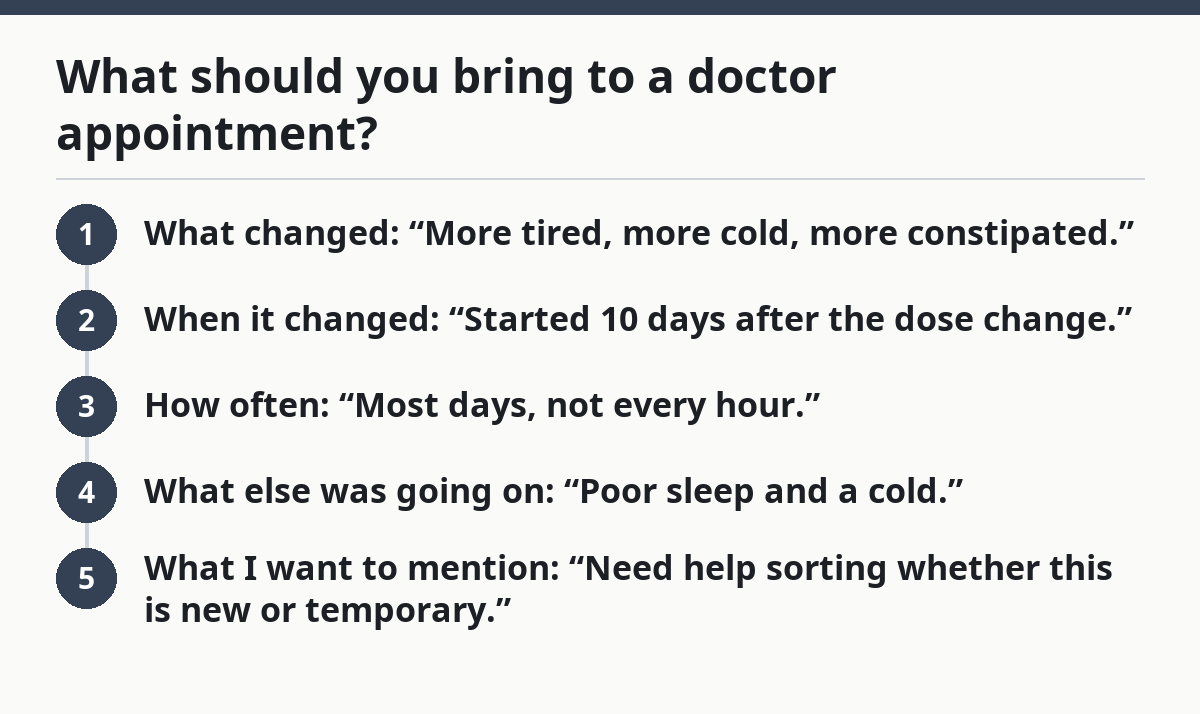
A simple format helps:
- What changed: “More tired, more cold, more constipated.”
- When it changed: “Started 10 days after the dose change.”
- How often: “Most days, not every hour.”
- What else was going on: “Poor sleep and a cold.”
- What I want to mention: “Need help sorting whether this is new or temporary.”
That is enough. No essays. No lab detective work.
When should you stop self-tracking and get help?
You should stop using symptom tracking as the main tool when the symptom is urgent, severe, or clearly outside a normal watch-and-wait pattern. That is where journaling ends and qualified help starts.
Chest pain, fainting, or severe shortness of breath: these can signal an emergency, not a thyroid logging issue — seek urgent medical care now.
Confusion, severe agitation, or trouble staying awake: this is not a symptom-journal problem — get emergency help.
Very fast or irregular heartbeat that does not settle: this may need same-day medical advice — call a clinician promptly.
Rapid worsening after a dose change: the timing matters, but the change may need real evaluation — contact the prescriber.
New swelling in the neck or trouble swallowing: this is not something to track for weeks — arrange medical review soon.
One more line: if symptoms are mild but keep returning for 2 to 3 weeks, the journal has done its job. Bring it in. Do not keep spiraling alone.
The mistakes that make symptom journals useless
The biggest mistake is checking too often. That turns normal day-to-day variation into a crisis signal. Once-daily notes are usually enough.
Other common errors:
- Changing the scale every day. If “tired” means 2 on Monday and 8 on Tuesday, the trend is garbage. Use the same 0–3 or 1–10 scale each time.
- Writing opinions instead of facts. “My thyroid is off” is not useful. “Napped 2 hours, skipped a walk, and woke at 4 a.m.” is.
- Ignoring dose changes. If the medicine changed 2 weeks ago, that detail belongs in the first line, not buried in a paragraph.
- Tracking only bad days. That makes the condition look worse than it may be. Record normal days too.
- Searching for patterns every night. The journal is for your next appointment, not for a midnight diagnosis project.
The correction is simple: keep the note short, keep the schedule fixed, and review it once a week. Not nightly.
What changes the tracking plan?
You should adjust the plan if your routine, medicine, or life changes enough to blur the pattern. A move, a new shift schedule, pregnancy, a new supplement, or a recent illness can all change the signal.
Standard tracking needs modification in these cases:
- After a dose change: note the exact date of the change and expect the pattern to be messy for a while.
- During a viral illness: record illness days separately so fever and fatigue do not get blamed on everything else.
- With shift work: use wake time, not clock time, as your anchor when possible.
- If you take biotin or other supplements: write that down before labs, because supplement timing can matter for some tests.
- If anxiety is high: keep the log shorter. A 3-item note may work better than a full symptom grid.
The truth is, not every symptom belongs to the thyroid. Sleep loss, infection, stress, pregnancy, and other medicines can all shape how you feel. That is why pattern tracking beats gut feeling alone, especially when you are following How to Track Thyroid Symptoms Between Lab Appointments Without Overchecking.
What a good result looks like after 2 to 4 weeks
A good result is not “I figured it all out.” It is “I have enough data to describe the pattern without guessing.” That usually takes 2 to 4 weeks of brief notes.
You know the system is working if:
- you can see whether symptoms are steady, improving, or worse
- you can connect changes to a dose change, illness, or missed doses
- you have fewer panicked checks during the day
- your doctor appointment starts with a useful summary instead of a blank stare
If the journal makes you more anxious, shrink it. Use fewer fields, one check-in per day, and a 2-week trial. The best tracking method is the one that helps you notice change without making every sensation feel urgent.
What thyroid symptoms should I track over time?
Track the symptoms that repeat, last more than a day, or change after a dose change. Fatigue, sleep changes, temperature sensitivity, bowel changes, heart pounding, tremor, mood shifts, concentration problems, and weight change are common examples. Keep the list short so you can spot real patterns instead of collecting noise.
How do I know if my symptoms are worth mentioning to my doctor?
Mention a symptom if it lasts several days, affects sleep or daily life, or shows up after a medicine change. You should also bring it up if it is new, getting worse, or comes with chest pain, fainting, trouble breathing, confusion, or a very fast heartbeat. When in doubt, write it down and bring the note.
Drafted with AI; not yet reviewed by a person.