
Last updated: November 20, 2026
Quick Answer: For When to Repeat Thyroid Labs After Starting a New Supplement, a repeat test is often discussed in weeks, not days; TSH is commonly rechecked about 6–8 weeks after a thyroid-related change, while biotin-related assay interference may need a much shorter hold depending on the product and lab method, so timing should be set with a qualified clinician. A new supplement can shift thyroid lab results, and repeat testing is usually worth discussing with a qualified clinician after a change that could affect absorption or hormone levels. The timing depends on the supplement, your current thyroid medicine, and whether symptoms changed. The sections below settle when to recheck, what to watch for, and when waiting makes sense.
Key takeaways
- A supplement can change thyroid labs by changing absorption, iodine intake, or the way the body handles thyroid hormone.
- Lab timing is not one-size-fits-all; a recent change often needs a planned follow-up, not an immediate recheck.
- Symptoms matter, but they do not replace thyroid labs.
- Some supplements interfere with the blood test itself, while others change the thyroid system over time.
- If the supplement was started for a specific deficiency or health issue, a clinician should help decide the follow-up window.
Who this applies to, and what it assumes
Picture this: you started a new supplement, your thyroid feels off, and now you want to know if a blood test should be repeated this week or later. This guide is for people who already have thyroid labs on the radar and want a sensible follow-up plan after a supplement change.
It assumes you know the names of your usual thyroid tests, such as TSH, free T4, and sometimes free T3. It also assumes the supplement is already in hand, whether it is iodine, selenium, biotin, iron, calcium, or a multivitamin. If your supplement was started because of pregnancy, a recent diagnosis, a heart issue, or a thyroid medication change, the timing belongs in a clinician’s hands.
The best starting point is usually the same one the thyroid testing prep and lab logistics hub covers: get the test lined up around the question you’re asking, not around the calendar alone.
- TSH: thyroid-stimulating hormone, the main screening lab for many thyroid follow-ups.
- Free T4: a circulating thyroid hormone that often helps show whether treatment or absorption changed; if results and symptoms do not match, consult a clinician and use the lab’s method notes or an authoritative source such as MedlinePlus or the American Thyroid Association.
- Free T3: sometimes used when the picture is less clear.
Can a supplement change thyroid labs fast?
Yes, some supplements can change thyroid labs quickly, but others take weeks to matter, and a few mostly affect the lab itself rather than the thyroid gland. Biotin is the classic example of test interference: it can distort certain immunoassays, so the result may look wrong even when your thyroid status has not truly changed. By contrast, iodine or selenium may influence thyroid function over time, which is why the follow-up window is different.
Here’s the catch: “fast” does not always mean “same day.” A supplement that changes absorption or hormone handling often needs enough time for the body to reach a new steady state, and the right interval depends on the supplement and the assay. That is why a repeat test right away can be noisy, while a test too late can miss a useful trend.
Common timing patterns people run into:
- Lab interference — the blood test can look altered without a real thyroid change.
- Absorption effects — the supplement changes how well thyroid medicine is taken up.
- Physiologic effects — the supplement changes thyroid function more gradually.
- Indirect effects — the supplement changes sleep, gut function, or energy, which can mimic thyroid symptoms.
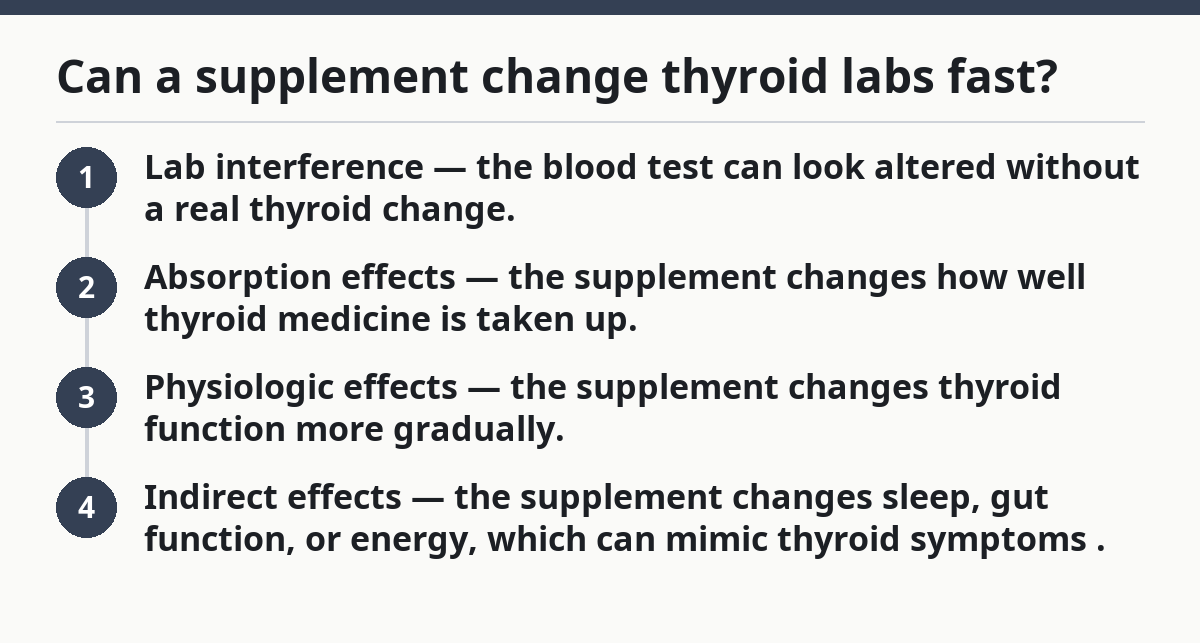
What matters most is whether the supplement is new, whether your thyroid medicine stayed the same, and whether the lab was drawn in a way that makes the result trustworthy.
When should thyroid labs be repeated after a supplement change?
Repeat thyroid labs after a supplement change when the change could affect a result you and your clinician are actually trying to interpret. The right interval is often measured in weeks, not days, because thyroid markers move slowly and because some supplements create short-lived lab noise. For many thyroid medication changes, TSH is commonly assessed again after about 6–8 weeks, though the exact timing depends on the situation and the clinician’s plan.
Picture this: you start a supplement on Monday, then feel shaky by Friday and want a blood draw before the weekend. That can be too soon for a meaningful trend, especially if the issue is absorption or a real thyroid shift rather than a lab artifact. The result may not tell you much unless the timing is matched to the supplement type.
A practical way to think about follow-up:
- If the issue is lab interference: the test may need to be repeated after the supplement is held long enough for interference to clear, which depends on the product and assay.
- If the issue is medicine absorption: follow-up is often done after enough time has passed for TSH to settle into a new pattern.
- If symptoms changed a lot: the timing may need to move earlier, because the clinical picture matters, not just the number.
The truth is, thyroid labs are less like a temperature reading and more like a slow report card. A result drawn too soon can mislead in either direction.
How do I think through the timing step by step?
The timing is best worked out by matching the supplement, the thyroid test, and the reason for the recheck. This is the part people often rush, and it is where bad timing creates confusion.
- Write down the exact supplement and start date. Use the label, not the brand memory, and note whether it is a single nutrient or a blend. Verify the ingredient list, because a multivitamin may include biotin, iodine, iron, or calcium in the same pill. A problem shows up when you cannot name the ingredient that might affect the test.
- Record any thyroid medicine schedule. Note the medicine name and the time you take it each day. Verify whether the supplement is taken within the same 4-hour window as your thyroid pill, because iron and calcium can reduce absorption. A problem shows up when the supplement and medicine are taken together and the lab is hard to interpret.
- Identify which thyroid labs were abnormal before. TSH alone may be enough for a routine follow-up, but free T4 or free T3 may matter if the picture was mixed. Verify the exact lab names on the order or report. A problem shows up when you are repeating the wrong marker and the change you care about never gets measured.
- Check whether the supplement is known for test interference. Biotin is the main one people hear about, but different assays behave differently. Verify whether the lab or clinician wants the supplement held before the draw. A problem shows up when a result looks impossible and the likely cause was never flagged.
- Wait long enough for a real thyroid shift to show up. Many thyroid changes are followed on a **weeks-long** timeline, not a 48-hour timeline. Verify the follow-up plan against the reason the supplement was started. A problem shows up when the test is repeated before the body has had time to settle.
- Watch symptoms, but do not treat them as proof; consult a clinician if they change. Track palpitations, constipation, heat or cold intolerance, sleep, and fatigue in plain language, and bring those notes to a clinician if they are new or worsening. Verify whether the symptoms started after the supplement or were already present. A problem shows up when symptoms are blamed on the supplement but the labs do not match that story.
- Keep the rest of the routine stable. Try not to change multiple variables at once, such as diet, thyroid dose, and supplement schedule. Verify that the only new factor is the supplement you are studying, or at least the main new factor. A problem shows up when several changes happen together and no one can tell which one moved the labs.
- Bring the timeline to follow-up. Share the supplement name, dates, symptom changes, and any lab values with the clinician who ordered the test. Verify that the repeat test is meant to answer the right question. A problem shows up when the lab is repeated without a plan for how the result will be used.
Which supplements most often change the plan?
The supplements that most often change thyroid lab timing are the ones that either interfere with the assay or interact with thyroid medicine. Biotin is a frequent cause of misleading results, while iron and calcium are common reasons thyroid medicine absorption changes. Iodine can matter too, because it can shift thyroid function in some people.
Picture this: you started a basic vitamin and thought it was harmless, then realized it contains several ingredients that each affect the thyroid story in a different way. That is why the label matters more than the front of the bottle.
A few common patterns:
- Biotin may distort certain thyroid test methods.
- Iron can reduce levothyroxine absorption if taken too close together.
- Calcium can do the same.
- Iodine can change thyroid activity in sensitive people.
- Selenium can matter in some settings, but the effect is not the same for every person.
For a deeper look at what different thyroid-related nutrients do, the hub on thyroid testing, labs, and appointment prep is the better place to start than trying to decode every supplement on one page. For practical medication timing, the American Thyroid Association and MedlinePlus both note that iron and calcium can interfere with levothyroxine absorption, so the supplement list should be reviewed with a clinician before retesting.
When should I stop and call the test plan wrong?
Stop the simple “wait and retest” approach when the situation is no longer routine. Thyroid labs after a supplement change need a different plan if the numbers, symptoms, or medication schedule stop lining up.
Severe symptoms appeared after the supplement: chest pain, marked palpitations, fainting, confusion, or severe weakness can mean the issue is bigger than a routine follow-up — get urgent medical help rather than waiting for a lab date.
The supplement contains biotin and the draw was already scheduled: the result may be unreliable — tell the ordering clinician and ask whether the test should be repeated under cleaner conditions.
You changed thyroid medicine and the supplement at the same time: the lab may not separate the two effects — a clinician should help sort the timeline before another blood draw.
The supplement was started for a pregnancy-related reason: the stakes are different and the timing often needs closer follow-up — use clinician-directed testing instead of an informal schedule.
Your symptoms are getting worse even though the previous labs were “normal”: normal numbers do not always match the clinical picture — the workup may need a different test or a different explanation.
You cannot confirm what is in the supplement: blends can hide biotin, iodine, or minerals that affect thyroid care — pause the guesswork and verify the label before repeating labs.
The best part? This is not about being perfect. It is about not letting a noisy result push the next decision.
What mistakes do people make with follow-up labs?
People usually make the same five mistakes, and each one can waste a blood draw. The fix is simple once you see the pattern, but the cost of getting it wrong is a lab result that cannot answer the question.
Because those mistakes usually come from timing, the first step is to slow down and match the test to the reason the supplement changed. Picture this: you get a repeat thyroid test after starting a new supplement, but you do not know whether the pill was taken that morning or whether the lab was meant to detect a real change. That is how avoidable confusion starts.
- Repeating too soon — the result can miss the real trend. The better choice is to match the timing to the reason for the supplement change.
- Ignoring assay interference — the lab may look abnormal for the wrong reason. The better choice is to flag biotin and other possible interferences before the draw.
- Changing several things at once — it becomes impossible to tell what caused the shift. The better choice is to keep one variable steady when possible.
- Chasing symptoms alone — thyroid-like symptoms overlap with sleep problems, stress, anemia, and illness. The better choice is to use symptoms as a signal, not the whole diagnosis.
- Not sharing the supplement list — the ordering clinician may not know about a hidden ingredient. The better choice is to bring the bottle or a photo of the label.
How should the follow-up be documented so the result means something?
The follow-up should be documented with the supplement name, the start date, the thyroid test date, and any symptom change. That record turns a vague “I started something new” into a usable timeline.
Because a thyroid result only helps if the date and dose are clear, keep the note short and specific. Picture this: two months from now, you are staring at a TSH result and trying to remember whether the supplement started before or after the lab changed. A short note saves that headache. It also helps the clinician compare the new result with the old one without guessing.
Useful details to keep in one place:
- supplement name and ingredient list
- date started or stopped
- thyroid medicine name and schedule
- exact lab names ordered
- symptom changes with dates
- any missed doses or dose timing changes
If you are sending a message to the clinician, plain language works best: “I started [supplement] on [date], and I’m wondering when thyroid labs should be repeated so the result is interpretable.”
How soon can a supplement change thyroid labs?
It can happen quickly if the supplement interferes with the test, but a true thyroid shift often takes weeks to show up clearly. The timing depends on whether the issue is lab interference, absorption, or a real physiologic effect. That is why a same-week repeat is often too early unless the clinician specifically wants to check for assay problems.
Should I retest thyroid labs after starting selenium or iodine?
Sometimes, but not automatically. Selenium and iodine can matter in thyroid care, yet the need for follow-up depends on the reason they were started, the dose in the product, and your thyroid history. Because these supplements can affect different people in different ways, a qualified clinician should help set the retest window rather than guessing from symptoms alone.
Drafted with AI; not yet reviewed by a person.