
Best Times to Take Levothyroxine When Your Morning Schedule

Last updated: November 20, 2026
If your wake-up time changes, the best time to take levothyroxine when your morning schedule is unpredictable is a consistent daily anchor you can protect from food for 30 to 60 minutes. Quick answer: for most people, that means taking it at the same repeatable point after waking, even if the clock time changes. This guide sorts out the timing options, the trade-offs, and the one choice that usually causes the fewest missed doses.
Key takeaways
- The best dose time is the one you can repeat after the alarm, not the one that looks perfect on paper.
- A fixed 30-to-60-minute food gap works better than a “maybe I’ll remember later” plan.
- If mornings vary, anchor the dose to a daily event you actually keep, such as waking up, brushing teeth, or pouring the first glass of water.
- Weekend sleep-ins and shift changes matter because levothyroxine works best with consistency, not random timing.
- If your routine keeps breaking, the answer is usually a different daily anchor — not more willpower.
Picture this: you’re up at 5:10 one day and 8:45 the next, and breakfast can happen anywhere in between. The best time to take levothyroxine when your morning schedule is unpredictable is still the earliest dependable moment you can protect from food for 30 to 60 minutes. The sections below settle which anchor works, what to do on late starts, and how to keep weekends from wrecking the pattern.
How to choose a levothyroxine time that survives bad mornings

The safest choice for an unpredictable morning is a time you can attach to a habit you already do within 5 minutes of waking. That usually means before coffee, before breakfast, and before the phone starts running your day.
Here’s the catch: a “perfect” schedule that you miss twice a week is worse than a slightly less elegant one you actually follow. Levothyroxine timing works best when the dose lands in the same place in the day, with the same food gap, over and over, and the NHS levothyroxine guidance and MedlinePlus levothyroxine overview both emphasize taking it consistently.
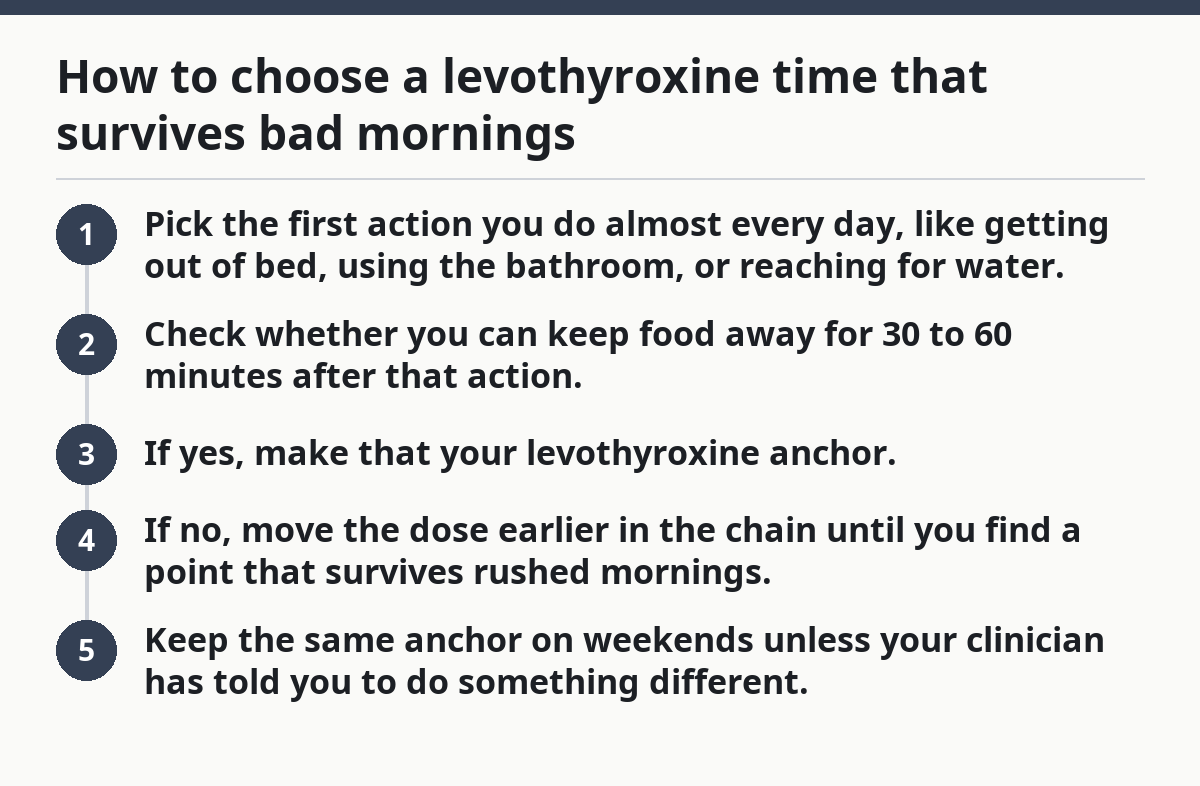
Use this simple filter:
- Pick the first action you do almost every day, like getting out of bed, using the bathroom, or reaching for water.
- Check whether you can keep food away for 30 to 60 minutes after that action.
- If yes, make that your levothyroxine anchor.
- If no, move the dose earlier in the chain until you find a point that survives rushed mornings.
- Keep the same anchor on weekends unless your clinician has told you to do something different.
This is why consistency matters more than a clever workaround. A routine that survives the worst Tuesday is better than one that only works when the morning is calm.
If your wake-up time swings by 2 to 3 hours, the dose still needs a repeatable rule, not a fresh decision every morning.
What this means in practice:
A person who wakes at 6:00 on workdays and 9:00 on days off may still take levothyroxine right after getting up, then delay breakfast. A person who cannot protect even 30 minutes in the morning may need a different daily anchor that is still consistent. That is a timing problem, not a moral failure.
What should you do on mornings when you wake up late?
Take levothyroxine as soon as you remember, then hold food and drinks with calories until your usual wait window passes. That is the least messy response when the alarm went wrong or the commute started early.
Late starts are common because the morning gets crowded fast. You may be dressing, helping a child, or leaving for work in 10 minutes. In that moment, the right move is not to “make up” the whole day at once — it’s to protect the dose you did remember.
Follow this order:
- Take the dose with plain water right away.
- Set a timer for your usual wait window, often 30 to 60 minutes.
- Keep breakfast, coffee, and supplements out of that window unless your prescriber has given a different plan.
- Get back to your normal anchor the next day instead of changing the time again.
- A late dose is usually better than a skipped dose.
- A rushed breakfast right after the tablet can turn a good habit into a noisy one.
The common mistake here is trying to “fix” the missed timing by taking the tablet at a totally new hour each day. That makes the medicine harder to fit into real life. The better move is to keep one main anchor and treat late wake-ups as exceptions, not as a new schedule; if you are unsure, ask your clinician or pharmacist for timing advice. The American Thyroid Association also advises consistent levothyroxine use.
For readers who need a broader routine plan, the hub on thyroid medication timing and daily routines is the right next stop; this page stays focused on choosing the dose time itself.
Can I change levothyroxine timing from day to day?

No, not as a normal habit; the better rule is to keep one main time and use day-to-day changes only when life forces them. Consistency matters more than chasing the “ideal” clock time.
This is where a lot of people get tripped up. They start the week taking levothyroxine at 6:30, then switch to 8:00 on Wednesday, then 5:45 on Friday because the day got busy. That sort of drift makes the timing harder to trust, especially when breakfast and coffee also move around.
A steadier pattern looks like this:
- Weekdays: one fixed dose trigger, such as “as soon as I wake.”
- Weekends: the same trigger, even if the clock says a different hour.
- Travel days: keep the same order of events, not the same exact clock time.
- Sick days: if the morning is abnormal, return to the anchor the next day.
Now, you might be wondering whether a 1-hour shift is a big deal. For timing habits, yes, because the problem is not one single late dose — it’s repeated variation. The whole point is to make the dose easy to place without a daily debate.
Who this is not for: someone who truly cannot keep a morning anchor for even 30 minutes on most days. In that case, the timing problem is bigger than a simple checklist, and a different schedule should be discussed with a clinician.
How weekend sleep-ins and shift work change the answer
Weekend sleep-ins should not create a second levothyroxine routine. If you sleep late, take the dose when you wake and still keep the same post-dose food gap.
That sounds simple, but many people accidentally build two schedules: a workday schedule and a weekend schedule. The tablet then gets bounced around the week, and the body never sees much consistency. Shift work can make this even harder, because mornings stop behaving like mornings.
The best way to handle it is to anchor the dose to a wake event, not a clock time:
- After a night shift, take the dose when you start your “day,” not when the sun comes up.
- On days off, keep the same rule you use on workdays.
- If your sleep flips every few days, choose the event that happens most reliably, not the one that sounds neatest.
A shift worker who wakes at 2:00 p.m. after a night shift can still use the same logic: dose first, then protect the food window. What changes is the hour on the clock. What should not change is the sequence.
The mistake to avoid is trying to “catch up” by taking it before bed one day and after breakfast the next, just because the schedule looks cleaner in the moment. That kind of bouncing is hard to maintain and easy to forget.
A simple morning routine that fits unpredictable wake-ups
The most practical routine is: wake up, take levothyroxine with water, wait 30 to 60 minutes, then eat and drink as usual. That routine is short enough to survive a messy morning.
Picture this: you’re half awake, the sink is crowded, and your first meeting starts in 45 minutes. A good routine has to work in real life, not just in a spreadsheet. The fewer steps between waking and dosing, the less chance you have to wander off and lose the thread.
Use this sequence:
- Put the tablet where you’ll see it first, such as near your toothbrush or water glass.
- Take it the moment you start your morning, not after you “get going.”
- Use plain water.
- Set a timer for 30 to 60 minutes before food.
- Keep the next dose day in the same order, even if the clock time changes.
- The tablet needs a reliable cue, not a better memory.
- A phone alarm can help, but only if it rings at the same point in the morning routine.
The truth is, most timing failures come from overcomplicated plans. If your routine needs a checklist longer than 5 steps, it probably won’t survive a rushed school morning or an early train. Shorter beats fancier.
What gets in the way of consistency, and how to fix it
The biggest problem is not choosing the wrong hour; it’s changing the rule every few days. If the timing keeps moving, the routine starts to depend on mood, traffic, and hunger.
Here are the most common breakdowns:
- Breakfast too early: you take the dose, then eat in 10 minutes because the day got loud. Fix it by moving the dose earlier in the chain or setting a timer before you leave the bedroom.
- Coffee too soon: you remember the pill, then pour coffee right after. Fix it by making coffee the reward after the wait window.
- Weekend drift: you sleep in and decide the dose can wait “just this once.” Fix it by keeping the same wake-up rule on weekends.
- Random rescue doses: you take it late one day, early the next, then forget which pattern you’re using. Fix it by writing one rule down and using it for a full week.
The trade-off is simple: a rigid rule can feel annoying for a few mornings, but a loose rule tends to fail more often. If you want the routine to stick, make it boring.
When this timing plan is a bad fit
This plan is a bad fit if your mornings are too chaotic to protect even a 30-minute food gap most days. In that case, the issue is not motivation; it’s that the routine itself doesn’t match your life.
That matters because levothyroxine timing depends on repetition. If your wake-up time, first meal, and first drink all move by hours, the “best time” becomes a moving target. A plan that looks neat on paper can still fall apart by Thursday.
The warning signs are easy to spot:
- you miss the dose more than once a week,
- breakfast sometimes happens within 15 minutes of waking,
- your schedule changes so much that you keep re-deciding the dose time,
- your work shifts make mornings disappear.
If that sounds familiar, the fix is usually not more reminders. It’s a better fit between the medicine and the routine, which is exactly the kind of question to bring up with a clinician or pharmacist. For a broader map of thyroid medication timing and daily routines, the hub page can help you compare options without guessing.
The best levothyroxine time for an unpredictable morning is the one you can repeat without thinking. That is the whole game.
Drafted with AI; not yet reviewed by a person.